
What Should I Check Before Opening an Investment Account?
Before you open an investment account, check the account type, the fees, the minimum deposit, what you can invest in, how your money is protected, and how easy it is to move money in and out. These checks take a little time now, and they can save you money and stress later. This guide walks you through each check in simple steps, so you can compare accounts with confidence and choose one that fits your goals.
Opening an account does not mean you have to invest right away. It gives you a place to invest when you are ready. The account you choose affects what you pay, what you can buy, and how simple the process feels.
What Is an Investment Account?
An investment account is an account you open with a broker, bank, or other financial firm so you can buy and hold investments such as funds and stocks. You put money into the account, and then you use that money to buy investments inside the account. The account holds your money and your investments in one place.
There are different types of investment accounts. Some are general accounts you can use for many goals. Others are retirement accounts with special tax rules. If you are new to this topic, start with a simple guide to what a brokerage account is. It explains the basic idea in plain terms.
You do not need to know everything first. You need enough to pick a safe, low cost account that matches your goal.
1. Choose the Right Type of Account
The first check is the account type. The right type depends on your goal and your time frame. A short term goal and a long term goal may need different accounts.
A General Brokerage Account
A general brokerage account is a flexible account for investing outside retirement. You can usually add money when you want and withdraw money when you need it, although selling an investment can have tax effects. This type of account is often used for general long term goals.
A Retirement Account
A retirement account is designed for retirement saving. It often has tax benefits, and it often has rules about when you can take money out without a penalty. Examples include accounts designed for retirement saving in the United States. If retirement is your main goal, learn the basics in what a retirement account is in simple terms.
Other Account Types
Some people also use education saving accounts, health saving accounts, or custodial accounts for a child. These accounts have their own rules. Do not open a special account just because it sounds useful. Open it only if it fits your goal and you understand its basic rules.
Ask yourself these questions before you choose:
- What is this money for?
- When might I need it?
- Do I want a retirement account, a general account, or both?
- Am I comfortable with the withdrawal rules?
If you are unsure, a general brokerage account is often the simplest place to learn. You can add a retirement account later when your goal is clear.
2. Check the Fees
Fees are one of the most important checks. A small fee may look tiny, but it is charged every year on your balance. Over time, a higher fee can take a meaningful amount from your returns. Always look for the full fee list, not just the headline fee.
Common fees to check include:
- The annual account fee, if any
- The fee for buying or selling an investment, often called a commission or trading fee
- The yearly fee inside a fund, often called an expense ratio
- Fees for moving money out, closing the account, or getting paper statements
- Fees for advice or managed services, if you use them
Many funds list an expense ratio as a percentage. A lower percentage means you pay less each year for the same balance. Compare the same type of fund across firms, because the same kind of fund can have a very different fee.
A Worked Example: How a Small Fee Difference Adds Up
Here is a simple example to show why fees matter. These are example figures only, used to show the math.
Suppose you have a balance of $5,000 in a fund.
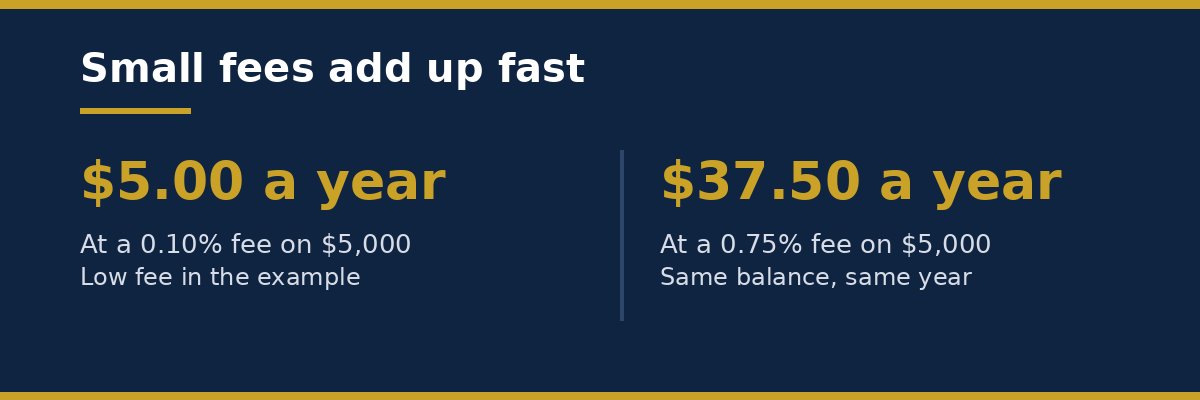
Example A: a low fee of 0.10 percent per year.
0.10 percent of $5,000 equals $5.00 per year.
Calculation: $5,000 times 0.0010 equals $5.00.
Example B: a higher fee of 0.75 percent per year.
0.75 percent of $5,000 equals $37.50 per year.
Calculation: $5,000 times 0.0075 equals $37.50.
Difference per year: $37.50 minus $5.00 equals $32.50.
So, on the same $5,000 balance, the higher fee costs $32.50 more per year in this example. That difference repeats each year, and it grows if your balance grows. This is why beginners are often told to look for low cost funds.
A low fee does not guarantee a good result, but it does mean less of your money goes to fees.
When you compare accounts, write down the fees for each one. Look for accounts with no annual account fee and low fund fees. If a fee is hard to find, treat that as a warning sign and ask the firm to explain it in plain words.
For general education about fees and how firms must describe them, you can read the investor education pages at investor.gov. The U.S. Securities and Exchange Commission provides plain guides for beginners there.
3. Check the Minimum Deposit
Some accounts ask for a minimum amount to open. Others let you start with a very small amount. Check both the account minimum and the minimum for each investment you plan to buy.
Ask these questions:
- What is the minimum to open the account?
- Is there a minimum to buy the fund or investment I want?
- Can I set up small automatic deposits?
- Is there a fee if my balance falls below a level?
If you are starting small, choose an account that lets you start with an amount you can afford. You can learn more about starting amounts in how much money you need to start investing.
Do not borrow money to meet a minimum. Do not use money you need for rent, bills, or an emergency fund. Start with money you can leave invested for a long time.
4. Check What You Can Invest In
Not every account offers the same investments. Check that the account lets you buy what you plan to buy. If you want simple diversified funds, make sure the account offers them at a low cost.
Common choices for beginners include:
- Index funds, which track a broad market index
- Exchange traded funds, often called ETFs, which trade like a stock but hold many investments
- Individual stocks, which are shares in one company
- Bonds or bond funds, which are often used for income or balance
Learn the difference in what an index fund is and why beginners use it and what an ETF is and how it is different from a stock.
Check these points too:
- Does the account offer the funds you want?
- Are there low cost index funds or ETFs?
- Can you buy fractional shares, so you can start with a small amount?
- Can you set up automatic investing?
Automatic investing can help you build a habit. It moves a set amount into your chosen investment on a regular schedule. You still need to choose the investment and the amount, and you can usually pause or change it later.
5. Check How Your Money Is Protected
Before you open an account, check how the firm protects your money and your information. This check is about safety and trust, not about investment returns. No account can protect you from market losses, but a sound firm should have clear protections and clear processes.
Look for these basics:
- The firm is registered and regulated in your country
- The firm explains how customer assets are held
- The firm offers two factor authentication for sign in
- The firm explains what happens if there is fraud or an error
- The firm has clear contact details and customer support
In the United States, you can check a firm or a person through the resources at investor.gov. The Consumer Financial Protection Bureau at consumerfinance.gov also offers guides about accounts, complaints, and common problems. These are general educational sources, not recommendations for any firm.
Use a strong password, turn on two factor authentication, and never share your login details. If a firm promises a guaranteed return, stop and check with a trusted source first.
6. Check the Tools, Support, and Transfers
An account should be easy to use. If the website or app is confusing, you may make mistakes or avoid checking your account. Try the demo or help pages before you apply, if they are available.
Check these practical points:
- Is the website and app clear and easy to use?
- Can you see your balance, holdings, and fees in one place?
- Can you download statements and tax documents?
- Is customer support easy to reach by phone, chat, or email?
- How long does it take to move money in?
- How long does it take to move money out?
- Are there fees or limits for transfers?
For general tax information in the United States, the Internal Revenue Service at irs.gov offers plain guides. For retirement and Social Security topics, ssa.gov offers general information. These sources explain rules, but they do not give personal tax advice.
Keep your statements and fee list in one place. Good records make tax time and future decisions much simpler.
7. Check Risk, Diversification, and Your Time Frame
Investing always involves risk. The value of your investments can go up and down. Before you open an account, think about how much risk you can accept and how long you can leave the money invested.
What risk means in investing is a useful starting point. Risk does not mean the same thing for every person. A person who needs the money in one year may need a different approach from a person who can leave it invested for twenty years.
Diversification is another key idea. It means spreading your money across many different investments, so one poor result does not decide your whole outcome. Learn the basics in what diversification is and why it matters.
Ask yourself:
- How long can I leave this money invested?
- How would I feel if the value fell for a while?
- Am I investing for one goal, or for several goals?
- Do I understand the basic risk of what I plan to buy?
If the answer to the last question is no, pause and learn more before you buy. Opening the account is not the same as buying an investment. You can open the account, read the guides, and decide later.
A Simple Checklist Before You Apply
Use this checklist to compare two or three accounts side by side. Write your answers in a simple table or list.
- Account type: does it fit my goal?
- Fees: what is the annual account fee, the trading fee, and the fund fee?
- Minimum: can I open it with an amount I can afford?
- Investments: does it offer the low cost funds I want?
- Protection: is the firm registered, and does it offer two factor authentication?
- Transfers: how easy is it to add money and take money out?
- Support: can I reach help when I need it?
- Tools: is the app clear, and can I see fees and statements easily?
- Tax: do I understand the basic tax reporting for this account type?
- Time frame: does this account fit how long I can leave the money invested?
If an account fails on fees, protection, or clarity, do not choose it just because it looks popular. A simple, low cost, clear account is often a better fit for a beginner than a complex account with many features you will not use.
FAQ
Do I need a lot of money to open an investment account?
No, not always. Many accounts let you start with a small amount, and some have no minimum. Check the account minimum and the fund minimum before you apply.
Is an investment account the same as a savings account?
No. A savings account usually holds cash and earns interest. An investment account holds investments such as funds and stocks, and the value can go up and down.
Can I open an investment account and invest later?
Yes, in many cases. You can open the account, add money, and take time to learn before you buy an investment. You do not have to buy on the same day you open the account.
What is the difference between a brokerage account and a retirement account?
A brokerage account is a general account for investing. A retirement account is designed for retirement saving and often has special tax rules and withdrawal rules.
How do I know if a firm is safe to use?
Check that the firm is registered and regulated, read its fee list and protection pages, and look for two factor authentication. You can also use investor.gov to check a firm and learn about common risks.
What should I do if I do not understand a fee?
Ask the firm to explain it in plain words before you open the account. If the answer is still unclear, compare another firm. A clear fee list is a good sign. A hidden or confusing fee list is a reason to pause.
Should I choose the account with the lowest fee?
A low fee is important, but it is not the only factor. Also check the account type, the investments offered, the protection, the support, and how easy the account is to use. The best choice is usually a low cost account that also fits your goal and is easy to manage.
Conclusion
Before you open an investment account, check the account type, the fees, the minimum, the investments offered, the protections, and how easy it is to use and transfer money. Compare two or three accounts side by side, and use the simple checklist in this guide. Start with an amount you can afford, choose low cost funds where they fit your goal, and take time to learn before you buy.
Opening the account is only the first step. Keep learning, check your fees and statements, and stay patient with your long term plan.
This article is for general information and education only. It is not legal or financial advice.
