
How Do I Pay Off a Car Loan Early?
Yes, you can pay off a car loan early in most cases. The simple method is to pay more than your required monthly payment and ask your lender to apply the extra money to your loan balance, which is called the principal. When the balance falls faster, less interest builds up over time, and the loan can end sooner. Before you start, check your loan agreement for a prepayment fee and for the lender rules on extra payments. Then pick a small extra amount you can pay each month without strain, and keep it going.
Each monthly payment covers part of the interest and part of the principal. Early in the loan, a larger share often goes to interest. As the balance falls, more of each payment goes to principal. Extra payments can speed up that shift. This guide explains how to check your loan, how to make extra payments the right way, and what an extra payment could mean for you.
What Does It Mean to Pay Off a Car Loan Early?
Paying off a car loan early means you finish before the final date in your loan agreement, by paying extra toward the principal or by paying the full remaining balance in one lump sum. It does not mean you skip a monthly payment. Your required payment is still due each month until the loan is fully paid. If you pay only the required amount, you will finish on the planned date. If you pay extra toward principal, you can finish sooner, if your lender applies the extra money that way.
Check Your Loan First
Do not send extra money until you know how your loan works. Read your loan agreement, check your online account, or contact your lender.
Is There a Prepayment Fee?
Some loans include a fee for paying off early, and some have no such fee. Look for the words prepayment fee or early payoff fee in your agreement. If you cannot find them, ask your lender and keep a note of the answer. If there is a fee, ask how much it is and compare it with the interest you might save. The Consumer Financial Protection Bureau has general guidance on auto loans at https://www.consumerfinance.gov/. The Federal Reserve also publishes general information about consumer credit at https://www.federalreserve.gov/.
How Are Extra Payments Applied?
This step matters most. An extra payment helps you most when it goes to principal. Some lenders apply it to principal by default. Others may treat it as an advance payment for next month, so the balance may not fall as fast as you expect. Ask your lender if an extra payment will go to principal and if you need to choose a principal only option. If you pay by cheque or bank transfer, write principal only in the note field if your lender asks for that.
What Is Your Payoff Amount?
Your current balance is not always the same as your payoff amount. The payoff amount is the total you would need to pay on a given date to close the loan in full. It can include interest that has built up since your last payment. Ask your lender for a payoff quote and the date it applies to.
Six Simple Ways to Pay Off a Car Loan Early
Pick one method that fits your budget. A small extra payment paid every month is often easier to keep up than a large payment you can only make once.
1. Add a Fixed Extra Amount Each Month
Choose a fixed extra amount and add it to your required monthly payment. Start with an amount you can pay even in a tight month, and raise it later if you can. The key is to pay it every month and to make sure it goes to principal. If you want a wider plan for all your debts, read How Do I Make a Debt Payoff Plan?.
2. Round Up Your Payment
If your required payment is 287, you could pay 300 each month. The extra 13 goes to principal if your lender applies it that way. This works well if a larger extra amount feels too much right now.
3. Make One Extra Payment Each Year
If monthly extras do not fit your budget, try one extra payment each year. You can split your monthly payment in half and pay that half every two weeks, which can add up to one extra monthly payment over a year, if your lender accepts that schedule and applies the extra money to principal. Check with your lender first, because some lenders hold part payments until the full monthly payment is received.
4. Use Extra Money When It Arrives
A tax refund, a work bonus, a gift, or money from selling an item you no longer need can all help. Send part or all of it to your car loan as an extra principal payment. First, keep enough money for rent, food, bills, and a small buffer for an urgent cost.
5. Think Carefully Before You Refinance
Refinancing means you take a new loan to pay off your old car loan. A shorter term can mean a higher monthly payment but a sooner payoff date. A longer term can mean a lower monthly payment but more interest over time, if the rate and term lead to that result. Read the new terms, check for fees, and compare the total under the old loan with the total under the new loan. Learn more in Should I Consolidate My Debt?.
6. Cut One Small Cost and Send the Saving to the Loan
Cut one small cost for a few months, such as a takeaway meal or a subscription you rarely use. Move that exact amount to your car loan each month as an extra principal payment. You can stop the cut at any time if your budget gets tight.
Worked Example: What an Extra 100 a Month Can Do
This is an example only. The figures below are not your loan figures. They show the maths in a simple case, so you can see how extra payments work. Your own result will depend on your balance, your rate, your required payment, and your extra amount.
Take a loan with a balance of 12,000 dollars. The annual interest rate is 7 percent. The required monthly payment is 300 dollars. The extra payment in this example is 100 dollars a month, so the total monthly payment becomes 400 dollars.
First, work out the interest for the first month. The formula is balance times annual rate divided by 12. So 12,000 times 0.07 divided by 12 equals 70 dollars.
With the required payment only, the first payment is 300 dollars. Interest is 70 dollars. Principal paid is 300 minus 70, which is 230 dollars. The new balance is 12,000 plus 70 minus 300, which is 11,770 dollars.
With the extra 100 dollars, the first payment is 400 dollars. Interest is still 70 dollars in the first month. Principal paid is 400 minus 70, which is 330 dollars. The new balance is 12,000 plus 70 minus 400, which is 11,670 dollars.
In the second month, the interest is a little lower, because the balance is lower. With the required payment only, the balance is 11,770 dollars. Interest is 11,770 times 0.07 divided by 12, which is 68.66 dollars when rounded to cents. With the extra payment, the balance is 11,670 dollars. Interest is 11,670 times 0.07 divided by 12, which is 68.08 dollars when rounded to cents.
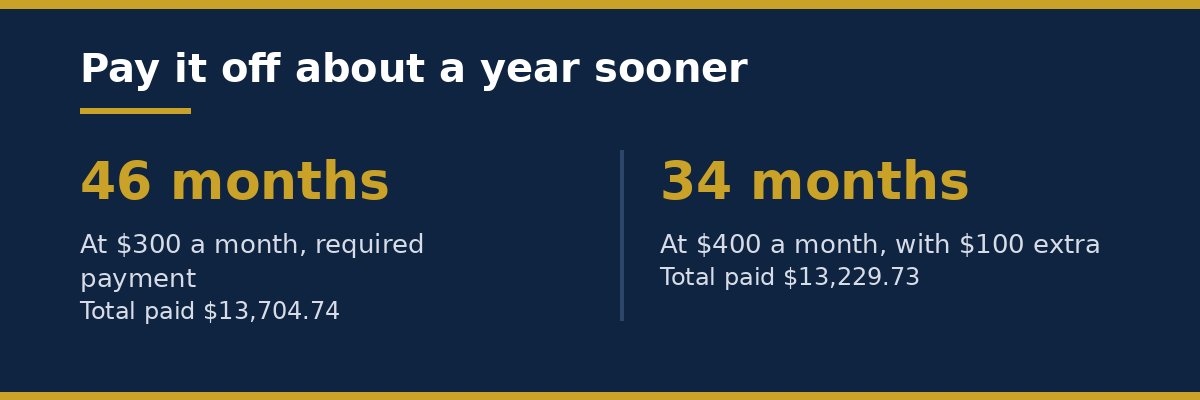
Now look at the full payoff. With a payment of 300 dollars a month, the loan takes about 46 months to pay off. The total interest paid is 1,704.74 dollars. The total paid is 12,000 plus 1,704.74, which is 13,704.74 dollars.
With a payment of 400 dollars a month, the loan takes about 34 months to pay off. The total interest paid is 1,229.73 dollars. The total paid is 12,000 plus 1,229.73, which is 13,229.73 dollars.
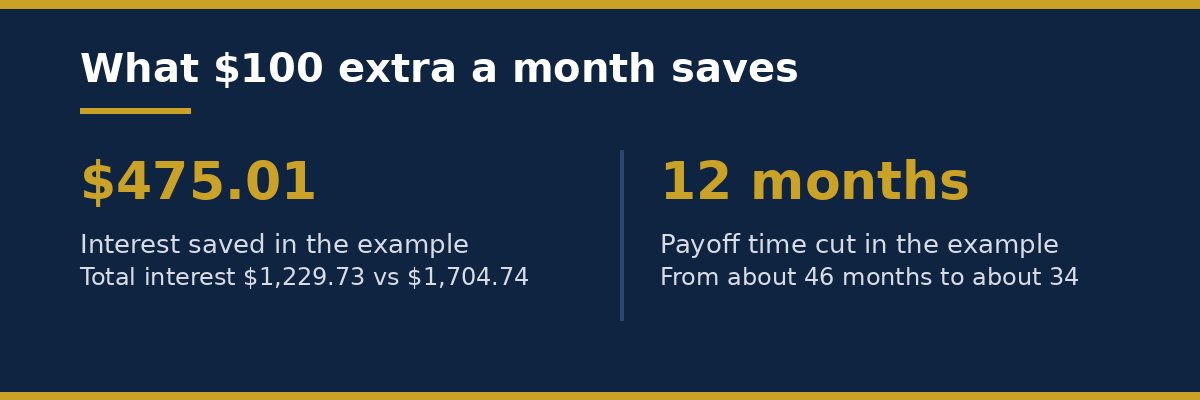
The difference is clear in this example. The extra 100 dollars a month cuts the payoff time by about 12 months, from about 46 months to about 34 months. It cuts the total interest by 475.01 dollars, because 1,704.74 minus 1,229.73 equals 475.01 dollars. Note that the final payment in each case is smaller than the normal monthly payment, because the remaining balance at the end is smaller than a full payment. The totals above allow for that smaller final payment.
You can repeat this maths with your own figures. Write down your balance, your annual rate, your required payment, and your extra amount. Work out the first month interest with the same formula. Then track the balance month by month, or use a loan calculator from a trusted source and check the result with your lender.
How to Make Extra Payments Correctly
An extra payment only helps in the way you want if it reaches the principal. First, make your required payment on time. Second, send the extra amount as a separate payment or as a clearly marked extra amount, if your lender asks for that, and keep a record of the date and amount. Third, check your next statement to see that the balance fell by the amount you expected. If it did not, contact the lender and ask how the extra payment was applied. If you are not sure which debt to tackle first, read Which Debt Should I Pay First, Smallest or Highest Interest?. You can also read Can I Pay Off Debt Faster With Extra Payments?.
Should You Pay Off Your Car Loan Early or Keep the Money?
Look at your full money picture before you decide. If you have a debt with a higher interest rate, paying extra to that debt may save more interest than paying extra to the car loan. The debt avalanche method means you pay extra to the highest interest debt first, while you pay the required amount on the others. The debt snowball method means you pay extra to the smallest balance first. Learn more in What Is the Debt Avalanche Method? and What Is the Debt Snowball Method?.
If you have no money set aside for an urgent cost, it may be wise to build a small buffer first. If you have only a few months left on the loan, the interest saving may be small. If you have many months left, the saving may be larger. An extra payment should fit your budget without forcing you to miss another bill. To see how long your own payoff may take, read How Long Will It Take to Pay Off My Debt?.
What to Do After the Final Payment
Ask your lender for written proof that the loan is paid in full, and keep it with your car papers. Check that the final balance is zero. The lender may send a release of lien, which shows the lender no longer has a claim on the car, and may tell you to contact your local motor vehicle office to update the title. Check your next statement too. If it shows a small amount still due, contact the lender at once. Once the loan is closed, you can use that monthly money for another goal, such as building savings or paying extra to another debt.
Frequently Asked Questions
Can I pay off my car loan early without a fee?
It depends on your loan agreement. Some loans have no prepayment fee, and some have a fee for early payoff. Read your agreement and ask your lender before you pay extra or pay the full balance.
Will paying extra lower my monthly payment?
In most cases, no. An extra payment usually shortens the loan term, not the required monthly payment. Your required payment stays the same until the loan ends, but the loan ends sooner.
Should I pay extra on my car loan or save the money?
It depends on your situation. If you have no emergency savings, a small buffer may come first. If you have a debt with a higher interest rate, that debt may come first. If your car loan is your main debt and you have a small buffer, extra payments can be a clear next step.
Can I pay off my car loan with a lump sum?
Yes, in most cases you can pay the full payoff amount in one payment. Ask your lender for a payoff quote with the date it applies to, because interest builds up each day. Send the full amount by that date, and ask for written proof that the loan is paid in full.
What if I cannot afford extra payments right now?
That is fine. Pay the required amount on time each month. When your budget allows, start with a small extra amount, even a small round up. You can also use extra money when it arrives, such as a refund or a bonus.
Conclusion
Paying off a car loan early is a simple idea. Check your loan for a fee and for the rules on extra payments. Choose an extra amount you can pay each month. Ask the lender to apply it to principal. Then keep going, and check your statements to see the balance fall.
The example in this guide shows the effect in clear numbers. On a 12,000 dollar balance at 7 percent, with a required payment of 300 dollars a month, an extra 100 dollars a month cuts the payoff time from about 46 months to about 34 months, and cuts total interest by 475.01 dollars in that example. Your own figures will be different, but the method is the same. Start with one step today. Read your loan agreement, ask your lender how extra payments work, and pick a small extra amount that fits your budget.
This article is for general information and education only. It is not legal or financial advice.
