
What Is a Treasury Bond in Simple Terms?
The short answer
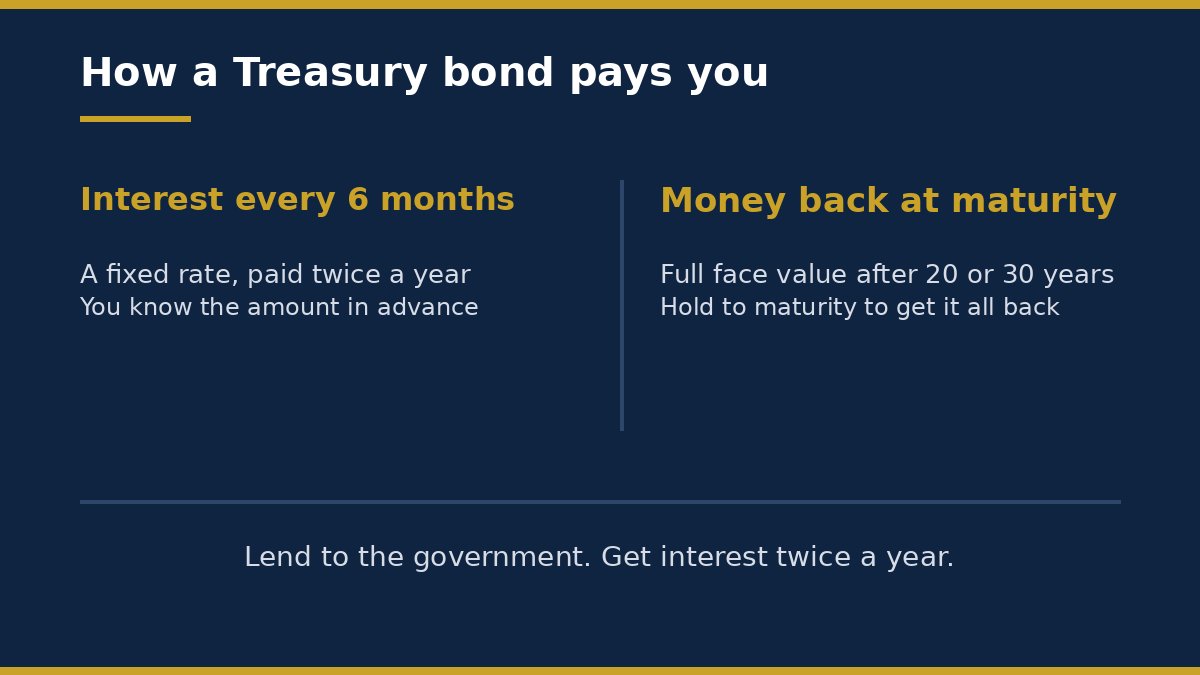
A Treasury bond is a loan you make to the United States government. You lend the government a set amount of money, and in return the government pays you interest every six months and gives your money back in full when the bond matures. Treasury bonds mature in 20 or 30 years, so they are the longest-term loans the US government sells to the public.
Think of it like this. When you buy a bond, you are the lender and the government is the borrower. The government promises to pay you a fixed interest rate for the whole life of the bond, and to return the amount you lent on a fixed date. Because the borrower is the US government, Treasury bonds are treated as one of the safest investments in the world. That safety is also why their interest rates are usually lower than the rates on riskier investments such as company bonds or stocks.
This guide explains how Treasury bonds work, how much they pay, how they differ from other government securities, what can go wrong, and how a beginner buys one.
How a Treasury bond works
A Treasury bond has three parts you need to understand: the face value, the interest rate, and the maturity date.
The face value is the amount you lend. On TreasuryDirect, the government’s own website for buying these securities, you can start with as little as 100 dollars. The face value is also the amount you get back at maturity.
The interest rate, also called the coupon rate, is fixed when the bond is issued. If the rate is 4 percent, a 10,000 dollar bond pays 400 dollars of interest each year. The interest is paid in two equal payments, one every six months, so you would receive 200 dollars in June and 200 dollars in December, for example. The rate never changes for the life of that bond, even if interest rates in the wider economy move up or down.
The maturity date is the day the bond ends. For a Treasury bond, that is 20 or 30 years after it is issued. On that date, the government returns your full face value. So if you buy a 30-year bond and hold it to the end, you collect interest for 30 years and then get your original amount back.
You do not have to hold a bond until maturity. Treasury bonds can be sold on the open market before they mature, through a bank or a broker, but the price you get depends on current interest rates, which is where the main risk comes in.
A worked example: 10,000 dollars at 4 percent
Numbers make this clearer, so here is a simple example. These are example figures, not a promise of any current rate. Rates change at each government auction, so always check the current rate before you buy.
Say you buy a 30-year Treasury bond with a face value of 10,000 dollars and a fixed interest rate of 4 percent a year.
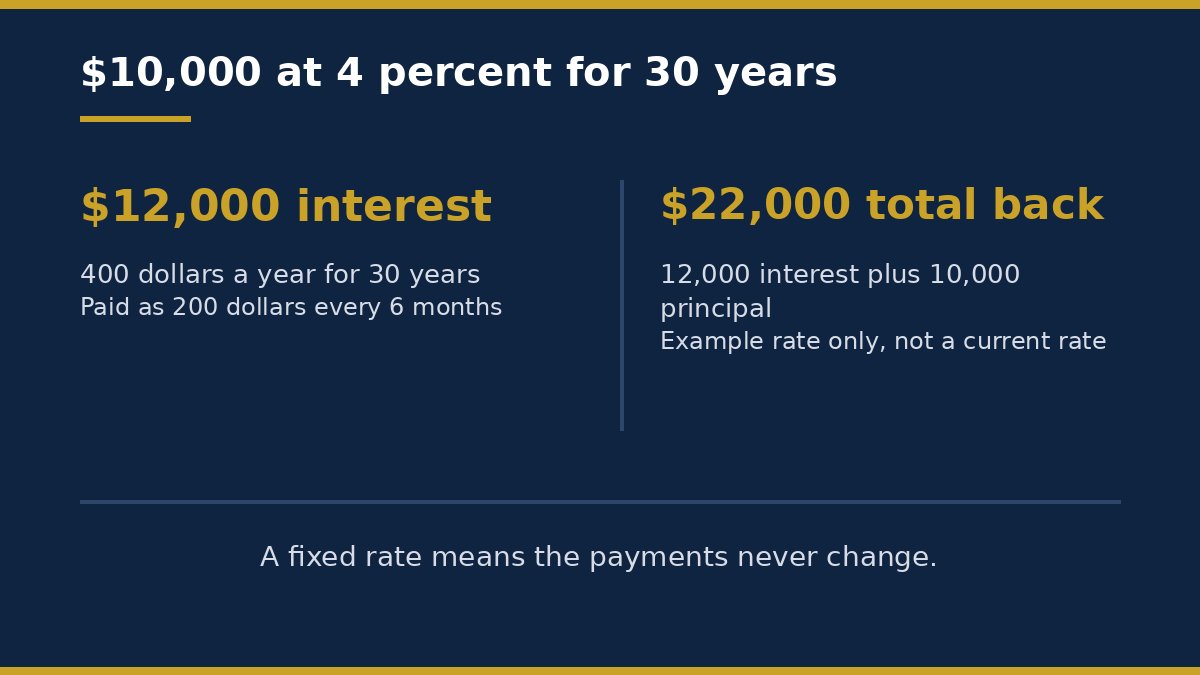
- Interest each year: 4 percent of 10,000 dollars is 400 dollars.
- Each payment: the 400 dollars is split into two payments of 200 dollars, one every six months.
- Interest over 30 years: 400 dollars a year for 30 years is 12,000 dollars.
- Money back at maturity: 10,000 dollars, the full face value.
- Total received over the life of the bond: 12,000 dollars of interest plus 10,000 dollars of principal, which is 22,000 dollars.
Now compare a smaller amount. A 1,000 dollar bond at the same example rate of 4 percent pays 40 dollars a year, in two payments of 20 dollars. Over 30 years that is 1,200 dollars of interest, plus the 1,000 dollars back at the end, for a total of 2,200 dollars.
The math is simple because the rate is fixed. You know exactly what you will receive and when, as long as you hold the bond to maturity. That predictability is the main attraction of Treasury bonds.
Treasury bonds, notes, and bills: what is the difference?
The US government sells three main types of marketable securities. They work the same way, but they last for different lengths of time.
Treasury bills, or T-bills, are the shortest. They mature in anything from 4 weeks to 1 year. They do not pay interest every six months. Instead, you buy them for less than their face value, and the government pays you the full face value at maturity. The difference is your return. For example, you might pay 980 dollars for a bill worth 1,000 dollars at maturity, and keep the 20 dollar difference.
Treasury notes, or T-notes, are the middle option. They mature in 2, 3, 5, 7, or 10 years, and they pay interest every six months, just like bonds.
Treasury bonds, or T-bonds, are the longest. They mature in 20 or 30 years, and they also pay interest every six months.
For a beginner saving for a long-term goal such as retirement, the bond is the one that matches a very long time horizon. For money you need in a year or two, a bill or a short note fits better.
There is also a fourth type worth knowing about: Treasury Inflation-Protected Securities, or TIPS. Their principal rises with inflation, which protects your buying power.
Why people buy Treasury bonds
People buy Treasury bonds for three main reasons: safety, steady income, and balance in a portfolio.
Safety comes first. Treasury bonds are backed by the full faith and credit of the United States government. That means the government has never failed to pay interest or return principal on these bonds. No investment is free of risk, but Treasury bonds are treated as the safest widely available investment in the world, because the US government can raise money through taxes and can issue new debt to meet its payments.
Steady income comes second. The interest payments arrive every six months, on a fixed schedule, at a fixed rate. For a retiree who wants predictable income, or for anyone who wants a reliable part of their portfolio, that regularity matters more than a high return.
Balance comes third. Stocks can fall sharply in a bad year. Bonds often hold their value better in those times, and sometimes rise when stocks fall. That is why many investors hold both. A simple portfolio might mix stocks for growth and bonds for stability, and Treasury bonds are a common choice for the stable part. If you want the wider picture, read our guide on how stocks, bonds, and funds work together.
There is also a tax point. Interest from Treasury bonds is subject to federal income tax, but it is exempt from state and local income tax. In a state with a high income tax, that exemption is worth something.
What can go wrong
Treasury bonds are safe from one kind of risk, but not from every kind. Here are the three risks a beginner should understand.
Interest rate risk is the biggest one. When interest rates rise, the market price of existing bonds falls. Say you hold a bond paying 4 percent, and new bonds now pay 5 percent. Nobody wants to pay full price for your 4 percent bond when they can buy a new one paying 5 percent, so your bond sells for less than its face value. If you hold to maturity, this does not matter, because you still get the full face value back. But if you need to sell early, you can lose money. This is the most common way people lose money on Treasury bonds.
Inflation risk is the second one. A fixed interest rate can lose buying power if prices rise faster than expected. If your bond pays 4 percent and inflation runs at 5 percent, your money buys less each year, even though the dollar amount you receive never falls. Over 20 or 30 years, inflation can take a real bite. That is why some investors hold TIPS alongside plain bonds.
Low return risk is the third one. Treasury bonds usually pay less than stocks over long periods. Over 30 years, a stock fund has historically grown far more than a Treasury bond, though with much bigger ups and downs. If you are young and saving for retirement, putting everything in Treasury bonds would likely leave you with far less money than a balanced portfolio. Bonds are for stability, not for maximum growth.
How to buy a Treasury bond
There are two simple ways for a beginner to buy one.
The first is TreasuryDirect, the US government’s own website. You open an account, link a bank account, and buy directly at auction, with no fees and no middleman. The minimum is 100 dollars, and you can set up repeat purchases. Our guide to TreasuryDirect explains the account setup step by step.
The second is through a bank or a broker. Most brokerage accounts let you buy Treasury bonds, and many let you buy them on the secondary market, which means buying a bond someone else is selling before maturity. A broker may charge a fee or take a spread, so check the cost first. The advantage is that you can hold the bond alongside your other investments in one account.
A third option is a bond fund or an exchange traded fund that holds Treasury bonds. That gives you instant diversification across many bonds, and you can buy and sell shares any trading day. The trade off is that a fund has no maturity date, so you never get a fixed amount back on a fixed date, and the fund charges a small annual fee. For many beginners, a low cost Treasury bond fund inside a retirement account is the simplest way to own this kind of investment. If that is new to you, read our guide on what an index fund is and why beginners use it.
Whichever route you choose, start small. Buy one bond, or a small amount in a fund, and watch how the interest payments arrive. You will learn more from holding a small amount for a year than from reading ten articles about it.
Who Treasury bonds suit, and who they do not suit
Treasury bonds suit an investor who wants safety and predictable income, and who can leave the money alone for a long time. They suit a retiree who needs steady payments, a cautious saver who wants something safer than stocks, and anyone balancing a stock portfolio with a stable anchor.
They do not suit someone who needs the money soon. If you need the cash in two years, a 30-year bond is the wrong tool, because you might have to sell when its price is down. They also do not suit someone chasing high growth. A young investor saving for retirement in 30 years will probably do better with a higher share of stocks, accepting the ups and downs along the way.
A good rule of thumb: match the maturity to your goal. Money needed in under a year belongs in a savings account or a T-bill. Money needed in 5 to 10 years fits a note or a bond fund. Money needed in 20 or 30 years can go into a long bond, but only as part of a balanced plan, not as the whole plan.
Frequently asked questions
Are Treasury bonds really risk free?
They are considered free of default risk, which means the risk that the borrower does not pay. They are not free of interest rate risk or inflation risk. If you sell before maturity when rates have risen, you can lose money. If inflation outruns your interest rate, your buying power falls. No investment is risk free in every sense.
What is the minimum amount to buy a Treasury bond?
Through TreasuryDirect, the minimum is 100 dollars. Through a broker, the minimum can be higher, often 1,000 dollars for a single bond on the secondary market. A bond fund can have a much lower minimum, sometimes as little as 1 dollar.
Do I pay tax on Treasury bond interest?
Yes, at the federal level. The interest is subject to federal income tax, but it is exempt from state and local income tax. That exemption can help if you live in a state with a high income tax. Keep records of the interest you receive, because you will need them at tax time.
Can I lose money on a Treasury bond?
Yes, in two ways. If you sell before maturity when interest rates have risen, the bond will be worth less than you paid. And if inflation runs higher than your interest rate, your money loses buying power even though the dollar amount is safe. Holding to maturity removes the first risk, but not the second.
Are Treasury bonds better than a savings account?
They usually pay more interest than a savings account, but your money is locked away for much longer. A savings account lets you withdraw at any time. A Treasury bond ties your money up for 20 or 30 years unless you sell it early, possibly at a loss. For an emergency fund, a savings account is the right place. For long-term money you will not touch, a bond can pay more.
Should I buy a Treasury bond or a Treasury note?
It depends on when you need the money. A note matures in 2 to 10 years. A bond matures in 20 or 30 years. If your goal is 10 years away, a note fits. If your goal is 25 years away, a bond fits. Match the maturity to the goal, and do not buy a longer term than you need.
Conclusion
A Treasury bond is a simple deal: you lend money to the US government for 20 or 30 years, it pays you interest every six months, and it returns your money in full at the end. It is one of the safest investments available, and one of the most predictable. Its weakness is the same as its strength: the fixed return is steady, but it can lose buying power to inflation, and its price can fall if interest rates rise and you need to sell early.
For most beginners, Treasury bonds make sense as one part of a balanced plan, not as the whole plan. Learn how they fit with stocks and funds, start small, and match the maturity to the date you need the money. If you are building your first investment plan, read our guide on a simple first investment plan, and consider how a small bond holding could steady the rest of your portfolio.
This article is for general information and education only. It is not legal or financial advice.
