

What Is a Pension Plan?
A pension plan is a retirement plan, usually offered by an employer, that pays you a regular monthly income after you stop working. You do not have to guess how long your savings will last, because the plan promises a set amount for life. This guide explains how a pension plan works in simple terms, how the payment is worked out, and how it compares with a 401(k) and an IRA.
This guide covers the formula behind the payment, what vesting means, what happens if you change jobs, and the steps to check your own pension.
What Is a Pension Plan in Simple Terms?
A pension plan is a promise from your employer to pay you income in retirement. While you work, you build up a benefit. When you retire, the plan pays you a monthly amount. In most traditional pension plans, the employer puts the money in and manages the investments. You do not choose the investments yourself, and you do not carry the investment risk. The employer does.
This type of plan is called a defined benefit plan, because the benefit is defined in advance by a formula. The formula usually uses three things: your salary, your years of service, and a percentage called the multiplier.
Pensions were once common in large companies and government jobs. Today they are less common in private companies, but they still exist in government work, teaching, health care, and some large firms.
A pension is one kind of retirement account. Read our simple guide to what a retirement account is in simple terms to see how they fit together.
How Does a Pension Plan Work?
A pension plan works in four steps. You earn the benefit while you work, the plan works out the amount with a formula, vesting decides how much of it you keep, and the plan pays you after you retire. Let us look at each step.
1. You Earn a Benefit While You Work
Each year you work for the employer, you earn a small piece of your future pension. The longer you stay, the larger your monthly payment becomes. Someone who works for the same employer for 30 years will usually get a much larger pension than someone who works there for 5 years.
Some employers ask you to pay a small part of your salary into the plan. Others pay the full cost themselves.
2. The Plan Uses a Formula
The plan uses a formula written in the plan rules. The most common formula is:
Monthly pension = multiplier x years of service x final average salary, divided by 12
The final average salary is often the average of your highest 3 or 5 years of pay. The multiplier is a small percentage, often between 1 percent and 2 percent. A higher multiplier, more years, or a higher salary all raise your pension.
3. Vesting Decides What You Keep
Vesting means ownership. You may need to work for the employer for a set number of years before the pension is fully yours. This period is called the vesting period.
There are two common types. With cliff vesting, you own nothing until you reach a set year, often 5 years, and then you own 100 percent. With graded vesting, you own a little more each year. For example, you might own 20 percent after 2 years, 40 percent after 3 years, and 100 percent after 6 years.
If you leave before you are vested, you may lose the employer paid part. Your own contributions, if any, are usually returned to you.
4. You Get Paid After You Retire
When you retire, the plan starts paying you each month, usually for the rest of your life. Some plans let you choose a smaller payment that continues to your spouse after you die. Others offer a lump sum instead of monthly payments. The choice is often hard to change later, so read the options with care.
A Worked Example: How Much Would You Get?
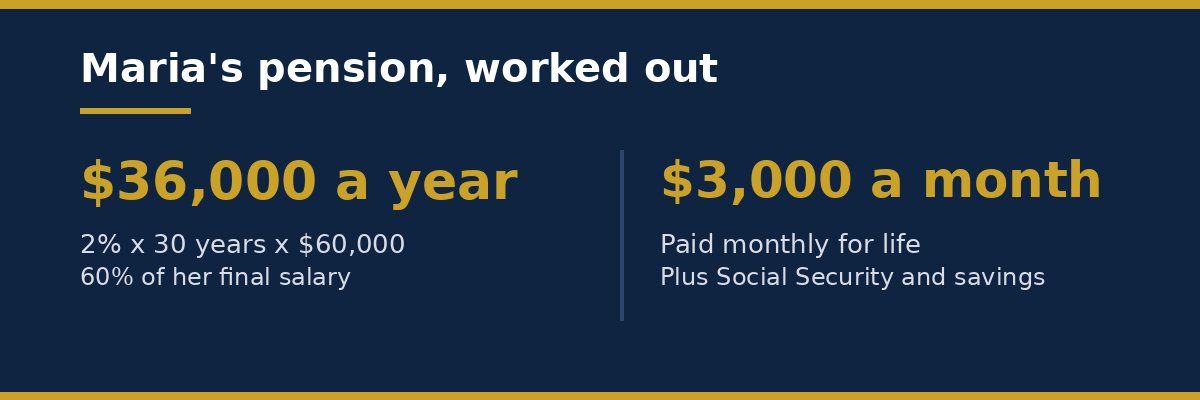
Imagine a teacher called Maria. Her plan uses a 2 percent multiplier, her final average salary is 60,000 dollars a year, and she works for 30 years.
Step 1: Multiply the multiplier by the years of service.
2 percent x 30 years = 60 percent
Step 2: Multiply that by her final average salary.
60 percent x 60,000 dollars = 36,000 dollars a year
Step 3: Divide by 12 to get the monthly payment.
36,000 dollars / 12 = 3,000 dollars a month
Maria would get 3,000 dollars a month for life, on top of any Social Security and personal savings she has.
Here is a second example with different numbers. Imagine a nurse called James. His plan uses a 1.5 percent multiplier. His final average salary is 80,000 dollars a year. He works for 25 years.
1.5 percent x 25 years = 37.5 percent
37.5 percent x 80,000 dollars = 30,000 dollars a year
30,000 dollars / 12 = 2,500 dollars a month
James would get 2,500 dollars a month. Notice that even though his salary is higher, his pension is lower, because his multiplier is smaller and he worked fewer years. Years of service and the multiplier matter as much as salary.
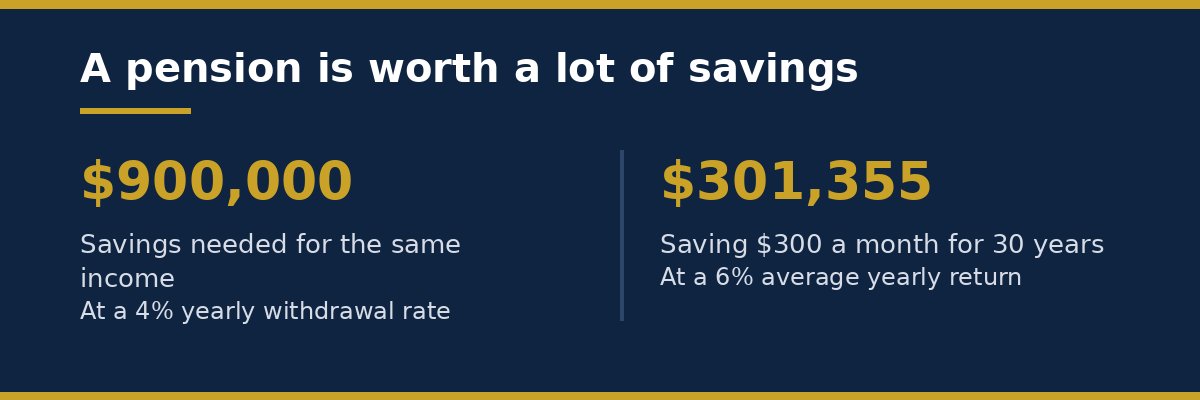
To see how large a pension really is, compare it with saving on your own. A payment of 36,000 dollars a year is the same income you would get from about 900,000 dollars of savings if you withdrew 4 percent a year. Building that much on your own takes many years of steady saving. For example, saving 300 dollars a month for 30 years at a 6 percent average yearly return would grow to about 301,355 dollars. You would have put in 108,000 dollars yourself, and growth would add about 193,355 dollars. That is a large sum, but it is still far below 900,000 dollars. This comparison shows why a pension is so valuable when you have one.
The Main Types of Pension Plans
Not all pensions work the same way. These are the main types you may come across.
Defined Benefit Plans
This is the traditional pension described above. Your employer promises a set monthly payment based on a formula. The employer invests the money and carries the risk. If the investments do badly, the employer must still pay your pension.
Defined Contribution Plans
In this type, the employer and often the worker put money into an individual account, but the final amount is not promised. It depends on how much was paid in and how the investments perform. A 401(k) is the best known example. You can learn more in our guide to what a 401(k) is in simple terms.
Cash Balance Plans
A cash balance plan is a mix of the two types. It looks like a savings account with a balance that grows each year, but the employer still guarantees the benefit. When you retire, you can take the balance as a lump sum or turn it into a monthly payment.
Government Pensions
Teachers, police officers, firefighters, and many other public workers often have a government pension. These plans usually work like a defined benefit plan, with a formula based on salary and years of service. They are often paid alongside Social Security, although in some jobs Social Security is reduced or does not apply.
Pension vs 401(k) vs IRA
Many workers have more than one type of retirement plan. Here is how the three main types compare.
| Feature | Pension (defined benefit) | 401(k) | IRA |
|---|---|---|---|
| Who pays in | Mostly the employer | You and often your employer | You |
| Who invests | The employer | You choose from a list | You choose |
| Who carries the risk | The employer | You | You |
| Payment in retirement | Monthly for life | You withdraw from your balance | You withdraw from your balance |
| Amount known in advance | Yes, from a formula | No, it depends on markets | No, it depends on markets |
A pension gives certainty. A 401(k) and an IRA give control and flexibility. Having both is often the strongest position. If your job offers a pension, also consider saving in a 401(k) or an IRA if you can. Our guide to what an IRA is in simple terms explains how an IRA works and who can open one.
What Happens If You Change Jobs?
Changing jobs is common, and it affects your pension. Here is what to check before you leave.
First, check your vesting. If you are fully vested, the benefit you have earned stays yours. If you are only partly vested, you keep only the vested part. If you are not vested at all, you may lose the employer paid benefit.
Second, ask what happens to your earned benefit. In many plans, the benefit stays in the plan and you can claim it when you reach retirement age. In some plans, you can move the value to another retirement account. This is called a rollover, and the rules and tax effects matter, so get the plan’s written options before you decide.
Third, do not cash out a small pension without thinking it through. Taking the money early can mean tax and a penalty, and you lose the future monthly income. A small pension that pays a few hundred dollars a month for life may be worth more than a lump sum that looks tempting today.
Fourth, keep your records. Note the employer name, the plan name, your dates of employment, and the plan administrator’s contact details. People lose track of old pensions more often than you might think.
How to Check Your Own Pension
If you are not sure what pension you have, follow these steps.
- Ask your employer. Your human resources team or plan administrator can tell you whether you have a pension, the plan type, the formula, and your vesting status. Ask for the summary plan description.
- Look at your benefit statement. Most plans send a yearly statement showing your earned benefit and your vesting. If you have not seen one, ask for it.
- Work out your own estimate. Use the formula in this guide with your salary, years of service, and multiplier. This gives you a rough idea of your monthly payment.
- Check old employers. If you had a pension at a past job, contact that employer’s human resources team or the plan administrator. In the United States, the Pension Benefit Guaranty Corporation can help you find a lost pension from a private employer plan.
- Look at the whole picture. A pension is one part of retirement income. Add your expected Social Security, any 401(k) or IRA savings, and other income. If you are starting late, read our guide on how to catch up on retirement savings at 50.
For official information about retirement plans in the United States, see the IRS retirement plans pages at https://www.irs.gov/retirement-plans and the Social Security Administration at https://www.ssa.gov/benefits/retirement/. You can also find beginner friendly investor education at https://www.investor.gov/.
Risks and Things to Watch
A pension is a strong benefit, but it is not free of risk. Here are the main things to watch.
Inflation is the biggest one. Many pensions do not rise with prices, or rise only a little. A payment of 3,000 dollars a month may buy much less in 20 years than it does today. Keep saving outside the pension so rising prices do not squeeze you later.
Plan funding matters too. If an employer has not set aside enough money, the plan may be underfunded. In the United States, most private pensions are insured by the Pension Benefit Guaranty Corporation, up to set limits.
Job changes can shrink a pension. Because the formula rewards long service with one employer, moving jobs often can leave you with several small pensions instead of one large one.
Frequently Asked Questions
Is a pension plan the same as Social Security?
No. Social Security is a government program that pays a monthly benefit based on your work history and the taxes you paid. A pension is a separate plan offered by an employer. Many retired workers get both. A pension does not replace Social Security, and Social Security does not replace a pension.
Do I pay tax on my pension?
In most cases, yes. Pension payments are usually treated as income and taxed in the year you receive them. If you paid tax on your own contributions already, that part may not be taxed again.
Can I take my pension as a lump sum?
Some plans allow it, and some do not. A lump sum gives you the money at once, but you then carry the risk of making it last. Monthly payments give you certainty for life. If your plan offers both, compare them with care before you choose, because the choice is often final.
What happens to my pension if my employer closes?
In the United States, most private pension plans are insured by the Pension Benefit Guaranty Corporation, which pays benefits up to legal limits if a plan ends without enough money. Government pensions are covered by different rules.
Should I still save if I have a pension?
Yes, in most cases. A pension rarely replaces your full salary, and it may not keep up with inflation. Extra savings in a 401(k) or an IRA give you flexibility and a cushion. If you have to choose between a lump sum and small regular payments, our guide on investing a lump sum or a little each month can help you think through the choice.
Conclusion
A pension plan is a promise of a steady monthly income in retirement, worked out from your salary, your years of service, and a small percentage multiplier. It is one of the most valuable benefits an employer can offer, because the employer carries the investment risk and the payment usually lasts for life.
If you have a pension, learn your formula, check your vesting, and keep your records. If you are choosing between jobs, count the pension as part of the pay. And whatever pension you have, keep saving on the side, because a pension rarely replaces your whole salary and prices rise over time. Starting early helps, because growth compounds over time, as our guide to how compound interest works shows. If you are unsure how much to save, our guide on how much money you need to start investing can help. A pension plus your own savings is a far stronger plan than either one alone.
This article is for general information and education only. It is not legal or financial advice.
