
How Do I Invest in Stocks for Beginners?
Yes, a beginner can invest in stocks, and the first step is simpler than most people expect. A stock is a small piece of ownership in a company. When you buy a stock, you own a tiny part of that business. If the business grows over time, your share can grow too. If it struggles, your share can fall. The beginner mistake is to start by picking single stocks. The simpler start is a broad fund that holds many stocks at once.
You do not need a lot of money, and you do not need to watch the market every day. You need an account, a simple plan, and the patience to leave the money alone for years. This guide explains each step in plain words, with a worked example you can copy.
What Is a Stock, in Simple Terms?
A stock is a share of a company. When a company needs money to grow, it can sell shares to the public. Each share is a small claim on the business. Shareholders can earn money in two ways: the share price can rise, and some companies pay part of their profit to shareholders as a dividend.
Shares trade on a stock exchange, and their prices move every day. News, company results, interest rates, and the wider economy all move prices. In the short term, prices jump around. Over long periods, the broad stock market has risen, but past growth never promises future growth. That is why time and patience matter more than timing.
If you are new to the basic building blocks, read How Do Stocks, Bonds, and Funds Work Together?
Before You Buy Your First Stock
Do not invest money you need soon. Investing works best with money you can leave alone for five years or more. Before you start, check three things.
First, build a small emergency fund. If a car repair or a lost job forces you to sell your investments at a bad time, the plan fails. Read How Much Should I Keep in an Emergency Fund? for a simple target.
Second, pay attention to high interest debt. A credit card charging high interest costs you more each year than the stock market is likely to return. Paying that debt down first is often the better move. Read Should I Pay Off Debt or Invest First?
Third, decide how much you can invest each month without strain. A small amount you can pay every month beats a large amount you can only pay once. Even 50 a month is a real start.
Step 1: Open an Investment Account
You buy stocks through an investment account, often called a brokerage account. You open it online with a broker, add money from your bank, and then place orders to buy. Most brokers in the United States and the United Kingdom now charge no commission to buy and sell shares, but fees still exist inside funds, so always check.
When you open an account, you choose an account type. A general investment account is the most flexible. A retirement account, such as a 401(k) or an IRA in the United States, or an ISA or pension in the United Kingdom, can offer tax benefits, but the money may be locked away until retirement. Beginners often start with a general account or a retirement account through work, and add the other later.
For a full checklist of what to look at before you open an account, read What Should I Check Before Opening an Investment Account?
Step 2: Start With a Broad Fund, Not a Single Stock
A single stock can fall a lot if that company has a bad year. A broad fund holds hundreds of companies at once, so one bad company hurts much less. For most beginners, a broad index fund or ETF is the sensible first buy.
An index fund follows a market index, such as the S&P 500, which tracks about 500 large United States companies. An ETF is a fund that trades on an exchange like a stock. Both give you instant spread across many companies. Read What Is an Index Fund, and Why Do Beginners Use It? and What Is an ETF, and How Is It Different From a Stock? to compare them.
This spread is called diversification. Read What Is Diversification, and Why Does It Matter? for a full explanation.
Step 3: Invest a Fixed Amount Every Month
The simplest habit is to invest the same amount on the same day each month, whatever the market is doing. This is called dollar cost averaging. When prices are high, your fixed amount buys fewer shares. When prices are low, it buys more. Over time, this smooths out the ups and downs, and it removes the need to guess the best day to buy.
Set up an automatic transfer from your bank to your investment account on payday. Then set the investment to buy automatically if your broker allows it. Automation beats willpower, because you never have to decide again each month.
A Worked Example: 100 a Month for 30 Years
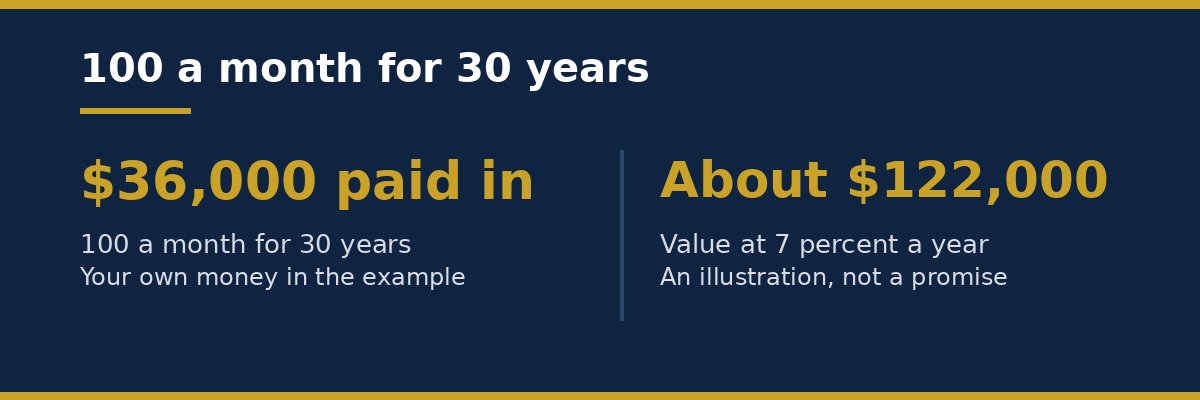
Here is a simple example with real math. The numbers use an assumed average return of 7 percent a year, which is an illustration only. Real returns vary, and no one can promise 7 percent.
| Monthly amount | Paid in over 30 years | Value after 30 years at 7 percent a year |
|---|---|---|
| 50 | 18,000 | About 61,000 |
| 100 | 36,000 | About 122,000 |
| 200 | 72,000 | About 244,000 |
At 100 a month, you pay in 36,000 over 30 years. At an assumed 7 percent a year, that could grow to about 122,000. Most of the growth comes in the later years, when the returns on your earlier returns start to add up. That is compound growth. Read How Does Compound Interest Work? to see the same idea in detail.
Time matters more than the starting amount. Starting ten years earlier with a smaller monthly amount often beats starting later with a larger one. If you can start now, start now, even with a small amount.
Step 4: Keep Fees Low
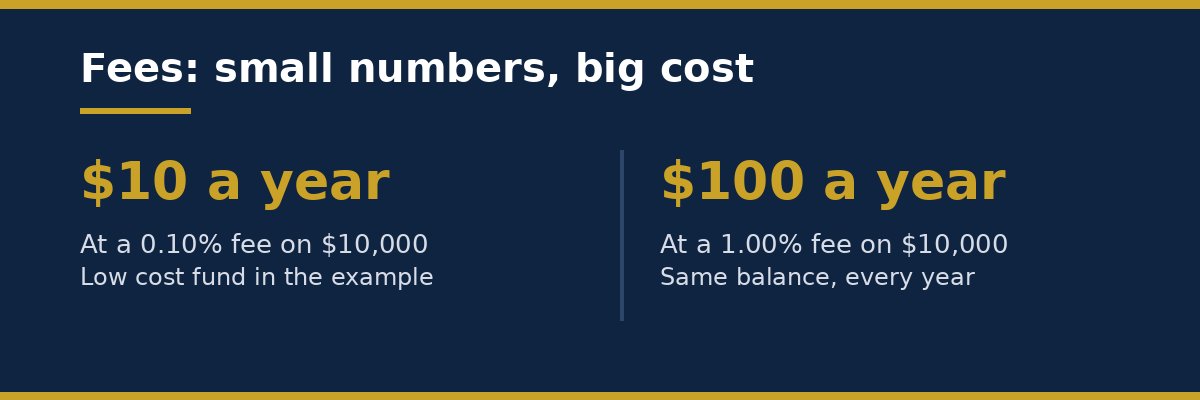
Fees look small, but they eat returns year after year. A fund charges a yearly fee called an expense ratio. A low cost index fund may charge 0.10 percent a year. An actively managed fund may charge 1.00 percent a year. On a 10,000 investment, that is 10 a year versus 100 a year, every year, and the gap grows as your balance grows.
Before you buy a fund, look for its expense ratio and compare it with a similar low cost fund. For a full explanation, read What Are Fees in Investing, and How Do They Hurt Returns?
Step 5: Leave It Alone and Review Once a Year
After you buy, the hardest part is doing nothing. Prices will fall sometimes. A fall of 10 or 20 percent is normal in the stock market, and it does not mean your plan is broken. Selling in a panic turns a paper fall into a real loss.
Check your investments once or twice a year, not once a day. Ask three questions. Am I still investing every month? Is my money still in a broad, low cost fund? Has my life changed enough to change the plan? If the answers are yes, yes, and no, leave it alone. Read What Is Risk in Investing, in Simple Terms? so a market fall does not surprise you.
Common Beginner Mistakes to Avoid
Most beginner losses come from the same few mistakes. Learn them now, so you do not pay for them later.
First, do not put all your money in one stock because a friend or a video said it will double. One company can fall hard, even a famous one. Second, do not borrow money to invest. Debt makes a normal market fall into a crisis. Third, do not try to time the market by jumping in and out. Even professional investors get the timing wrong most of the time. Fourth, do not chase last year’s winner. A fund that did well last year may do badly this year. A simple, steady plan beats a clever one you abandon.
For the full list, read What Mistakes Do Beginner Investors Make Most?
FAQ
How much money do I need to start investing in stocks?
You can start with very little. Many brokers let you start with 50 or 100, and some let you buy part of a share. Read How Much Money Do I Need to Start Investing? for the minimums that matter.
Is investing in stocks risky for beginners?
Yes, stocks can fall, and you can lose money. The risk is highest when you invest money you need soon, or when you put everything in one stock. A broad fund, a long time frame, and a monthly habit lower the risk, but they never remove it.
Should I buy single stocks or a fund first?
Most beginners should start with a broad fund. It gives you hundreds of stocks in one purchase. You can add single stocks later, once you understand how to read a company and how much of your money to risk on one idea.
How do I choose my first fund?
Look for a broad index fund or ETF, a low yearly fee, and a large number of companies inside it. A fund that tracks a broad market index is a common first choice. Avoid funds with high fees or a narrow focus until you know why you want them.
When should I sell my stocks?
Sell when your life changes, not when the market falls. If you need the money for a planned goal, or your plan changes, selling is sensible. Selling because prices fell last week usually locks in a loss. Review once a year and sell only for a planned reason.
Conclusion
Investing in stocks as a beginner comes down to five steps: open an account, start with a broad low cost fund, invest a fixed amount every month, keep fees low, and leave the money alone for years. You do not need to pick the perfect stock or the perfect day. You need a simple plan you can keep. Start small, stay steady, and let time do the heavy work. For a full first plan, read What Is a Simple First Investment Plan?
This article is for general information and education only. It is not legal or financial advice.
