
How Do I Negotiate a Lower Credit Card Interest Rate?
The Short Answer
Yes, you can ask your credit card company for a lower interest rate, and it costs nothing to try. Call the number on the back of your card, ask for a lower APR, and give two reasons: you pay on time and you have been a customer for a while. Many people who ask get a cut. A survey of 2,000 US cardholders in May 2026 by LendingTree found that 23 percent had asked for a lower rate in the past year, and 84 percent of those who asked got one, with an average cut of 6.3 percentage points. That is a survey result, not a promise. Your issuer is not required to lower your rate because you ask. But the call is free, it takes about ten minutes, and a lower rate means less interest on every dollar you carry.
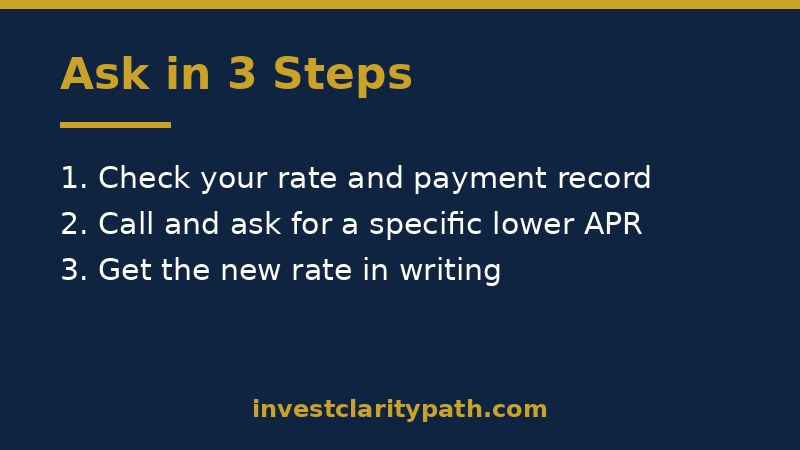
Before you call, know your current rate, your payment record, and your balance. Ask for a specific number. If the first person says no, ask what would change the answer, and ask again in a few months. If the issuer will not move, a balance transfer card or a hardship program may help.
Why Your Rate Is What It Is
Credit card interest is priced as an APR, which is the yearly cost of borrowing shown as a percentage. Your APR is built from two parts: a base rate that moves with the wider market, and a margin the issuer adds for your account. When the base rate rises, card rates usually rise with it. When it falls, card rates often fall much more slowly.
The average is high. The Federal Reserve’s G.19 consumer credit release puts the average APR on card accounts that were charged interest at 22.36 percent in the third quarter of 2026, and 21.19 percent across all card accounts, including people who pay in full. Those figures come from the release of October 7, 2026, covering August 2026. If your rate is near that average, you are paying about what most people who carry a balance pay. If your rate is well above it, you have a strong reason to ask for a cut.
Your own rate depends on your credit history when you applied, how long you have held the card, and whether your rate was ever raised. A card you opened years ago may still carry the rate from a time when your credit was weaker. That is one reason asking works: the issuer may not have updated your rate even though your record has improved.
To see how interest builds on a balance, read our guide on how credit card interest charges work.
Does Asking Actually Work?
Asking works more often than most people expect, because most people never ask. In the LendingTree survey from May 2026, only 23 percent of cardholders had asked for a lower APR in the past year. Of those who asked, 84 percent said they got one, and the average cut was 6.3 percentage points. Treat those numbers as a rough guide. The survey was self reported, and it was commissioned by a lending marketplace, so it is not a guarantee of what will happen on your call.
There is also a rule that can work in your favour. The Consumer Financial Protection Bureau explains that if your issuer raised your rate, it generally has to review that rate at least every six months. Under Regulation Z, section 1026.59, the issuer must reduce the rate, as appropriate, within 45 days of finishing a review. If your rate is higher than the rate a new customer with a similar profile would get, it must come down, though not necessarily to your original rate. That rule only applies if your rate was raised. If it was never raised, the plain ask is your route.
The point is simple. The worst result of the call is a no, and a no costs you ten minutes. The best result is a lower rate on a balance you already carry.
Before You Call: 4 Checks in 10 Minutes
Do these four checks before you pick up the phone. They take about ten minutes, and they make the call much stronger.
Check 1: Your Current APR
Open your latest statement and find the APR for purchases. Your statement must show a separate APR for each balance type, so check the purchases APR, not the cash advance APR. Write the number down. Also note the minimum payment warning box on the statement, which estimates how long minimum only payments take to clear the balance. Those two numbers are your starting line.
Check 2: Your Payment Record
Count how many months in a row you have paid on time with this issuer. Twelve months of on time payments is a strong record. Six months is still useful. If you have a recent late payment, be honest about it on the call and say what changed since then. A long clean record is your best argument, so lead with it.
Check 3: Your Balance and How Long You Have Held the Card
Write down your current balance and the year you opened the account. A customer of five years with a steady balance is worth keeping, and the issuer knows it costs money to win a new customer. If you have another card with a lower rate, note that too. A competing offer is useful leverage, but only mention a real offer you actually hold.
Check 4: What Rate to Ask For
Ask for a specific number. A good target is 5 to 6 points below your current rate, which matches the average cut in the LendingTree survey. If your rate is 24 percent, ask for 18 percent. If the issuer offers a smaller cut, take it if it helps, and ask when you can ask again. A 3 point cut is still worth having.
The Call in 5 Steps
Step 1: Call the Number on the Back of Your Card
Call the customer service number printed on the back of your card. Calling on a Tuesday, Wednesday, or Thursday morning usually means shorter hold times. Have your statement, your balance, and your target rate in front of you before you dial.
Step 2: Ask for the Right Department
When you get through, say you would like to discuss lowering the interest rate on your account. The first representative may be able to help. If they say they cannot change rates, politely ask to speak with the retention or loyalty department, which often has more room to act.
Step 3: State Your Case in One Short Sentence
Keep it simple. Say how long you have been a customer, that you pay on time, and what rate you would like. For example: “I have been a customer for four years and I have paid on time for the last 18 months. My rate is 24 percent. Can you lower it to 18 percent?” One clear sentence beats a long story.
Step 4: Name Your Reason, Then Stop Talking
Give one reason, then let the representative answer. Good reasons are your payment record, your years as a customer, or a lower rate offer you already hold. Do not threaten to close the account unless you truly plan to close it.
Step 5: Get the New Rate in Writing
If they agree, ask three things before you hang up. First, what is the new APR exactly. Second, when does it start. Third, will you send written confirmation. Write down the name of the representative, the date, and the time of the call. Check your next statement to make sure the new rate is there. If it is not, call back with your notes.
A Worked Example: What a 6 Point Cut Saves
Here is the math on a $2,000 balance, using simple interest on a fixed balance. This is an illustration, not a payoff schedule, because a real payoff changes as the balance falls.
At the average rate of 22.36 percent, a $2,000 balance costs $447.20 a year in interest. That is $2,000 times 0.2236, which equals $447.20. Divide by 12 months and the monthly interest is $37.27.
Now take off 6.3 points, the average cut in the LendingTree survey. The new rate is 16.06 percent. A $2,000 balance at 16.06 percent costs $321.20 a year. That is $2,000 times 0.1606, which equals $321.20. Divide by 12 months and the monthly interest is $26.77.
The saving is $10.50 a month, which is $37.27 minus $26.77. Over a year, that is about $126. The balance is the same. The payments are the same. Only the rate changed, and the saving repeats every month you carry the balance.
The saving grows with the balance. On a $5,000 balance, the same cut saves about $26.25 a month, or about $315 a year. On a $1,000 balance, it saves about $5.25 a month, or about $63 a year.
If you are only paying the minimum each month, a lower rate also helps the balance fall faster, because more of each payment goes to the balance instead of interest. Read our guide on what happens if you only pay the minimum on a credit card to see why the minimum is a slow way out.
If They Say No: 3 Fallbacks That Still Help
A no is not the end. Try these three fallbacks in order.
Fallback 1: Ask What Would Change the Answer
Ask the representative what would need to change for a lower rate. Common answers are a few more months of on time payments, a lower balance, or a better credit score. Write the answer down, work on that one thing, and call again in three to six months. A second ask after a real improvement often works.
Fallback 2: Consider a Balance Transfer Card
A balance transfer card lets you move a balance to a new card with a low or zero percent rate for a set period, often 15 to 21 months. The transfer usually carries a fee, often 3 to 5 percent of the amount moved, so check that the fee is smaller than the interest you would save. You also need a good enough credit record to be approved. Read our guide on what a balance transfer card is in simple terms before you apply, and do not use the new card for fresh spending while you pay the old balance down.
Fallback 3: Ask About a Hardship or Repayment Program
If a payment is at risk, ask about a hardship program. The Consumer Financial Protection Bureau says many card companies will work with you on a repayment plan that fits your situation, and these programs can lower your monthly payment at a reduced interest rate. Ask whether the card stays open and how the program is reported to the credit bureaus, because those terms matter for your credit record. A hardship program is a different request from a rate cut, and it is meant for times when paying is genuinely hard.
If you want a full plan for clearing the balance, read our guide on how to make a debt payoff plan you can stick to.
What Not to Do on the Call
Do not miss a payment to gain leverage. A missed payment hurts your credit record and can trigger a penalty rate, which is the opposite of what you want. Do not close the account in anger if they say no, because closing a card can raise your credit use ratio and lower your available credit. Do not accept a new card or a higher limit on the call unless you planned to, because a new account is a separate decision. And do not agree to a rate you do not understand. If the representative offers a “promotional rate,” ask how long it lasts and what the rate becomes when it ends.
If you think the issuer has broken a rule, you can file a complaint with the Consumer Financial Protection Bureau at consumerfinance.gov/complaint. The Bureau sends the complaint to the company, and it says most companies respond within 15 days.
FAQ
Can asking for a lower rate hurt my credit score?
No. Asking for a lower rate on your own card does not change your credit score by itself. The issuer may review your account, but that is a review of an existing account, which the Consumer Financial Protection Bureau lists as a soft inquiry, and soft inquiries do not affect your score. Applying for a new card, by contrast, usually adds a hard inquiry.
How often can I ask for a lower rate?
You can ask any time, but asking every month is unlikely to help. Ask once, then ask again after three to six months if the first answer was no, especially if your payment record or balance has improved since then.
Should I ask before or after a late payment?
Ask before a late payment if you can. A clean recent record is your strongest argument. If you have already paid late, wait until you have a few months of on time payments again, then ask. If a payment is at risk right now, call and ask about a hardship program instead of a rate cut, because that is the program built for that situation.
What if I have more than one card?
Start with the card that carries the largest balance or the highest rate, because that is where a cut saves the most. Then work through the others one at a time.
Is a balance transfer better than asking for a lower rate?
It depends. Asking is free and takes ten minutes, so try it first. A balance transfer can save more if you qualify for a zero percent period and you can clear the balance before that period ends, but the transfer fee and the rate after the period ends can wipe out the saving if the balance is still there. Compare the two with your real numbers before you choose. If you are weighing debt against investing, read our guide on whether to pay off debt or invest first.
Conclusion
Negotiating a lower credit card interest rate starts with a ten minute call and a clear ask. Know your rate, your payment record, and the number you want. State your case in one sentence, and get any new rate in writing. Most people who ask get a cut, and a few points off saves real money every month you carry a balance. If the answer is no, ask what would change it, consider a balance transfer, or ask about a hardship program. The call costs nothing, and the saving repeats.
This article is for general information and education only. It is not legal or financial advice.
