
How to Save Money on Gas: Everyday Ways to Cut Fuel Costs
Learning how to save money on gas does not need a new car or a big change in your life. It comes from small everyday choices: driving more smoothly, keeping your car in good shape, planning trips so you drive fewer miles, and buying fuel at a fair price instead of the nearest pump. Each choice saves a little. Together, they can cut your monthly fuel bill by a useful amount.
Fuel is one of those costs that feels fixed, but it is not. The amount you spend depends on how far you drive, how you drive, and what you pay per gallon. You can change all three, at least a little. This guide shows how, with a worked example using round numbers stated clearly as an example.
This article is for general information and education only. It is not legal or financial advice, and it does not replace advice from a qualified professional for your own situation.
Why fuel costs more than it needs to
Most fuel waste is invisible. You do not see it leave the tank. You see it later, at the pump, when the total is higher than you expected. Three habits cause most of it: hard acceleration and braking, driving faster than you need to, and leaving the engine running while you wait.
Hard acceleration uses more fuel because the engine works harder to build speed quickly. Hard braking wastes the speed you just paid for in fuel. Driving fast uses more fuel too, because air resistance grows as speed rises. Idling uses fuel while you go nowhere at all.
Poor car care adds to the cost as well. Soft tyres, a dirty air filter, and old engine oil can all make the engine work harder. Short trips also cost more per mile, because a cold engine uses more fuel in the first few miles than a warm one.
Drive smoothly and slow down a little
Smooth driving is the single easiest way to save money on gas. It costs nothing, and it works on every trip. Accelerate gently from a stop, and build speed bit by bit. Look ahead in traffic, so you can lift off the gas early instead of braking hard at the last moment. When you see a red light ahead, ease off and coast. You will often reach the light at the same time as the driver who sped up and braked, but you will have used less fuel.
Keep your speed steady on open roads. If your car has cruise control, use it on highways, where it helps you hold one speed instead of drifting up and down. A small drop in speed can save fuel. You do not need to drive very slowly. Just avoid racing between lights and holding a high speed when a slightly lower speed would do.
Turn the engine off if you will wait more than a minute or two, for example while waiting for someone outside a shop or school. Idling for a long time burns fuel for no miles at all. Short stops at traffic lights are different. There, it is usually better to leave the engine running.
Keep your car in good shape
A car that is looked after uses less fuel. Start with tyre pressure, because it is free to check and easy to fix. Soft tyres make the engine work harder, because more of the tyre touches the road. Check the pressure once a month, when the tyres are cold, and inflate them to the level shown in your car manual or on the sticker inside the driver door. Do not guess the number, and do not use the number on the tyre itself, which is a maximum, not the right pressure for your car.
Next, follow your car service schedule. Regular oil changes, a clean air filter, and spark plugs in good shape all help the engine run well. You do not need to do these jobs yourself. A regular service covers them.
Remove weight you do not need. A roof box, a bike rack, or heavy items left in the boot all add weight and drag, and the engine uses more fuel to carry them. Take the roof box off when you are not using it. Clear out the boot once a month. The saving from each item is small, but the habit is free.
Plan trips and drive fewer miles
The cheapest fuel is the fuel you never use. Plan your week so you drive fewer miles, and the saving is direct. Combine errands into one trip instead of making three separate trips. If you need groceries, a pharmacy item, and a parcel drop, do them in one loop. A warm engine on one combined trip uses less fuel than a cold engine started three times.
Think about your regular routes too. A slightly longer route with steady traffic can use less fuel than a shorter route with many stops and long queues. Try both routes for a week each, and see which one feels smoother. A navigation app can help you avoid heavy traffic, but do not follow it blindly into narrow streets you do not know.
Walk, cycle, or share a ride for short trips when you can. A trip of under a mile often costs more per mile in fuel than a longer trip, because the engine is still cold. Walking that trip saves the whole fuel cost. Car sharing with a neighbour or colleague for a regular trip, like the school run or the commute, can cut the fuel cost for that trip in half.
Use fuel apps and loyalty programmes with care
Fuel apps and loyalty programmes can save money, but only if you use them with care. A fuel price app shows the price at nearby stations, so you can pick a cheaper one on a route you already drive. That is useful. What is not useful is driving a long way out of your route to save a few cents a gallon, because the extra miles can cost more than the saving. The worked example later in this guide shows how to check that.
A loyalty programme gives you a small discount or points for each gallon you buy. If the programme is free, and you would buy fuel at that station anyway, take the saving. But do not let a loyalty card push you to a station that is far more expensive than others nearby. Compare the price after the discount with the price at other stations, not before it.
When a cheaper station is worth the trip
A cheaper station is worth the trip only when the saving is bigger than the cost of getting there. That is easy to check with simple maths, and it stops you from chasing a low price that costs you more.
Use this rule. First, work out how much fuel you will buy. Then multiply the price saving per gallon by that amount. That is your gross saving. Then work out the fuel cost of the extra trip. If the gross saving is bigger than the trip cost, the detour saves money. If it is smaller, fill up at the nearer station.
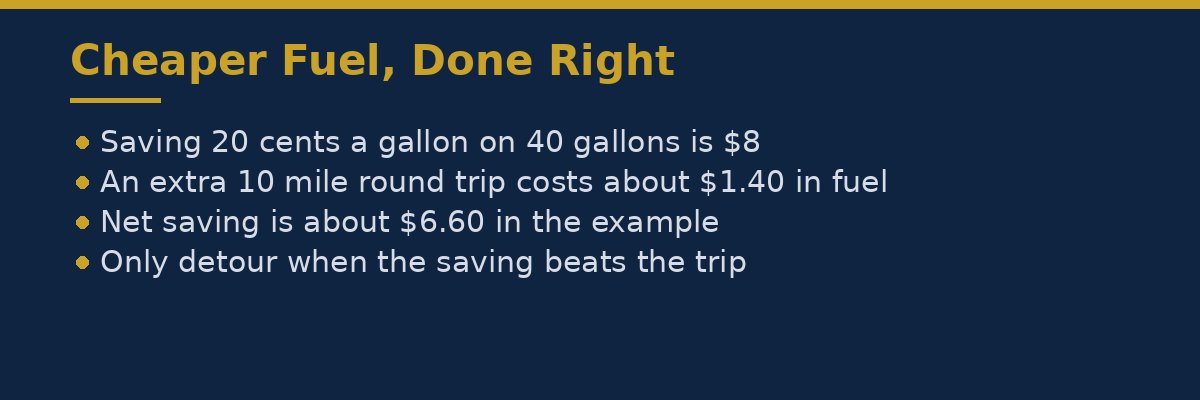
Here is a short example with round numbers, stated as an example. You need 40 gallons. The cheaper station saves 20 cents a gallon, so the gross saving is 40 times $0.20, which is $8.00. The cheaper station is 10 miles away and back, and your car uses an example 25 miles per gallon, so the trip uses 10 divided by 25, which is 0.4 gallons. At an example price of $3.50 a gallon, the trip costs 0.4 times $3.50, which is $1.40. The net saving is $8.00 minus $1.40, which is $6.60. In this example, the trip is worth it.
Now change one number. If the saving is only 5 cents a gallon, the gross saving is 40 times $0.05, which is $2.00. The trip still costs $1.40, so the net saving is only $0.60. That is a lot of driving for 60 cents.
Worked example: your monthly fuel savings
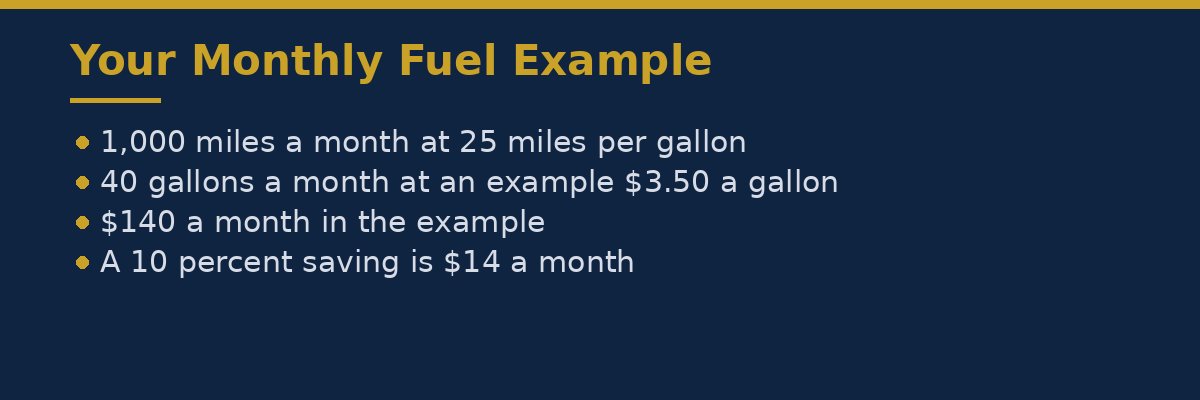
Here is a full monthly example, using round numbers stated clearly as an example. The numbers are not a claim about any real driver, car, or fuel price. They show how the maths works, so you can repeat it with your own numbers.
In the example, you drive 1,000 miles a month. Your car uses an example 25 miles per gallon. That means you use 1,000 divided by 25, which is 40 gallons a month. Fuel costs an example $3.50 a gallon. That means you spend 40 times $3.50, which is $140 a month on fuel, or $1,680 a year.
Now suppose smoother driving, better car care, and fewer short trips cut your fuel use by 10 percent. That is a modest change, not a big one. A 10 percent cut means you use 4 fewer gallons a month, because 10 percent of 40 is 4. At the example price of $3.50 a gallon, that saves 4 times $3.50, which is $14 a month, or $168 a year.
Add a cheaper station to the same example. If you save an example 10 cents a gallon on the 36 gallons you still buy, that is 36 times $0.10, which is $3.60 a month, or about $43 a year. Add the two savings together, and the total is $14 plus $3.60, which is $17.60 a month, or about $211 a year.
What not to do
Do not buy fuel additives or gadgets that promise big savings without clear proof. Most of them do not change fuel use in a real car, and the money spent on them wipes out any small saving. Spend the money on a service or on tyre pressure checks instead.
Do not fill up with a higher grade of fuel than your car needs, unless your car manual says to. For most cars, the standard grade is the right one, and a higher grade does not give better fuel economy. Check your manual, not the pump advertising.
Do not let fuel saving push you into unsafe driving. Driving far below the flow of traffic, braking sharply to save fuel, or looking at a fuel app while driving are all unsafe. Save fuel with smooth, calm driving, not with risky driving.
Frequently asked questions
How much can I save on gas by driving more smoothly?
It depends on your car and your driving now. In the worked example in this guide, a 10 percent cut in fuel use saves $14 a month on a $140 monthly fuel bill, using example numbers. Your own saving will depend on your miles, your car, and your fuel price, so work it out with your own numbers.
Does cruise control save gas?
Cruise control can help on open highways, because it holds a steady speed instead of drifting up and down. It is less useful in heavy traffic or on hilly roads, where you need to adjust speed often. Use it where the road is clear and steady.
Is it cheaper to fill up in the morning?
There is no reliable saving from filling up at a certain time of day for most drivers. Fuel price changes by station and by day matter far more than the hour. Check the price at stations on your route, and fill up where the price is fair.
Should I use a fuel loyalty programme?
If it is free and you would use that station anyway, yes, take the saving. But compare the price after the discount with other stations nearby. A discount on an expensive price can still be a bad deal, so check the final price, not the discount alone.
Does a roof box really use more fuel?
Yes, a roof box adds drag, and the engine uses more fuel to push it through the air, even when it is empty. Take it off when you are not using it. The same applies to a bike rack or any other item fixed to the outside of the car.
How do I save money on gas on a tight budget?
Start with the free habits: smooth driving, fewer short trips, and combining errands into one trip. Then check tyre pressure once a month, which is also free. Those steps cost nothing and can cut your fuel use. For more ideas on cutting costs across your budget, read our guide on how to save money on a tight budget.
Conclusion, and your first step today
Learning how to save money on gas is about small choices, repeated every day. Drive smoothly, keep your tyres at the right pressure, combine trips, and buy fuel where the price is fair. None of these steps is hard on its own, and together they can save a useful amount each month.
Start today with one step. Check your tyre pressure, and drive your next trip with gentle acceleration and early braking. Then work out your own monthly fuel numbers, using the worked example above. If you want to cut other everyday costs too, read our guides on how to save money on groceries and how to cancel subscriptions to save money.
For free, impartial information on driving habits that save fuel, see the US Department of Energy fuel economy driving tips at https://www.fueleconomy.gov/feg/drive.shtml
This article is for general information and education only. It is not legal or financial advice.
