

How to Save Money for a House: A Step-by-Step Deposit Plan
Learning how to save money for a house starts with a simple plan. First, set a deposit goal. Second, divide that goal by the number of months you have. Third, save that monthly amount, every month, in a separate account. That is the whole plan, and this guide works through each step with real example math, so you can build your own version.
A deposit, also called a down payment, is the part of the home price you pay yourself, before any loan covers the rest. The bigger your deposit, the smaller the loan you need. This guide shows you how to set the goal, find your monthly number, choose where to keep the money, and stay on track when life gets in the way.
If you are still deciding whether buying is right for you at all, read Is It Better to Get an Apartment or House? first. This guide is for people who have decided to save for a home, and want a clear plan to follow.

Step 1: Decide what kind of home you are saving for
Before you can set a number, you need a rough idea of the home you want. You do not need the exact house, but you do need a realistic price range for your area.
Look at homes that fit your real needs, not your dream list. How many bedrooms do you need? Which areas can you afford to live in? What do similar homes actually sell for in those areas? Write down a price range, not a single price, because prices change and you may need to adjust.
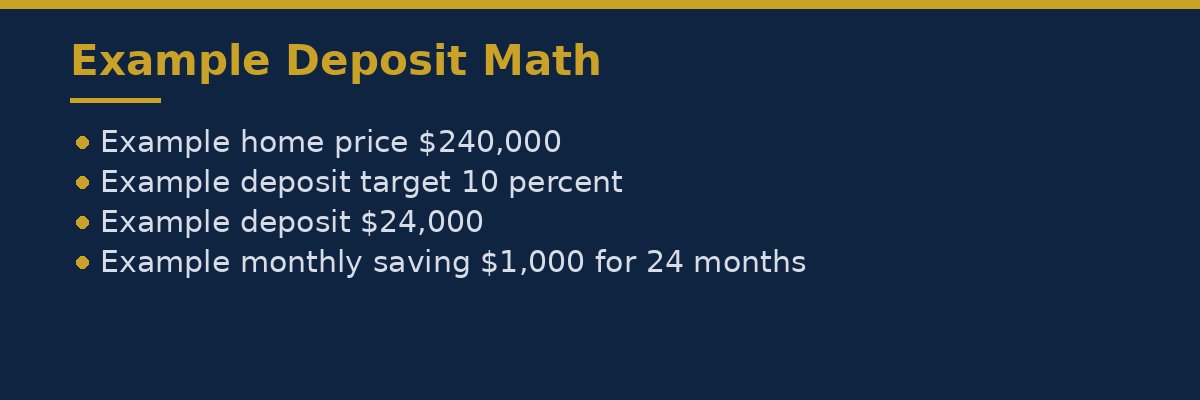
For example, suppose homes that fit your needs in your area sell for around 240,000 dollars. That is an example price, used only to show the math in this guide. Your own price will be different, and you should use real prices from your area when you build your own plan.
Step 2: Set your deposit goal
Your deposit goal is a share of the home price. For this guide, we will use 10 percent as an example target. That is only an example. Some buyers save more, and some save less, and the right target for you depends on your situation, your area, and the type of loan you may use. This guide does not tell you what share to save. It shows you how to do the math, so you can test any target you choose.
Here is the example math. If the example home price is 240,000 dollars, and the example target is 10 percent, the deposit goal is 240,000 times 0.10, which equals 24,000 dollars.
If you used a 20 percent example target instead, the goal would be 240,000 times 0.20, which equals 48,000 dollars. That is double the money, and it would take double the time at the same monthly saving rate, or double the monthly amount in the same time. Testing two targets side by side is a good way to see what is realistic for you.
Remember that the deposit is not the only cost of buying a home. There are also fees, moving costs, and the cost of furnishing and settling in. A good plan adds a small extra buffer for those costs, on top of the deposit goal. For example, you might add 5,000 dollars as an example buffer for fees and moving, which would make the total goal 24,000 plus 5,000, which equals 29,000 dollars.
Step 3: Find your monthly saving number
This is the step that turns a big goal into a monthly habit. Divide your total goal by the number of months you have to save.
Here is the worked example, using the numbers from Step 2. The total goal is 29,000 dollars, including the example buffer. If you have 24 months to save, the monthly number is 29,000 divided by 24, which equals about 1,208 dollars a month.
If that number is too high, you have three choices, and only three. Save for longer, save a smaller deposit, or increase your income. For example, saving the same 29,000 dollars over 36 months would be 29,000 divided by 36, which equals about 806 dollars a month. That is much easier each month, but it takes a year longer.
Try the math with your own numbers. Write down your total goal, your months, and your monthly number. If the monthly number is higher than what you can save after bills and food, change the timeline or the target, and do the math again. A plan you can keep for two years is better than a plan you quit after two months.
Step 4: Build a budget that leaves room for the deposit
Your monthly saving number only works if your budget has room for it. That means your income must be higher than your spending, by at least the monthly number, every month.
Start by writing down your real income after tax, and your real spending, using your bank statements. Our guide How Do I Create a Monthly Budget That Actually Works? walks through this step by step. If your spending is higher than your income, you cannot save for a deposit until that gap is fixed.
Then look for the gap. If your monthly number is 1,208 dollars, but your budget only leaves 500 dollars spare, you need to find 708 dollars more each month. That can come from cutting spending, earning extra income, or a mix of both.
If you are saving for a house and an emergency fund at the same time, read How Do I Save for a Goal and an Emergency Fund at the Same Time? Keep the two goals separate, so a car repair does not eat your house deposit.
Step 5: Choose where to keep the deposit
Where you keep the money matters, because the deposit needs to be safe and easy to reach when you buy, but hard to spend by accident before then.
Keep the deposit in a separate account from your everyday spending money. That separation is the single most useful step in this whole guide. When the money sits in your spending account, it gets spent. When it sits in its own account, you can see it grow, and you are less likely to dip into it.
When choosing an account, compare the features that matter for a deposit: safety, easy access when you need it, no fees that eat into your savings, and a way to move money in automatically. You do not need a complex product. A simple savings account is the usual choice for a deposit, because the money is safe and you can reach it when you buy.
Do not put deposit money into investments that can fall in value, unless you understand the risk and have a long time before you buy. A deposit you need in two years should not be in something that could drop just when you need it.
The Consumer Financial Protection Bureau has a guide to owning a home that explains the buying process in plain language, including the costs beyond the deposit.
Step 6: Automate the saving
The best deposit plan is one that happens without willpower. Set up an automatic transfer on payday, moving your monthly number from your spending account to your deposit account, on the same day your pay arrives.
If your monthly number is 1,208 dollars, set the transfer to 1,208 dollars, or split it into two transfers of 604 dollars if you are paid twice a month. What matters is that the money moves before you can spend it.
If your income changes each month, use the lowest normal month as your base, and set the automatic transfer to the amount you can keep even in a low month. In a good month, add the extra by hand.
Step 7: Protect the plan when life happens
A deposit plan runs for months or years, and life will interrupt it. A car repair, a medical bill, or a drop in income can all put the plan at risk. The fix is to plan for interruptions before they happen.
First, keep an emergency fund separate from your deposit. Even a small one helps. If you have no emergency fund yet, read How to Build an Emergency Fund From Zero and build a small buffer before you push hard on the deposit. Without it, every surprise comes straight out of your house savings.
Second, decide in advance what counts as a reason to pause. A real emergency is a reason. A sale, a holiday, or a new phone is not. Write your rule down, and stick to it.
Third, if you do need to pause, pause the plan, do not abandon it. Reduce the monthly amount for one or two months, then return to the full amount. A plan that bends is a plan that survives.
Full worked example: saving 29,000 dollars in 24 months
Here is the full plan from this guide, put together in one place, using the example numbers from the steps above.
Example home price: 240,000 dollars. Example deposit target: 10 percent, which is 24,000 dollars. Example extra buffer for fees and moving: 5,000 dollars. Total goal: 29,000 dollars.
Timeline: 24 months. Monthly saving needed: 29,000 divided by 24, which equals about 1,208 dollars a month.
Now check it against a household budget. Suppose the household takes home 5,000 dollars a month after tax. Suppose fixed costs are 3,000 dollars, and variable costs are 700 dollars. That leaves 5,000 minus 3,000 minus 700, which equals 1,300 dollars spare each month.
The monthly saving number is 1,208 dollars, and the spare money is 1,300 dollars. That leaves 92 dollars a month of slack. The plan works, but only just, so this household should look for a little more room, perhaps by cutting 100 dollars of variable spending.
Your own numbers will be different. Run the same steps: price, target, buffer, months, monthly number, and a check against your real budget. If the plan is tight, lengthen the timeline or find more room in the budget, before you start, not after six months of struggle.
Mistakes to avoid
Saving without a number. “Save what is left over” usually means saving nothing, because spending fills the gap. A fixed monthly number, moved on payday, is what makes saving real.
Keeping the deposit in your spending account. It will be spent. Separate it, on day one.
Dipping into the deposit for non emergencies. Every withdrawal pushes the buying date back. If you take out 1,000 dollars, and you save 1,208 dollars a month, you have lost almost a month of progress.
Waiting for the perfect time. There is rarely a perfect time to start. A small monthly amount, started now, beats a large amount that never starts. If your monthly number is too high today, start with what you can, and raise it as your income or spending allows.
Frequently asked questions
How much should I save for a house deposit?
It depends on the home price in your area and the target you choose. This guide uses 10 percent as an example target, so a 240,000 dollar example home needs a 24,000 dollar example deposit. Your target may be higher or lower. Work out your own goal with real local prices, and add a buffer for fees and moving.
How long does it take to save for a house?
It depends on your goal and your monthly number. A 29,000 dollar goal saved at 1,208 dollars a month takes 24 months. The same goal at 806 dollars a month takes 36 months. Divide your goal by your monthly amount to find your timeline, then adjust one of the two until the plan fits your life.
Where should I keep my house deposit?
Keep it in a separate account from your everyday spending money, in a safe, easily reachable account. Compare safety, access, and fees before you choose, and check the current terms yourself, because rates and terms change. Do not put money you need soon into anything that can fall in value.
Can I save for a house and an emergency fund at the same time?
Yes, but keep them separate, so an emergency does not eat your deposit. Split your monthly saving between the two goals, and build at least a small emergency buffer first, so a surprise bill does not stop your house plan.
What if house prices rise while I am saving?
Rising prices make the goal bigger, which is why you should check your price range once a year and update the plan if needed. A longer timeline, a higher monthly amount, or a different area may be needed. Do not panic and rush into a home you cannot afford because prices moved.
Should I pay off debt before saving for a house?
It depends on your situation. High interest debt usually costs more than savings earn, so many people deal with expensive debt first, or at the same time as saving. This article is not financial advice, and you should consider your own situation before deciding.
Conclusion, and your first step today
Saving for a house is a long project, but it runs on a short habit: one automatic transfer, every payday, into a separate account. Set your goal, find your monthly number, and check it against your real budget. Then start, even if the first amount is smaller than the full number.
Your first step today is simple. Look at home prices in your area, pick a realistic price range, and work out your deposit goal with the math in Step 2. Then divide it by your months, and see your monthly number. If it fits, set up the transfer. If it does not fit, change the timeline or the target, and try again.
A deposit grows one month at a time. Start this month, and the number will be larger next month than it is today.
This article is for general information and education only. It is not legal or financial advice.
