
Real Estate Investing for Beginners: How to Start Small
Real estate investing for beginners means putting money into property, or into funds that own property, with the aim of earning rent or seeing the value grow over time. You do not need to buy a whole apartment building on day one. Many beginners start small, with a fund that owns property, a shared investment, or a home they live in and rent part of.
This guide explains how real estate investing works, the main strategies, what it costs, and the risks. It is educational only. It does not recommend any property, fund, or investment, and it does not promise any return.
How real estate investing works
Real estate can earn money in two main ways. The first is rent: a tenant pays you each month to live in, or use, a property you own. The second is growth in value: the property may be worth more later than when you bought it, so you can sell it for more than you paid. Some investments aim for both, and some aim mainly for one.
But property also has costs. A rental property needs insurance, taxes, repairs, and sometimes a manager. A property can also sit empty, with no rent coming in, while the costs continue. And property is hard to sell quickly. Unlike a savings account, you cannot take your money out of a house in a day.
Before you go further, make sure you understand the basics of risk. Read What Is Risk in Investing? and What Is Diversification and Why Does It Matter? Real estate is one part of a wider plan, not a replacement for savings, an emergency fund, or other investments.
The main strategies, explained simply
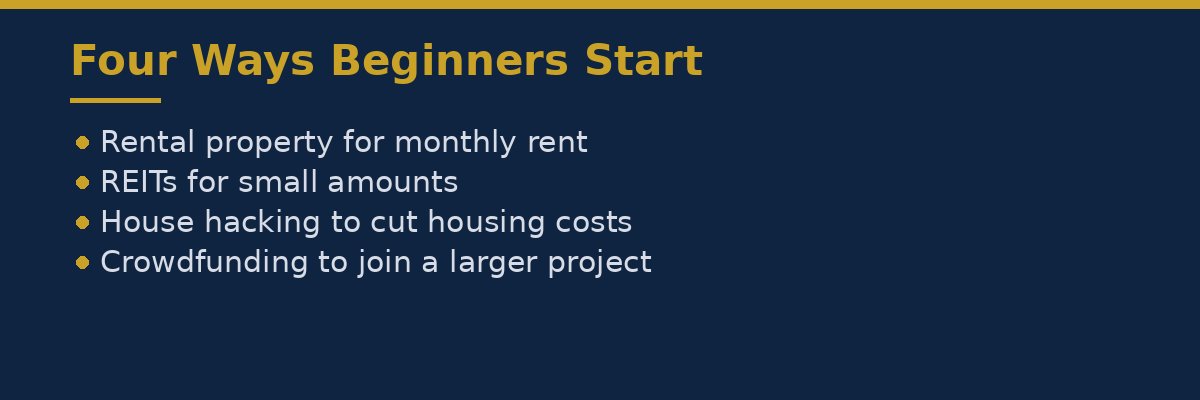
1. Buying a rental property
You buy a home or apartment and rent it to a tenant. The tenant pays rent each month, and you pay the costs of owning the property. The aim is for the rent to be higher than the costs, leaving a profit, and for the property to hold or grow its value over time.
This is the most hands-on strategy. You, or a manager you pay, must find tenants, collect rent, handle repairs, and follow local landlord rules. It usually needs the most money to start, because you need a deposit, plus money for fees, repairs, and empty months.
2. REITs: funds that own property
A REIT, or real estate investment trust, is a company or fund that owns property, such as offices, shops, apartments, or warehouses, and lets many people invest in it together. You buy shares in the REIT, and the REIT pays you a share of the rent it collects, usually as a dividend.
REITs let beginners start with a small amount, because you buy shares rather than a whole building. You can also sell your shares more easily than you can sell a house. But the value of the shares can fall, just like any other investment, and the dividend is not guaranteed.
To learn more, the U.S. Securities and Exchange Commission explains what a REIT is in plain language.
3. House hacking
House hacking means buying a home to live in, and renting out part of it to reduce your own housing cost. For example, you might buy a home with an extra bedroom and rent that room, or buy a property with two units, live in one, and rent the other.
This can be a good first step, because you are buying a home you would need anyway, and the rent helps with the cost. But you become a landlord, with all the duties that brings, and you share your home with a tenant, which is not for everyone. Check local rules before you plan this, because some areas limit short term rentals or extra tenants.
4. Real estate crowdfunding
Crowdfunding platforms let many people pool small amounts of money to fund a larger property project, such as a building or a development. Each person owns a small share, and earns a share of the rent or the profit when the project is sold.
This lets beginners join a larger project with a smaller amount. But the money is often locked in for years, the project can fail, and the return is not guaranteed. Read the platform’s terms carefully, check what fees it charges, and never invest money you cannot afford to lose.
5. Fixing and selling, also called flipping
Flipping means buying a property, improving it, and selling it for more than you paid, including the cost of the work. It can look simple on television, but it needs skill in pricing, building work, and timing. A repair that costs more than planned, or a slow sale, can turn a profit into a loss. Most beginners should treat flipping as an advanced step, not a starting point.
What it costs to start
The cost depends on the strategy. A REIT or a crowdfunding share can start with a small amount, because you are buying a share, not a building. A rental property needs far more, because you need a deposit, fees, and a cash buffer.
Here is a simple example using round numbers, to show how the costs add up. These are example figures only, not real prices.
Suppose an example rental property costs 200,000 dollars. A 20 percent deposit, used only as an example, would be 40,000 dollars. That is 200,000 times 0.20, which equals 40,000. Then add example extra costs: 5,000 dollars for fees and closing costs, 5,000 dollars for initial repairs, and 10,000 dollars kept aside as a buffer for empty months and surprise repairs. The total cash needed before the first rent arrives is 40,000 plus 5,000 plus 5,000 plus 10,000, which equals 60,000 dollars.
Many beginners are surprised by that last number. The deposit is not the full cost. The buffer matters most, because a property with no buffer can force you to borrow, or sell, at the worst time.
For REITs and crowdfunding, the starting cost is lower, but check the fees. A platform may charge a fee to join, a yearly management fee, or a share of the profit. Fees reduce your return, so read them before you invest.
Worked example: checking a rental property
Before you buy a rental, work through the monthly numbers. Here is a full worked example, using round numbers that are only examples.
Suppose the example property costs 200,000 dollars, with a 40,000 dollar deposit, so the loan is 160,000 dollars. Suppose the example loan rate is 6 percent a year, used only for this example, and the loan runs for 30 years. The example monthly loan payment is about 960 dollars. This figure is an example, not a real quote, and real payments depend on the actual rate, term, and fees.
Now add the other monthly costs, all as examples. Property tax: 250 dollars. Insurance: 100 dollars. Repairs and maintenance set aside: 150 dollars. Property management, if you use one: 120 dollars. Total monthly costs are 960 plus 250 plus 100 plus 150 plus 120, which equals 1,580 dollars.
Suppose the property rents for 1,800 dollars a month. The monthly result is 1,800 minus 1,580, which equals 220 dollars. That is the example profit before tax and before empty months.
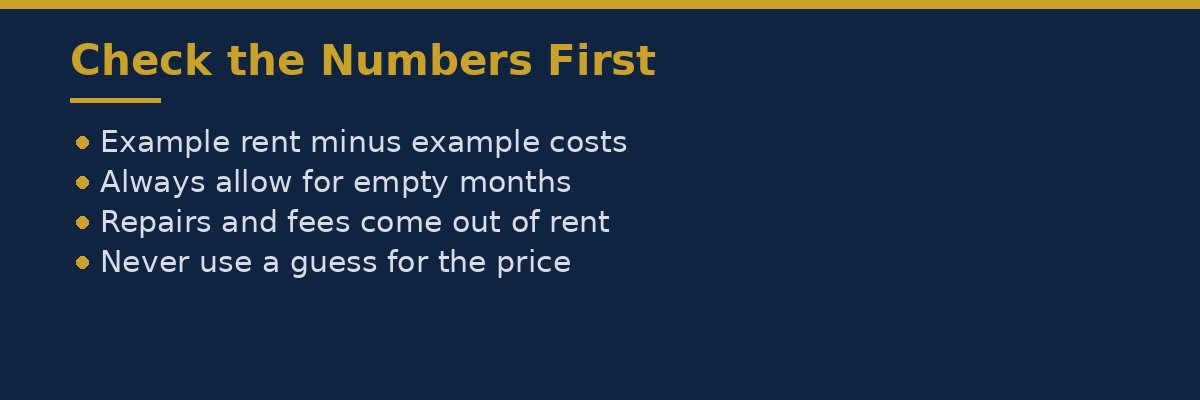
Now allow for empty months. If the property is empty for one month a year, you lose 1,800 dollars of rent, but the costs of about 1,580 dollars a month mostly continue. Over a year, the example profit is 220 dollars times 12 months, which is 2,640 dollars, minus the 1,800 dollars of lost rent, which leaves 840 dollars for the year, before tax. That is a very different picture from the simple monthly figure.
This is why beginners must always allow for empty months and repairs in the math. A property that looks good on a perfect month can be a poor investment in a real year.
The risks every beginner should understand
Real estate has real risks. Here are the main ones.
Vacancy: the property sits empty, with no rent, while costs continue. A long vacancy can use up your buffer fast.
Repairs: roofs, heating, plumbing, and appliances all break. A single large repair can cost more than a year of profit.
Price falls: property values can fall as well as rise. If you need to sell during a fall, you may get less than you paid.
Loan risk: if you borrow to buy, you must pay the loan even when there is no rent. If rates rise, your payments can rise too, depending on the type of loan.
Illiquidity: you cannot sell a house in a day. A sale can take weeks or months, and it costs money in fees.
Concentration: one property is a large share of your money in one place. If that one property has a problem, your whole investment feels it. That is why diversification matters, and why many beginners hold property alongside other investments, not instead of them.
A step by step plan to start small
Step 1: Build your base first. Before investing in property, have an emergency fund and no high interest debt that you are struggling with. Property is a long term step, not a fix for short term money problems. If you are still deciding how much you need to start investing at all, read How Much Money Do I Need to Start Investing?
Step 2: Learn the rules where you live. Landlord duties, tenant rights, taxes, and local limits on rentals are different in every area. Check your local government website, and speak to a qualified professional if you are unsure.
Step 3: Pick one strategy. For most beginners, that means either a REIT, to learn how property funds work with a small amount, or house hacking, if you are already planning to buy a home. A full rental property is usually a later step, after you have learned the numbers.
Step 4: Do the math on paper, three times. Once with perfect numbers, once with one empty month, and once with a large repair. If the investment only works in the perfect case, it does not work.
Step 5: Start small and learn. A small first step teaches you how the process works, what the costs really are, and whether you enjoy being a landlord or an investor. You can always do more later.
Step 6: Keep records from day one. Every cost, every rent payment, every repair, and every fee. Good records help with taxes, and they show you whether the investment is really making money.
Step 7: Review once a year. Check the rent against the costs, the value of the property, and your own goals. If the numbers no longer work, decide calmly whether to adjust, hold, or sell, rather than reacting to one bad month.
If you want a simple plan that covers all your investing, not just property, read What Is a Simple First Investment Plan? It helps you place real estate in the right order, after savings and an emergency fund.
Mistakes beginners make most
Buying because prices are rising. A rising market does not make a bad rental a good one. The monthly numbers matter more than the trend.
Forgetting the buffer. Buying with every dollar you have, and no money left for repairs or empty months, is the most common beginner mistake.
Trusting a seller’s numbers. Always check the rent, the costs, and the condition yourself. A property that is advertised with high rent may have high costs, or a rent that no tenant will actually pay.
Ignoring local rules. Landlord duties, safety checks, and tax rules are real, and breaking them can cost far more than the rent you earn.
Putting everything into one property. One property, in one area, with one tenant, is a concentrated risk. Beginners should understand that before they commit a large share of their money.
Frequently asked questions
How much money do I need to start real estate investing?
It depends on the strategy. A REIT or crowdfunding share can start with a small amount, because you buy a share, not a building. A rental property needs far more: a deposit, fees, repair money, and a cash buffer.
Are REITs good for beginners?
REITs can be a simpler first step, because you can start small, you do not manage a property, and you can sell your shares more easily than a house. But the share value can fall, and the dividend is not guaranteed. Learn what a REIT is, check the fees, and understand the risks before you buy.
Is rental property passive income?
No, not in the usual sense. A rental needs work: finding tenants, handling repairs, keeping records, and following the rules. A manager can do some of that work, but the manager charges a fee, and you are still responsible. Treat it as a small business, not as money that arrives by itself.
What is house hacking?
House hacking means buying a home to live in and renting out part of it, for example a room or a second unit, to reduce your own housing cost. It can be a good first step if you are already buying a home, but you become a landlord, so check local rules first.
Can I invest in real estate with little money?
You can start with a small amount through a REIT or crowdfunding, but you should still learn the risks, check the fees, and never invest money you need for bills or an emergency. A small start is a learning step, not a shortcut to a large income.
Do I need a loan to invest in real estate?
No. REITs and crowdfunding do not need a loan. A rental property often uses a loan, but borrowing adds risk, because you must pay the loan even when there is no rent. Beginners should understand loan costs fully before borrowing.
Conclusion, and your first step today
Real estate investing for beginners is not about buying the biggest property you can afford. It is about learning how the numbers work, picking one simple strategy, and starting small enough that a bad month does not hurt you.
Your first step today is not to buy anything. It is to learn. Read about risk and diversification, pick one strategy from this guide, and work through the example math with numbers from your own area. If the numbers work in a good month, a bad month, and a month with a large repair, you are ready to look further.
This article is for general information and education only. It is not legal or financial advice.
