

How Do I Use a Car Loan Calculator to Plan My Car Payment?
Short answer: a car loan calculator turns three numbers into your monthly payment: how much you borrow, the interest rate, and how many months you take to repay it. Type those three numbers in, and it shows the monthly payment and the total interest you will pay. Use it before you shop, so you know what payment fits your budget and what the car really costs you over the whole loan. This guide explains each number, works through a real example, and shows how a longer loan or a higher rate changes the cost. It is educational only, not financial advice.
What a car loan calculator does
A car loan calculator is a simple tool. It does the loan math for you, so you do not have to guess what a car will cost each month. You give it the loan amount, the yearly interest rate, and the loan term in months. It gives back the monthly payment, the total interest, and the total amount you will pay by the end of the loan.
That matters because the monthly payment is only part of the story. Two loans can have the same monthly payment but very different total costs, if one runs longer or charges a higher rate. The calculator shows both numbers, so you can compare loans properly instead of judging by the monthly figure alone.
You can find free car loan calculators on bank websites and on the US Consumer Financial Protection Bureau site. You do not need to pay for one, and you do not need to give personal details to use a basic one.
For general guidance on car loans, see the Consumer Financial Protection Bureau: https://www.consumerfinance.gov/consumer-tools/auto-loans/
The three numbers the calculator needs
Number 1: the loan amount. This is the car price minus your down payment and minus any trade-in value. If the car costs 25,000 dollars and you pay 5,000 dollars down, you borrow 20,000 dollars. A bigger down payment means a smaller loan, a smaller monthly payment, and less interest. It also protects you if the car loses value faster than the loan is repaid.
Number 2: the interest rate, shown as APR, which is the yearly cost of borrowing. A lower rate means a lower payment and less total interest. Your rate depends on your credit history, the lender, and the loan term. Shorter loans often carry lower rates. The rate a dealer quotes is not always the best rate you can get, so check with your bank or credit union too, before you agree to anything.
Number 3: the loan term, in months. Common terms are 36, 48, 60, and 72 months. A longer term cuts the monthly payment, which feels easier, but it raises the total interest and keeps you paying for longer. A shorter term costs more each month but saves interest and frees you from the loan sooner.
Some calculators also ask for a sales tax figure or fees. If yours does, add them to the amount borrowed, because they are part of what you repay. If you are not sure of the tax, use your state rate as a rough guide, and treat the result as an estimate, not an exact promise.
A worked example: a 20,000 dollar loan at 7 percent
Here is a real example with simple numbers. You buy a car for 25,000 dollars. You pay 5,000 dollars down. You borrow 20,000 dollars at 7 percent APR for 60 months, which is five years.
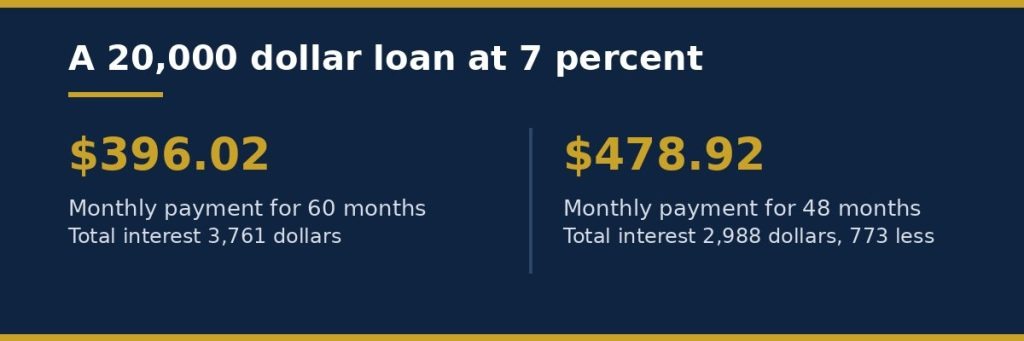
The calculator gives a monthly payment of 396.02 dollars. Over 60 months, you pay 23,761 dollars in total. That means the interest costs you 3,761 dollars on top of the 20,000 dollars you borrowed.
Now change one number at a time and watch what happens.
Keep the loan and rate the same, but shorten the term to 48 months. The monthly payment rises to 478.92 dollars, but the total interest falls to 2,988 dollars. You pay about 83 dollars more each month, and you save about 773 dollars in interest, and you are free of the loan a full year sooner.
Keep the loan and term the same, but stretch the term to 72 months. The monthly payment falls to 340.98 dollars, but the total interest rises to 4,551 dollars. You save about 55 dollars a month, and you pay about 790 dollars more in interest, and you are still paying for the car in year six, when it is older and may need repairs.
Keep the loan and term the same, but change the rate. At 5 percent, the payment is 377.42 dollars a month and total interest is 2,645 dollars. At 9 percent, the payment is 415.17 dollars a month and total interest is 4,910 dollars. A two point difference in the rate, from 7 to 9 percent, costs about 19 dollars a month and about 1,149 dollars over the loan. That is why checking more than one lender matters.
Finally, change the loan amount. Borrow 15,000 dollars instead of 20,000, at the same 7 percent for 60 months, and the payment is 297.02 dollars a month, with total interest of 2,821 dollars. Every 5,000 dollars less you borrow saves about 99 dollars a month and about 940 dollars in interest on these terms.
How to use the result in your budget
A payment is only affordable if it fits your monthly budget without squeezing everything else. A common way to check is the 50/30/20 rule: about 50 percent of take-home pay for needs, 30 percent for wants, and 20 percent for saving and extra debt payments. A car payment sits inside needs, next to rent, food, and bills. If the payment pushes needs far above 50 percent, the car is too expensive for your pay right now.
To learn the split in detail, read: What Is the 50/30/20 Budget Rule, and Does It Work?
Run the calculator three times before you buy. First, run it with the car you want, at the price the dealer quotes. Second, run it with a cheaper car, or a bigger down payment, and see how much the payment falls. Third, run it with a shorter term, and see whether you can afford the higher payment in exchange for less interest. The comparison tells you what each choice really costs.
Also remember that the loan payment is not the full cost of the car. Insurance, fuel, and maintenance come every month too. A 396 dollar payment with 150 dollars of insurance and 120 dollars of fuel costs 666 dollars a month to run, not 396. Add those costs before you decide the car fits.
A sinking fund helps with the costs that arrive once or twice a year, like insurance and yearly checks. Set a little aside each month for them, so they do not wreck a single month.
To set one up, read: What Is a Sinking Fund?
Five mistakes the calculator cannot catch
Mistake 1: Only looking at the monthly payment. A dealer can cut the payment by stretching the loan to 72 or 84 months. The payment looks small, but the interest grows and you pay for an old car for years. Always check the total interest too.
Mistake 2: Borrowing with no down payment. With nothing down, you borrow the full price, and the car loses value faster than the loan shrinks. If you need to sell it, you may owe more than it is worth. Save a down payment first, even a small one.
Mistake 3: Accepting the first rate you are offered. Rates vary by lender. A bank, a credit union, and the dealer may quote different rates for the same loan. Get at least two quotes before you sign, and compare the APR, not just the monthly payment.
Mistake 4: Forgetting the running costs. Insurance for a new car can cost much more than for an old one. Get an insurance quote before you buy, and add fuel and maintenance to the monthly total. A car that fits on payment alone may not fit once the running costs are added.
Mistake 5: Rolling old debt into the new loan. If you still owe money on your old car, a dealer may offer to add that debt to the new loan. That raises the amount borrowed, the payment, and the interest, and it starts the new loan underwater. It is usually better to clear the old loan first, or to choose a cheaper car.
How to plan the purchase step by step
Step 1: Work out your monthly budget first. Write down take-home pay, then subtract rent, food, bills, and saving. What is left is the most the car can cost each month, including insurance and fuel, not just the loan payment.
To build that budget, read: How Do I Create a Monthly Budget That Actually Works?
Step 2: Decide your down payment. The more you pay up front, the less you borrow. If you need time to save it, set the money aside each month in a separate pot until you reach the target.
Step 3: Check your credit and get two rate quotes. A better credit score usually means a lower rate. A bank or credit union quote gives you a number to compare against the dealer offer.
Step 4: Run the calculator with real numbers. Use the loan amount, the best rate you were quoted, and a 48 or 60 month term. Note the monthly payment and the total interest.
Step 5: Check the full monthly cost. Add insurance, fuel, and a share of yearly costs. If the total fits the budget with room to spare, the car fits. If it does not, pick a cheaper car, save a bigger down payment, or wait.
Step 6: Review the budget after the first month with the car. Check that the real costs match the calculator. If they are higher, adjust the budget in the same month, before the gap grows.
To build that review habit, read: How Do I Review My Budget at the End of the Month?
FAQ
What is a good car loan interest rate?
It depends on your credit history, the lender, and the term. Rates move over time, and a good rate for one person may be different for another. The useful check is to compare at least two quotes for the same loan amount and term, and to pick the lower APR. A lower rate always means less total interest.
How much should my car payment be?
A common check is that the payment, plus insurance and fuel, fits inside the needs part of your budget, which is about 50 percent of take-home pay in the 50/30/20 rule. If the payment alone takes a large share of your pay, the car is probably too expensive for now.
Is a longer car loan better?
A longer loan gives a smaller monthly payment, which feels easier, but it costs more interest and keeps you paying longer. A shorter loan costs more each month but saves interest. For a 20,000 dollar loan at 7 percent, 48 months costs 2,988 dollars in interest, 60 months costs 3,761 dollars, and 72 months costs 4,551 dollars.
Should I pay cash or take a loan for a car?
Paying cash avoids interest completely, but it takes a large sum out of your savings at once. A loan spreads the cost, but adds interest. If a loan would leave you with no emergency savings, it is usually better to buy a cheaper car, or to save longer and pay more down.
Does a car loan calculator include tax and fees?
Some do, some do not. A basic calculator uses only the loan amount, the rate, and the term. If yours has fields for tax and fees, fill them in, because they are part of what you repay. If it does not, add tax and fees to the loan amount yourself before you run it.
What is the difference between APR and interest rate?
The interest rate is the cost of borrowing the money. The APR includes the interest rate plus most fees, shown as a yearly rate. When you compare two loans, compare the APR, because it shows the fuller cost.
Conclusion
A car loan calculator is a planning tool, not a sales tool. Give it the amount you will borrow, the rate you were quoted, and the term, and it shows the monthly payment and the total interest. The worked example shows why all three numbers matter: on a 20,000 dollar loan at 7 percent, 60 months costs 396.02 dollars a month and 3,761 dollars in interest, while 48 months costs more each month but saves about 773 dollars, and 72 months costs less each month but adds about 790 dollars. Run the numbers before you shop, add insurance and fuel, check the total against your budget, and pick the shortest term you can afford. That is how a calculator keeps a car purchase inside your plan.
This article is for general information and education only. It is not legal or financial advice.
