

How Do I Negotiate Medical Bills and Pay Down Medical Debt?
A medical bill can feel like a bill you simply have to pay, in full, right away. But in many cases the first number on the bill is not the final number. Hospitals often have room to lower it, plus payment plans and financial help that are not printed on the bill itself. You just have to ask.
To negotiate medical bills, ask for an itemized bill, check it line by line for errors, check what your insurance already paid, ask about financial assistance, and then ask for a discount or a payment plan. Get any agreement in writing before you pay. In the worked example below, a $4,800 hospital bill is negotiated down to $2,880 and then paid off at $120 a month over 24 months.
Why Medical Bills Are Often Negotiable
Medical bills are different from most other bills. The price on the bill is often a starting price, not a fixed price. Hospitals set their listed prices high, and insurance companies then pay a lower agreed price. If you do not have insurance, or if a charge falls outside your cover, you may be billed at that high listed price even though the hospital would accept less.
That is why asking matters. Many hospitals have a billing office, a financial assistance office, or both, and their job includes working with patients who cannot pay the full amount at once. They can often offer a discount for paying in full, a discount based on your income, or a monthly payment plan. None of this happens unless you call and ask.
You also have rights. Federal rules protect you against some surprise out of network bills, through the No Surprises Act, and the Consumer Financial Protection Bureau publishes guidance on medical debt and your rights. That page is a good place to check the current rules for yourself.
Step 1: Ask for an Itemized Bill
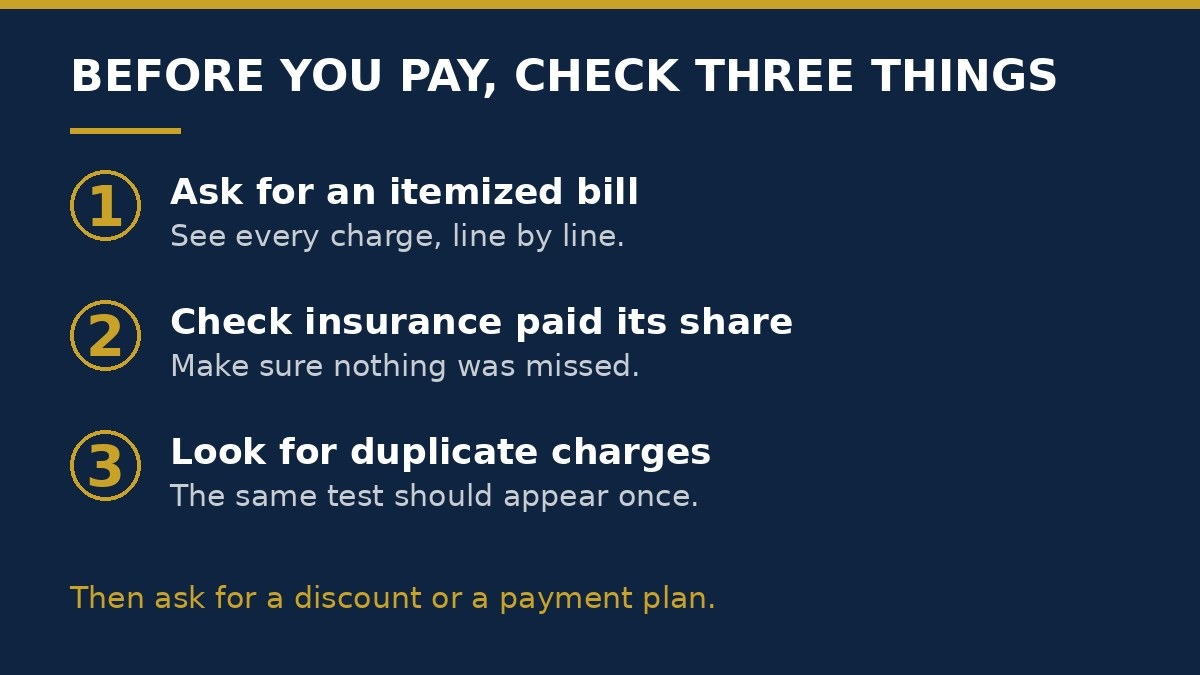
Never negotiate from the summary bill alone. The summary usually shows one total and very little detail. Ask the hospital or clinic for an itemized bill, which lists every charge on its own line, with the date, the service, and the amount.
Once you have it, read it slowly. Check the dates of service against your own records. Check that every procedure listed is one you actually had. Check for charges that appear twice, such as the same test listed on two lines. Check that the bill matches what your insurance statement, called an explanation of benefits, says was billed.
If a charge is wrong or unclear, call the billing office, ask what it is, and ask for it to be removed and a corrected bill sent. Do not pay a bill you have not checked, and do not agree to a payment plan for a total that still contains a mistake. Fix the bill first, then negotiate the corrected amount.
Step 2: Check What Your Insurance Paid
If you have health insurance, get your explanation of benefits for the same visit and compare it with the itemized bill. The explanation of benefits shows what the provider billed, what your insurance paid, and what you owe. These two documents should agree. If they do not, call your insurer first and then the billing office, and ask which figure is right.
Look for a service your plan should have covered, a charge your plan already paid, and a bill sent before your insurance finished processing the claim. If the claim is still being processed, ask the billing office to pause the bill until the insurance decision is final. Paying too early can mean paying for something your insurance would have covered.
If you do not have insurance, say so plainly when you call. Many hospitals have a lower self pay price that is very different from the listed price on the bill, and it is only offered when you ask. Ask this exact question: “What is the self pay price for this bill?”
Step 3: Ask About Financial Assistance
Most nonprofit hospitals in the United States must offer financial assistance, sometimes called charity care, to patients who qualify. The rules and income limits change by hospital, so you have to ask the hospital itself what it offers. This is one of the most important calls you can make, because financial assistance can reduce a bill by a large amount or, in some cases, clear it completely.
Ask the billing office or the financial assistance office these questions:
- Do you offer financial assistance or charity care, and how do I apply?
- What income limits apply, and what documents do you need from me?
- Is there a deadline to apply, and will you pause collections while my application is reviewed?
- If I do not qualify for full help, is there a partial discount based on my income?
Apply as soon as you can, even if you think you earn too much. While your application is reviewed, ask in writing for the bill to be put on hold so it is not sent to collections. Keep copies of everything you send and receive.
Step 4: Ask for a Discount
Once the bill is corrected and you know whether financial assistance applies, ask for a discount on the remaining amount. This is the negotiation itself, and it is a normal request. Billing offices hear it every day.
Here is a simple script you can use on the phone: “I have reviewed my itemized bill, and the amount I owe is $4,800. I want to pay what I owe, but I cannot pay the full amount right now. Is there a discount if I pay in full today, or a lower amount you can accept to settle this bill?”
If they offer a discount for paying in full, ask them to confirm the exact amount and the deadline in writing. If you cannot pay in full, say so, and ask what discount they can offer with a payment plan instead. If the first person says no, politely ask for a supervisor or the financial assistance office.
Before you agree, ask whether the amount is final, with no other charges coming later for the same visit, and whether the account will be marked as paid in full. Never agree to a discount over the phone without written confirmation. A verbal promise is hard to prove later if the bill comes back.
Step 5: Set Up a Payment Plan You Can Keep
If you cannot pay the agreed amount at once, ask for a monthly payment plan. Many hospitals offer interest free plans, so the total stays the same, just spread over time. Always ask whether the plan charges interest or fees, because that changes the total.
Before you agree, check the monthly amount against your budget. A plan you cannot keep is worse than a slower plan you can keep, because a missed payment can send the bill to collections. Work out what you can pay each month after rent, food, transport, and other bills, and offer that amount. If the hospital asks for too much, ask for a longer plan with a smaller monthly amount.
If you cannot pay at all right now, say so plainly. Our guide on how to talk to a lender if you cannot pay explains how to have that conversation calmly and clearly, and the same approach works with a hospital billing office.
Get the payment plan in writing too. The letter should show the total amount, the monthly payment, the number of months, whether there is any interest or fee, and the date of the first payment. Pay on time every month, and keep a record of every payment.
Worked Example: One Bill, Before and After
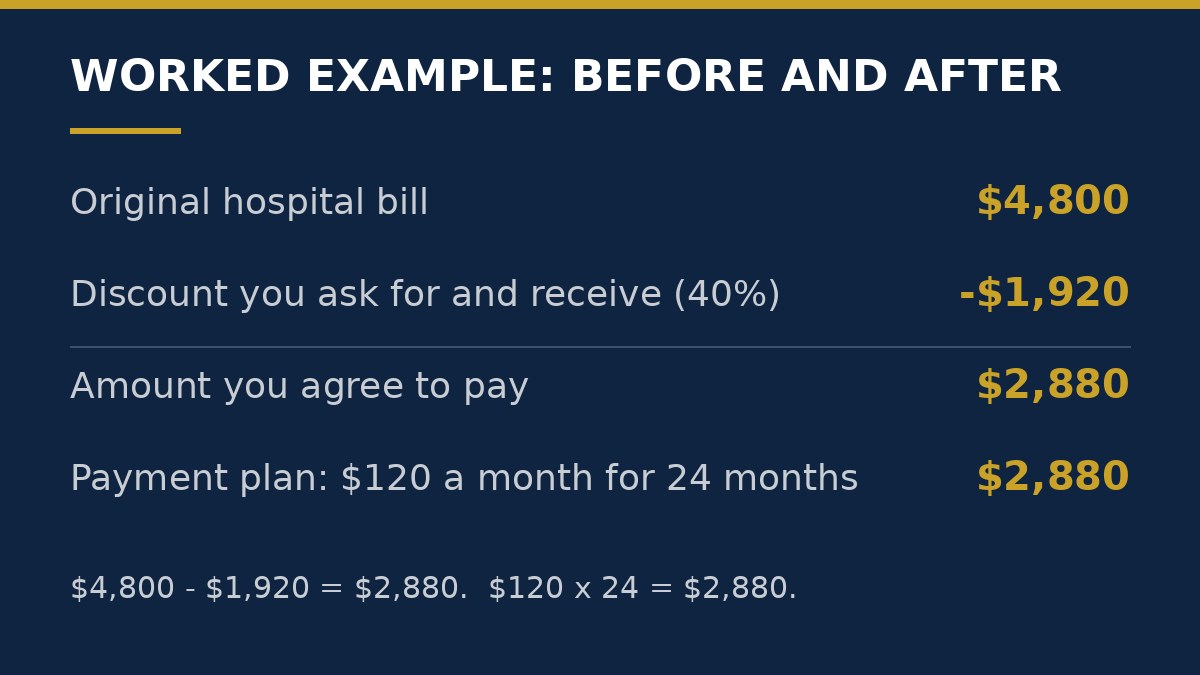
Here is a worked example, so you can see how the steps fit together. The figures are an example only, to show the math.
A patient receives a hospital bill for $4,800. She calls the billing office and asks for a discount. The hospital agrees to reduce the bill by 40 percent. The discount is 40 percent of $4,800, which is $1,920. Subtract the discount from the bill: $4,800 minus $1,920 equals $2,880. That is the amount she agrees to pay.
She cannot pay $2,880 at once, so she asks for a payment plan. The hospital offers 24 months with no interest. Divide the amount by the months: $2,880 divided by 24 equals $120 a month. Check the total: $120 times 24 equals $2,880, which matches the agreed amount exactly.
Without the discount, $4,800 divided by 24 equals $200 a month. The negotiation saves $80 a month for two years, which is $1,920 in total, the same as the discount.
Now check the plan against a budget. If she can pay $120 a month without missing rent or food, the plan works. If $120 is still too much, she should ask for a longer plan before signing. A 36 month plan, for example, would be $2,880 divided by 36, which equals $80 a month.
How to Pay Down the Medical Debt
Once you have an agreed amount and a plan, add the medical bill to your payoff plan. Write down every debt you have, with its balance, minimum payment, and interest rate. Our guide on how to make a debt payoff plan walks through that step by step.
If you have more than one debt, decide the order. One method is to pay the smallest balance first, called the debt snowball method, and another is to pay the highest interest rate first. Our guide on which debt to pay first, smallest or highest interest, explains both. Medical debt on an interest free hospital plan often has no interest, so it may sit behind a credit card debt that does charge interest. That is fine, as long as you keep paying the hospital plan on time.
Some people ask whether to put medical debt on a credit card or take out a loan to pay it off. Be careful. A credit card charges interest, and a hospital plan often does not, so moving the debt can make it more expensive. Before you borrow, read our guide on whether you should consolidate your debt, and check how long it will take to pay off your debt at your current pace.
Whatever order you choose, pay the hospital plan on time, every month. A missed payment can break the plan and send the balance to collections, which is the outcome this whole process is trying to avoid.
What to Do If the Bill Goes to Collections
If a bill is sent to a collection agency, do not panic, and do not ignore it. Ignoring a collection account makes it worse, not better. The Consumer Financial Protection Bureau has a clear guide to debt collection and your rights, and it is worth reading before you speak to any collector.
First, ask the collector for written proof of the debt, including the original provider, the amount, and the date of service. Do not agree you owe it, and do not pay, until you have that proof. Check it against your own records, and if the amount is wrong, or the bill was already reduced or paid, dispute it in writing.
You can still negotiate with a collector, and the same rules apply: ask for the full amount in writing, ask for a discount for paying in full, and ask for a payment plan you can keep. Get any agreement in writing before you pay a dollar. And keep paying your other debts on time, so one medical bill does not pull the rest of your plan down with it.
Mistakes to Avoid With Medical Bills
These are the mistakes to avoid:
- Paying the first bill without checking it. Errors and duplicate charges are common, and you cannot get money back easily once it is paid.
- Putting the bill on a credit card right away. A hospital plan is often interest free, and a credit card is not.
- Agreeing to a monthly payment you cannot keep. A missed payment can end the plan and send the bill to collections.
- Accepting a verbal discount. Always get the agreed amount in writing before you pay.
- Ignoring the bill or the collector. Silence does not make a debt go away, and it removes your chance to negotiate.
- Borrowing to pay the bill before asking about financial assistance. Help from the hospital is often cheaper than any loan.
- Skipping the insurance check. A bill sent before insurance finished processing may not be what you actually owe.
Frequently Asked Questions
Can I really negotiate a medical bill?
Yes, in many cases. Hospitals often accept less than the listed price, offer financial assistance, or set up a payment plan. Ask for an itemized bill first, check it for errors, then call the billing office and ask for a discount or a plan. Get any agreement in writing.
What if I have no health insurance?
Say so when you call. Many hospitals have a lower self pay price, only offered when you ask. Also ask about financial assistance, because you may qualify even without insurance.
What is an itemized bill, and why do I need one?
An itemized bill lists every charge on its own line, with the date, the service, and the amount. You need it to check for errors, duplicate charges, and services you did not receive. Never negotiate from the summary bill alone.
What should I do if I cannot pay anything right now?
Call the billing office and say so plainly. Ask about financial assistance, ask whether the bill can be put on hold, and ask what happens if you cannot pay. Do not ignore the bill.
Does medical debt affect my credit score?
Medical debt rules have changed in recent years and are still being updated. Check the current guidance from the Consumer Financial Protection Bureau, rather than old advice. The safest approach is the same: negotiate the bill, get a plan you can keep, and pay on time.
Conclusion
A medical bill is not always a fixed price. Ask for an itemized bill, check it for errors, check what your insurance paid, ask about financial assistance, then ask for a discount or a payment plan you can keep. In the example here, a $4,800 bill became $2,880 after a 40 percent discount, and $120 a month for 24 months paid it off in full. Your numbers will be different, but the steps are the same.
This article is for general information and education only. It is not legal or financial advice.
