

How Do I Budget for a Holiday Trip Without Debt?
How Do I Budget for a Holiday Trip Without Debt?
A holiday trip without debt starts with one decision: the trip is paid for before you leave, not after you come home. You pick a total price first, then save that amount in small monthly parts, then book inside the total. The trip happens only when the money is there. That order is the whole method, and it is the difference between a holiday and a loan.
The stakes are real. In Bankrate’s 2025 summer vacation survey, 29 percent of Americans planning summer travel said they would take on debt for the trip. Among people not travelling at all, 65 percent said they could not afford it. The average credit card charges about 20 percent interest, so debt on a holiday is one of the dearest kinds of borrowing. A trip that feels free in July can cost hundreds more by Christmas.
This guide shows how to price a trip honestly, save for it month by month, book at the right time, and keep spending on track while you travel. It works for a family trip, a couple’s weekend, or a solo break. It is educational only. It is not financial advice, and it does not tell you where to travel or how much to spend.
The 6 Costs of a Holiday Trip
Most trip budgets fail because they count only the big two costs, travel and the hotel, and forget the other four. A real trip has six costs, and you need a number for each one before you save a single dollar.
The first cost is getting there. For a flight, check the real fare for your dates, with bags and seat choice included. For a drive, count fuel, tolls, and parking. Hopper reported the average round-trip domestic airfare for summer 2025 at 265 dollars per person, so a family of four flying pays over a thousand dollars before anything else.
The second cost is where you stay. Multiply the nightly rate by the number of nights, then add taxes and fees, which can add 15 to 25 percent to the advertised price. A room listed at 150 dollars a night for four nights is 600 dollars before fees, and closer to 700 dollars after them.
The third cost is food. Count three meals a day, plus snacks and drinks, for every person and every day. A family of four can spend 100 dollars a day on food without eating anywhere fancy, which is 500 dollars on a five-day trip.
The fourth cost is what you do. Tickets, tours, theme parks, and shows add up fast. A theme park day can cost 100 dollars or more per person. List every activity you actually plan to do, with its real ticket price, not a guess.
The fifth cost is getting around once you are there. Rental cars, rideshares, buses, and parking all count. A rental car at 60 dollars a day for five days is 300 dollars, before fuel and insurance.
The sixth cost is everything else. Travel insurance, tips, souvenirs, phone charges, and a buffer for surprises. A good rule is to add 10 percent of the first five costs as a buffer, and treat it as spent. If you do not use it, it stays in your pocket. If you do use it, the trip still fits the budget.
A Worked Example: A 2,867 Dollar Family Trip
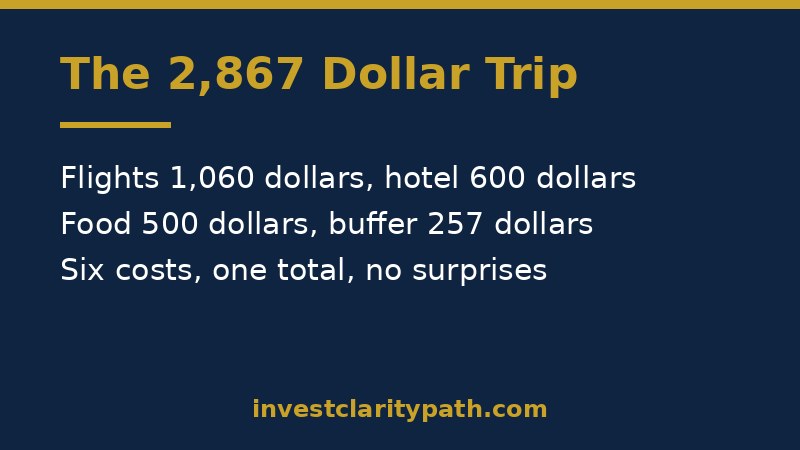
Here is a full budget for a family of four on a five-day domestic trip, built on the average spend of 2,867 dollars per vacationing household in the 2025 Allianz Vacation Confidence Index. These are example numbers for one family, to show how the six costs add up. Your trip will differ, but the method is the same.
Flights: four round trips at 265 dollars each, which is 1,060 dollars. Hotel: four nights at 150 dollars a night, which is 600 dollars. Food: 100 dollars a day for five days, which is 500 dollars. Activities: 300 dollars for tickets and one tour. Local transport: 150 dollars for rideshares and parking. Buffer: 257 dollars, which is about 10 percent of the rest. Add them up: 1,060 plus 600 is 1,660, plus 500 is 2,160, plus 300 is 2,460, plus 150 is 2,610, plus 257 is 2,867 dollars.
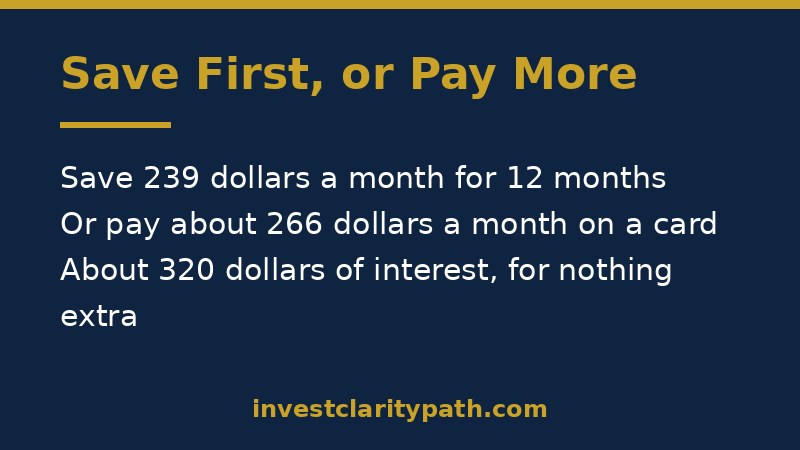
Now turn the total into a monthly saving plan. Divide 2,867 dollars by the number of months until the trip. With 12 months to save, that is 2,867 divided by 12, which is 238.92 dollars, or about 239 dollars a month. With 6 months to save, it is 2,867 divided by 6, which is 477.83 dollars, or about 478 dollars a month. The longer the runway, the smaller the monthly amount, which is why starting early is the single easiest way to afford a trip.
Compare that with paying by credit card. Put the same 2,867 dollars on a card charging 20 percent interest and pay it off over 12 months. The monthly payment is about 266 dollars, and the total paid is about 3,187 dollars. About 320 dollars of that is interest alone. The card route costs about 27 dollars more each month than saving 239 dollars a month, and it buys nothing extra. Saving first is cheaper, and the trip is already paid for when you leave.
How to Budget for a Holiday Trip in 5 Steps
Step 1: Set the total before you look at dates
Pick the trip and the total first. Use the six costs above and price each one from real listings, not guesses. Write the total down. If the total is more than you can save in time, change the trip before you change the budget. A shorter trip, a closer place, or cheaper dates beats a bigger loan every time. How Do I Budget for Holidays and Big Expenses? covers the same thinking for holidays at home, and How to Create a Monthly Budget That Actually Works? shows where the trip money fits in your month.
Step 2: Open a separate trip fund
Open a separate savings account, or a separate pot in your bank app, and name it for the trip. What Is a Sinking Fund? explains how a sinking fund works: a small pot you fill bit by bit for one known cost. Keep trip money apart from your emergency fund and your daily spending. How Do I Build an Emergency Fund From Zero? explains why the emergency fund stays untouched. A trip is not an emergency, and raiding that fund turns a holiday into a risk.
Step 3: Automate the monthly amount
Set an automatic transfer for the monthly amount on payday, the day the money arrives. If the plan is 239 dollars a month, move 239 dollars the same day, before spending starts. What Is a Pay-Yourself-First Budget and How Do I Use It? explains why paying yourself first works better than saving what is left over. What is left over is usually nothing. If 239 dollars is too much, lengthen the runway or shrink the trip, but keep the transfer automatic.
Step 4: Book at the right time
Flights are usually cheapest about one to two months before departure. Google Flights data from October 2026, covering five years of fares, found domestic fares lowest on average about 39 days before departure, in a low range of 22 to 57 days. Expedia’s 2026 Air Hacks report put the cheapest domestic window at 15 to 30 days out, about 130 dollars cheaper per ticket than booking 180 or more days ahead. Booking inside 14 days is typically 20 to 30 percent dearer. Tuesday departures averaged about 14 percent less than Sunday departures. Set a price alert when you pick your dates, and book inside the window, not months early and not at the last minute.
Step 5: Track spending daily on the trip
A trip budget only works if you check it. Each evening, add up the day’s spending in a notes app and compare it with the daily amount. If food cost 140 dollars against a 100 dollar day, the next day gets 60 dollars, or the buffer covers it. Small daily checks stop one expensive day from wrecking the whole trip. How Do I Review My Budget at the End of the Month? shows the same review habit for home, and it works just as well on holiday.
How to Cut Trip Costs Without Ruining the Trip
The biggest saving is usually the date. Travelling in the shoulder season, the weeks just before or after the peak, often cuts flights and hotels by a third or more, with the same weather and smaller crowds. A Tuesday or Wednesday flight is often cheaper than a Friday or Sunday flight, and a hotel a short walk from the centre often costs far less than one on the main street.
Food is the next biggest saving. One cooked meal a day, a hotel with breakfast included, or a grocery run for snacks and drinks can cut the food bill by a third. How Do I Cut Food Spending Without Cutting Meals? has the same ideas for home, and they travel well.
The third saving is the activities list. Pick one paid highlight per day and fill the rest with free things: parks, beaches, markets, walks, and viewpoints. A trip with one great paid activity a day feels richer than a trip with four rushed ones, and it costs far less. Check whether the city has a free day at museums, or a pass that covers several places for one price, before you pay full price at the door.
What Not to Do
The first mistake is putting the trip on a credit card and hoping to pay it off later. At about 20 percent interest, the average card turns a 2,867 dollar trip into about 3,187 dollars over a year. Later rarely comes, and the interest keeps growing while the holiday is a memory. If the trip fund is short, take a shorter trip, not a loan.
The second mistake is raiding the emergency fund. A holiday is a planned cost, not an emergency. If you spend the emergency fund on a trip and the car breaks down the next week, you have no buffer left. Keep the two pots separate, always.
The third mistake is budgeting only the flight and the hotel. Food, activities, transport, and extras are often half the trip. A budget that forgets them is not a budget. It is a wish. Price all six costs, or the trip will cost more than you planned, and the extra will land on a card.
The fourth mistake is booking too early or too late. Six months ahead is often the dearest way to fly, and inside two weeks is usually 20 to 30 percent dearer. Aim for the three to eight week window for domestic flights, and set a price alert so you do not have to watch fares every day.
Frequently Asked Questions
How much should I budget for a holiday trip?
It depends on the trip, but start with the six costs: travel, stay, food, activities, local transport, and a 10 percent buffer. The average U.S. household planned to spend 2,867 dollars per vacation in the 2025 Allianz Vacation Confidence Index, and Deloitte put the average longest summer trip budget at 3,471 dollars. Price your own trip from real listings, not from an average.
How far ahead should I save for a trip?
Twelve months is ideal, because the monthly amount stays small. A 2,867 dollar trip needs about 239 dollars a month over 12 months, or about 478 dollars a month over 6 months. Start the trip fund the day you pick the trip, and set the transfer to run on payday.
When is the cheapest time to book a flight?
For a domestic flight, about one to two months before departure. Google Flights data found fares lowest on average about 39 days out, in a range of 22 to 57 days. Expedia’s 2026 report put the cheapest window at 15 to 30 days out. Booking inside 14 days is typically 20 to 30 percent dearer, and booking six months ahead is often dearer too.
Should I use a credit card for a holiday?
Only if you can pay it in full when the bill comes, and only to earn rewards or protection. If you carry the balance, the interest wipes out the reward. At about 20 percent interest, a 2,867 dollar trip paid off over 12 months costs about 3,187 dollars, with about 320 dollars of interest. Saving first is cheaper.
What if my trip fund is short?
Change the trip, not the budget. Travel for fewer days, pick a closer place, travel in the shoulder season, or move the trip by a month or two. A shorter trip you can afford beats a longer trip on a card. Do not raid your emergency fund and do not borrow the difference.
How do I keep spending on track during the trip?
Set a daily amount for food and activities, and add up each day’s spending every evening. If one day runs over, the next day pulls back, or the buffer covers it. Carry the trip fund in a separate account or card, so daily spending never dips into money meant for home.
Conclusion
A holiday trip without debt is a planning problem, not a money problem. Price all six costs, save the total in monthly parts, book inside the cheapest window, and check spending each day on the trip. A 2,867 dollar family trip needs about 239 dollars a month for a year, and that is cheaper than the same trip on a card, which costs about 3,187 dollars with interest.
Start today, even if the trip is a year away. Open the trip fund, set the automatic transfer for payday, and set a price alert for the flights. The trip will feel better when it is already paid for, and you will come home to memories instead of a bill.
If you are still building the fund, see our guide on saving for a vacation without debt.
This article is for general information and education only. It is not legal or financial advice.
