

Best Joint Savings Account: How Couples and Families Choose One
The best joint savings account for a couple or a family is not the one with the loudest advert. It is the one that fits how you both save, how you both use money, and what you are saving for together. A joint savings account is an account in two or more names, where each person named on the account can usually put money in, and each person can usually take money out. That shared access is what makes it useful, and it is also why it is important to choose carefully and agree on the rules first.
This post explains what a joint savings account is, what to compare before you open one, how couples and families use one fairly, and what to ask before you sign anything. It does not name specific banks, and it does not state any specific rate or account terms, because rates and terms change and vary. Instead, it shows you how to compare accounts yourself, so you can pick the one that fits your household. It is educational only. It is not financial advice.

What is a joint savings account?
A joint savings account is a savings account held in the names of two or more people. Common examples are a married couple, a couple who live together, a parent and an adult child, or two family members saving for a shared goal. Each person named on the account is usually an owner of the account, and each owner can usually deposit money, withdraw money, and see the balance and the statements.
That is different from a single savings account, where only one person owns the account, and different from simply giving someone your card or password, which is not a safe way to share. A joint account gives both people proper, visible access, and it creates a clear record of what went in and what came out.
How is a joint savings account different from a joint checking account?
A joint checking account and a joint savings account look similar, but they are used in different ways.
A joint checking account is for everyday money: pay, bills, groceries, and daily spending. Money moves in and out often, and both people may use a card linked to the account. A joint savings account is for money you want to keep aside: a shared goal, or a safety fund for unexpected costs. Money moves in regularly, and moves out rarely, only when the goal is reached or a real need arises.
To learn the basics of a shared bank account first, read what is a joint bank account, which explains joint accounts in simple terms. And to understand the difference between account types, see what is the difference between a checking and a savings account.
What to compare before you open a joint savings account
Do not pick the first account you see. Compare a few options using the same list, so you can see the differences clearly. Here is what to compare.
Fees
Check every fee, not just the headline. Ask about a monthly fee, a fee for going below a minimum balance, a fee for too many withdrawals, a fee for a paper statement, and any fee for closing the account. An account with no monthly fee can still cost money in other ways, so read the fee list in full. Write down the fees for each account you compare, side by side.
Minimum balance and minimum deposit
Some accounts ask for a minimum amount to open the account, and some ask you to keep a minimum balance to avoid a fee. Check both numbers. If the minimum balance is higher than you can keep most months, the account may cost you fees, even if it looks good in other ways. Pick an account whose minimums fit the amount you can realistically keep in it.
Access for both people
Check that both people named on the account can see the balance, get statements, and move money in the ways you need, such as online, by phone, or in a branch. Check whether both people need to agree for a withdrawal, or whether one person alone can withdraw. That rule matters a lot: an account where one person can withdraw alone needs more trust and clearer rules than one where both must agree. Ask the bank or credit union to explain this rule in plain words before you open the account.
How money moves in and out
Check how you can put money in: by transfer, by direct deposit from pay, or in a branch. Check how you can take money out: by transfer to a checking account, in a branch, or by other means. Check how long a transfer takes, and whether there is a limit on the number of withdrawals or transfers each month. A savings account that is hard to withdraw from can be a good thing for a long-term goal, because it stops impulse spending, but it is a bad thing for an emergency fund, where you need the money quickly.
Interest and how it is paid
A savings account may pay interest, which is a small amount the bank or credit union adds to your balance for keeping money with them. Do not choose an account on interest alone, and do not assume a rate you saw in an advert is the rate you will get. Ask how the interest is worked out, when it is paid, whether it changes, and whether any conditions apply. Compare accounts on the full picture, fees, access, and minimums included, not on one number alone. This post gives no specific rate for any bank, because rates change often and vary by account.
Safety and protection
Check that the bank or credit union is covered by deposit protection for your country. In the United States, banks are usually covered by the Federal Deposit Insurance Corporation, and credit unions by the National Credit Union Administration. You can check a bank’s coverage on the FDIC website at fdic.gov/resources/consumers. Deposit protection has limits, so ask what the limit is and how it applies to a joint account.
Service and support
Think about how you will use the account day to day. Is there a branch near you, if you need one? Is the online and mobile access clear and easy for both people to use? Can you both get help by phone if something goes wrong? A good account is one you can both use without frustration.
How couples use a joint savings account fairly
A joint savings account works best when both people agree on the rules before the first deposit. Sit down together and answer these questions, in writing, so you can both refer back to them.
Agree on the goal first
What is the money for? A holiday, a home fund, a car, or an emergency fund? Write the goal and the target amount down. A shared goal gives the account a purpose, and it makes it easier to say no to spending the money on something else.
Agree on how much each person puts in
There are a few fair ways to do this. Each person can put in the same amount each month, which is simple when incomes are similar. Or each person can put in the same share of their income, which can feel fairer when incomes are different. Or one person can put in a fixed amount and the other can add extra when they can. Pick the method you both agree on, and write it down. Review it every few months, or when income changes.
Agree on when money can come out
Decide in advance when a withdrawal is allowed. For a holiday fund, the rule might be that money comes out only when the holiday is booked. For an emergency fund, the rule might be that money comes out only for a true emergency, like a broken boiler or a car repair, and that both people agree first. Write the rule down, so a withdrawal is a joint decision, not a surprise.
Agree on how you will check it together
Pick a short monthly check-in, even ten minutes, to look at the balance together, see what went in, and confirm the plan is on track. A regular check-in stops small problems from becoming arguments, and it keeps both people equally involved. Our guide on how couples budget together without arguments has more ideas for talking about money as a team, and our guide on how to choose a bank account as a beginner can help you ask the right questions when you compare accounts.
What to ask before you open the account
Take this list with you and write down the answers for each account you compare. The Consumer Financial Protection Bureau also has free information about bank accounts at consumerfinance.gov/consumer-tools.
- What are all the fees, including monthly fees, minimum balance fees, and withdrawal fees?
- What is the minimum amount to open the account, and the minimum balance to keep?
- Can each person named on the account withdraw money alone, or must both agree?
- How can we put money in, and how can we take it out, and how long does a transfer take?
- Is there a limit on withdrawals or transfers each month, and what happens if we go over it?
- How is interest worked out, when is it paid, and can it change?
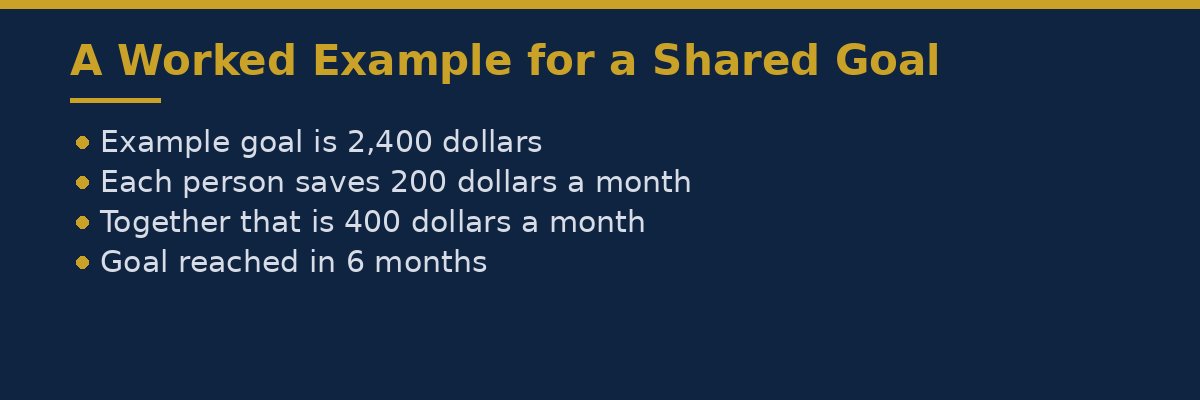
Worked example: saving 2,400 dollars together
Here is a worked example using round numbers that we state clearly. This is an example only, not a promise of what you will save. Your goal and your amounts will be different.
Suppose a couple wants to save 2,400 dollars for a shared holiday. Each person agrees to put 200 dollars into the joint savings account each month.
Each month, the total saved is 200 dollars plus 200 dollars, which equals 400 dollars a month.
Divide the goal by the monthly saving: 2,400 divided by 400 equals 6. So it takes 6 months to reach the goal.
Check the math: 400 dollars a month times 6 months equals 2,400 dollars. That is the goal, reached.
Use the same method for your own goal: add what each person will put in each month, then divide the goal by that monthly total to find the number of months.
Common mistakes to avoid
Do not open a joint savings account before you agree the rules. An account opened in a rush, without an agreed goal or withdrawal rule, often leads to arguments later. Talk first, then open.
Do not ignore the fees. A small monthly fee can take a real amount over a year, especially if the balance is small. Compare the full fee list, not just the headline, and pick an account whose fees fit your balance.
Do not assume both people must agree to a withdrawal. In many joint accounts, one person alone can withdraw. Ask the bank or credit union to explain this rule clearly, and agree your own rule on top of it, so a withdrawal is always a joint decision in your household, even if the bank allows one person to act alone.
Frequently asked questions
What is the best joint savings account?
There is no single best account for everyone. The best joint savings account for your household is the one with fees and minimums you can live with, access that works for both people, clear rules on withdrawals, and protection you understand. Compare a few accounts with the list in this post, and pick the one that fits your goal and your habits. This post names no specific bank and gives no specific rate, because rates and terms change.
Can both people withdraw from a joint savings account?
In most joint accounts, each person named on the account can usually withdraw money. But the exact rule varies by bank or credit union, and by country. Ask before you open the account whether one person alone can withdraw, or whether both must agree, and get the answer in writing if you can.
Should a couple keep separate savings as well as a joint savings account?
Many couples do both: a joint savings account for shared goals, and a personal savings account each for personal goals. That setup can work well, as long as both people agree how much goes to the joint account and how much stays personal. There is no single right answer, only the setup you both agree on and use as planned.
What happens to a joint savings account if one person dies?
The answer varies by bank, by account terms, and by local law. In some cases the surviving owner can still access the money, and in other cases extra steps are needed. Ask the bank or credit union this question before you open the account, and speak to a qualified professional if you need advice about your own situation.
Is a joint savings account safe?
A joint savings account at a covered bank or credit union has the same kind of deposit protection as a single account, up to the protection limit. Check the coverage on the FDIC website at fdic.gov/resources/consumers, and ask what the limit is for a joint account. Safety also depends on trust: only open a joint account with someone you trust fully, because each owner can usually withdraw money.
Conclusion, and your first step today
Choosing the best joint savings account is not about finding a perfect bank. It is about agreeing a shared goal, comparing fees, minimums, access, and withdrawal rules, and picking the account that fits how you both save. Start today with one step: sit down together, pick your shared goal, write down the target amount, and agree how much each person will put in each month. Then use the worked example method to see how many months it will take, and take the question list in this post to the bank or credit union when you compare accounts.
This article is for general information and education only. It is not legal or financial advice.
