
Best Online Savings Account Rates: How to Compare Them in Plain English
The best online savings account rates are the rates that pay you the most interest for the money you keep in savings, without charging fees that eat up that interest, and without locking your money away when you need it. A higher rate is good, but it is not the whole story. The best account for you is the one with a strong rate, low or no fees, a low minimum, easy access to your money, and deposit insurance.
What does APY mean in plain English?
APY stands for annual percentage yield. It tells you how much interest your savings could earn in one year, including the effect of compound interest. Compound interest means the interest you earn is added to your balance, and then that larger balance earns interest too.
Think of it this way. If you put money in a savings account, the bank pays you interest for keeping your money there. The APY is the yearly figure that shows that interest, with compounding included. A higher APY means more interest on the same amount of money, if all else is equal.
APY is different from a simple interest rate. A simple interest rate may not include compounding. That is why two accounts can look similar at first, but pay different amounts over a year. When you compare the best online savings account rates, always compare APY to APY, not an APY from one bank to a simple interest rate from another.
Our guide to what APY is and why it is different from an interest rate explains this in more detail, with simple examples.
The short answer: how to find the best rate for you
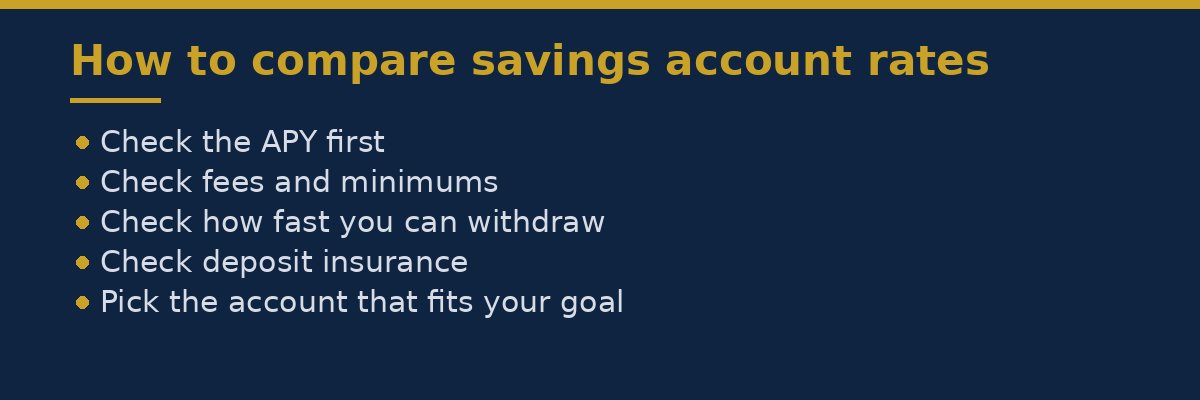
Start with a short list of three or four online savings accounts. Write down the APY for each one, on the same day, because rates change. Then check the monthly fee, the minimum balance, the minimum deposit to open, how you can withdraw money, and whether the account is insured. Then do the simple maths in the worked example below, using the rates you found. The account with the best result, after fees and after you allow for access, is usually the best choice for you.
Do not open an account just because it has the highest rate on a list. A rate that is a little higher is not worth much if the account charges a monthly fee, needs a large minimum balance you cannot keep, or takes days to send your money back when you need it urgently.
Step 1: Compare APY on the same day
Rates change often, so compare on the same day. Go to each bank website and write down the APY shown for the savings account. Make sure you are looking at the same type of account. A regular savings account, a high yield savings account, and a money market account are not the same thing, and their rates are not directly comparable.
Check whether the rate is a normal rate or a short term special offer. Some accounts show a high rate for the first few months, then drop to a lower rate. Look for how long the rate lasts, and what the rate will be after that period. If you cannot find that information easily, that is a warning sign.
Also check whether the rate depends on your balance. Some accounts pay a higher rate only if you keep a certain amount in the account. If your balance is below that amount, you may earn a much lower rate. Write down both figures, so you are comparing like with like.
A good comparison table has five columns: bank name, APY, monthly fee, minimum balance, and how to withdraw. Fill it in for three or four accounts. The winner should be clear once you see the numbers side by side.
Step 2: Work out what the rate is worth in dollars
A rate only matters when you turn it into dollars. A difference that looks small as a percentage can still be worth real money over a year, especially on a larger balance. A difference that looks large can be small in dollars if your balance is small.
Use this simple method. Take your savings balance, multiply it by the APY as a decimal, and you get a rough idea of the interest for one year, before tax and before compounding in detail. This is an estimate for comparison, not an exact forecast, because interest is usually added monthly and your balance will change.
Worked example with clearly labelled example rates
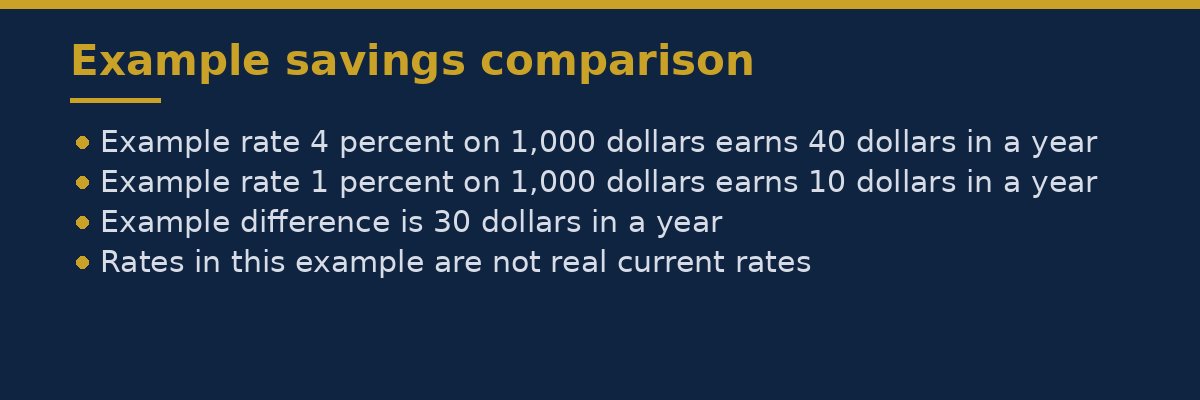
This example uses made up example rates only. These are not real current rates for any bank. They are used only to show the maths.
Imagine you have 1,000 dollars in savings, and you compare two example accounts. Example account A pays an example rate of 4 percent APY. In one year, 1,000 dollars multiplied by 4 percent is 40 dollars. That is 1,000 times 0.04, which equals 40. Example account B pays an example rate of 1 percent APY. In one year, 1,000 dollars multiplied by 1 percent is 10 dollars. That is 1,000 times 0.01, which equals 10. The difference is 40 dollars minus 10 dollars, which is 30 dollars in one year, on a balance of 1,000 dollars.
Now try the same maths with a larger balance. If you have 5,000 dollars, example account A at 4 percent pays 200 dollars in a year, because 5,000 times 0.04 equals 200. Example account B at 1 percent pays 50 dollars, because 5,000 times 0.01 equals 50. The difference is 150 dollars in one year. If you have 10,000 dollars, the difference grows again. At 4 percent, you earn 400 dollars in a year. At 1 percent, you earn 100 dollars. The difference is 300 dollars.
This is why the rate matters more as your balance grows. On a small balance, the difference may be only a few dollars, and fees or access may matter more. On a larger balance, the rate difference can be worth hundreds of dollars a year. Use your own balance and the rates you see on the day to do the same check.
Step 3: Check fees, minimums, and rules
A high rate is not a good deal if fees take the interest back. Check these points before you open any account.
First, the monthly fee. Many online savings accounts have no monthly fee. If an account charges a monthly fee, subtract that fee from the interest you expect to earn. For example, if you expect 40 dollars of interest in a year, but the account charges 5 dollars a month, that is 60 dollars a year in fees, and you would lose money overall.
Second, the minimum balance. Some accounts need a minimum balance to earn the headline rate, or to avoid a fee. If you cannot keep that balance every month, you may earn a lower rate or pay a fee. Choose an account whose minimum fits your real balance, not a balance you hope to reach.
Third, the minimum deposit to open, and the withdrawal rules. Some accounts need only 1 dollar to open, while others need 100 dollars or more. Check how you get your money out, how long a transfer takes, and whether there is a limit on withdrawals each month. An emergency fund needs fast access. If a transfer takes three working days, that may be too slow for a real emergency.
Fourth, other fees. Look for fees for paper statements, for closing the account, for a wire transfer, or for falling below a minimum. These fees are often small, but they add up, and they are easy to miss.
Our guide to high yield accounts compared with normal savings accounts can help you see how fees and rates work together in the two types of account.
Step 4: Check safety and deposit insurance
Before you open any savings account, check that your money is protected by deposit insurance. In the United States, banks are usually insured by the Federal Deposit Insurance Corporation, known as the FDIC, and credit unions are usually insured by the National Credit Union Administration, known as the NCUA. Deposit insurance protects your money up to a set limit if the bank or credit union fails.
Do not assume an account is insured just because it looks like a bank account. Check the bank or credit union website for the FDIC or NCUA logo and wording, and check the official source. You can read the official FDIC information about deposit insurance here: FDIC deposit insurance resources. The Consumer Financial Protection Bureau also publishes general guidance for consumers about bank accounts, and its main site is here: Consumer Financial Protection Bureau.
Our guide to whether your money is safe in a bank and what insurance means explains this in simple terms.
Step 5: Check access and everyday use
A savings account should be easy to use, but not so easy that you spend the money by accident. Check how you deposit money. Can you set up a direct deposit from your pay, or a regular transfer from your checking account on payday? A regular automatic transfer is one of the easiest ways to build savings without thinking about it. Check how you withdraw money. Can you transfer it to your checking account online, and how long does that take? Is there a mobile app, and can you talk to a real person if something goes wrong? Think about your goal. If the money is an emergency fund, fast access matters most. If the money is for a holiday in six months, a slightly slower transfer may be fine.
A simple comparison checklist
Use this checklist for every account you compare, and write the answer in your comparison table.
- What is the APY today, and is it a normal rate or a short term offer?
- Is there a monthly fee, and can it be avoided?
- What is the minimum balance to earn the headline rate, and to avoid a fee?
- What is the minimum deposit to open the account?
- How long does a withdrawal take, and is there a monthly limit?
- Is the account insured by the FDIC or NCUA, and up to what limit?
- Can you set up an automatic transfer on payday?
If an account fails on fees, minimums, insurance, or access, cross it off the list, even if its rate looks high. The best online savings account rates are only the best when the rest of the account works for you too. Once you have opened an account, recheck your rate every six months. Do not move your money for a tiny difference of only a few dollars a year. Move when the difference is clear, the new account has no fee and a low minimum, and you are sure about insurance and access.
Frequently asked questions
What is the best online savings account rate?
There is no single best rate for everyone, because rates change often and the best account depends on your balance, your fees, and how fast you need access to your money. Compare APY, fees, minimums, and access on the same day, and use the worked example method in this guide to see what each rate is worth in dollars for your balance.
What does APY mean for a savings account?
APY means annual percentage yield. It shows how much interest your savings could earn in one year, including compound interest. A higher APY means more interest on the same balance, if all else is equal. Always compare APY to APY when you compare accounts.
Is an online savings account safe?
An online savings account can be safe if it is held with an insured bank or credit union. Check for FDIC insurance for a bank, or NCUA insurance for a credit union, and check the official FDIC or NCUA information before you deposit money. Do not rely on a logo alone if you cannot find clear wording about insurance.
Conclusion
The best online savings account rates are not just the highest number on a list. They are the rates that pay you the most after fees, on a balance you can actually keep, in an account you can reach when you need it, with deposit insurance in place.
Start with three or four accounts, compare APY on the same day, work out what each rate is worth in dollars for your balance, check fees and minimums, check insurance, and check access. Then pick the account that fits your goal, set up a small automatic transfer on payday if you can, and recheck your rate every six months.
Your first step today is simple. Write down your current savings balance, pick three online savings accounts to compare, and fill in the comparison table in this guide with the APY, fee, minimum, and withdrawal time for each one. That one table will tell you more than any list of best rates ever could.
This article is for general information and education only. It is not legal or financial advice.
