

How to Pay Off $10,000 in Credit Card Debt: A Simple Plan
Learning how to pay off $10,000 in credit card debt starts with a simple plan you can follow every month. Stop adding new charges to the card, find one fixed amount you can pay each month, pay that same amount on the same day, and keep going until the balance is zero. That is the whole plan. The rest of this guide shows you how to pick the amount, how to choose your payoff order, and what the numbers look like in a worked example.
A $10,000 balance can feel too big to move. It is not. The problem is usually the minimum payment. Most of it goes to interest in the early months, so the balance falls very slowly. A fixed payment changes that. As the interest charge falls, more of each payment goes to the balance, and the payoff date moves much closer.
This guide is for one card with a $10,000 balance, but the same steps work if the $10,000 is spread across two or three cards. You still list every balance, pick one order, and pay one fixed total each month.
Why a $10,000 balance feels stuck
Credit card interest is charged on the balance you carry from month to month. Each month, the card issuer adds an interest charge based on your balance and your annual percentage rate, which is usually called the APR. Part of your payment covers that interest charge, and only the rest reduces your balance.
When the balance is high, the interest charge is high. When you pay only the minimum, the payment is only a little higher than the interest charge, so the balance falls by a small amount. The next month, the interest charge is almost as high again. That is why a balance can stay near $10,000 for a long time even when you pay every month.
A fixed payment breaks this pattern. As the balance falls, the interest charge falls too, so more of your fixed payment goes to the balance each month.
Step 1: Stop adding to the balance
Before you build a payoff plan, stop the balance from growing. That means no new purchases on the card you are paying off, if you can avoid them. Everyday spending on a card you are trying to clear makes the plan much harder, because each new purchase adds interest on top of the old balance.
Take the card out of your wallet and out of saved payment methods online, at least for now. Use cash or a debit card for everyday spending, within a budget you have already set. Also check your statements for subscriptions you forgot about, and cancel the ones you do not use.
Step 2: Write down the real numbers
You cannot plan what you cannot see. Get your latest statement and write down four numbers: the balance, the APR, the minimum payment, and the payment due date. If the $10,000 is on more than one card, write down the same four numbers for each card.
Then look at your monthly budget and find how much you can pay toward the debt each month, after rent, food, transport, utilities, insurance, and other minimum payments. Be honest. A payment you can keep for many months is better than a large payment you can only keep for one month.
Step 3: Keep a small cushion first
Many payoff plans fail because one surprise cost sends the person back to the card. A car repair, a medical bill, or a broken phone can wipe out a month of progress if there is no cash set aside. That is why it helps to keep a small cushion before you put every spare dollar toward the card.
A small cushion does not need to be a full emergency fund. Start with a modest amount you can build in a few weeks, for example $500 or $1,000, and keep it in a separate savings account. Pay minimums on the card while you build it, then switch your focus to the payoff. If you already have a cushion, skip this step.
Step 4: Choose snowball or avalanche
There are two common ways to order your payments, and both work. The right one is the one you will stick with. This is the part of the plan where many people get stuck choosing, so keep it simple.
The snowball method: smallest balance first
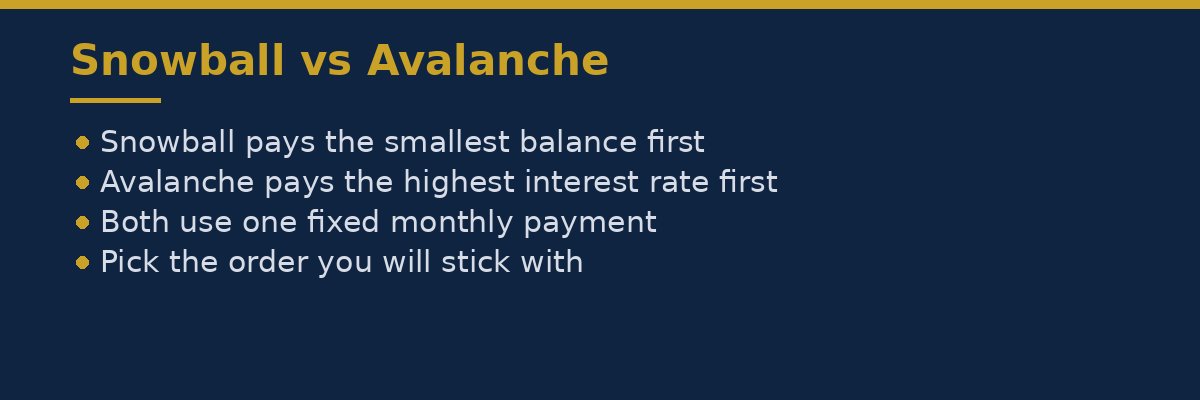
With the snowball method, you list your debts from the smallest balance to the largest, and you pay off the smallest one first. You pay minimums on all the others, and you put every extra dollar toward the smallest balance. When it is gone, you move to the next smallest, and you add the payment you were making on the first one to the payment on the next one.
The snowball method is useful because it gives you a win early. Paying off a whole balance, even a small one, proves the plan is working, and that feeling helps many people keep going.
The avalanche method: highest interest rate first
With the avalanche method, you list your debts from the highest APR to the lowest, and you pay off the highest rate first. You still pay minimums on all the others, and you put every extra dollar toward the highest rate debt. When it is gone, you move to the next highest rate.
The avalanche method usually costs less in total interest, because you clear the most expensive debt first. It can feel slower at the start if the highest rate debt is also the largest balance, because the first win takes longer.
Which one should you pick?
If you have only one card with the full $10,000, the order does not matter, because there is only one balance to pay. The choice matters when the $10,000 is spread across cards. In that case, ask yourself one question: do I need an early win to stay motivated, or do I want the lowest total interest cost? If you need the win, pick snowball. If you want the lowest cost and you will keep going, pick avalanche.
Step 5: Set one fixed payment and automate it
Once you know your order, set one fixed monthly payment and pay it on the same day each month. Pick a date just after payday, so the money is there before other spending takes it. Then set up an automatic payment for at least that amount, if your card issuer offers it.
Automation helps in two ways. First, you never miss a payment by accident. Second, you do not have to decide the amount fresh each month. The decision is made once, and the payment happens on its own. If your income changes from month to month, set the automatic payment to the amount you can pay in a normal low month, and add extra manually in good months.
Worked example: minimum payments vs a fixed monthly payment
Here is the math, using round numbers stated clearly as an example. The example uses a $10,000 balance and an example APR of 20 percent. That APR is an example only. It is not your APR, and it is not a claim about any real card. Your own APR is on your statement, and your own numbers will differ.
With an example APR of 20 percent, the monthly interest rate is 20 percent divided by 12, which is about 1.67 percent a month. On a $10,000 balance, the first month interest charge is $10,000 times 20 percent divided by 12, which is $166.67.
Now compare three fixed monthly payments, all on the same example balance and the same example APR:
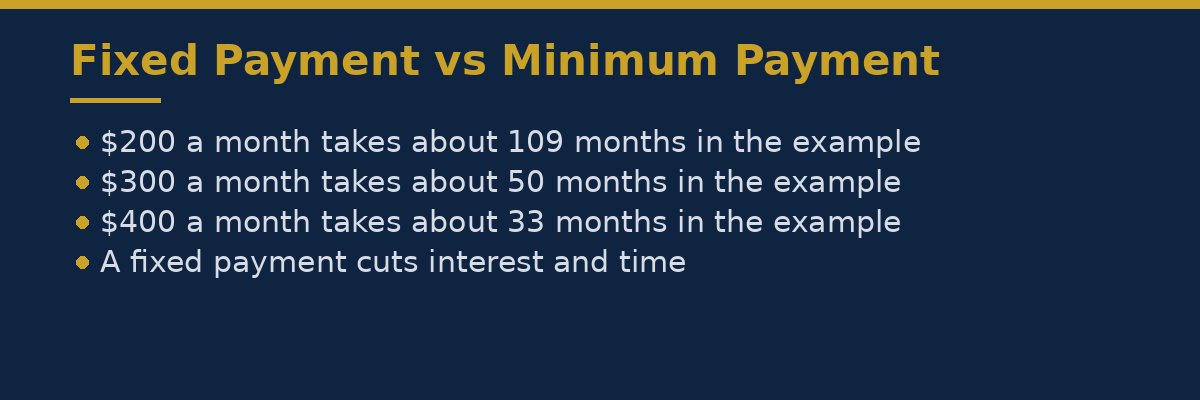
- Paying $200 a month: the balance is cleared in about 109 months, which is just over 9 years. Total interest is about $11,680, and total paid is about $21,680. The first payment of $200 covers $166.67 of interest and only $33.33 of the balance.
- Paying $300 a month: the balance is cleared in about 50 months, which is just over 4 years. Total interest is about $4,718, and total paid is about $14,718. That is about 59 months sooner and about $6,962 less interest than paying $200 a month.
- Paying $400 a month: the balance is cleared in about 33 months, which is under 3 years. Total interest is about $3,044, and total paid is about $13,044. That is about 76 months sooner and about $8,636 less interest than paying $200 a month.
Look at the first three months of the $300 a month plan. Month 1: interest $166.67, payment to balance $133.33, new balance $9,866.67. Month 2: interest $164.44, payment to balance $135.56, new balance $9,731.11. Month 3: interest $162.19, payment to balance $137.81, new balance $9,593.30. The change is small at first, but it grows each month.
The totals above are approximate, because the final payment is smaller than the fixed amount, and because a real card may add fees or use a slightly different method to work out interest. But the lesson is clear. Raising the payment from $200 to $300 a month cuts the time by more than half and saves thousands in interest in this example.
Step 6: Find extra money for the payment
A higher fixed payment needs money from somewhere. Look for it in small, repeatable places. First, cancel subscriptions you have not used in the last month. Second, cook at home a few more times a week. Third, cut one small daily cost, like a delivery or a bought coffee. Fourth, ask your phone, internet, or insurance provider if a cheaper plan fits your use. Fifth, if you have spare time, look for a small extra income step, like a few hours of extra work or selling items you no longer use. Send that extra income to the card in the same week you receive it.
Step 7: What to do if you can only pay the minimum
If your budget shows you can only pay the minimum right now, do not stop paying. Pay the minimum on time every month, and do not add new charges. A minimum payment still keeps the account in good standing, even though the balance falls slowly. To see the cost of that path in detail, read what happens if you only pay the minimum on a credit card.
Then work on the income and spending side. Look for one small cut and one small income step, even if each is only $25 or $50 a month. That turns a minimum-only plan into a plan with a little extra, and the worked example above shows how much even $100 extra can matter.
If you cannot cover even the minimum payments, or if you are already missing payments, get help early. A reputable nonprofit credit counsellor can review your full situation and explain options in plain language. The Consumer Financial Protection Bureau has free information on credit cards and debt help at consumerfinance.gov. Early help gives you more options than late help. You can also ask your card issuer about hardship options, if you have had a drop in income or a large unexpected cost. Issuers do not always offer help, but asking is free, and it is better to ask before you miss a payment than after.
Common mistakes to avoid
Do not move the balance to a new card without reading the terms. A balance transfer can look helpful, but it may have a fee, and the terms after any low rate period matter more than the first months.
Do not stop paying other bills to pay the card faster. Rent, utilities, food, insurance, and minimum payments on other debts still come first. A payoff plan that breaks your budget will not last. Do not close the card as soon as the balance is zero without thinking it through. If you want to stop using the card, you can leave it open and unused, or ask the issuer about your options, before you decide.
Frequently asked questions
How long does it take to pay off $10,000 in credit card debt?
It depends on your APR and your monthly payment. In the worked example, with an example APR of 20 percent, $200 a month takes about 109 months, $300 a month takes about 50 months, and $400 a month takes about 33 months. Your own APR and payment will give a different answer.
Should I use snowball or avalanche for $10,000 of credit card debt?
If the $10,000 is on one card, the order does not matter. If it is spread across cards, snowball pays the smallest balance first and gives an early win, while avalanche pays the highest APR first and usually costs less in total interest. Pick the one you will stick with.
Is it better to pay off credit card debt or save first?
For most people, the best order is a small cash cushion first, then the card payoff, then a bigger emergency fund. The small cushion stops one surprise from sending you back to the card.
What if I can only pay the minimum on $10,000 of debt?
Pay the minimum on time every month and do not add new charges. Then look for one small cut and one small income step, so you can pay a little above the minimum. Even $50 or $100 extra a month moves the payoff date closer.
Should I ask my card issuer for a lower APR?
You can ask. Issuers do not always agree, and a lower rate is not guaranteed. Whatever the answer, keep paying your fixed amount. The plan does not depend on a lower rate to work.
What happens if I miss a payment while paying off the card?
A missed payment can add a late fee and extra interest, and it can affect your credit record. If you think you will miss a payment, contact the issuer before the due date and ask about your options.
Conclusion, and your first step today
Learning how to pay off $10,000 in credit card debt is not about finding a trick. It is about one fixed payment, paid every month, in the right order, without adding new charges. Start today with three small steps. Write down your balance, your APR, and your minimum payment. Find the fixed amount you can pay each month. Set up the automatic payment for that amount.
If you want more help with the order of your debts, read our guides on the debt snowball method and the debt avalanche method. For free, impartial information on credit cards and on finding reputable debt help, see the Consumer Financial Protection Bureau at https://www.consumerfinance.gov/consumer-tools/credit-cards/
This article is for general information and education only. It is not legal or financial advice.
