

What Is a CD Ladder, and How Does It Work?
The Short Answer
A CD ladder is a simple way to spread your savings across several certificates of deposit, called CDs, that mature at different times. Instead of putting all your money into one CD for five years, you split it into smaller parts and put each part into a CD with a different length, for example one year, two years, three years, four years, and five years.
Think of it like the rungs of a ladder. Each CD is one rung. The shortest CD matures first, then the next one, so you get regular access to part of your money while the longer CDs keep earning interest. When a CD matures, you can use the money, or you can put it into a new long CD and keep the ladder going.
What Is a Certificate of Deposit?
A certificate of deposit, or CD, is a type of savings account at a bank or credit union. You put money in for a set period, called the term, and you agree not to take it out until that term ends. In return, the bank usually pays you interest at a fixed rate for that term.
Common terms are three months, six months, one year, two years, three years, and five years. Shorter terms often pay a lower rate, and longer terms often pay a higher rate, but that is not a rule. When the term ends, the CD matures. You get your money back, plus the interest it earned.
If you take money out before it matures, you usually pay an early withdrawal penalty, often losing some interest. That is why a CD suits money you do not need straight away. If you are new to CDs, start with our guide What Is a Certificate of Deposit?
What Is a CD Ladder?
A CD ladder is not a special product you buy. It is a way of organising several ordinary CDs so that they mature at regular intervals, usually once a year.
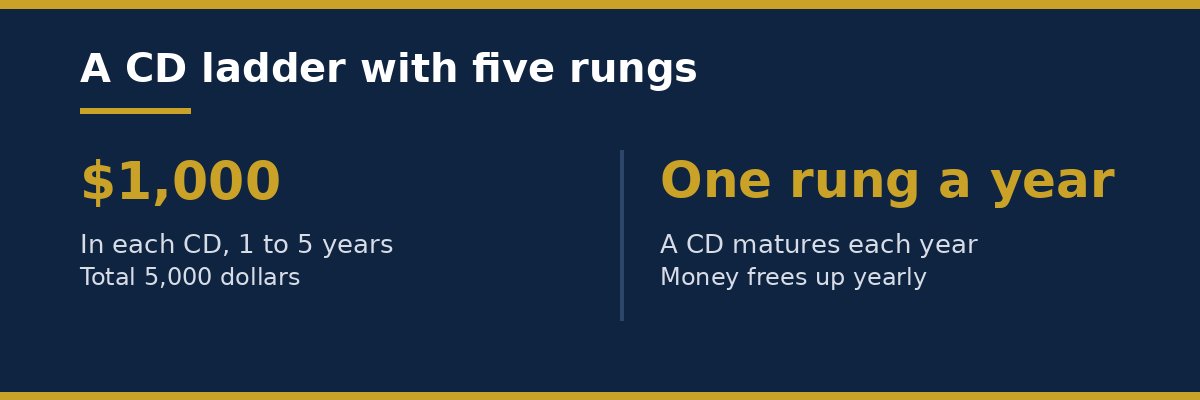
Imagine you have 5,000 dollars to save, and you do not need all of it at once. Instead of locking it all away for five years, split it into five parts of 1,000 dollars each: a one year CD, a two year CD, a three year CD, a four year CD, and a five year CD.
After one year, the first CD matures. After two years, the second matures, and so on. That is the whole point of a ladder. A single five year CD locks all your money away for five years. A ladder keeps part of it within reach, while the longer CDs keep earning interest.
How to Build a CD Ladder, Step by Step
Building a CD ladder is simple, and you can do it with any amount that fits your budget.
Step 1: Decide How Much Money to Use
Decide how much you can set aside without needing it for bills or an emergency. A ladder suits savings you can leave alone for at least a year. Keep your emergency fund separate, in an account you can reach at once. Start small if you are not sure.
Step 2: Choose How Many Rungs to Have
Decide how many CDs you want in your ladder. Five is a common number, with terms of one to five years, but three can work too. More rungs mean smaller amounts in each CD and more regular maturing dates. A five year ladder gives you one CD maturing every year, and one CD earning the longest term rate.
Step 3: Split the Money Equally
Split your total amount equally across the rungs. If you have 5,000 dollars and five rungs, that is 1,000 dollars per CD. Equal splits keep the maths simple, and they mean the same amount comes free each year. Some banks have a minimum amount for a CD, often 500 dollars or 1,000 dollars, so check that first.
Step 4: Open the CDs
Open each CD with the term you planned, at the same bank or different banks. Check the rate, whether it is fixed, the early withdrawal penalty, and what happens at maturity. Some banks renew a CD automatically, so note each maturity date. To understand how the rate is shown, read What Is APY and Why Is It Different From Interest Rate?
Step 5: Decide What to Do When Each Rung Matures
This step repeats every year. When a CD matures, take the money out, or open a new CD with the longest term in your ladder. If you renew each time, after five years all your CDs are five year CDs, but one still matures every year.
A Worked Example: 5,000 Dollars in Five CDs
Here is a simple worked example with round numbers, clearly labelled as an example. All rates below are example rates only, not real rates from any real bank. They show the maths, nothing more.
Suppose you have 5,000 dollars, split into five CDs of 1,000 dollars each, with terms of 1, 2, 3, 4, and 5 years, at example yearly rates of 3, 3.5, 4, 4.25, and 4.5 percent. Here is the interest each rung earns in one year:
- 1 year CD: 1,000 dollars at 3 percent, which is 30 dollars of interest in a year
- 2 year CD: 1,000 dollars at 3.5 percent, which is 35 dollars of interest in a year
- 3 year CD: 1,000 dollars at 4 percent, which is 40 dollars of interest in a year
- 4 year CD: 1,000 dollars at 4.25 percent, which is 42 dollars and 50 cents of interest in a year
- 5 year CD: 1,000 dollars at 4.5 percent, which is 45 dollars of interest in a year
Add them together: 30 plus 35 plus 40 plus 42.50 plus 45, which is 192 dollars and 50 cents of interest in a year, across all five CDs, in this example.
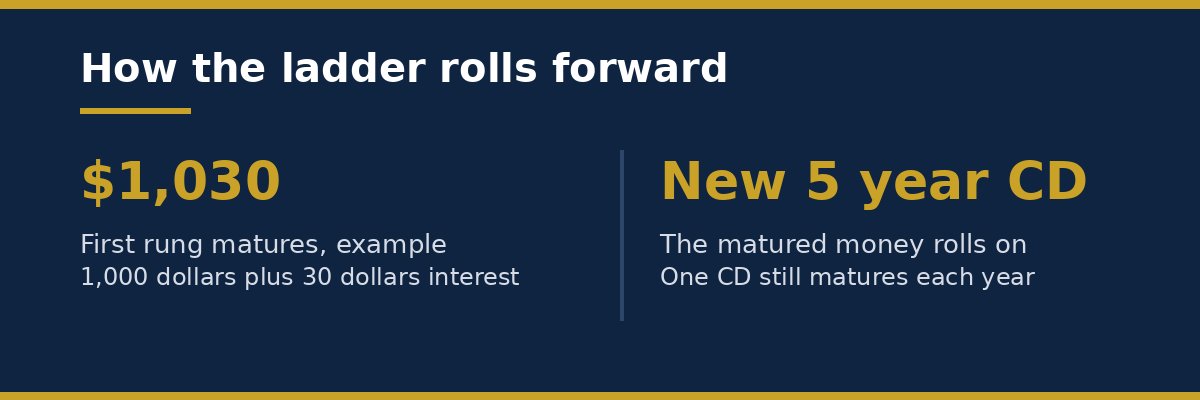
After one year, the 1 year CD matures: 1,000 dollars plus 30 dollars of example interest, or 1,030 dollars in total. If you need the money, take it. If not, open a new 5 year CD with that 1,030 dollars, at the rate available that day, which could be higher or lower than the example rate.
What Happens When Each Rung Matures
Each time a CD matures, the same choice comes up: use the money, or renew it into a new long CD. If you take the money out, your ladder gets shorter, because you have one less CD. That is fine if you planned to use the money, for example for a large purchase or a home repair.
If you renew it, your ladder stays the same length and keeps rolling. After the first five years, every CD will have been renewed at least once, at different times and different rates. Watch out for automatic renewal. Many banks renew a CD automatically if you do nothing during a short grace period, often about 7 to 10 days after maturity. Put each maturity date in your calendar, with a reminder a week before, so you do not miss the window.
The Pros of a CD Ladder
A CD ladder has three strengths. First, regular access: one CD matures every year, so you never wait five years for all your money. Second, it spreads rate risk. If rates rise, your maturing CD renews at the higher rate. If rates fall, only one CD renews at the lower rate. Third, it is simple. Once set up, check the maturity dates once a year. There is no trading and no market watching.
The Cons of a CD Ladder
A CD ladder also has limits. First, money is locked away until each CD matures. If you need it in a hurry, you may pay an early withdrawal penalty. A ladder is not a substitute for an emergency fund. Second, interest may be lower than other options over the long term. CDs often pay more than a normal savings account, but less than a broad mix of investments over many years. Third, a ladder does not protect you from inflation. If prices rise faster than your CD rate, your money buys less at maturity. That is why a ladder suits medium term savings best.
If you are weighing a CD ladder against a savings account, read Is a High Yield Savings Account Safe? to see how safety, access, and interest compare.
Who a CD Ladder Suits, and Who It Does Not Suit
Who It Suits
A CD ladder suits you if you have savings you do not need at once, you want a fixed rate, and you like money maturing every year. It suits a goal a few years away, such as a house deposit or a car, where you want the money safe and earning interest. Each year, when a CD matures, you can add new savings and open a new CD, so the ladder grows with you.
Who It Does Not Suit
A CD ladder does not suit money you may need at short notice, such as your emergency fund or bills due next month. That money should stay in an account you can reach at once. It also does not suit money you need to grow over a long time, such as retirement savings in 30 years, because a ladder alone may not keep up with rising prices. If you move money often, a savings account or a money market account may fit better. Our guide What Is a Money Market Account? explains that option. If you are still choosing, read How Do I Choose a Bank Account as a Beginner?
FDIC Insurance in Simple Terms
The Federal Deposit Insurance Corporation, known as the FDIC, is a US government agency. It insures deposits at member banks, up to 250,000 dollars per depositor, per insured bank, for each ownership category. If an insured bank fails, the FDIC protects your deposits up to that limit. So 5,000 dollars in CDs at an insured bank is covered, because it is below the limit. Above 250,000 dollars at one bank, in the same ownership category, the extra amount is not covered.
Check that your bank is FDIC insured before you open a CD. Credit unions have a similar system, run by the National Credit Union Administration, known as the NCUA, with the same 250,000 dollar limit. FDIC insurance does not protect you from inflation, and it does not guarantee a rate. For details, see Deposit Insurance, fdic.gov and Certificates of Deposit, investor.gov
Common Mistakes Beginners Make
Locking Away Money You Need Soon
Do not put emergency money into a ladder. If your car breaks down and your money is locked in CDs, you may pay a penalty to get it out, or wait months for the next rung to mature. Keep emergency money in an accessible savings account.
Forgetting the Maturity Dates
If you miss the grace period, the bank may renew the CD automatically, at the rate then available, and lock you in again. Put every maturity date in your calendar, with a reminder a week before.
Chasing the Highest Rate Without Checking the Terms
A high rate may come with a long term, a large minimum deposit, or a heavy penalty. Check the term, the minimum, the penalty, and whether the rate is fixed, before you open the CD. A slightly lower rate with a shorter term may suit you better.
FAQ
What is a CD ladder in simple terms?
A CD ladder is a set of several CDs with different maturity dates, usually one maturing each year. You split your money across them, so part of your savings comes free at regular intervals, while the longer CDs keep earning interest.
How much money do I need to start a CD ladder?
It depends on the bank, because many set a minimum for a CD, often 500 dollars or 1,000 dollars. With five rungs at 1,000 dollars each, you would need 5,000 dollars in total, in this example. You can start smaller, with fewer rungs.
What happens when a CD in my ladder matures?
You get your original money back, plus the interest it earned. You can take it out and use it, or put it into a new CD, usually with the longest term in your ladder, to keep the ladder going.
Is a CD ladder safe?
CDs at an FDIC insured bank are insured up to 250,000 dollars per depositor, per insured bank, for each ownership category. That insurance does not protect you from inflation, and it does not guarantee a rate of interest.
Can I lose money with a CD ladder?
You can lose some interest, and in some cases part of your deposit, if you take money out before maturity and pay an early withdrawal penalty. You can also lose spending power if prices rise faster than your CD rate.
Is a CD ladder better than a savings account?
It depends on what you need. A ladder often pays more interest, but money is locked away until each CD matures. A savings account pays less in many cases, but you can take money out at any time.
Conclusion
A CD ladder is simple at heart: split your savings across several CDs that mature at different times, so one CD comes free each year, while the longer CDs keep earning interest. When a CD matures, use the money, or put it into a new long CD and keep the ladder rolling.
In the worked example, 5,000 dollars split into five 1,000 dollar CDs, at example rates of 3, 3.5, 4, 4.25, and 4.5 percent, earned 192 dollars and 50 cents of interest in a year. When the first CD matured, it returned 1,030 dollars in total, ready to use or to renew. The strengths are regular access, a spread of rates, and a calm pattern. The limits are locked in money, a modest return, and no protection from inflation. Use a ladder for medium term savings, keep emergency money elsewhere, and note every maturity date.
This article is for general information and education only. It is not legal or financial advice.
