
What Is a SEP IRA, in Simple Terms?
The Short Answer
A SEP IRA is a retirement savings plan for self-employed people and small business owners. SEP stands for Simplified Employee Pension. It is a type of IRA, so the money sits in an individual retirement account in your name, and it grows for retirement.
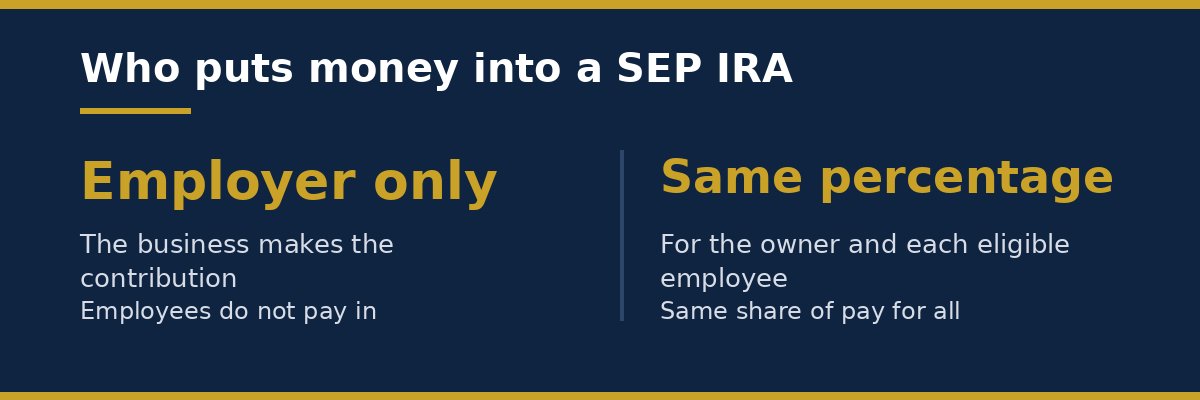
The idea is simple. If you work for yourself, or you run a small business with a few employees, you can set money aside for retirement in a SEP IRA. The employer makes the contributions, not the employee. You choose a percentage of pay, and you put that same percentage aside for yourself and each eligible employee.
What a SEP IRA Really Is
A SEP IRA is an IRA-based plan. An IRA is an individual retirement account, held in your name, with tax rules set by the IRS. A SEP is the set of rules that lets an employer contribute to those accounts.
The business sets up the plan and contributes a percentage of each eligible worker’s pay into a SEP IRA for that worker. Each worker, including the owner, gets their own account, and the worker chooses how it is invested. Only the employer contributes. If you are self-employed with no employees, you contribute as the employer, for yourself. The plan is flexible: the employer can change the percentage each year, or contribute nothing in a slow year.
If you are still learning how IRAs work, start with our guide What Is an IRA, in Simple Terms?
Who Can Open a SEP IRA
A SEP IRA is open to two main groups: self-employed people, including freelancers, consultants, and sole traders, and small business owners with employees. It is designed for small businesses, where a simple plan matters more than a complex one.
You do not need employees. A self-employed person with no staff can open a SEP IRA for themselves alone. A writer, a designer, a plumber, or a small shop owner can all use one.
If the business has employees, the plan must cover those who qualify: in general, a worker at least 21 years old, who worked for the business in at least three of the last five years, and earned at least a minimum amount of pay during the year. For 2026, that minimum is 800 dollars, according to the IRS. If your employees qualify, they get the same percentage as you, so count the cost for the whole team first.
Who Makes the Contributions
Only the employer makes contributions to a SEP IRA. That is the single most important rule to remember.
The employee does not put money from their pay into the SEP IRA. There is no salary deferral, so the worker cannot ask for part of their wage to go in before tax. The employer decides the percentage and pays the whole contribution from the business.
For a self-employed person with no employees, you act as the employer and contribute for yourself. You do not add a separate employee contribution on top.
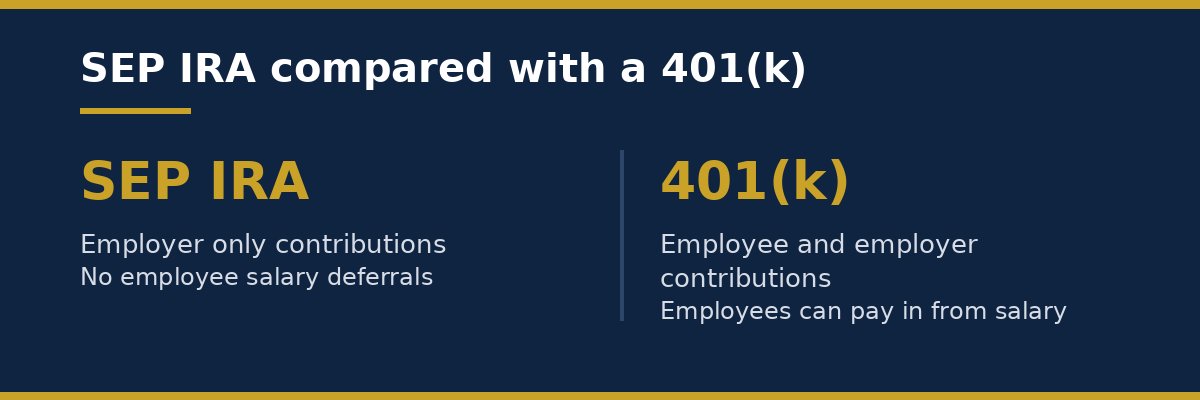
This is different from a 401(k), where the employee usually contributes from their own salary and the employer may add a match. In a SEP IRA, there is no employee side at all. To save more from your own money as well, use a separate account, such as a traditional IRA or a Roth IRA. The same percentage applies to everyone: 10 percent for the owner means 10 percent for each eligible employee too.
See What Is a 401(k), in Simple Terms? for the comparison.
How the Contribution Rule Works
The rule is a percentage of pay, up to a yearly IRS limit. The business picks a percentage, from zero up to 25 percent of compensation, and applies it to each eligible person’s pay.
There is also a dollar cap. For 2026, the IRS says the contribution for one person cannot be more than the lesser of 25 percent of compensation, or 72,000 dollars. So even if 25 percent of someone’s pay is more than 72,000 dollars, the contribution stops at 72,000 dollars for 2026.
Only pay up to a certain amount counts. For 2026, only the first 360,000 dollars of compensation counts toward the 25 percent. The limit changes each year with inflation, so always check the current IRS figure.
For self-employed people, the maths has one extra step. The 25 percent is not 25 percent of gross business income. It is worked out from net self-employment earnings, after an adjustment for self-employment tax, so in practice the effective rate is often about 20 percent of net earnings. If the exact calculation is unclear, a tax professional can work it out from your tax return figures.
A Worked Example: A Self-Employed Person Saving 10 Percent
Here is a simple example with round numbers, clearly labelled as an example. Suppose a self-employed graphic designer, called Maya in this example, has example yearly net earnings of 60,000 dollars, and her business sets the contribution at 10 percent.
- Example yearly net earnings: 60,000 dollars
- Example contribution percentage: 10 percent
- Contribution: 10 percent of 60,000 dollars, which is 0.10 times 60,000, which is 6,000 dollars
So, in this example, Maya’s business contributes 6,000 dollars to her SEP IRA for the year, and nothing more.
If her example earnings rise to 80,000 dollars in a good year, the same 10 percent gives 8,000 dollars. If they fall to 40,000 dollars, it gives 4,000 dollars. If the business sets the percentage to zero, the contribution is zero.
To see the dollar cap, take a larger example. Suppose a business owner has example compensation of 300,000 dollars, and the business sets the contribution at 25 percent. Then 25 percent of 300,000 dollars is 75,000 dollars, but the 2026 cap is 72,000 dollars, so the contribution is limited to 72,000 dollars. These are example numbers, not real figures for any real person.
SEP IRA vs a Traditional IRA
A SEP IRA and a traditional IRA share the same kind of account, but they work differently. A traditional IRA is funded by you, from your own money, up to the yearly IRA limit. A SEP IRA is funded by the employer, as a percentage of pay, up to the much higher SEP limit.
The tax treatment is similar in broad terms. Contributions are generally tax deductible in the year they are made, and the money grows without yearly tax on the growth. Tax is generally paid when the money is taken out in retirement.
The limits are very different. For 2026, the IRS sets the general IRA limit at 7,500 dollars, covering traditional and Roth IRAs combined. A SEP IRA can reach 72,000 dollars. That is why a SEP IRA appeals to a self-employed person with good earnings.
You can hold both: a SEP IRA funded by the business, and a traditional IRA funded from personal money. The limits apply separately, but the deduction rules interact, so check how they fit together first. For the Roth side, read What Is a Roth IRA?
SEP IRA vs a 401(k)
A 401(k) is the retirement plan most people meet through a job at a larger employer. A SEP IRA is the simpler cousin, built for small businesses and the self-employed.
With a 401(k), the employee usually contributes from their own salary, often before tax, and the employer may add a match. With a SEP IRA, the employee contributes nothing. Only the employer contributes, as a percentage of pay.
A 401(k) also allows catch-up contributions for workers aged 50 and over. A SEP IRA has no catch-up contribution and no employee deferral, though its 72,000 dollar limit for 2026 is high.
The paperwork is where the SEP IRA wins clearly. A 401(k) needs a plan document, yearly testing, and regular filings. A SEP IRA needs a short written agreement, usually a single IRS form, and no yearly filing. A 401(k) can also offer loans from the account in some plans, and a Roth option for employee contributions.
When You Can Take Money Out, and the Tax Treatment
Money in a SEP IRA is meant for retirement, so the withdrawal rules follow the same pattern as a traditional IRA. You can take money out at any time, but the tax result depends on when you take it.
Withdrawals in retirement are generally taxed as income in the year you take them. The contributions went in without tax at the time, in most cases, and the growth was not taxed year by year. Tax is paid later, when the money comes out.
If you take money out before age 59 and a half, an extra 10 percent early withdrawal penalty generally applies on top of the income tax, unless an exception applies. That is why a SEP IRA is a poor place for money you may need next year.
The account also has required minimum distributions: the IRS requires a minimum withdrawal each year once you reach a certain age, currently in your seventies. The money is yours. If you close the business, the SEP IRA stays in your name, and you can keep it or roll it into another retirement account.
Who a SEP IRA Suits
A SEP IRA suits a self-employed person with no employees, or with only a few, who wants a simple way to save for retirement. It suits someone whose income varies, because the contribution can be changed or skipped in a slow year. And it suits someone who earns enough that the higher SEP limit matters, where a personal IRA alone would be too small.
It suits a freelancer less well if they want to save from their own salary as well, because the SEP IRA does not allow that. It suits a growing business less well once staff numbers rise, because the same percentage must be paid for every eligible employee.
It also suits someone comfortable choosing their own investments inside the IRA, or using the default options the provider offers. The SEP IRA itself does not pick investments for you, and it carries the usual investment risk. The value can fall as well as rise.
Before choosing, ask three questions: can the business afford the same percentage for every qualifying employee, do you want employee contributions, and is simple paperwork worth more than the extra features of a 401(k)?
For help thinking about how much to save overall, read How Much Should I Save for Retirement? and Financial Planning for Retirement.
How to Open a SEP IRA in Simple Steps
First, check that the plan fits. Confirm you have self-employment income or a small business, list any employees who would qualify, and work out the cost for everyone, not just yourself.
Second, pick a provider. Banks, brokers, and fund companies offer SEP IRAs. Compare the fees, the investment options, and whether the provider handles the plan paperwork.
Third, complete the written plan agreement. Most small businesses use the IRS model form, Form 5305-SEP. You keep it on file. You do not send it to the IRS.
Fourth, open a SEP IRA account for each eligible person, including yourself. Each account is in that person’s name.
Fifth, make the contribution. You can contribute for a tax year up to the tax filing deadline for that year, including extensions, at the same percentage for everyone.
Sixth, tell your employees about the plan, and keep a record of the contributions each year.
Common Mistakes Beginners Make
Forgetting the Employees
The most common mistake is setting a generous percentage for the owner and forgetting the same percentage must be paid for every eligible employee. Work out the total cost for the whole team first.
Treating It Like a 401(k)
A SEP IRA has no employee contributions and no catch-up contributions. Do not plan to put part of your salary into it yourself, and do not expect an extra amount for being over 50.
Taking Money Out Early
Early withdrawals generally bring income tax plus a 10 percent penalty, unless an exception applies. A SEP IRA is for retirement, not for a short term need.
For the basic facts, see the IRS SEP pages: SEP contribution limits, irs.gov and Investor.gov, investor.gov
FAQ
What is a SEP IRA in simple terms?
A SEP IRA is a retirement plan for self-employed people and small business owners. The employer contributes a percentage of pay into an IRA for each eligible worker. Only the employer contributes.
Who can open a SEP IRA?
A self-employed person with no employees can open one, and so can a small business owner with employees. Qualifying employees must be covered at the same percentage as the owner.
Who puts money into a SEP IRA?
Only the employer. The employee does not contribute from their salary. If you are self-employed, you contribute as the employer, for yourself.
How much can be contributed to a SEP IRA in 2026?
For 2026, the IRS limit is the lesser of 25 percent of compensation or 72,000 dollars. Only the first 360,000 dollars of compensation counts. Check the current IRS figure each year.
How is a SEP IRA different from a traditional IRA?
A traditional IRA is funded by you, from your own money, up to a much lower yearly limit. A SEP IRA is funded by the employer, as a percentage of pay, up to the higher SEP limit.
Can I take money out of a SEP IRA early?
Yes, but taking money out before age 59 and a half generally brings income tax plus a 10 percent early withdrawal penalty, unless an exception applies.
Conclusion
A SEP IRA is simple at heart: a small business or a self-employed person sets a percentage of pay, and the business contributes that percentage into a retirement account for each eligible worker, including the owner. Only the employer contributes. The amount is a percentage of pay, up to the yearly IRS limit: 72,000 dollars or 25 percent of compensation for 2026, whichever is smaller.
The strengths are clear: little paperwork, flexible yearly contributions, and a much higher limit than a personal IRA. The limits are clear too: no employee contributions, no catch-up contributions, and the same percentage for every eligible employee. For a self-employed person working alone, or a small business with a few staff, those trade offs often make sense.
If a SEP IRA fits your situation, the next step is simple: check who qualifies, pick a provider, complete the short plan agreement, and set a percentage the business can afford for everyone.
This article is for general information and education only. It is not legal or financial advice.
