
What Is a Mutual Fund, in Simple Terms?
What Is a Mutual Fund?
A mutual fund is a pool of money from many people that is invested together in a large mix of stocks, bonds, or other investments. When you buy into a mutual fund, you are not buying one company. You are buying a small share of a whole basket that a professional fund manager looks after for you.
Think of it like a group picnic. One person buying food alone can only afford a few items. If 100 people each put in a small amount, the group can buy a wide spread of food. A mutual fund works in a similar way. Many investors put their money together, and the fund uses that combined money to buy many different investments at once.
That simple idea is the reason many beginners start with mutual funds. You can own a small piece of hundreds of investments with one purchase, instead of trying to pick and buy each one yourself.
How Pooling Works
Pooling is the core idea behind a mutual fund. Here is how it works in plain steps.
First, many investors send money to the same fund. Each investor receives shares in the fund. The number of shares depends on how much money was invested and the price of one share on that day.
Second, the fund manager, or the team running the fund, uses the pooled money to buy investments that fit the fund’s stated goal. For example, a fund might focus on large United States companies, or on government bonds, or on a mix of stocks and bonds.
Third, the value of your shares moves up or down with the value of everything the fund owns. If the investments in the fund do well, the value of your shares usually rises. If they do poorly, the value of your shares usually falls. Your return is your share of the whole basket, not the result of one single company.
Fourth, any income the fund earns, such as dividends from stocks or interest from bonds, may be paid out to investors or reinvested to buy more shares. The fund’s documents explain how this works for that specific fund.
The price of a mutual fund share is called the net asset value, or NAV. It is worked out once per trading day, after the market closes, by taking the total value of everything the fund owns, subtracting what the fund owes, and dividing the result by the number of shares. You buy or sell at that day’s NAV, not at a price that changes every minute during the day.
How a Mutual Fund Is Different From a Single Stock
A single stock is a share in one company. If you buy a stock, your money rises or falls with that one company. If the company does well, your investment may grow. If the company runs into trouble, your investment may fall sharply.
A mutual fund spreads your money across many companies or bonds. That spread is called diversification. If one company in the fund has a bad year, the other holdings may help soften the effect. That does not remove risk. The whole market can fall, and a mutual fund can lose value. But a single bad company is less likely to wipe out your whole investment when you hold a fund.
To learn more about this idea, read what diversification is and why it matters.
Another difference is choice. With a single stock, you choose the company. With a mutual fund, you choose the fund and its goal, and the manager chooses the individual investments inside it. That can suit a beginner who does not want to research dozens of companies one by one.
A third difference is cost and effort. Buying 100 different stocks yourself would take a lot of money and a lot of time. A mutual fund lets you get that spread in one step, for the price of one fund purchase, plus the fund’s fees.
How a Mutual Fund Is Different From an ETF
A mutual fund and an ETF, or exchange traded fund, are cousins. Both hold a basket of investments. Both can offer diversification. The main differences are how you buy them and how they are priced.
You buy a mutual fund directly from the fund company or through a broker, and your order is completed at the end of the day NAV. You buy an ETF on a stock exchange during market hours, just like a stock, and its price moves during the day.
Many ETFs track an index and have very low fees. Many mutual funds are actively managed, which means a manager tries to pick investments that will do better than the market, and that work usually costs more. Some mutual funds also track an index, and those are often called index funds.
For a clear comparison, read what an ETF is and how it is different from a stock.
Neither type is right for every person. A beginner should look at the goal, the fees, and how often the person wants to trade, rather than choosing by name alone.
What Is Inside a Mutual Fund?
The contents depend on the fund’s goal. Here are the common types in plain words.
A stock fund, also called an equity fund, mainly holds stocks. It may focus on large companies, small companies, companies in one country, or companies around the world. Stock funds can grow over the long term, but their value can swing up and down in the short term.
A bond fund mainly holds bonds. Bonds are loans to a government or a company, and they usually pay interest. Bond funds are often steadier than stock funds, but they can still lose value, especially when interest rates rise.
A balanced fund holds both stocks and bonds. The mix is stated in advance, for example 60 percent stocks and 40 percent bonds. The idea is to balance growth and steadiness.
An index fund holds the same investments as a market index, such as the S&P 500. The S&P 500 index is maintained by S&P Dow Jones Indices, part of S&P Global. An index fund does not try to beat the index. It tries to match it, and it usually charges a low fee for that simple job. To learn more, read what an index fund is and why beginners use it.
Before choosing any fund, read its goal in plain words. If you cannot explain in one sentence what the fund holds and why, keep reading until you can, or choose a simpler fund.
Fees in Plain Terms
Mutual funds charge fees, and fees matter because they come out of your return every year. Here are the fees a beginner is most likely to see.
The expense ratio is the main yearly fee. It is shown as a percentage. For example, an expense ratio of 0.50 percent means you pay 50 cents per year for every 100 dollars invested in the fund. An expense ratio of 0.05 percent means you pay 5 cents per year for every 100 dollars invested. That gap may look small, but over many years it adds up.
Some funds charge a sales load, which is a fee when you buy or sell. A front end load is charged when you buy. A back end load is charged when you sell. Many funds have no load at all. Those are called no load funds.
Some funds also charge a fee for short term trading, or a small account fee if the balance is very low. The fund’s prospectus, which is its official information document, lists all of these fees. A beginner should look for the expense ratio first, then check for any load.
A Worked Example: How Growth Can Build Over Time
This is an example only, to show the math. It is not a promise of what will happen.
Suppose you invest 100 dollars every month into a mutual fund. Suppose the fund earns an average return of 6 percent per year, after fees, every year. That 6 percent figure is an assumption for this example only. Real returns move up and down, and some years are negative.
Here is how the math works in the first year.
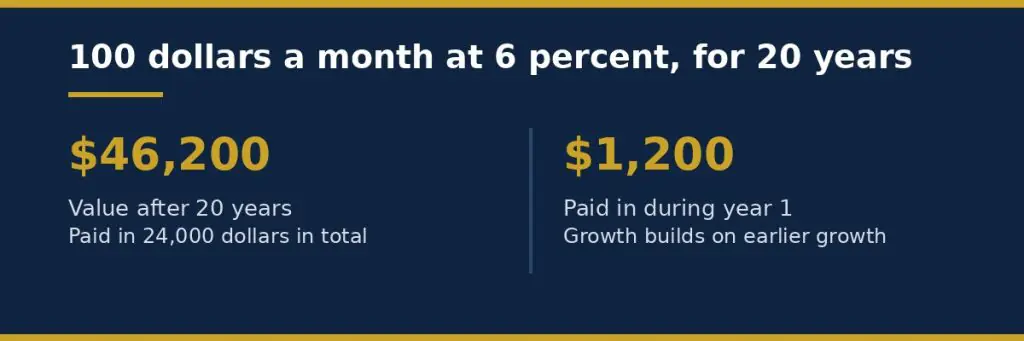
Step 1: You invest 100 dollars each month, so you invest 1,200 dollars in the year. That is 100 dollars times 12 months, which equals 1,200 dollars.
Step 2: Your money earns about 6 percent over the year. For a simple estimate, 6 percent of 1,200 dollars is 72 dollars. That is 1,200 dollars times 0.06, which equals 72 dollars.
Step 3: Add the return to your investment. You have 1,200 dollars plus 72 dollars, which equals 1,272 dollars at the end of year one, before any change in the timing of monthly payments.
Now look at what happens over a longer time. If you keep investing 100 dollars every month for 20 years, you will have paid in 24,000 dollars in total. That is 100 dollars times 12 months times 20 years, which equals 24,000 dollars.
With a steady 6 percent average annual return, compounded each year, that same monthly habit could grow to about 46,200 dollars after 20 years. That figure comes from the standard future value formula for regular monthly payments, using a 6 percent annual return and 240 monthly payments of 100 dollars. The growth above your 24,000 dollars paid in is about 22,200 dollars, which is 46,200 dollars minus 24,000 dollars.
The point is not the exact final number. The point is that regular investing, plus time, plus compound interest working on earlier returns, can turn small monthly amounts into a much larger sum than the total paid in. It also shows why starting early and staying steady often matters more than trying to find the perfect fund.
How a Beginner Would Start
Starting with a mutual fund does not need a large sum. Many funds allow a first investment of 100 dollars or less, and some allow less through an automatic monthly plan. Check the fund’s minimum before you begin.
Here are simple steps a beginner can follow to learn and prepare.
Step 1: Set a clear goal. Are you saving for retirement in 30 years, or for a house in five years? The goal helps you choose between a stock fund, a bond fund, or a balanced fund.
Step 2: Decide how much you can invest each month without missing bills or emergency savings. For help thinking this through, read how much you should invest each month.
Step 3: Look for a low cost, diversified fund that matches your goal. Compare expense ratios, read the fund’s goal in plain words, and check what it holds. An index fund is a common starting point for many beginners because its goal is simple and its fees are often low.
Step 4: Check how much money you need to start. If you are unsure, read how much money you need to start investing.
Step 5: Set up an automatic monthly investment if you can. A small automatic payment is easier to keep up than a large payment you have to remember each month.
Step 6: Review the fund once or twice a year. Check that the goal still fits, the fees have not changed much, and the mix still suits your plan. Do not check the price every day. Daily moves can tempt you to buy and sell at the wrong times.
Frequently Asked Questions
Do I need a lot of money to start a mutual fund?
No. Many funds allow a first investment of 100 dollars or less, and some allow a smaller start through an automatic monthly plan. The exact minimum varies by fund, so check the fund’s minimum before you begin. Starting small and adding regularly is a normal way to begin.
Can I lose money in a mutual fund?
Yes. A mutual fund can lose value if the investments it holds fall. The value of your shares moves with the whole basket. Diversification can soften the effect of one bad holding, but it cannot remove market risk. That is why the time frame matters. Money needed soon is usually kept out of funds that can fall in value.
How do I make money from a mutual fund?
You can gain in three ways. First, the value of your shares may rise if the fund’s holdings rise. Second, the fund may pay you income, such as dividends or interest. Third, the fund may pay you a capital gain distribution when it sells holdings for a profit. You only lock in a gain or loss when you sell your shares.
Is a mutual fund the same as a stock?
No. A stock is a share in one company. A mutual fund is a share in a basket of many investments. A stock price changes all day. A mutual fund price is set once per day, after the market closes. A mutual fund also spreads your money across many holdings, while a single stock does not.
Is a mutual fund the same as an ETF?
No, although they are similar. Both hold a basket of investments. The main difference is trading. You buy an ETF on an exchange during market hours, and its price moves during the day. You buy a mutual fund at the end of day NAV. Many mutual funds are actively managed and charge more, while many ETFs track an index and charge less, but there are low cost funds of both types.
Conclusion
A mutual fund is a simple idea with a useful result. Many people pool their money, a manager invests it in a wide basket of stocks or bonds, and each person owns a share of that basket. That spread can help a beginner start investing without picking dozens of companies one by one.
The most important parts to remember are the goal of the fund, the fee you pay each year, and the time frame for your money. A low cost, diversified fund that matches a long term goal is a common starting point. A high fee, a narrow focus, or a fund you cannot explain in simple words is a reason to pause and look again.
Start small if you need to, invest regularly if you can, and review your choice once or twice a year. That steady habit, more than any single fund pick, is what gives the idea time to work.
This article is for general information and education only. It is not legal or financial advice.