
How Much Should I Invest Each Month?
Short answer: invest what you can afford every month without missing bills, and start with any amount, even 25 or 50 dollars. There is no single right number for everyone. A useful starting point is 10 to 15 percent of your take-home pay, if you can manage it, after you have a small emergency cushion and after you have taken any full employer match. The exact amount matters less than doing it every month, for years, without stopping. This guide gives you three simple rules, a worked example with real math, and the mistakes to avoid.
Why the amount matters less than the habit
Most beginners ask the wrong question first. They want a magic number, like 500 dollars, and they wait until they can afford it. While they wait, months pass and nothing is invested. A smaller amount started now almost always beats a bigger amount started years later, because growth builds on growth over time. That is the whole power of compound interest: money you invest early earns returns, and those returns earn returns of their own.
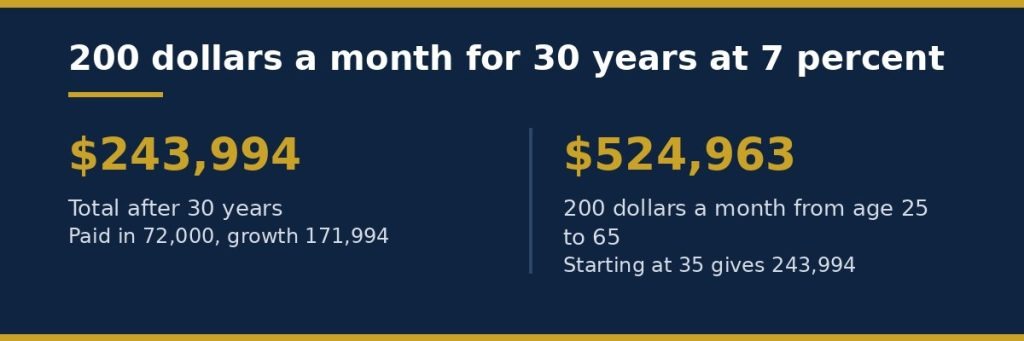
Think of it this way. Two people both invest 200 dollars a month and both earn the same average yearly growth of 7 percent. One starts at 25 and keeps going until 65, which is 40 years. The other starts at 35 and invests until 65, which is 30 years. The first person ends with about 525,000 dollars. The second ends with about 244,000 dollars. The first person paid in 96,000 dollars over 40 years. The second paid in 72,000 dollars over 30 years. The ten extra years cost the second person only 24,000 dollars in extra payments, but the gap in the final amount is about 281,000 dollars. The early years do the heavy lifting, because the money has more time to grow.
These figures are an example, not a promise. Real returns move up and down, and no one can promise 7 percent. The point is the shape of the growth: starting matters more than the size of the first payment.
To see how growth builds on itself, read: How Does Compound Interest Work?
Rule 1: Never invest money you need for bills
The first rule is the simplest. Your monthly investment amount must come after your needs are covered. Rent, food, transport, bills, and minimum debt payments come first. If investing 200 dollars a month means missing a bill, the amount is too high. If it means cutting into money for food, it is too high.
Start by writing down your take-home pay, then subtract the costs you cannot avoid. What is left is your free money for the month, and investing lives there, next to extra debt payments and saving. If 100 dollars is free, 50 dollars a month is a good start. If 400 dollars is free, you can do more.
A small emergency cushion comes before investing for most beginners. A first target of 500 to 1,000 dollars in a savings account covers the small shocks, like a car repair or a broken phone, so you do not have to sell investments or borrow when something breaks. Once that cushion is there, monthly investing can start properly.
To build that cushion first, read: How Do I Build an Emergency Fund From Zero?
Rule 2: Take the full employer match first
If your job offers a retirement plan with an employer match, that match is the first money to grab. A common setup is that the employer adds money when you put money in, for example matching part of what you save up to a limit. It is part of your pay, and you only get it if you contribute.
So before you decide on a monthly amount elsewhere, check your work plan. If the match needs 5 percent of your pay, start there. That 5 percent is the floor, not the ceiling, and you can add more later once the match is covered.
If your employer does not offer a match, or you are self-employed, this rule does not apply, and you can skip straight to Rule 3. The point is order: free matching money first, then the rest of your plan.
To plan your first steps, read: What Is a Simple First Investment Plan?
Rule 3: Use a percentage, not a fixed dollar amount
A percentage adjusts itself as your pay changes. A fixed dollar amount does not. If you pick 10 percent of take-home pay, the amount grows when you get a raise and shrinks if your pay drops. That keeps the habit alive through good months and tight months.
Here are three common starting points:
Start at 5 percent if money is tight. On 3,000 dollars of take-home pay, that is 150 dollars a month. It is enough to build the habit and to see real growth over time.
Aim for 10 percent as a solid beginner target. On 3,000 dollars, that is 300 dollars a month. Most beginners who can manage 10 percent are in good shape.
Work toward 15 percent over time if you can. On 3,000 dollars, that is 450 dollars a month. This is a common long-term target for people saving for retirement, and it is fine to reach it slowly, one percent at a time.
If 5 percent feels hard, start at 2 or 3 percent. A small amount every month beats a big plan that never starts. You can raise the percentage by one point every time your pay rises, so the extra money is invested before you get used to spending it.
A popular way to split your pay is the 50/30/20 rule: about 50 percent for needs, 30 percent for wants, and 20 percent for saving and extra debt payments together. Investing sits inside that 20 percent, next to building savings. On 3,000 dollars of take-home pay, 20 percent is 600 dollars for saving and extra debt payments combined. If you have high-interest debt, part of that 600 should go to the debt first.
To learn the split in detail, read: What Is the 50/30/20 Budget Rule, and Does It Work?
A worked example: 50, 100, and 200 dollars a month
Here is what different monthly amounts can grow into over 30 years, using the same example: an average yearly growth of 7 percent, money added every month, and all growth left in. Real growth is uneven, and the figures are rounded.
Investing 50 dollars a month for 30 years: you pay in 18,000 dollars. The total grows to about 61,000 dollars. Growth adds about 43,000 dollars.
Investing 100 dollars a month for 30 years: you pay in 36,000 dollars. The total grows to about 122,000 dollars. Growth adds about 86,000 dollars.
Investing 200 dollars a month for 30 years: you pay in 72,000 dollars. The total grows to about 244,000 dollars. Growth adds about 172,000 dollars.
Investing 300 dollars a month for 30 years: you pay in 108,000 dollars. The total grows to about 366,000 dollars. Growth adds about 258,000 dollars.
Notice two things. First, doubling the monthly amount roughly doubles the final total. Second, most of the final total is growth, not money you paid in. At 200 dollars a month, you paid 72,000 dollars, but growth added 172,000 dollars. Time and steady growth do most of the work.
You can test your own numbers with the US Securities and Exchange Commission compound interest calculator at https://www.investor.gov/financial-tools-calculators/calculators/compound-interest-calculator
What if you can only invest 25 or 50 dollars a month?
Then invest 25 or 50 dollars a month. A small amount is not a waste. At 50 dollars a month, the example above reaches about 61,000 dollars in 30 years. At 25 dollars a month, it reaches about 30,000 dollars. Those are real amounts, built from small payments you barely notice.
The main risk with a small amount is stopping. Many people invest 50 dollars a month for a few months, then stop when money feels tight and never restart. The fix is to automate it: set the money to move on payday, every month, before you can spend it.
To set that up, read: How Do I Automate Saving and Investing?
If even 25 dollars feels hard, check two things before giving up. First, look for one small regular cost you can cut, like a subscription you do not use. Second, check whether high-interest debt is eating the money first. Credit card debt at a high rate usually costs more than investing earns, so paying that down first is often the better move. Once it is gone, the money you were paying to the card becomes your monthly investment amount.
If you have very little to start with, read: How Much Money Do I Need to Start Investing?
What should you invest in first?
The amount is only half the question. The other half is where the money goes. For most beginners, the simplest first step is a broad, low-cost index fund, which spreads your money across many companies at once instead of betting on one stock. Low fees matter, because a small yearly fee taken every year adds up to a large amount over 30 years. A fund that charges 0.1 percent a year keeps far more of your money than one that charges 1 percent a year.
Keep the first choice simple. One broad index fund is enough to start, and you can learn about other choices later. The worst beginner mistake is spending months picking the perfect investment while investing nothing.
To understand the simple first choice, read: What Is an Index Fund, and Why Do Beginners Use It?
To see why fees matter so much, read: What Are Fees in Investing, and How Do They Hurt Returns?
When should you raise the monthly amount?
Raise it when your pay rises, when a debt is paid off, or when a regular cost ends. The easiest way is to raise it by one percent of pay at a time. A one percent rise is small enough that you will not feel it, and over a few years it adds up to a big change.
Good moments to raise the amount:
When you get a raise. Put half the raise into investing and keep the other half for spending. Your spending still goes up, and your investing goes up too.
When you finish paying off a debt. The monthly payment you were sending to the lender can become your new investment amount. You were already living without that money, so moving it changes nothing in your daily life.
When a regular bill ends. A car payment that finishes, or a subscription you cancel, frees up money every month. Move at least half of it into investing before it becomes spending money.
Five mistakes that shrink your monthly amount
Mistake 1: Waiting until you can afford a big amount. Waiting costs more than starting small. Months spent waiting are months with no growth at all.
Mistake 2: Investing money you need next month. If the money has to come back out soon, it should not be invested. Money you need soon should stay in savings, because investments go up and down.
Mistake 3: Stopping when markets fall. A fall in prices feels scary, but monthly investing during a fall buys more for the same money. Stopping during falls and restarting during rises is the opposite of what works.
Mistake 4: Copying someone else’s amount. A friend investing 500 dollars a month may earn twice what you earn, or have no rent to pay. Your number must fit your pay and your costs, not theirs.
Mistake 5: Forgetting fees and taxes. A high fee quietly takes a slice every year. Check the fee on any fund before you buy it, and learn the basic tax rules for the account you use.
To avoid the common early errors, read: What Mistakes Do Beginner Investors Make Most?
FAQ
Is 100 dollars a month enough to invest?
Yes, for a beginner. At the 7 percent example rate, 100 dollars a month grows to about 122,000 dollars in 30 years, from 36,000 dollars paid in. The key is to keep it going every month and to raise it when your pay rises.
What percent of my salary should I invest?
A common target is 10 to 15 percent of take-home pay for long-term saving, reached over time. Start at 5 percent if money is tight, and raise it by one percent at a time. The right percent is the one you can keep paying every month without missing bills.
Is it better to invest monthly or all at once?
For most beginners, monthly investing is better, because it is steady, it spreads the timing risk, and it fits a monthly pay cheque. Investing a lump sum all at once can work too, but it needs money you already have saved, and it is harder to keep up as a habit.
What if my pay changes from month to month?
Use a percentage of each month’s pay, or set a small fixed amount you can always afford, like 50 dollars, and add extra in good months. The fixed small amount keeps the habit alive, and the extra payments in good months speed up the growth.
Can I invest too much each month?
Yes, if the amount leaves you short for bills, emergencies, or food. Investing should never mean borrowing to cover everyday costs. If you have to use a credit card to get through the month, the amount is too high. Cut it back until the month works without borrowing.
Conclusion
How much you should invest each month comes down to three steps. Cover your bills first, take any full employer match, then pick a percentage of take-home pay you can keep paying, starting at 5 percent if money is tight and working toward 10 to 15 percent over time. The worked example shows why starting matters more than the size: 200 dollars a month for 30 years grows to about 244,000 dollars in the example, and starting ten years earlier adds about 281,000 dollars to the final total. Set the amount to move on payday, review it once a year, and raise it by one percent whenever your pay rises or a debt ends. Start with what you can afford this month, and let time do the rest.
This article is for general information and education only. It is not legal or financial advice.
