

How Do I Make Money From Photography as a Side Income?
The short answer
Yes, you can make money from photography as a side income, and you do not need a professional studio to start. The simplest path is to sell something people already want: portraits, event photos, product photos, prints, or stock photos. You need a camera or a good phone, a small portfolio, and a clear price. Most beginners start with one type of work, earn their first paid job, and then grow from there.
Photography is a skill-based side income, which means your income grows as your skill and your reputation grow. The first job is the hardest to get. After that, every happy client can send you the next one. This guide covers the six main ways photographers earn, how much you can realistically expect, what you need to start, and a worked example of a month of paid sessions.
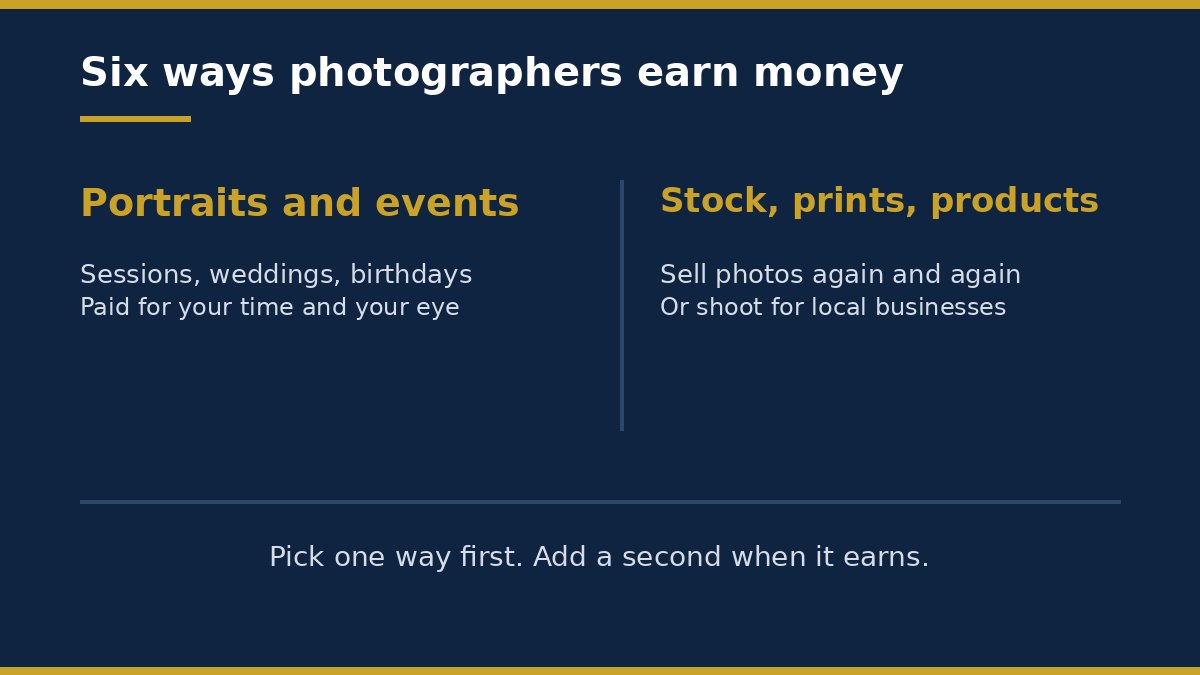
Six ways photographers earn money
There is no single way to earn from photography. Each path fits a different skill level, a different amount of time, and a different kind of customer. Here are the six most common ones for beginners.
1. Portrait and family sessions
This is the most common starting point. You photograph families, couples, graduates, or individuals, usually outdoors or in their home. A session lasts 30 to 60 minutes, and you deliver a set of edited photos a few days later. Clients pay for your time, your eye, and your editing, not just for pressing a button. Mini sessions, which are short 20 minute shoots at one location, are a popular way to book several clients in a single afternoon.
2. Event photography
Weddings, birthdays, graduations, and small business events all need a photographer. Events pay more than portraits, but they also demand more: you cannot miss a moment, you need backup equipment, and the editing takes longer. Start with small events for people you know, and build up to paid bookings once you have a portfolio that shows you can handle a full day.
3. Stock photography
Stock sites sell your photos to businesses, bloggers, and designers. You upload a photo once, and it can sell many times. Each sale pays a small amount, often under a dollar, so stock photography is a slow build. It suits people who enjoy shooting and who can build a large library over time. The income is small at first, but it can become steady, and it keeps earning while you do other work.
4. Prints and wall art
If your photos look good printed large, you can sell prints online or at local markets. Landscapes, city scenes, and nature photos sell best as prints. You can sell through a print-on-demand service, which prints and ships for you, or you can print locally and sell at a craft fair. Print sales depend heavily on finding the right buyers, so this path works best alongside a social media account or a small online shop.
5. Product and real estate photos
Small businesses need photos of their products for their websites and online shops. Estate agents need photos of houses for sale. Both are steady, local work, and both value reliability more than artistic genius. A clean, bright, well-lit photo is what the client wants. This kind of work is less glamorous than portraits, but it is often more regular, and one good client can send repeat work every month.
6. Presets, courses, and editing services
Once you have a style people like, you can sell what you know. Photo presets are ready-made editing settings other photographers buy and apply to their own photos. A short online course can teach beginners what you have learned. You can also offer editing as a service, fixing other photographers’ photos for a fee. These are digital products, so you make them once and sell them again and again. Our guide to selling digital products explains that model in detail.
You do not need to do all six. Pick one, get good at it, and add a second only when the first is earning.
A worked example: four portrait sessions in a month
Let us work through the money, because the numbers tell you whether this is worth your time. These are example figures, not a promise. Prices vary by city, skill, and demand, so treat this as a model you can adjust with your own prices.
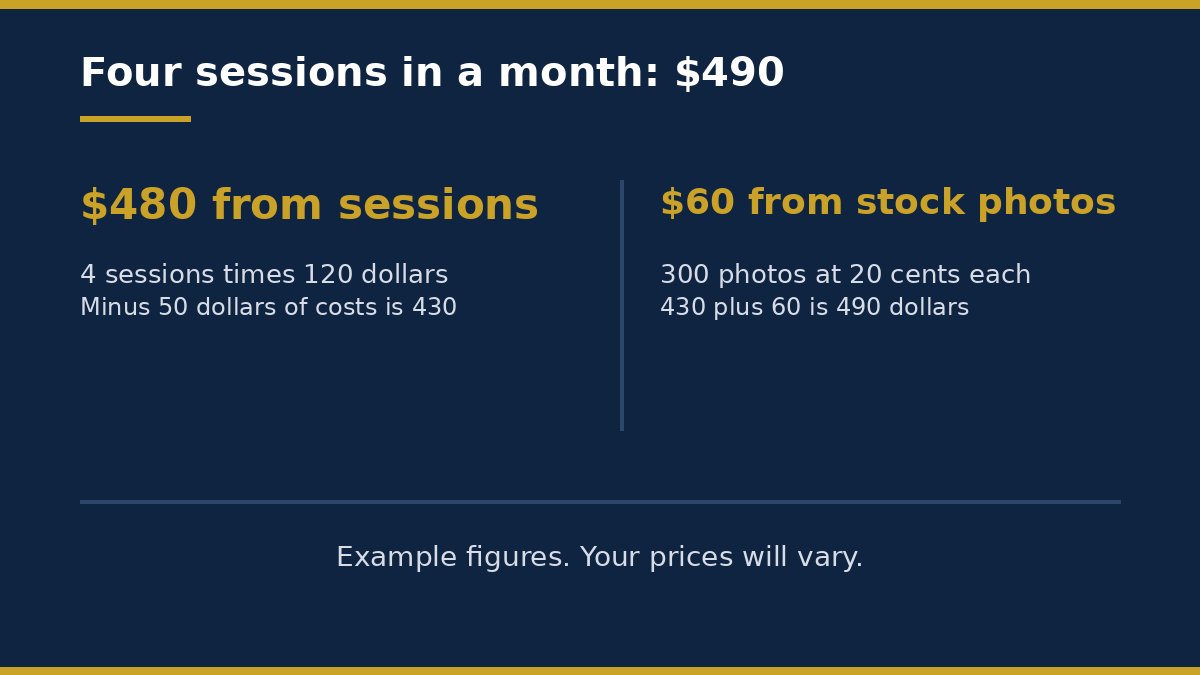
Say you offer 30 minute mini sessions at 120 dollars each. You book four sessions in a month, all on weekends.
- Gross income: 4 sessions times 120 dollars is 480 dollars.
- Costs: travel to the locations, about 40 dollars for the month, and your photo editing software at 10 dollars a month, for a total of 50 dollars. You already own the camera, so there is no new equipment cost this month.
- Net income before tax: 480 dollars minus 50 dollars is 430 dollars.
Now add a small stock photo income. Say you have 300 photos on a stock site, and on average each photo earns 20 cents a month. That is 300 times 0.20 dollars, which is 60 dollars a month.
- Total for the month: 430 dollars from sessions plus 60 dollars from stock, which is 490 dollars.
That is a realistic first-year month for a part-time photographer: a few hundred dollars, earned in about 10 to 12 hours of work including shooting, editing, and talking to clients. It will not replace a full-time salary, and it should not be expected to. But as a side income, it is real money, and it grows as your prices rise and your bookings fill up.
What you need to start
You need less gear than you think. Here is the honest minimum.
A camera you already own is enough to start. A modern phone can take photos good enough for social media and small prints, and many beginners take their first paid job with a phone. A basic mirrorless camera or DSLR gives you more control and better results in low light, but it is not required on day one.
A small portfolio matters more than a big camera. Take 10 to 20 of your best photos and put them in one place, such as a free online gallery or a simple social media page. Clients want to see what your photos look like, not what your camera costs. If you have no clients yet, photograph friends and family for free, with their permission, and use those photos as your portfolio.
Editing software is the third essential. Free tools can handle basic edits, but most working photographers use a paid editor such as Lightroom, which costs around 10 dollars a month. Learning to edit well is as important as learning to shoot, because editing is what turns a good photo into a finished product a client will pay for. You also need a simple way to take payment and to deliver photos. A payment link or a bank transfer works fine at the start, and a shared online folder is enough for delivery.
How to find your first paying clients
Your first clients almost always come from people you already know. Tell friends, family, and coworkers that you are offering photo sessions. Offer the first few sessions at a low introductory price, or free in exchange for a testimonial and permission to use the photos in your portfolio. One happy client who shares your photos can bring three more.
Local groups are the next best source. Community pages, parent groups, and local business groups are full of people looking for a photographer for a birthday, a graduation, or a product launch. Answer quickly, share your portfolio link, and quote a clear price. Most beginners lose jobs by replying slowly or by being vague about price, not by lacking skill.
For stock photography, the path is different. You sign up with a stock site, upload your best photos, and add clear titles and keywords so buyers can find them. It takes time to build a library, so upload a few photos every week and be patient.
Whatever route you choose, keep your promises. Deliver on time, communicate clearly, and be easy to work with. In photography, reputation is everything.
Pricing your work
Pricing is where most beginners struggle, so keep it simple. Start by working out your costs and your time, then add a margin.
Work out the hours a job takes, including travel, shooting, editing, and delivery. If a session takes 3 hours in total and you want 30 dollars an hour, the price should be at least 90 dollars, plus any travel or printing costs. That is your floor. Then look at what other photographers in your area charge for similar work, and set your price in that range. If you are new, price at the lower end, but never price so low that you earn less than minimum wage for your time. Cheap prices attract difficult clients and leave you exhausted.
Raise your prices as your bookings fill up. If you are turning people away, your price is too low. If nobody books, your price may be too high, or your portfolio may need work. Our guide to pricing your first freelance service explains this in more detail, and it applies just as well to photography.
Mistakes to avoid
The most common beginner mistake is buying expensive gear before earning anything. A new camera will not get you clients. A good portfolio and a clear offer will. Spend your first earnings on learning and on marketing, not on a second lens.
The second mistake is giving away your work for free for too long. A few free sessions to build a portfolio is sensible. Doing free work for months is not. Once you have ten good photos and two happy clients, start charging, even if the price is low.
The third mistake is under-delivering on editing. Clients judge you on the finished photos, not on the raw files. Take time to edit carefully, deliver on the date you promised, and check every photo before you send it. One sloppy delivery can cost you more than the fee was worth.
The fourth mistake is ignoring the business side. Track your income and your costs from the first paid job, keep receipts, and set aside money for tax. Side income is taxable in most countries, and a small habit of tracking now saves a painful surprise later. Our guide to tracking side income for tax explains the simple system to use.
How much time does it take?
A part-time photographer can start with 5 to 10 hours a week. That covers one or two sessions, the editing, and a little time finding clients. Stock photography takes less time per week once the photos are uploaded, but it needs regular uploads to grow.
Be honest with yourself about your time. If you have a full-time job and a family, two sessions a month may be all you can handle, and that is fine. Two sessions at 120 dollars is 240 dollars a month, which is a useful side income.
Frequently asked questions
Can I make money from photography with just a phone?
Yes, for some kinds of work. Phone cameras are good enough for social media photos, small prints, and many stock photos. For paid portraits and events, clients usually expect a dedicated camera, and a phone struggles in low light. Start with what you have, earn your first money, and upgrade when the work demands it.
How much can a beginner photographer earn?
It varies widely. A beginner doing a few portrait sessions a month can earn a few hundred dollars a month. A photographer with regular event and product clients can earn more. Stock photography usually earns very little at first, often under 50 dollars a month, and grows slowly. Treat the first year as a learning year, and judge the income in the second year.
Do I need a license or insurance to photograph people?
Rules vary by place, so check local requirements. In many areas, no license is needed to photograph portraits as a small side business, but some venues require a permit, and professional liability insurance is wise once you charge for events. It is usually cheap for a part-time photographer, and it protects you if equipment is damaged or a client makes a claim.
How do I get paid for stock photos?
You sign up with a stock site, upload photos, and earn a small payment each time someone downloads one. Payments are usually collected in your account and paid out once you reach a minimum amount, often 25 or 50 dollars. The exact rate depends on the site and your contributor level, so read the terms before you upload a large library.
Should I charge per hour or per session?
Per session is simpler for clients, because they know the total cost upfront. Set a session price that covers your time, your editing, and a set number of finished photos. Charge extra for anything beyond that, such as more photos, prints, or a second location. Hourly pricing works better for events, where the length can vary.
What if a client does not like the photos?
Offer one round of small changes, such as brightness or cropping, at no extra cost. If the client is still unhappy, listen to what they expected and learn from it. Clear communication before the shoot, including showing examples of your style, prevents most of these problems.
Conclusion
Photography can be a real side income, and it starts smaller than most people think. Pick one way to earn, build a small portfolio, find your first clients among people you know, and charge a clear price that respects your time. The worked example shows the shape of it: a few sessions a month, plus a growing stock library, can bring in a few hundred dollars a month in your first year.
The photographers who succeed are not always the most talented. They are the ones who show up, deliver on time, and treat every client well. Start with the camera you have, take the first job, and let the second job come from the first. If you want to turn another skill into income as well, read our guide on turning a skill into income, and if you want more ideas, browse our list of side income ideas for beginners.
This article is for general information and education only. It is not legal or financial advice.
