
What Is a Stock Exchange in Simple Terms?
The short answer
A stock exchange is a marketplace where buyers and sellers meet to trade shares of companies. When you hear that someone “bought stock,” the trade almost always happened on a stock exchange, through a broker, on a computer system that matches buyers with sellers in seconds.
Think of a farmers market. Farmers bring produce, shoppers bring money, and the market gives them a safe, organised place to trade. A stock exchange does the same job for shares. Companies list their shares on the exchange, investors place orders to buy or sell, and the exchange makes sure the trade is recorded, the money moves, and the shares change hands.
You never walk into an exchange building to buy shares yourself. You place an order through a broker, and the broker sends it to the exchange. The exchange does the matching. This guide explains how that matching works, what the big exchanges are, how prices are set, and how a beginner uses one.
What is traded on a stock exchange?
The main thing traded on a stock exchange is shares, also called stocks. A share is a small piece of ownership in a company. When a company wants to raise money to grow, it can sell shares to the public. Those shares then trade on an exchange, where investors buy and sell them among themselves.
Exchanges also trade other investments. Exchange traded funds, or ETFs, trade on exchanges just like shares. Many bonds trade there too, although a lot of bond trading still happens off exchange, directly between big institutions. For a beginner, shares and ETFs are the two things that matter most, and both are bought and sold on an exchange.
Each company listed on an exchange has a ticker symbol, a short code of one to five letters. That code is how the market identifies the company. When you place an order, you use the ticker symbol, the number of shares, and the price you are willing to pay.
How a trade happens
A trade on a stock exchange follows the same five steps every time.
First, a company lists its shares. Listing means the company meets the exchange rules on size, financial reporting, and governance, and agrees to publish its results regularly. Listing is a quality check, not a guarantee. A listed company can still fail.
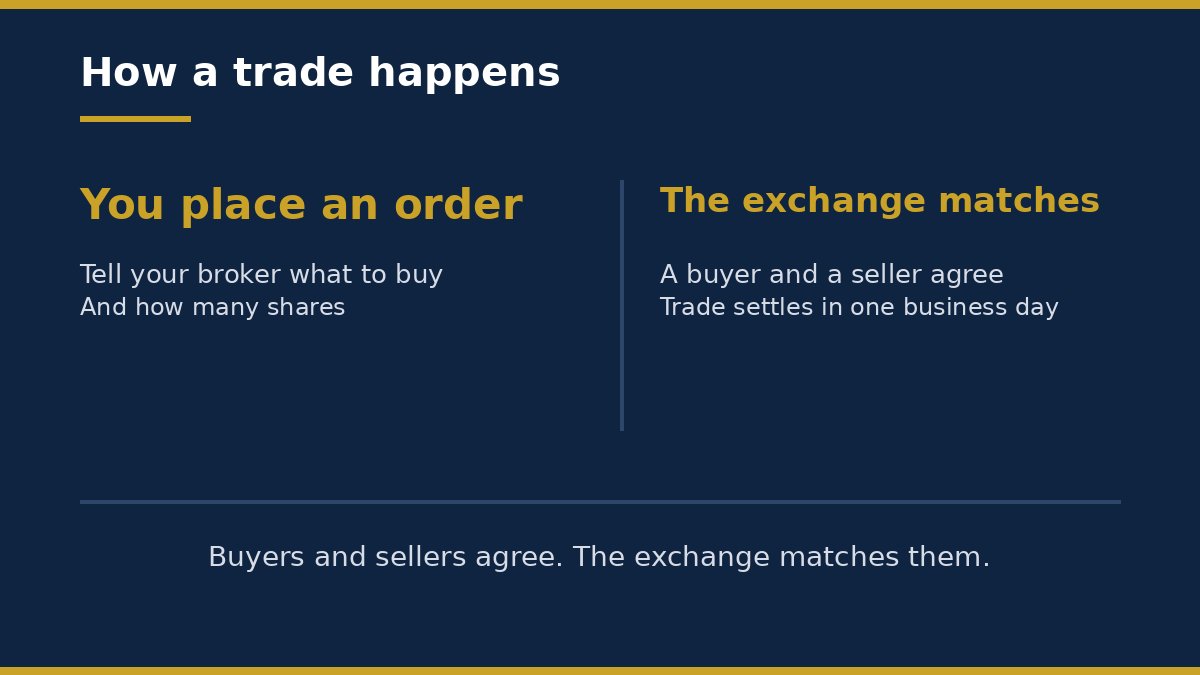
Second, a buyer places an order. You tell your broker what you want to buy, how many shares, and at what price. Your broker sends that order to the exchange.
Third, a seller places an order. Somebody else who owns those shares tells their broker they want to sell, how many shares, and at what price.
Fourth, the exchange matches them. The exchange computer looks for a buyer and a seller whose prices agree. When it finds a match, the trade happens, usually in a fraction of a second. The price of the last matched trade becomes the current market price for that share.
Fifth, the trade settles. The money moves from the buyer to the seller, and the shares move from the seller to the buyer. In the United States, most stock trades now settle one business day after the trade.
You do not need to understand the computer systems behind this. What matters is the idea: the exchange is a fair meeting place with clear rules, and the price is set by what buyers and sellers agree on, not by the exchange itself.
A worked example: 20 shares at 25 dollars
Numbers make this clearer, so here is a simple example.
Say a company has 1 million shares in total, and the last traded price is 25 dollars a share. The total value of the company on the market, called its market capitalisation, is 1 million shares times 25 dollars, which is 25 million dollars.
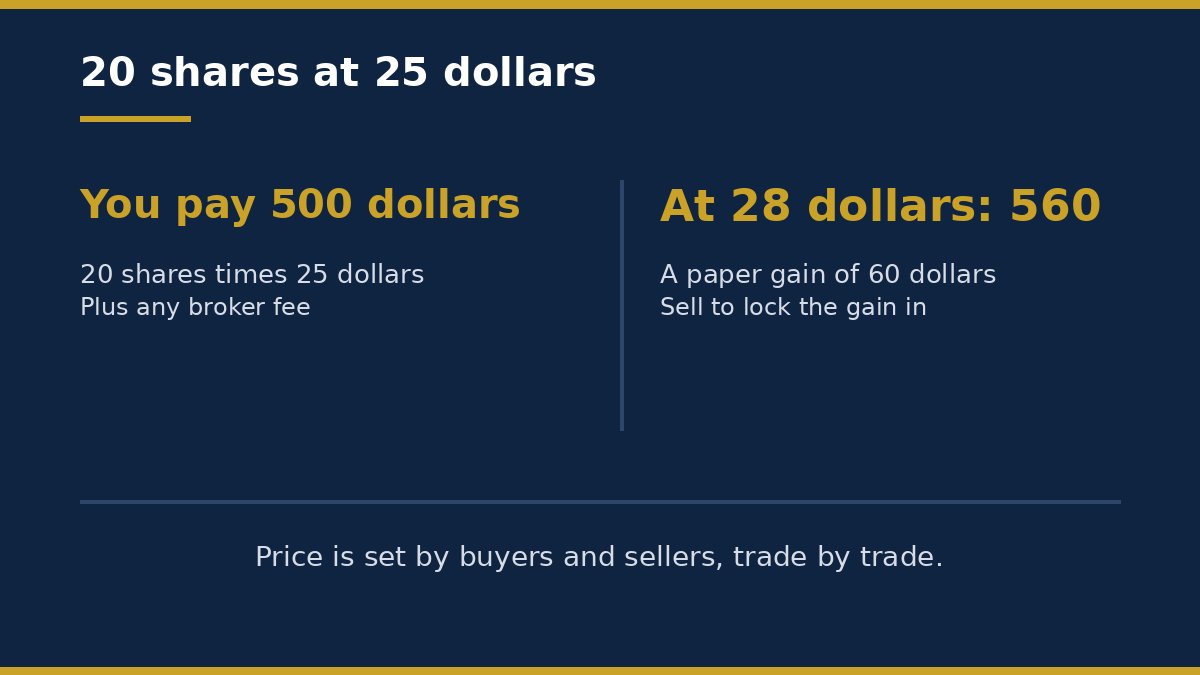
Now say you want to buy 20 shares. Your order is 20 shares times 25 dollars, which is 500 dollars. If a seller is willing to sell 20 shares at 25 dollars, the exchange matches your orders and the trade happens. You pay 500 dollars, plus any fee your broker charges, and you now own 20 shares.
A week later, the share price rises to 28 dollars. Your 20 shares are now worth 20 times 28 dollars, which is 560 dollars. Your gain on paper is 60 dollars. If you sell at 28 dollars, you keep that gain, minus any fees and any tax you owe. If the price falls to 22 dollars instead, your 20 shares are worth 440 dollars, and you have a paper loss of 60 dollars. You only lock in the loss if you sell.
That is the whole mechanism. The exchange does not decide the price. Buyers and sellers do, trade by trade, all day long.
The biggest stock exchanges
Most trading in the United States happens on two exchanges.
The New York Stock Exchange, or NYSE, is the oldest and largest stock exchange in the world by the total value of the companies listed on it. It lists many of the biggest and oldest companies. You can read more about it on the NYSE website (https://www.nyse.com/).
The Nasdaq is the second largest exchange in the United States. It lists many technology companies, and it was the first exchange to run fully electronically, with no physical trading floor. Many of the best known technology companies trade on the Nasdaq.
Outside the United States, the biggest exchanges include the London Stock Exchange, the Tokyo Stock Exchange, and the Shanghai Stock Exchange. Each country has its own main exchange, and each has its own rules and trading hours.
Exchanges are open on business days, and each has set hours. The NYSE and the Nasdaq trade from 9:30 in the morning to 4:00 in the afternoon, Eastern Time, Monday to Friday, except on public holidays. Outside those hours, some trading still happens in extended sessions, but fewer buyers and sellers are active, so prices can move more sharply.
How prices move up and down
Share prices move because supply and demand change. If more people want to buy a share than sell it, buyers have to offer more, and the price rises. If more people want to sell than buy, sellers have to accept less, and the price falls.
News moves prices fast. A company that reports strong profits often sees its price rise. A company that reports a loss, or warns that sales are falling, often sees its price fall. The wider economy matters too. Interest rates, inflation, and jobs data can move the whole market at once.
This is why prices change every second the market is open. Each new trade reflects the latest information and the latest mood of buyers and sellers. Over a single day, a share can rise or fall by several percent. Over years, the price tends to follow the company’s profits, but in the short term, mood and news matter more.
A beginner should expect this movement. It is normal, not a sign that something is broken. Our guide on what risk in investing means in simple terms explains why prices swing and how to think about that risk. Link: https://investclaritypath.com/what-is-risk-in-investing/
What an index measures
You will often hear that “the market was up today” or “the market fell.” That usually refers to an index. An index tracks a group of shares and turns their combined movement into a single number.
The S&P 500 tracks 500 large American companies, and it is the most watched index in the United States. The Dow Jones Industrial Average tracks 30 large companies. The Nasdaq Composite tracks the companies listed on the Nasdaq exchange. When one of these numbers rises, it means the group of shares it tracks went up on average.
You cannot buy an index directly, but you can buy a fund that tracks it. An index fund buys the same shares as the index, in the same proportions, so its value moves with the index. That is why index funds are a common first investment for beginners. If that idea is new to you, read our guide on what an index fund is and why beginners use it. Link: https://investclaritypath.com/what-is-an-index-fund-and-why-do-beginners-use-it/
How a beginner uses a stock exchange
You use a stock exchange through a broker, never directly. Here is the simple path.
First, open a brokerage account. This is an account with a company that is allowed to send orders to the exchange for you. Many brokers now let you open an account online with no minimum deposit. If you want the wider picture first, read our guide on how much money you need to start investing. Link: https://investclaritypath.com/how-much-money-do-i-need-to-start-investing/
Second, put money into the account. You transfer money from your bank account, and it sits as cash until you place an order.
Third, choose what to buy. For most beginners, a broad index fund or an ETF is a simpler first step than picking single shares. A single share can fall a long way if one company has a bad year. A fund spreads that risk across many companies. Our guide on what an ETF is and how it differs from a stock explains the choice in plain words. Link: https://investclaritypath.com/what-is-an-etf-and-how-is-it-different-from-a-stock/
Fourth, place an order. You will see two main order types. A market order buys at the best price available right now. A limit order buys only if the price falls to a level you set. A market order is simpler, and it suits a beginner buying a fund. A limit order gives you control over the price, and it suits someone buying a single share that moves fast.
Fifth, hold and review. After you buy, check your investment on a schedule, for example once a month, not every hour. Prices move all day, and watching them constantly leads to rushed decisions. If you are building a plan rather than chasing a single trade, read our guide on a simple first investment plan. Link: https://investclaritypath.com/what-is-a-simple-first-investment-plan/
What can go wrong
A stock exchange is a safe and well regulated marketplace, but investing through it still carries risk. Here are the main risks a beginner should understand.
Price risk is the first one. Shares can fall, sometimes sharply, and sometimes for a long time. In a bear market, prices fall across the whole market for months. Our guide on what a bear market is in simple terms explains how those periods work and what investors usually do in them. Link: https://investclaritypath.com/what-is-a-bear-market-in-simple-terms/
Company risk is the second one. A single company can fail, even if it is listed on a big exchange. Listing is a quality check, not a guarantee. That is why diversification matters: owning many companies through a fund means one failure does not sink your whole investment. Our guide on diversification explains the idea in simple terms. Link: https://investclaritypath.com/what-is-diversification-and-why-does-it-matter/
Cost risk is the third one. Some brokers charge fees on every trade, and some funds charge an annual fee. Small fees add up over years, especially if you trade often. A fund with a low annual fee keeps more of your return. Check the fee before you buy, and trade rarely.
Scam risk is the fourth one. People sometimes promote a small share online with big promises, then sell their own shares once the price jumps. That is called a pump and dump, and it is illegal. If a stranger promises a share will double, treat that as a warning, not an opportunity.
Stock exchange, stock market, and broker: what is the difference?
These three words get mixed up, so here is the simple split.
The stock exchange is the place where trading happens. The NYSE and the Nasdaq are exchanges.
The stock market is the whole system: all the exchanges, all the buyers and sellers, all the shares, and all the trading put together. When people say “the market,” they usually mean this whole system.
The broker is the company that sends your order to the exchange. You open an account with a broker, and the broker does the trading for you. You never deal with the exchange directly.
One more word worth knowing is a listing. When a company first sells its shares to the public, that is called an initial public offering, or IPO. After the IPO, the shares trade on the exchange, and the company is said to be listed. From then on, most trading is between investors, not between investors and the company.
Frequently asked questions
Do I need a lot of money to use a stock exchange?
No. Many brokers let you start with a small amount, and some let you buy a fraction of a share. That means you can own part of a share that costs 300 dollars by buying 30 dollars worth of it. The amount matters less than the habit of investing regularly and holding for the long term.
Can I buy shares outside market hours?
Most trading happens during market hours, 9:30 in the morning to 4:00 in the afternoon, Eastern Time. Some brokers offer trading before the market opens and after it closes, but fewer buyers and sellers are active then, so prices can jump more sharply. For a beginner, trading during normal hours is the safer choice.
What happens if a stock exchange closes?
Exchanges close for public holidays and, very rarely, for emergencies. Your shares do not disappear when the exchange closes. You still own them, and trading resumes when the exchange reopens. The price may jump at the open if news arrived while the market was closed.
Is a stock exchange the same in every country?
No. Every country has its own exchange, its own rules, and its own trading hours. The idea is the same everywhere, a marketplace that matches buyers and sellers, but the details differ. A beginner in the United States will mostly use the NYSE or the Nasdaq.
Do I own the company if I buy one share?
You own a very small piece of it. One share of a company with 1 million shares means you own one millionth of the company. That gives you a claim on a tiny part of its profits and, in most cases, a vote on company matters. It does not give you any say in how the company is run day to day.
Should a beginner buy single shares or a fund?
Most beginners do better starting with a fund, because a fund spreads the risk across many companies. Single shares can be rewarding, but they can also fall hard if one company struggles. If you do buy single shares, keep them a small part of your total investment, and learn how the company makes its money first.
Conclusion
A stock exchange is a marketplace with clear rules, where buyers and sellers trade shares and the price is set by their orders. The NYSE and the Nasdaq are the two main exchanges in the United States. You use them through a broker, and you can start with a small amount. Prices move every second the market is open, because buyers and sellers react to news, profits, and the wider economy.
For most beginners, the exchange is best used slowly. Buy a broad fund, hold it for years, check it on a schedule, and let time do the work. If you want to go deeper, read our guide on how stocks, bonds, and funds work together, and our guide on what risk in investing means in simple terms, before you place your first order. Link: https://investclaritypath.com/how-do-stocks-bonds-and-funds-work-together/
This article is for general information and education only. It is not legal or financial advice.
