

What Happens to My 401(k) When I Change Jobs?
The Short Answer
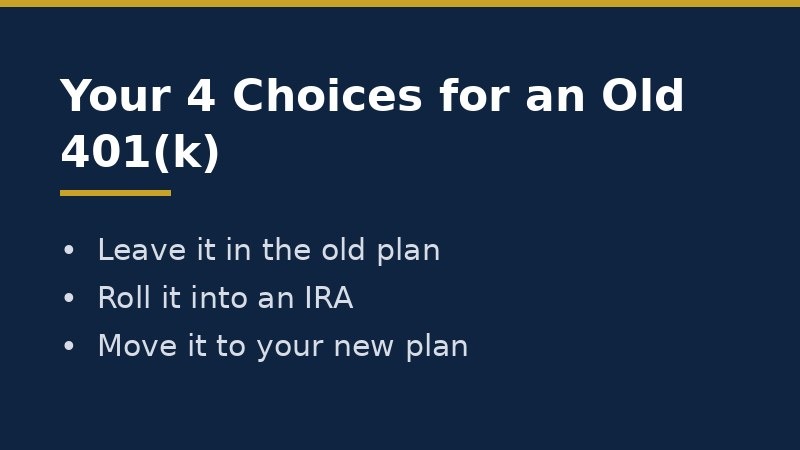
When you change jobs, your 401(k) does not disappear. The money stays in the old plan until you decide what to do with it. You have four choices: leave it in the old plan, roll it into an IRA, move it into your new employer’s plan, or cash it out. The first three choices keep the money growing for retirement. Cashing it out is usually the worst choice, because tax and a penalty can take a large part of it.
The best choice for most people is a direct rollover into an IRA or into the new employer’s plan. A direct rollover moves the money from one retirement account to another without you touching it, so there is no tax and no penalty. The choice depends on your new plan’s fees, your investment options, and whether you want to keep everything in one place.
First, Check What Is Yours: Vesting
Before you decide, check how much of the money is actually yours. Your own contributions are always yours. Your employer’s contributions, called matching contributions, may be yours only after a vesting schedule. Vesting is the timetable that decides when employer money becomes fully yours.
Some employers make you fully vested at once. Others vest you gradually, for example 20 percent a year over five years. If you leave after two years on a five year schedule, you keep 40 percent of the employer contributions and lose the rest. Your plan statement or your old employer’s HR team can tell you your vested balance. Our guide on what a 401(k) match is explains how matching contributions work.
Do not assume your full balance is yours. Check the vested amount first, because that is the number your decision is really about.
Choice 1: Leave It in the Old Plan
You can usually leave the money in your old employer’s plan. It keeps growing, invested the same way, and you do not have to do anything. This is the simplest choice, and it can be the right one if the old plan has low fees and good investment options.
The downsides are that you cannot add new money to it, you have one more account to track, and your old employer could change the plan or its fees later. Some plans also charge higher fees to former employees, or force out small balances. If your balance is below a set amount, often $1,000 to $7,000 depending on the plan, the old employer may move it to an IRA for you or send you a cheque. Check your plan’s rules before you rely on this choice.
Choice 2: Roll It Into an IRA
A rollover into an IRA, an individual retirement account, is the most common choice, and often the best one. You open an IRA with a broker, and the money moves directly from the old 401(k) to the IRA. Your money keeps its tax advantaged status, and you get a much wider choice of investments, usually at lower cost.
A direct rollover is the key: the money moves from the old plan straight to the IRA, without passing through your hands. Ask for a direct rollover, not a cheque made out to you. If the money is paid to you directly, the old plan must hold back 20 percent for tax, and you have 60 days to put the full amount, including the 20 percent held back, into the new account. If you miss the deadline, the amount counts as a withdrawal, with tax and possibly a penalty.
An IRA also gives you control. You pick the broker, you pick the funds, and the account stays with you no matter how many times you change jobs. Our guide on what an IRA is, in simple terms explains the account, and our guide on how to choose between a 401(k) and an IRA compares the two.
Choice 3: Move It Into Your New Employer’s Plan
If your new employer offers a 401(k), you can usually roll your old balance into it. This keeps everything in one place, which is simpler to manage. It can also be the right choice if the new plan has low fees and good funds, or if you want to keep the option of borrowing from the plan, which IRAs do not allow.
The downside is that your new plan’s investment choices are limited to what the employer offers, and the fees may be higher than an IRA. Compare the new plan’s fees and fund choices with an IRA before you decide. If the new plan is expensive or has poor funds, the IRA is usually better.
Choice 4: Cash It Out, the Costly Mistake
Cashing out means taking the money as cash. It feels like free money, but it is the most expensive choice by far.
When you cash out a traditional 401(k), the amount counts as income for the year, so you owe income tax on it. On top of that, if you are under age 59 and a half, you usually owe a 10 percent early withdrawal penalty. And if the money is paid to you directly, the plan holds back 20 percent for tax straight away.
The real cost is not just the tax. It is the growth you lose. Money taken out at 30 does not grow for the next 35 years. That lost growth is usually far larger than the tax bill. Cashing out should be a last resort, only if you truly have no other way to cover an urgent need.
A Worked Example: Cashing Out vs Rolling Over, Real Math
Here is a worked example with real math, so you can see what cashing out actually costs. These are example numbers to show the math, not tax advice. Tax rates vary, and your own situation may differ.
Imagine you are 35 years old and you have $20,000 in your old 401(k), all vested. You change jobs and you are tempted to cash it out.
Cashing out: The plan holds back 20 percent for tax, which is $4,000. You receive $16,000. At tax time, the $20,000 counts as income. If your income tax rate is 22 percent, the tax is $4,400. You already paid $4,000 through the holdback, so you owe $400 more. Then the 10 percent early withdrawal penalty adds $2,000. Total cost: $4,400 in tax plus $2,000 in penalty equals $6,400. You keep $13,600 of the $20,000. You have lost almost a third of it.
Rolling over: You move the full $20,000 directly into an IRA. No tax, no penalty, no holdback. The full $20,000 keeps growing.
Now look at the growth you lose by cashing out. If the $20,000 had stayed invested and grown by 7 percent a year on average, it would be worth about $40,000 by age 45, about $78,000 by age 55, and about $152,000 by age 65. These are example numbers using 7 percent average growth, not a promise. But they show the scale: cashing out $20,000 at 35 can cost you more than $130,000 by retirement, once lost growth is counted. The $13,600 you kept is a small price for that loss.
If you are in real financial trouble, talk to a qualified financial or tax professional before you cash out. There are a few exceptions to the penalty, for example for certain medical costs or disability, and a professional can tell you whether any apply to you.
What to Do, Step by Step
Step 1: Find your old plan’s contact details and check your vested balance. Your old employer’s HR team or the plan provider can give you the number.
Step 2: Decide where the money should go: leave it, roll it into an IRA, or move it to your new plan. Compare fees and investment choices. For most people, a direct rollover into a low cost IRA is the strongest choice.
Step 3: Open the IRA, or confirm your new plan accepts rollovers. Do this before you ask the old plan to move the money, so the money has somewhere to go.
Step 4: Ask the old plan for a direct rollover. The money should move straight from the old plan to the new account, without a cheque made out to you. Confirm the transfer is complete, and check the new account balance.
Step 5: Invest the money in the new account. A rollover does not invest the money for you. It usually arrives as cash in the new account, and you need to buy your funds. Pick a broad, low cost fund, as you would with any long term investment. Our guide on what a simple first investment plan looks like shows a simple way to set that up.
How This Fits Your Retirement Plan
A job change is a good time to check your whole retirement plan. How much have you saved so far? How much do you need? Our guide on how much you should have saved for retirement by age gives simple targets by age, and our guide on how much you need to retire explains how to work out your own number.
If your new job offers a 401(k) with a match, sign up and contribute at least enough to get the full match. A match is free money, and it is the first step in any retirement plan. Then keep your old money working for you through a rollover, instead of cashing it out and starting again from zero.
FAQ
How long do I have to decide what to do with my old 401(k)?
There is no strict deadline for most choices. You can usually leave the money in the old plan for months while you decide. But do not leave it for years without checking, because fees can change and small balances can be forced out. Make the decision within a few months of leaving, while the details are fresh.
Does a rollover count toward my yearly IRA contribution limit?
No. A rollover is not a contribution. It does not count toward the yearly limit on new IRA contributions, and it does not use up your contribution room. You can roll over any amount, no matter how large, and still contribute the full yearly amount separately.
What happens if my old employer goes out of business?
Your 401(k) money is held in a trust, separate from your employer’s own money. If the employer goes out of business, your money is still yours, though the plan may take time to wind up and move. Keep records of your account, and contact the plan provider directly if your employer closes.
Can I roll a Roth 401(k) into a Roth IRA?
Yes. A Roth 401(k) rolls into a Roth IRA, and a traditional 401(k) rolls into a traditional IRA. Keep Roth money with Roth money and traditional money with traditional money, so the tax treatment stays the same. Mixing them can create a tax bill you did not expect.
What if I have a loan from my old 401(k)?
A 401(k) loan becomes due when you leave the job, usually within a short window. If you do not repay it, the unpaid amount counts as a withdrawal, with tax and possibly a penalty. Check the loan balance before you leave, and make a plan to repay it or accept the cost. Do not ignore it, because the tax bill will arrive whether you plan for it or not.
Conclusion
When you change jobs, your 401(k) stays yours, and you have four choices: leave it, roll it into an IRA, move it to your new plan, or cash it out. A direct rollover into a low cost IRA is the best choice for most people, because it keeps the full amount growing, gives you more investment choices, and avoids tax and penalties. Cashing out is the costly mistake: tax and a 10 percent penalty can take a third of the money, and the lost growth over decades is far larger. Check your vested balance, choose a direct rollover, and invest the money when it arrives. Your future self will thank you.
This article is for general information and education only. It is not legal or financial advice.
