

How Do I Create a Budget I Will Actually Follow for 90 Days?
The Short Answer
To create a budget you will actually follow for 90 days, keep it simple enough to check in five minutes a week. Start with your take home pay, list your fixed needs, give yourself one flexible spending number, and check that number every week. Then test it for 90 days and change only one thing at a time when it does not fit. A budget fails when it is too strict, too detailed, or never checked. A 90 day budget works because it gives you time to fix the plan instead of quitting it after one bad week.
Ninety days is long enough to see a real pattern and short enough to stay focused. In the first month you learn what you actually spend. In the second month you fix the numbers that were wrong. In the third month you find out whether the plan can hold. By day 90 you have a budget built on your real life, not on a guess.
Why Most Budgets Fail in the First Month
Most budgets fail for the same three reasons, and none of them is a lack of willpower.
First, the budget is too strict. A plan that cuts every fun expense to zero lasts about a week. Then one takeaway meal or one unplanned buy breaks the plan, and the whole budget feels ruined. A budget needs room for real life, or it will not survive real life.
Second, the budget is too detailed. Tracking twenty categories every day is a second job. Most people stop after a few days because the tracking takes more time than the spending. A budget with five or six groups is enough. You can always add detail later, after the habit is set.
Third, the budget is never checked. A plan written once and never looked at again is not a budget, it is a wish. The weekly check is the part that makes the plan work. Five minutes a week is enough, but the check has to happen.
If your last budget failed, it probably failed for one of these reasons. The 90 day plan below fixes all three: it leaves room for fun, it uses few categories, and it builds the weekly check into the plan.
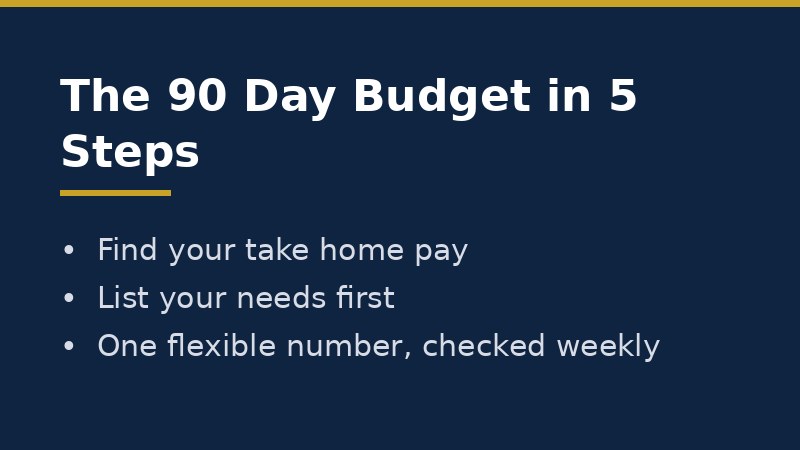
The 90 Day Budget in 5 Steps
Step 1: Find Your Take Home Pay
Your budget starts with the money that actually reaches your bank account. Take home pay is your pay after tax and other money taken out before you are paid. If your pay changes from month to month, use the average of the last three months.
Add up every source of regular income: your main job, any regular side income, and any regular benefit or support. Leave out one off money, like a gift or a tax refund, because you cannot count on it every month. Your budget must work on your normal pay alone.
If you have never made a budget before, our guide on how to create a monthly budget walks through this step in more detail.
Step 2: List Your Needs First
Needs are the bills you must pay to live and work. Rent, utilities, groceries, transport, phone, and minimum loan payments all belong here. Write down each one with its monthly amount. Use your bank statements from the last two or three months to get real numbers, not guesses.
Add the needs up. If the total is more than 60 percent of your take home pay, money will feel tight, and that is useful to know. It does not mean the budget is broken. It means you need to be honest about how much room is left for wants and saving.
Step 3: Give Yourself One Flexible Number
Flexible spending is the money for food beyond basic groceries, fun, clothes, and small extras. Instead of tracking ten small categories, give yourself one flexible number for the month, then divide it by four to get a weekly amount.
This single number is the heart of the 90 day budget. When you check your budget each week, this is the number you check. If the weekly amount is right, the whole budget holds. If it is wrong, you will see it in the first two weeks, and you can fix it early.
Step 4: Set Your Saving Amount Before the Month Starts
Saving works best when it happens first, not with whatever is left at the end of the month. Pick a saving amount you can keep even in a tight month, even if it is small. A small amount saved every month beats a large amount saved once and then stopped.
If you are building an emergency fund, read our guide on how much to keep in an emergency fund to pick a first target. If you already have a small cushion, the same saving amount can go toward a goal, like a holiday or a deposit. You can read about saving for a goal in our guide on how to save for a vacation.
Step 5: Set a Weekly Check, Same Day Every Week
Pick one day and one time each week, for example Sunday evening for five minutes. In that check, look at three numbers only: how much flexible money you have spent this week, how much is left for the rest of the month, and whether any bill is coming up that you forgot.
Write the numbers down, even in a simple note on your phone. Writing them down is what turns a guess into a plan. After four weekly checks, you will know whether your flexible number is right.
A Worked Example: A 90 Day Budget in Real Numbers
Here is a worked example with real math, so you can copy the steps with your own numbers.
Imagine your take home pay is $3,600 a month.
Step 1: Needs. Rent is $1,200, utilities are $180, groceries are $420, transport is $200, phone is $60, and a minimum loan payment is $140. Add them up: $1,200 plus $180 plus $420 plus $200 plus $60 plus $140 equals $2,200. Needs are $2,200 a month.
Step 2: Saving. You choose $400 a month for your emergency fund. That is about 11 percent of your take home pay. It is not a huge amount, but it is an amount you can keep.
Step 3: Flexible spending. Take home pay minus needs minus saving gives the flexible number. $3,600 minus $2,200 minus $400 equals $1,000. Your flexible spending is $1,000 a month. Divide by four weeks: $1,000 divided by 4 equals $250. Your weekly flexible amount is $250.
Step 4: The 90 day test. In month one, you spend $290 in the first week, $40 over the weekly amount. You do not quit. You spend $210 the next week, and the two weeks average $250. At the end of month one, flexible spending totals $1,040, which is $40 over. You raise the monthly flexible number to $1,040 and lower saving to $360 for month two, or you keep saving at $400 and accept $40 less for fun. Either fix is fine. The point is that you made a small fix instead of dropping the budget.
By month three, the weekly amount feels normal, and the checks take five minutes. That is what a budget you can follow looks like.
What to Do When You Go Over Budget
Going over budget will happen, probably in the first month. It does not mean you failed. It means the plan needs a small fix.
First, find out why. Was it a one off cost, like a car repair or a birthday, or was it a pattern, like eating out four times a week? A one off cost needs no change to the plan. A pattern needs a small change.
Second, move the extra amount to the next week. If you spent $40 over this week, spend $40 less next week. If you spent $100 over, spread the fix over two weeks. This keeps the monthly total on track without a week of zero spending.
Third, if you go over most weeks, raise the flexible number. A budget that is too low will fail every week, and a budget that fails every week will be dropped. Raise it by a small amount, test it for a month, and see if it holds. For more on fixing a budget that keeps breaking, read our guide on why your budget fails every month.
How to Keep Going After Day 90
After 90 days, you have three months of real spending data. That is enough to set a budget for the next three months with confidence.
Look at your three monthly totals for flexible spending. Use the middle month, not the lowest one, as your new monthly number. The lowest month was probably a lucky month. The middle month is your real life.
Then pick one improvement for the next 90 days. It could be raising your saving amount by $50, cutting one regular cost, or setting a new goal. One change per quarter is enough. Twelve small changes over a year add up to a much stronger budget.
If your income changes, or a big cost changes, redo the five steps with the new numbers. A budget is not a fixed document. It is a plan you update when life changes.
FAQ
How much should I save in a 90 day budget?
Save an amount you can keep even in a tight month. For many beginners, $100 to $400 a month is a realistic start, depending on income. A small amount saved for 90 days in a row is better than a large amount saved once. You can raise it after the first 90 days, when you know what your spending really looks like.
What if my income changes every month?
Use the average of your last three months as your take home pay for the plan. In a good month, put the extra money toward saving before you spend it. In a low month, cut flexible spending first and keep needs and saving steady. A weekly check matters even more when income changes, because it catches a short month early.
Should I track every purchase for 90 days?
No. Track only your weekly flexible total. Check your bank balance once a week, add up the flexible spending, and compare it to your weekly amount. Tracking every coffee will wear you out. Tracking one weekly number will keep you going.
What is a good weekly check routine?
Pick a fixed day and time, and check three numbers: flexible money spent this week, flexible money left this month, and any bill due before the next check. Write the numbers down. Five minutes is enough. If you miss a week, just do the check the next week. Missing one check does not break the plan.
Can I use the 50-30-20 rule for a 90 day budget?
Yes. The 50-30-20 rule is a simple guide: about 50 percent of take home pay for needs, 30 percent for wants, and 20 percent for saving and extra debt payments. You can read more in our guide to what the 50-30-20 budget rule is. Use it as a starting point, then adjust the numbers to fit your real costs over the 90 days.
Conclusion
A budget you can follow for 90 days is a simple one: take home pay, needs, one flexible number, a saving amount, and a five minute weekly check. Give it a full 90 days before you judge it. Fix one small thing at a time when the numbers do not fit. By day 90, you will have a plan built on your real spending, and a habit that can carry you into the next 90 days.
This article is for general information and education only. It is not legal or financial advice.
