

Can Side Income Replace a Full-Time Job?
The Short Answer
Yes, side income can replace a full-time job, but it should not happen in one jump. It happens in stages: first the side income covers a bill, then it covers a month of expenses, then it covers your full pay for several months in a row, and only then do you think about leaving your job. Most people who replace a job with side income took months or years to build it, while the job paid the bills. The job is the safety net that lets the side income grow without pressure.
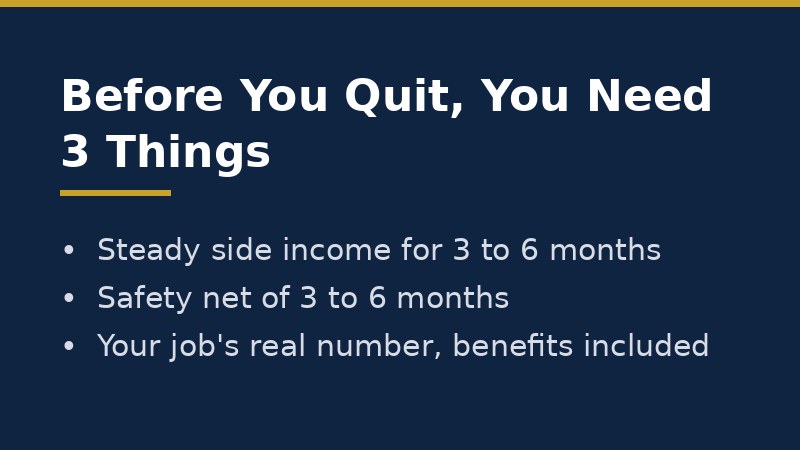
Before you quit, you need three things: a side income that has paid you steadily for at least three to six months, a safety net of three to six months of expenses, and a clear number for what your job really pays you, including benefits like health cover and retirement contributions. If any of those three is missing, keep the job and keep building.
Why the Jump Feels Tempting, and Why It Is Risky
A side income that earns $500 in its best month feels like freedom. But one good month is not a job replacement. Side income goes up and down. Clients leave, platforms change their rules, and slow months happen. A full-time job pays the same amount every month, plus benefits. A side income has to beat the job’s total value, not just its monthly pay, and it has to do it for months in a row.
The risk is not just money. A job also gives you structure, colleagues, and a routine. People who quit too early often find that the freedom they wanted turns into stress, because every slow week feels like a threat. Building the side income while the job pays the bills removes that pressure, and the side income grows faster when you are not desperate for it to pay the rent.
Stage 1: The Side Income Pays for Itself
In the first stage, the side income covers its own costs and a little more. If you spend $50 a month on tools or a website, the side income should earn more than $50. This stage proves the idea works and that someone will pay for it.
Pick a side income that fits your skills and your time. Our guide on how to choose a side income that fits your skills explains how to pick one, and our guide on what the simplest side income is for beginners lists easy starting points. If you are starting from nothing, our guide on how to start a side income with no money shows the cheapest ways in.
Stage 2: The Side Income Covers a Real Bill
In the second stage, the side income pays a real monthly bill, like your phone, your groceries, or your car payment. This is the stage where the income starts to matter, and where you learn whether it is steady or seasonal.
Track the income every month. Write down what you earned, what you spent to earn it, and how many hours it took. That record tells you your real hourly rate. If you earned $400 in a month and spent 20 hours on it, your rate is $20 an hour. If your job pays $25 an hour, the side income is not yet beating the job. Our guide on how much time a side income really takes helps you work out the hours honestly.
Stage 3: The Side Income Covers Your Full Pay
The test that matters is this: can the side income cover your full monthly pay, after tax and after its own costs, for three to six months in a row? Not one month. Three to six months.
Work out your job’s real number first. Take your monthly take home pay, then add the value of benefits you would lose: health cover, retirement contributions, paid time off, and any bonus. If your take home pay is $3,000 a month and your benefits are worth $600 a month, your side income needs to earn about $3,600 a month, after its own costs and after tax, to truly replace the job.
That number surprises most people. It is higher than the pay cheque alone, because the job pays for things you do not see on the pay slip. Be honest about it now, or you will feel the gap later.
A Worked Example: The Replacement Number in Real Math
Here is a worked example with real math, so you can work out your own replacement number.
Imagine your job pays $3,200 a month after tax. Your employer pays $400 a month toward your health cover and $200 a month into your retirement account. Your job’s total value is $3,200 plus $400 plus $200, which is $3,800 a month.
Your side income is freelance design work. In a good month it earns $2,000. But it costs $200 a month in software and fees, and you set aside 25 percent for tax. Tax on $2,000 is $500. So your side income after costs and tax is $2,000 minus $200 minus $500, which is $1,300 a month. That is real money, but it is far from the $3,800 your job is worth.
To replace the job, the side income needs to earn enough that $1,300 becomes $3,800 after costs and tax. Working backwards: if costs stay at 10 percent and tax at 25 percent, you keep about 65 percent of what you earn. $3,800 divided by 0.65 equals about $5,846. Your side income needs to earn about $5,850 a month before costs and tax to truly replace the job. That is almost three times the current $2,000.
That gap is normal. It does not mean the side income has failed. It means you need more clients, higher prices, or a second income stream before the job can go. The math tells you how far you have to go, and that is useful, because it stops you from quitting too early.
The Safety Net You Need Before You Quit
Even when the side income covers your pay, do not quit without a safety net. Aim for three to six months of essential expenses in a separate savings account. Essential expenses are rent, utilities, groceries, transport, and minimum loan payments. If those add up to $2,500 a month, your safety net should be $7,500 to $15,000.
The safety net covers slow months, lost clients, and surprises. Without it, one bad month forces you back into a job in a panic, often a worse job than the one you left. With it, a bad month is a problem you can solve calmly.
You can read how to build that fund in our guide on how to build an emergency fund from zero, and how much to keep in our guide on how much to keep in an emergency fund.
The Practical Steps to Get There
Raise your prices slowly. Most side incomes undercharge at first. A small price rise, tested with new clients, is the fastest way to close the gap between your side income and your job’s value. If you are not sure how to price your work, our guide on how to price your first freelance service shows the steps.
Get more than one client, or more than one income stream. One client who pays half your income is a risk. If that client leaves, your income halves overnight. Three or four clients, or two different kinds of side income, spread the risk. Our guide on how to grow a side income past the first client explains how to add the second and third client.
Set aside tax from day one. Side income is usually taxed, and the tax bill arrives later. Put aside 20 to 30 percent of every payment into a separate account, so tax time is not a shock. Our guide on how to track side income for tax in simple terms shows a simple system for this.
Test the life before you quit. Take a week of holiday and live on your side income routine for that week. Work the hours you would work, earn what you would earn, and see how it feels. A test week tells you more than a hundred articles about freedom.
Traps to Avoid
The biggest trap is quitting on one good month. A single month of strong earnings is not a pattern. Wait for three to six steady months, and check that the income covers your full job value, not just your pay cheque.
Another trap is forgetting the costs of working for yourself. Health cover, retirement saving, sick days, and holidays all cost money when you are on your own. Add them to your replacement number before you decide.
A third trap is a side income that depends on one platform. If a marketplace, a social media site, or a single client controls your income, a rule change can cut it overnight. Build your own client list and your own way to reach customers, so no single platform can switch you off.
Watch out for scams that promise fast replacement income. Real side income grows slowly. Any offer that promises you can quit your job in 30 days is almost always a scam. Our guide on how to avoid side income scams lists the warning signs.
FAQ
How long does it take for side income to replace a job?
It usually takes months or years, not weeks. Most people need one to three years of steady building, while the job pays the bills. The time depends on the skill, the prices, and the hours you can give it. A side income that replaces a job in three months is rare, and usually means the person already had clients or a large audience.
How much side income do I need before I quit my job?
Your side income needs to cover your take home pay plus the value of your benefits, after its own costs and after tax, for three to six months in a row. On top of that, you need a safety net of three to six months of essential expenses. If your job is worth $3,800 a month in total, your side income needs to clear $3,800 a month after costs and tax, not just earn $3,800 before costs.
Should I quit my job to focus on side income full time?
Only after the side income has passed the test above. Quitting to focus sounds brave, but it adds pressure that often makes the work worse. Building while employed is slower, but it is safer, and the side income grows better when it does not have to pay the rent from day one.
What is the safest side income to replace a job with?
The safest is one with many small clients, low costs, and skills you already have. Freelance work, tutoring, and selling a skill you own are safer than a single product or a single platform. Whatever you choose, spread the risk across more than one client and more than one way of finding work.
What if my side income drops after I quit?
That is what the safety net is for. Use it to cover the gap while you find new clients or adjust your prices. If the drop lasts more than three months, treat it as a signal to change the plan: lower your costs, raise your prices, add a new income stream, or take part time work while you rebuild. A safety net buys you time to fix the problem instead of panicking.
Conclusion
Side income can replace a full-time job, but the safe path is slow and tested. Build it while the job pays the bills. Let it cover a bill, then a month of expenses, then your full pay, including benefits, for three to six months in a row. Save a safety net of three to six months of expenses before you quit. Work out your real replacement number, with tax and costs included, and do not quit on one good month. That is how side income becomes a job replacement, instead of a gamble.
This article is for general information and education only. It is not legal or financial advice.
