
How Do I Pay Off a Car Loan Faster?
A car loan can feel like it goes on forever, especially when most of each monthly payment seems to go to interest. The good news is that you do not need a pay rise or a windfall to finish it sooner. A small extra payment each month can cut months off the loan and save you hundreds of dollars in interest.
To pay off a car loan faster, pay more than the minimum each month and ask your lender to apply the extra money to the principal, which is the amount you still owe on the car. Even $50 extra a month makes a real difference. The worked example below shows how an extra $100 a month on a $25,000 loan saves $865.44 in interest and finishes the loan 11 months sooner.
How Does a Car Loan Work?
A car loan is a simple interest loan in most cases. That means interest is charged each month on the balance you still owe. Your monthly payment is split into two parts: interest for that month, and principal, which lowers what you owe.
Early in the loan, the balance is high, so the interest part is bigger and the principal part is smaller. As the balance falls, the interest part shrinks and more of each payment goes to principal. This is why extra payments are so powerful. Every extra dollar goes straight to the principal, which lowers the balance, which lowers the next month of interest, and so on.
Loan terms are usually 36, 48, 60, or 72 months. A longer term means a lower monthly payment, but far more interest over the life of the loan.
Before you start, find your loan details: the balance, the interest rate, the monthly payment, and the payoff date, from your monthly statement or your lender’s website. You need these numbers to plan. The Consumer Financial Protection Bureau has free auto loan tools that explain how car loans work and what to check before you sign or change anything. The Federal Reserve publishes average new car loan rates in its G.19 consumer credit release, so you can check current rates before you shop for a loan.
Step 1: Check for a Prepayment Penalty
Before you pay extra, check that your loan has no prepayment penalty. A prepayment penalty is a fee some lenders charge if you pay the loan off early, and it can wipe out the savings from extra payments.
Look at your loan agreement, or call your lender and ask two questions: is there a prepayment penalty, and will extra payments be applied to the principal? Most car loans today have no prepayment penalty, but confirm it in writing.
Also ask how to make sure the extra money goes to principal. Some lenders apply extra money to your next payment instead, which does not help you as much. Ask them to apply any extra amount to the principal balance, and check your next statement to confirm they did.
Step 2: Pay a Little Extra Every Month
The simplest way to pay off a car loan faster is to add a fixed extra amount to your monthly payment. Pick an amount you can keep paying every month, even in a tight month, and set it up automatically so you do not have to remember it.
Start small if you need to. An extra $25 a month still helps. If you can manage $50 or $100, the savings grow fast, as the worked example below shows.
A useful trick is to pay the extra amount on the same day as your normal payment, so it becomes one habit. Our guide on paying off debt faster with extra payments explains more ways to do this.
If you have more than one debt, think about which one to attack first. The debt avalanche method says to pay extra on the highest interest debt first, while paying the minimum on the rest. If your car loan has the highest rate, it is the right target.
Worked Example: An Extra $100 a Month on a $25,000 Loan
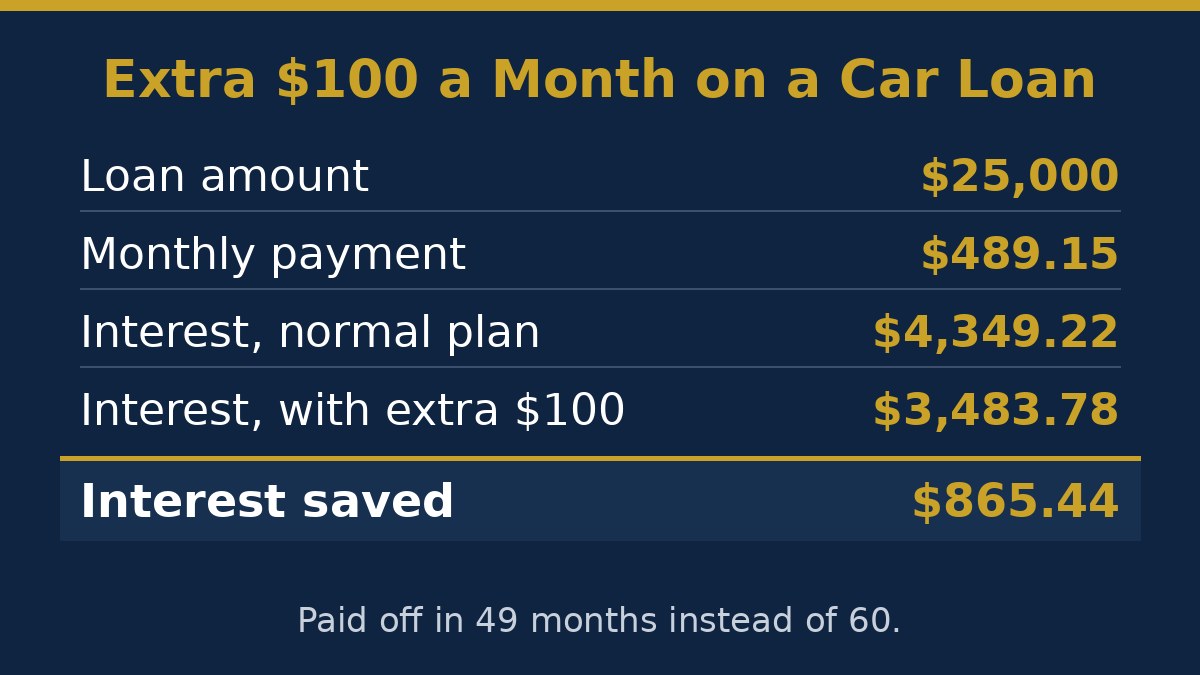
Here is a worked example with real math. It uses a car loan of $25,000, an annual interest rate of 6.5%, and a term of 60 months. Change the figures to match your own loan, and the method stays the same.
First, the normal payment. With a monthly rate of 6.5% divided by 12, the monthly payment works out to $489.15.
- Loan amount: $25,000
- Annual interest rate: 6.5%
- Term: 60 months
- Monthly payment: $489.15
- Total paid over 60 months: $489.15 times 60 equals $29,349.22
- Total interest paid: $29,349.22 minus $25,000 equals $4,349.22
Now add an extra $100 a month, so the monthly payment becomes $589.15, with the extra $100 applied to the principal each month.
- New monthly payment: $489.15 plus $100 equals $589.15
- Loan paid off in: 49 months, instead of 60
- Total paid: $28,483.78
- Total interest paid: $28,483.78 minus $25,000 equals $3,483.78
- Interest saved: $4,349.22 minus $3,483.78 equals $865.44
- Time saved: 60 minus 49 equals 11 months
So $100 extra a month saves $865.44 in interest and frees you from the payment 11 months sooner. That is almost a full year without a car payment, which you can then save or put toward your next goal.
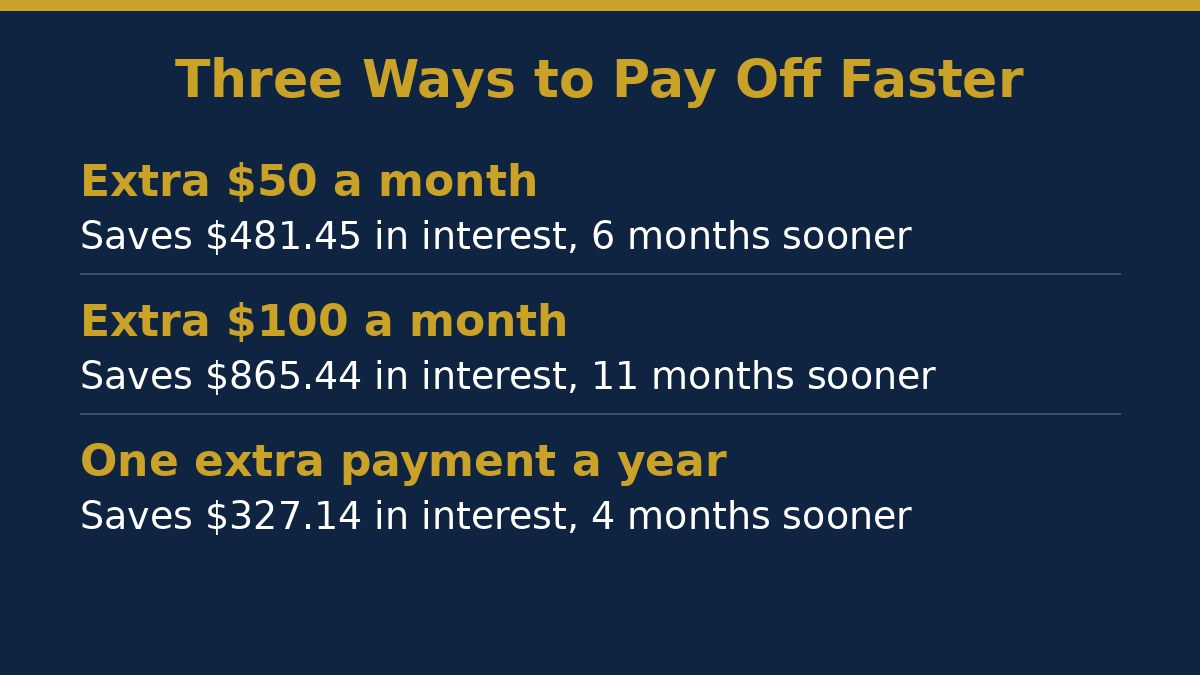
A smaller extra amount still helps. An extra $50 a month pays the loan off in 54 months and saves $481.45 in interest. Even rounding your payment up to $500 saves $114.33 and finishes the loan 1 month sooner. Any extra amount, paid every month, moves the finish line closer.
If you want a full plan for all your debts, not just the car loan, read our guide on how to make a debt payoff plan. It shows how to list every debt, pick the order, and set a monthly extra payment you can keep.
Step 3: Make One Extra Payment Each Year
If a higher monthly payment feels too tight, make one extra full payment each year instead, from a tax refund, a work bonus, or a little saved each month in a separate account.
In the worked example, one extra payment of $489.15 each year pays the loan off in 56 months instead of 60, and saves $327.14 in interest. That is 4 months sooner, from a single extra payment a year.
The biweekly trick gives you the same result automatically. Pay half your monthly payment every two weeks, and you will make 26 half payments in a year, which equals 13 full monthly payments. Check with your lender first, because some lenders hold biweekly payments and only apply them once a month. Ask them to apply each half payment when it arrives.
Step 4: Round Up Your Monthly Payment
Rounding up is the easiest extra payment of all, because it feels small. If your payment is $489.15, round it up to $500. That is only $10.85 extra a month, and in the worked example it saves $114.33 and finishes the loan 1 month sooner.
If your payment is $312.40, round it up to $325 or $350. Pick a round number that feels easy, and set the automatic payment to that amount. You will barely notice the difference, but the loan will still end sooner.
Rounding up works best when it is automatic. Change the automatic payment to the rounded amount, confirm the extra goes to principal, and check one statement to make sure it worked.
Step 5: Send Windfalls Straight to the Loan
Windfalls are money that arrives outside your normal pay: a tax refund, a work bonus, cash back, a rebate, or money from selling something you no longer need. These are the easiest extra payments to make, because the money was never in your budget.
When a windfall arrives, send at least part of it to the car loan the same day, before you spend it on something else. A $500 tax refund sent to the principal cuts the balance at once, and every month after that charges interest on a smaller balance.
You do not have to send the whole windfall. A simple split is to send half to the loan and keep half for fun or saving. If you send something extra every time unexpected money arrives, the loan will end months sooner.
Step 6: Refinance Only When the Numbers Truly Improve
Refinancing means taking out a new loan to pay off the old one, usually to get a lower interest rate or a shorter term. It can help you pay off the car faster, but only when the new loan is clearly better.
Refinancing may be worth it if your credit score has improved since you bought the car, or if interest rates have fallen. A lower rate means more of each payment goes to principal. Our guide on what a credit score is in simple terms explains how scores work, and the Consumer Financial Protection Bureau guide to getting an auto loan explains what to compare when you shop for a new loan.
Do not refinance into a longer term just to lower the payment, because you will pay interest for more months and the total cost often goes up. Only refinance when the new loan has a lower rate, the same or a shorter term, and no large fees. And keep paying the old amount on the new loan if you can: if the new payment is $430 and the old one was $489.15, keep paying $489.15, and the extra $59.15 a month is a built-in extra payment.
Also check whether your current loan has a prepayment penalty before you refinance, and count any fees on the new loan. If the fees are more than the interest you would save, refinancing is not worth it.
Mistakes to Avoid When Paying Off a Car Loan
Paying a car loan off faster is simple, but a few mistakes can slow you down or cost you money.
- Paying extra without telling the lender to apply it to principal. Always confirm in writing that extra payments go to principal, or you will not save as much interest.
- Ignoring a prepayment penalty. Check your loan agreement first. A penalty can cancel out the interest you save.
- Skipping a payment on another debt to pay extra on the car. Late payments damage your credit score and can add fees.
- Paying extra on the car loan while a higher rate debt sits unpaid. If a credit card charges a much higher rate, pay that first. The debt avalanche method explains how to order your debts by interest rate.
- Extending the loan to lower the payment. A longer term feels easier each month, but it costs far more in total interest. Shorten the loan if you can, do not lengthen it.
- Forgetting to check your statements. After you start paying extra, check your statement each month. Make sure the balance is falling faster and the extra money went to principal.
- Using all your savings to pay off the car. Keep an emergency fund. If you empty your savings to clear the loan and then the car needs a repair, you will be back in debt. Pay extra from your monthly cash flow, not from your emergency money.
Frequently Asked Questions
Can I pay off my car loan early?
Yes, you usually can. Check your loan agreement for a prepayment penalty, then pay extra each month and ask your lender to apply the extra money to the principal.
How much extra should I pay on my car loan each month?
Pay what you can keep paying every month. Even $50 extra a month helps. In the worked example in this guide, $50 extra saves $481.45 in interest and finishes the loan 6 months sooner, while $100 extra saves $865.44 and finishes it 11 months sooner.
Does paying extra on a car loan lower the monthly payment?
No, your monthly payment usually stays the same. Extra payments shorten the loan instead, so you make fewer payments in total and pay less interest. You finish sooner, and then the payment stops completely.
Is it better to pay off a car loan or save the money?
If you have no emergency fund, build a small one first, because a surprise bill without savings can push you back into debt. After that, paying extra on the loan is usually a good use of spare money, because it saves you interest at the loan rate. If you have higher rate debt, such as a credit card, pay that first.
Will paying off my car loan early hurt my credit score?
Paying off a loan can change your credit mix, and your score may dip a little for a short time after the loan closes. But paying on time every month helps your payment history, which matters most. A small short term dip is not a reason to keep paying interest you do not need to pay.
Should I refinance my car loan to pay it off faster?
Refinancing can help if you can get a clearly lower interest rate and a term that is the same or shorter, with no large fees. Do not refinance into a longer term just to lower the payment, because you will usually pay more interest in total. Compare the total cost of the new loan with the total cost of keeping the old one, and only switch when the new loan is cheaper overall.
What happens after I pay off my car loan?
Your lender should send you the car title, which proves you own the car outright. Keep the title in a safe place. Your monthly payment stops, so send that money to your next goal, such as an emergency fund, another debt, or saving for your next car. The same extra payment habit works for a personal loan too, and our guide on how to pay off a personal loan faster shows how.
Conclusion
Paying off a car loan faster comes down to one simple habit: pay more than the minimum, and make sure the extra money goes to the principal. An extra $100 a month on a $25,000 loan at 6.5% saves $865.44 in interest and ends the loan 11 months sooner. An extra $50 a month saves $481.45 and ends it 6 months sooner. One extra payment a year saves $327.14 and ends it 4 months sooner.
Start by checking for a prepayment penalty, then pick an extra amount you can keep paying, set it up automatically, and check your statements to confirm the extra money is cutting the principal. When a windfall arrives, send part of it to the loan. If you refinance, only do it when the new loan is clearly cheaper overall.
This article is for general information and education only. It is not legal or financial advice.
