

How Do I Budget for Christmas Without Going Into Debt?
Christmas is the season when even careful spenders can end the year in debt. Gifts, food, travel, decorations, and parties all land in the same few weeks, and the bills arrive in January, long after the fun is over.
To budget for Christmas without going into debt, set one total you can afford, split it into categories such as gifts, food, travel, and decorations, and save that total a little at a time before December. Pay with money you have saved, not with a credit card you plan to pay off later. The worked example below uses real numbers, and its total comes to $800.
How Much Should You Spend on Christmas?
There is no single dollar amount that fits everyone, because Christmas spending depends on your pay, your family size, and how many people you buy for. The right total is the amount you can pay for in cash, after bills and regular saving are covered. If paying for Christmas means skipping rent or missing a bill, the total is too high.
A useful test is the 50/30/20 budget rule, which splits take-home pay into needs, wants, and saving. Christmas sits in the wants part, with the rest of your fun money. Read our guide to the 50/30/20 budget rule to see how the split works, then check how much room your wants budget leaves for Christmas. A smaller Christmas you can afford beats a big one that follows you into the new year as debt.
Before you set a Christmas total, make sure your everyday budget is in order. Our guide on how to create a monthly budget that actually works shows the steps. Once you know what a normal month costs, you can see what is left for Christmas. The free US government budgeting page at USA.gov is a good cross-check.
Step 1: Set One Total Number First
Start with one total, not with a shopping list. A list with no total grows every time you add a name. A total keeps every gift inside the number you already chose.
Work out your total from your pay, not from what you wish you could spend. Look at what is left after bills and saving, and how many months you have until Christmas. If you can set aside $80 a month for ten months, your total is $800, because $80 times 10 equals $800. If you can only set aside $50 a month, your total is $500, because $50 times 10 equals $500. The right total is the one you can actually save.
Write the total down where you will see it, on your phone or on the fridge. Tell the people you buy for, in a kind and simple way, that you are keeping Christmas smaller this year. Most people understand, because many of them are trying to do the same thing. The Consumer Financial Protection Bureau suggests the same first step in its five-step holiday spending plan: set a budget before you shop, and count your normal bills first so you do not come up short.
Step 2: Split the Total Into Categories
Once you have a total, split it into categories. Christmas is not only gifts. Food, travel, decorations, cards, and giving all cost money, and forgetting them is how a budget breaks. Give each category its own limit.
Here are the categories most people need:
- Gifts. Usually the biggest category. List every person you buy for, with a limit next to each name. Eight people at $50 each is $400, because 8 times $50 equals $400.
- Food and hosting. Christmas dinner, baking, drinks, and snacks. If you host, this can be one of the biggest costs after gifts.
- Travel. Fuel, tickets, and parking, if you visit family or friends.
- Decorations. A tree, lights, and ornaments. Reuse what you already own first.
- Cards and wrapping. Cards, paper, tape, and gift bags. Small items add up fast.
- Giving. Donations and tips for people who help you through the year.
Add the limits together and check that they equal your total. If they add up to more, trim the biggest category first, which is usually gifts. A smaller gift list, or a lower limit per person, is the fastest fix. Our guide on how to budget for holidays and big expenses uses the same method for any big event, not just Christmas.
Step 3: Save a Little Each Month
A Christmas budget only works if the money is saved before December. Saving $80 a month feels easy, finding $800 in December feels hard. Start early and make the saving automatic.
Open a separate savings account, or a pot in your banking app, and call it your Christmas fund. Set up an automatic transfer on payday, so the money moves before you can spend it. In the worked example below, $80 a month for ten months, from January to October, builds the full $800. If you start in July, you need $160 a month for five months, because $160 times 5 equals $800. If you start in October, you need about $267 a month for three months, because $800 divided by 3 equals about $267. The later you start, the bigger each transfer, so the best time to start is now.
Do not take the money from your emergency fund. That fund is for real emergencies, such as a broken car or a lost job, not for gifts. If you are not sure how much to hold back for surprises, read our guide on how much to keep in an emergency fund. A Christmas fund and an emergency fund are two different pots, and you need both.
If you like to track saving week by week, our guide on how to set a weekly budget instead of a monthly one shows a simple way to do it. Saving $20 a week for 40 weeks also reaches $800, because $20 times 40 equals $800.
Worked Example: An $800 Christmas Budget
Here is a full worked example, using a monthly take-home pay of $3,400 and a Christmas total of $800. Change the figures to match your own pay and family.
Split the $800 total into categories:
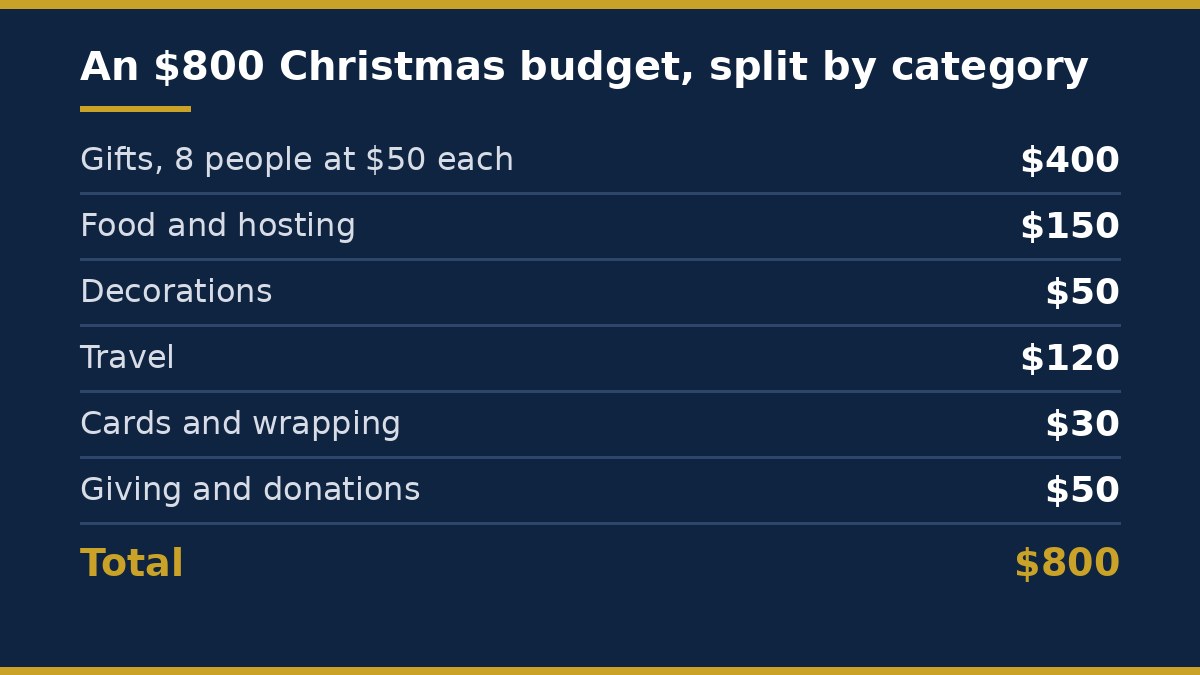
- Gifts, 8 people at $50 each: $400
- Food and hosting: $150
- Decorations: $50
- Travel: $120
- Cards and wrapping: $30
- Giving and donations: $50
- Total: $400 plus $150 plus $50 plus $120 plus $30 plus $50 equals $800.
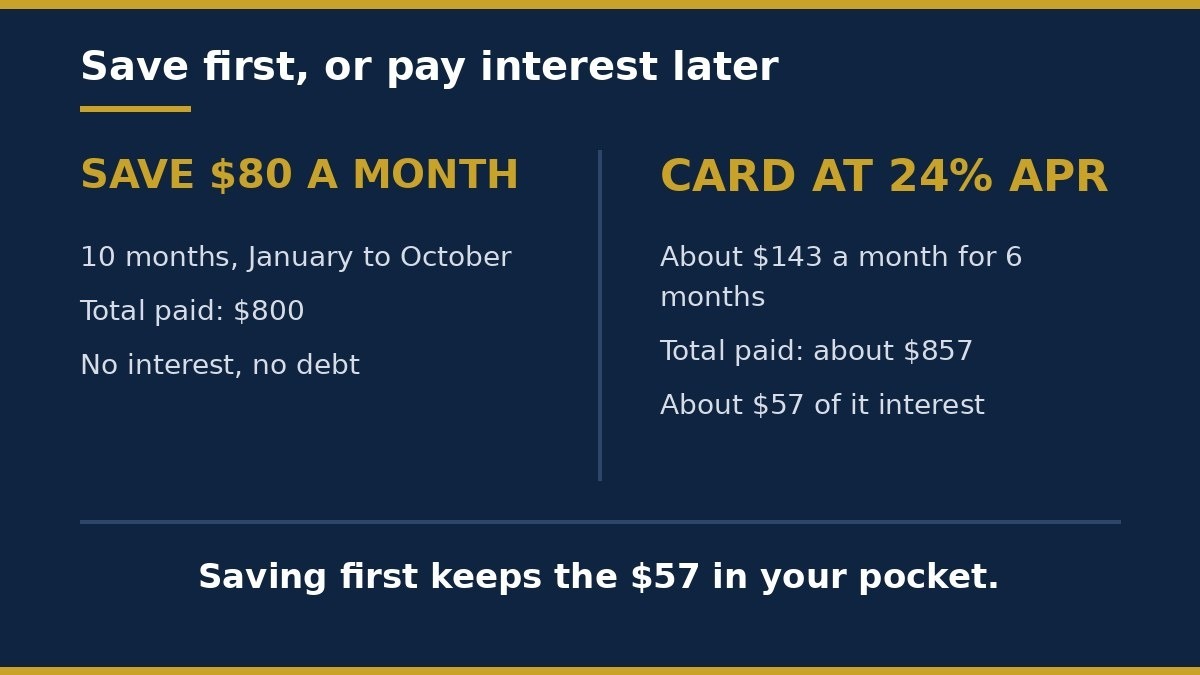
Now the saving plan. Save $80 a month for ten months, from January to October, and you reach $800, because $80 times 10 equals $800. That $80 is about 2.4 percent of the $3,400 take-home pay here, because $80 divided by $3,400 equals about 0.024. A small, steady amount each month beats one large payment in December.
Check the total against your pay. The $800 total is about 24 percent of one month of take-home pay, because $800 divided by $3,400 equals about 0.235. That is a fair share for a year of saving, but a painful share to find in one December paycheck. That is why the saving plan matters as much as the total. If $800 is too much for your pay, lower the total and the gift limits to match.
What Christmas Costs on a Credit Card
Paying for Christmas on a credit card feels easy in December and expensive in January. Interest turns a gift budget into a bigger bill, and minimum payments stretch it out for months.
Take the same $800. If you put it on a credit card at 24 percent APR and pay it off over six months, each payment is about $143, because interest adds about $57 to the total. You pay about $857 in all, because $800 plus about $57 equals about $857. That is $57 of interest for gifts already opened and put away.
If you only pay the minimum each month, it costs far more, because most of the payment goes to interest and the balance falls slowly. A card can turn one Christmas into debt that is still there at Easter. The Consumer Financial Protection Bureau makes the same point: leave the credit card at home unless you have a plan to repay the debt, and bring only the cash you plan to spend.
The cheapest way to pay for Christmas is with money saved in advance. The next cheapest is to pay a card balance in full on the first statement, before interest is charged. The most expensive way is to pay it off slowly over many months. If you still have Christmas debt from last year, pay that off first, and keep this year smaller until the old balance is gone.
6 Ways to Cut Christmas Costs Without Cutting the Joy
You do not have to spend less joyfully, only more cleverly. These six ideas cut the cost without cutting the meaning of the season.
- Draw names instead of buying for everyone. Eight people buying for everyone spend $400 at $50 a gift, because 8 times $50 equals $400. With a name draw, each person buys one $50 gift, so each person spends only $50.
- Make some gifts by hand. Baked goods, a photo book, or a handmade card can mean more than a shop-bought gift, for far less money.
- Shop the sales early. Start in October or November, watch prices, and buy when the price drops. Avoid panic buying in the last week, when prices are high and choices are few.
- Use cash envelopes. Put the cash for each category in a labelled envelope, and stop when it is empty. Cash makes the limit real in a way a card never does.
- Host a potluck instead of cooking everything yourself. Ask each guest to bring one dish, so everyone shares the cost.
- Reuse decorations. Last year tree, lights, and ornaments still work. Buy only what is broken or missing, and store them carefully in January.
Food is one of the easiest places to save, because a Christmas meal feeds a crowd and small choices add up. Our guide on how to cut food spending without cutting meals has ideas that work for a holiday table too, such as planning the menu first and buying only what it needs.
What to Do If Christmas Is Only Weeks Away
If you are reading this in late November or December, do not give up on the budget. A late budget still beats no budget, and a smaller Christmas beats a Christmas on credit.
First, set a total you can pay in cash right now, even if it is smaller than you hoped. Then cut the list. Buy for children and close family first, and give cards or homemade gifts to everyone else. Agree a low limit, such as $25 each, and stick to it. Eight people at $25 each is $200, because 8 times $25 equals $200, half the $400 gift budget in the worked example.
Second, pay with cash or a debit card only. Leave the credit card at home when you shop, so you cannot spend money you do not have. Check your spending after every trip, and move money between categories if one runs short and another has spare cash.
Mistakes to Avoid at Christmas
Most Christmas debt comes from a few common mistakes.
- Having no total. Without a total, every gift feels small on its own, and the spending adds up fast.
- Forgetting food and travel. Gifts are only part of Christmas, and food, travel, and hosting can add hundreds of dollars never in the plan.
- Buying on credit with no payoff plan. A card is only safe if you can pay the full balance on the first statement.
- Raiding the emergency fund. Christmas is a planned event, not an emergency. Use a Christmas fund instead.
- Buying for everyone at the same level. Close family and coworkers do not need the same size gift. Set different limits for each group.
- Panic buying in the last week. Late shopping means higher prices and rushed choices.
Frequently Asked Questions
How much should I budget for Christmas?
Spend only what you can pay for in cash after bills and regular saving are covered. In the worked example here, the total is $800: gifts $400, food and hosting $150, decorations $50, travel $120, cards and wrapping $30, and giving $50. Your own total depends on your pay and your gift list.
How do I save for Christmas if I live paycheck to paycheck?
Start with $10 or $20 a week, and set up an automatic transfer on payday. Saving $20 a week for 40 weeks reaches $800, because $20 times 40 equals $800. If even $20 a week is too much, cut one small weekly cost, such as one takeaway coffee, and move that money into your Christmas fund instead.
Is it okay to use a credit card for Christmas gifts?
It is only safe if you can pay the full balance on the first statement, before interest is charged. Paying $800 off over six months at 24 percent APR costs about $857 in total, with about $57 of it interest. If you cannot pay in full, save first and pay with cash instead.
When should I start saving for Christmas?
Start in January, as soon as the last Christmas is over. Saving $80 a month for ten months, from January to October, builds $800, because $80 times 10 equals $800. Starting early keeps each amount small.
How do I tell my family I am spending less this year?
Be honest and simple. Say you are keeping Christmas smaller this year so you can start the new year without debt, and suggest a lower limit per person, or a name draw. Most families welcome the idea, because it takes the pressure off everyone.
What if I already went into debt last Christmas?
Pay off the old balance first, before you plan new Christmas spending. Keep this year small, pay with cash, and use a name draw or homemade gifts to cut the gift list. Once the old debt is gone, open a Christmas fund in January and save a little each month, so next Christmas is paid for before December.
Conclusion
Budgeting for Christmas without going into debt comes down to three steps: set one total you can afford, split it into categories, and save it a little at a time before December. In the example here, the total is $800, saved at $80 a month for ten months, and paid for in cash. The same method works at $500 or at $1,000. Start early, keep the list small, pay with money you already have, and enjoy a Christmas that does not follow you into the new year as debt.
This article is for general information and education only. It is not legal or financial advice.
