
How Do I Pay Off Debt on a Low Income?
Yes, you can pay off debt on a low income, and you do it with a small, steady plan rather than a large payment you cannot keep up. The goal is not to clear everything at once. The goal is to stop the balance from growing, pay a little more than the minimum every month, and keep going until one debt is gone. Then you move the same payment to the next debt. That simple order is what turns a tight budget into real progress.
Low income does not mean you have no options. It means your plan has to fit your real numbers. A plan that asks for 200 dollars you do not have will fail in week one. A plan that asks for 25 dollars you do have can work for a year.
Start With the Full Picture
Before you pay anything extra, write down every debt you owe. For each one, note the lender, the balance, the interest rate, the minimum payment, and the due date. Many people skip this step because it feels uncomfortable, but you cannot build a plan from a guess. A list on paper is the start of control, and it is also the first time many people see the whole problem clearly.
Check each statement for mistakes. Look for a balance that looks wrong, a fee you do not recognise, or a payment that was not recorded. If something looks wrong, call the lender and ask them to explain it. Keep notes of who you spoke to and what they said.
Then add up your monthly income after tax. Include your main job, any regular extra work, and any benefits you receive. Use the lowest normal month, not the best month, so your plan still works when income dips. If your income changes from month to month, use the average of the last three months and keep a small buffer for the months that come in lower.
Build a Budget That Leaves Room for Debt
A budget on a low income is not about cutting everything you enjoy. It is about knowing where the money goes and choosing what matters most. Start with the costs you must pay first: rent or mortgage, food, transport to work, utilities, and any medicine you need. These come before extra debt payments, because missing them creates new problems.
Next, look at the flexible spending: eating out, streaming services, clothes, and small daily buys. Pick one or two changes you can keep, not ten changes you will drop in a week. Cooking at home three more times a week, pausing one subscription, or setting a weekly cash limit for small buys can free up 25 to 50 dollars a month.
Write your plan down in one place. A simple sheet with income at the top, needed costs next, and the debt payment last is enough. Review it once a month and change it when life changes. A budget that never changes is a budget that stops matching real life.
If your income barely covers the basics, do not skip food or medicine to pay debt faster. A plan that harms your health or your housing is not a good plan. In that case, talk to your lender or a nonprofit credit counsellor, which this guide covers later.
Pick Your Payoff Order
There are two simple ways to choose which debt to pay first, and both work. Pick the one that fits you, then stay with it.
The snowball method
Pay the smallest balance first while you pay the minimum on the rest. When the smallest debt is gone, add its payment to the next smallest. The early win keeps you going, which matters when progress feels slow. If motivation is your main problem, this method is often the better pick.
The avalanche method
Pay the highest interest rate first while you pay the minimum on the rest. This saves the most interest over time, because the most expensive debt shrinks first. If you are steady and patient and you want the lowest total cost, this method is often the better pick.
Either order beats paying only the minimum on everything. The worst choice is no choice, because minimum payments stretch a small balance over many years.
A Worked Example With Real Math
Here is what the choice looks like in numbers. This is an example only, using a small balance and a stated example rate, so you can see how the maths works.
Take a credit card balance of 1,000 dollars at an example APR of 24 percent. That is a monthly interest rate of 2 percent, because 24 divided by 12 is 2. The minimum payment is 2 percent of the balance each month, with a floor of 25 dollars, so the payment shrinks as the balance shrinks.
Option 1: pay the minimum only
Each month, interest of 2 percent is added, then the minimum payment is taken off. Because the payment falls as the balance falls, the debt shrinks very slowly. It takes 82 months, which is almost 7 years, to clear the 1,000 dollar balance. Total interest paid is 1,031.90 dollars, so total paid is 2,031.90 dollars. You pay more in interest than you borrowed in the first place.
Option 2: pay a fixed 50 dollars a month
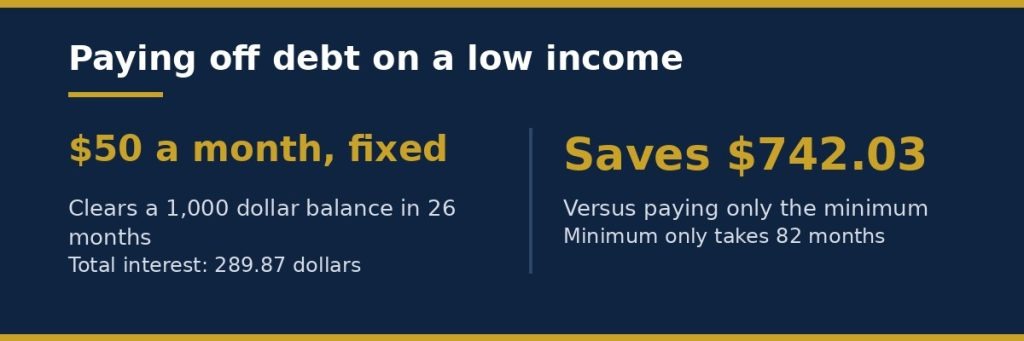
Now pay a fixed 50 dollars every month instead of the shrinking minimum. The same 2 percent monthly interest applies, but the steady payment cuts the balance much faster. It takes 26 months, which is just over 2 years, to clear the same 1,000 dollar balance. Total interest paid is 289.87 dollars, so total paid is 1,289.87 dollars.
What the difference means
The fixed 50 dollar payment saves 742.03 dollars in interest and finishes 56 months sooner. The payment is only 25 dollars more than the first minimum payment, yet the result is very different. That is why a fixed payment, even a modest one, is the heart of paying off debt on a low income. Pick the largest fixed amount you can truly pay every month, set it up as an automatic payment if you can, and let the steady habit do the work.
Your own numbers will differ, because your balance and rate will differ, but the pattern holds: a fixed payment beats a shrinking minimum payment almost every time.
Find Extra Money Without a Second Job
You do not need a second job to find a little extra for debt, though extra work can help if it fits your life. Start with money already in your home and your habits.
Sell things you no longer use, such as old phones, clothes, books, or tools. A single clear-out can bring in 50 to 100 dollars, which is a useful first extra payment or the start of a small emergency fund.
Check for money you are missing. Look for a tax refund you have not claimed, a deposit you can get back, or a benefit you qualify for but have not applied for. Ask your local council or a community advice service what help exists where you live. These checks cost nothing and sometimes find real money.
If you do want extra income, pick work that fits the hours you already have. A few hours a week of cleaning, delivery, tutoring, or online tasks can add 40 to 80 dollars a month. Put that money straight to the debt you are paying first, before it gets spent on something else.
Lower the Cost of the Debt Itself
Paying less interest is as useful as paying more each month, so it is worth asking about.
Call your lender and ask if a lower interest rate is possible, especially if you have paid on time for a while. Lenders can say no, and many do, but a short polite call costs nothing. Ask what a lower rate would mean for your monthly payment and for the total interest, and get any offer in writing before you agree to it.
Ask about a hardship plan if your income has fallen or an unexpected cost has hit you. Some lenders offer a lower payment or a paused fee for a short time. These plans can help you stay on track, but read the terms first, because a paused payment can still add interest.
A balance transfer card or a consolidation loan can lower your rate, but only if the new terms are truly better and you can pay the new payment on time. Watch for transfer fees, a low rate that ends after a few months, and any fee for paying early. If the numbers do not clearly help, do not take the new debt.
Keep One Small Emergency Fund
This sounds strange in a guide about paying debt, but a small emergency fund protects your plan. Without it, a broken car or a dental bill goes straight onto a card, and you are back where you started.
Aim for 250 to 500 dollars first, saved in a separate account you do not touch for daily spending. Save it before you push extra money to debt, or build it slowly alongside your debt payment, even 10 dollars a week. Once the small fund exists, put all extra money to the debt.
Talk to Your Lenders Early
If you cannot make a payment, call the lender before the due date, not after it. Explain what has changed, say what you can pay, and ask what options exist. Lenders deal with this every day, and a missed payment hurts your record more than an honest call made in time.
Never ignore letters or calls about a debt. Ignoring them does not make the debt go away, and it can lead to fees, a damaged credit record, or legal action. If a debt collector contacts you, ask for the debt in writing and check that the amount and the lender are correct before you agree to pay anything. The Consumer Financial Protection Bureau explains how debt collection works (https://www.consumerfinance.gov/consumer-tools/debt-collection/) in plain language.
When to Ask for Help With Debt
Some debts need more than a budget and a fixed payment. Ask for help if you cannot cover rent, food, and minimum payments at the same time, if you are using one card to pay another, or if you feel stressed every time the post arrives.
A nonprofit credit counsellor can review your full picture, help you build a plan, and in some cases set up a debt management plan with your lenders. Look for a nonprofit agency, not a company that charges large upfront fees or promises to erase your debt. The National Foundation for Credit Counseling lists nonprofit credit counsellors (https://www.nfcc.org/) who can help you find honest advice.
Free advice services exist in many areas, and a short call can tell you whether a formal plan would help or whether a simpler change is enough. Asking for help early gives you more choices than asking when the problem is already large.
Stay Motivated When Progress Feels Slow
Debt payoff is slow at the start, and that is normal. Track one number only, the total balance, on the first of each month. If you slip and miss a month, restart the next month with the same fixed payment.
Related Reading
- What Is the Debt Snowball Method? (https://investclaritypath.com/what-is-the-debt-snowball-method/)
- What Is the Debt Avalanche Method? (https://investclaritypath.com/what-is-the-debt-avalanche-method/)
- How Do I Make a Debt Payoff Plan? (https://investclaritypath.com/how-do-i-make-a-debt-payoff-plan/)
- What Is a Debt-Free Plan for the Next 12 Months? (https://investclaritypath.com/what-is-a-debt-free-plan-for-the-next-12-months/)
- When Should I Ask for Help With Debt? (https://investclaritypath.com/when-should-i-ask-for-help-with-debt/)
- What Happens If I Only Pay the Minimum on My Credit Card? (https://investclaritypath.com/what-happens-if-i-only-pay-the-minimum-on-my-credit-card/)
Frequently Asked Questions
How much should I pay toward debt on a low income?
Pay the largest fixed amount you can afford each month after your needed costs are covered. Even 25 or 50 dollars a month, paid every month without fail, beats a larger amount you can only pay once. Start with what fits, then raise it when income rises or a cost falls away.
Should I pay off the smallest debt or the highest interest debt first?
Pay the smallest balance first if you need early wins to stay motivated, and pay the highest interest rate first if you want the lowest total cost. Both methods work when you pay the minimum on the other debts and a fixed amount on the one you are clearing. Pick the one you will stick with.
Should I save money or pay debt first?
Do both in order: build a small emergency fund of 250 to 500 dollars first, then put extra money to debt. Without that small buffer, every surprise cost lands back on a card. Once the buffer exists, focus your extra money on the debt until it is gone.
Can I pay off debt if I can only afford the minimum?
You can, but it will take a long time and cost a lot of interest, as the worked example above shows. If the minimum is truly all you can pay, start by talking to your lender about a lower rate or a hardship plan, and ask a nonprofit credit counsellor to check your full picture. Even finding 10 extra dollars a month shortens the time.
What should I do if a lender will not lower my rate?
Keep paying the fixed amount you planned, and check your other costs for a small saving you can move to debt. Do not take a new loan with worse terms just to escape the old one. If the payments still do not fit, ask a nonprofit credit counsellor for help before the debt grows further.
Is it worth getting help from a credit counsellor?
Yes, if you cannot cover your needed costs and minimum payments together, or if you feel stuck and stressed about the debt. A nonprofit counsellor can review your income and debts, explain your options, and help you talk to lenders. Avoid any company that charges large fees upfront or promises to make the debt disappear.
Conclusion
Paying off debt on a low income comes down to four steady habits: list every debt, build a budget that leaves room for debt, pay a fixed amount each month, and keep going after setbacks. The worked example shows why the fixed payment matters: 50 dollars a month cleared a 1,000 dollar example balance in 26 months with 289.87 dollars of interest, while the minimum alone took 82 months and cost 1,031.90 dollars of interest. Your numbers will differ, but the lesson is the same. Start with the amount you can pay, pay it every month, clear one debt at a time, and ask for help early when you need it. Small steady steps, repeated for a year or two, can clear debts that once felt impossible.
This article is for general information and education only. It is not legal or financial advice.
