

How Do I Set a Side Income Goal That Is Realistic?
A realistic side income goal is one you can reach with the hours you truly have, at a rate someone will actually pay, in a time frame you can keep. Most goals fail because they start with a wish, not with a count of hours and a price. This guide shows you how to build a goal from your real week, your real skills, and a simple worked example, so the number on the page matches the life you live.
The Short Answer
Pick a monthly amount you can earn from hours you already have free, at a rate you can charge today, and check it every week. Start small, prove the number for one month, then raise it. A goal of 200 dollars a month that you hit is worth more than a goal of 2,000 dollars a month that you quit on in week two.
What a Realistic Goal Looks Like
A realistic goal has four parts. It names a clear amount of money, a clear time frame, a clear way to earn it, and a clear way to check progress. “Earn extra money” is not a goal. “Earn 300 dollars a month from weekend design work by the end of next month” is a goal, because you can test it.
The amount should come from your time and your rate, not from a number you saw online. Someone else earning 5,000 dollars a month from a side income does not tell you what your first month should look like. Your goal should fit your week, not theirs.
Start With Your Reason, Not a Number
Before you pick a number, write down why you want the extra money. The reason shapes the goal. Saving for a holiday needs a fixed total by a fixed date. Paying down a card needs a steady amount every month. Building a small cushion needs a regular habit more than a big number. Each reason points to a different target.
Be specific. “I want extra money” is too vague to guide a decision. “I want 150 dollars a month toward my credit card” tells you exactly what to aim for. It also tells you when you can stop pushing, and when you should keep going.
Count Your Real Hours First
Most side income goals fail on hours, not on effort. People count the hours they wish they had, not the hours they truly have. The fix is simple. Look at a normal week, not a perfect week, and count the free hours that already exist.
Start with your fixed time. Work, sleep, meals, travel, family, and chores all take hours first. What is left is your real free time. Now subtract one more layer, because life is never perfect. A sick child, a late shift, or a broken car can take a whole evening. If your week shows ten free hours, plan as if you have six or seven.
Pick a Number From Your Time and Your Rate
Your monthly goal comes from a simple formula. Hours per week times your hourly rate gives your weekly earnings. Weekly earnings times four gives a rough monthly figure. Then subtract fees and set money aside for tax, and what is left is the money you can actually plan around.
Your rate is the part most beginners guess wrong. A rate is not what you wish you could charge. It is what buyers actually pay for that work today. Check real listings, ask in a local group, or look at what similar services charge. If new writers in your area charge 20 dollars an hour, a goal built on 75 dollars an hour will not hold up.
Do not forget fees. A freelance platform, a marketplace, or a payment service often takes a share of each job. Some take 10 percent, some take more. Your goal should be built on what reaches your account, not on the headline price the client pays.
Tax is the other part beginners miss. Side income is often taxed differently from a salary, and in the United States self-employed workers may owe self-employment tax as well as income tax. The exact rules depend on your country and your situation, so check the guidance for your own case. A safe habit is to set a share of each payment aside as soon as it arrives, before you spend it.
A Worked Example With Real Math
Here is a full example, with every rate labelled as an example only. Your own numbers will be different, and that is the point. Run the same steps with your own hours and your own rate.
Maya is a beginner freelance writer. She has six free hours a week. Her example rate is 25 dollars per hour, which is what similar beginner writers charge on the platform she uses. She works four weeks in the month for this example.
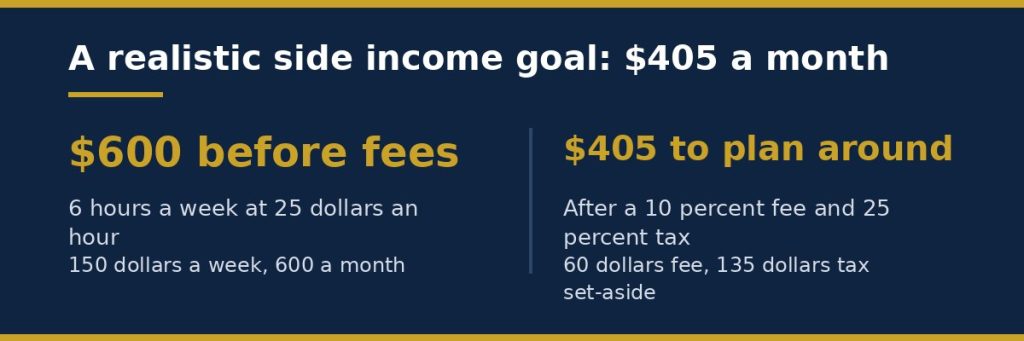
First, weekly earnings before fees and tax. Six hours times 25 dollars per hour equals 150 dollars per week.
Next, monthly earnings before fees and tax. 150 dollars per week times four weeks equals 600 dollars per month.
Now subtract the platform fee. The example platform fee is 10 percent. Ten percent of 600 dollars is 60 dollars. So 600 dollars minus 60 dollars equals 540 dollars after the fee.
Now set money aside for tax. The example tax set-aside is 25 percent of the amount after the fee. Twenty-five percent of 540 dollars is 135 dollars. So 540 dollars minus 135 dollars equals 405 dollars left after the fee and the tax set-aside.
Maya’s realistic monthly goal, after fees and after setting tax money aside, is 405 dollars. If she had set her goal at 600 dollars, she would have felt short every month, even though she did the work. The 600 dollar figure was never hers to spend. The 405 dollar figure is the one she can plan around, and she can raise it later by adding hours, raising her rate, or finding clients who pay directly with no platform fee.
Try the same math with your own numbers. Write down your hours, your rate, your fee, and your tax set-aside.
Set Three Levels: Floor, Target, and Stretch
One number is not enough. A single number turns every month into a pass or a fail, and one slow week can feel like a failure. Three levels give you room to breathe while still pushing forward.
Your floor is the minimum that keeps the habit alive. It should be low enough to reach even in a bad month, for example one finished job or 100 dollars. The floor is not the goal you brag about. It is the goal that keeps you going when life gets busy. Hitting the floor means you did not quit.
Your target is the number from the worked example above, the amount your hours and rate can produce in a normal month. This is the number you plan around and the number you report to yourself each month. It should feel doable with steady work, not easy and not exhausting.
Your stretch is the number you reach for when things go well. It might be your target plus one extra job, or your target with a small rate rise. For Maya, the stretch could be 500 dollars after fees and tax set-aside, reached by adding one more hour a week or one small extra job. The stretch is a bonus, not a test. If you miss it, the month is still a success when you hit your target.
Break the Monthly Goal Into Weekly Steps
A monthly goal is too big to act on in a single day. Break it into weekly steps, and each week into a small list of tasks. This turns a money goal into a work plan you can follow on a Tuesday evening.
Take Maya’s target of 405 dollars after fees and tax set-aside. Working backwards, she needs 600 dollars before fees and tax each month, which is 150 dollars a week. At 25 dollars an hour, that is six hours of paid work a week. But paid work is not the only time she spends. She also needs time to find clients, send messages, and fix drafts. So her weekly plan might be four hours of paid writing and two hours of finding work and answering clients.
Track It Simply Every Week
Tracking does not need a fancy app. A notebook, a notes app, or a simple spreadsheet is enough. What matters is that you record the same three things every week: hours worked, money earned before fees, and money kept after fees and tax set-aside. Those three numbers tell you everything you need to know.
Check your numbers at the same time each week, for example Sunday evening. Compare what you earned with one quarter of your monthly target, because a month has about four weeks. If you are behind by a small amount, you can add an hour or send a few more messages next week. If you are behind by a lot, you can see it early, while there is still time to fix it, instead of finding out on the last day of the month.
When to Raise or Lower the Goal
A goal is not a promise carved in stone. It is a plan you adjust as you learn. Raise it when the evidence says you can. Lower it when the evidence says you should. Both moves are smart, and neither one is failure.
Raise your target when you hit it three months in a row without strain, or when your rate rises, or when you gain regular clients who book you without a long search.
Lower your target when your life changes, for example a new job, a new baby, a health issue, or a busy season at work. Lower it when you miss the target three months in a row even though you worked the hours you planned. The problem is usually the number, not your effort. A lower goal you hit rebuilds momentum faster than a high goal you keep missing.
Mistakes That Make Goals Fail
The first mistake is copying someone else’s number. A creator online who earns 5,000 dollars a month may have an audience, a team, or years of work behind that number. Your first goal should come from your own hours and rate, not from their highlight reel.
The second mistake is counting gross income as spending money. If a client pays you 600 dollars and the platform takes 60 dollars, you did not earn 600 dollars to spend. You earned 540 dollars before tax, and less after you set tax money aside. Build your goal on the money that stays with you.
The third mistake is setting a goal with no weekly check. A monthly goal without a weekly check is a wish you remember on the last day of the month. A five minute check each week keeps the goal alive and shows problems while you can still fix them.
The fourth mistake is picking a type of side income that does not fit your hours. A job that needs you free at midday will not work if your free hours are late evenings. A job that needs fast replies will not work if you can only check messages once a day. Fit the work to your real schedule, not to a schedule you wish you had.
Frequently Asked Questions
How much should my first side income goal be?
Start with what your real hours and your real rate can produce in one month, after fees and after setting money aside for tax. For many beginners that is 100 to 500 dollars a month. Run the worked example in this guide with your own hours and rate, and use the final figure as your first target. You can raise it once you prove it.
How many hours a week do I need for a side income goal?
Most beginners need three to ten hours a week to reach a first goal of a few hundred dollars a month. The exact hours depend on your rate and your type of work. Higher rate work needs fewer hours for the same money. Count only the hours you truly have free in a normal week, and leave a buffer for bad weeks.
Should my side income goal be monthly or yearly?
Use a monthly goal for your working plan, and keep a yearly dream in the background if you like. A monthly goal is close enough to guide your week and to show problems early. A yearly goal alone is too far away to change what you do on a Tuesday evening.
What if I miss my side income goal?
Treat a miss as information. Check whether the hours were real, whether the rate was real, and whether the work fit your schedule. If you worked the hours but earned less, the rate or the type of work may need to change. If you did not work the hours, the goal may have needed more time than your week truly holds. Adjust one thing, set the goal again, and try for another month.
Do I need to set money aside for tax on side income?
In many countries, yes, side income can be taxed, and in the United States self-employed workers may owe self-employment tax as well as income tax. The rules depend on where you live and how much you earn, so check the guidance for your own situation. The IRS explains the basics of self-employment tax and the gig economy on its own site, and those pages are a good place to start reading.
Conclusion
A realistic side income goal starts with your life, not with a number from the internet. Count your real hours, check the rate you can charge today, subtract fees, set tax money aside, and build your goal on what is left. Set a floor, a target, and a stretch, break the target into weekly steps, and check your numbers every week. When the evidence says to adjust, adjust.
Related Reading
- How Can I Start a Side Income With No Money? (https://investclaritypath.com/how-can-i-start-a-side-income-with-no-money/)
- How Do I Find My First Freelance Client? (https://investclaritypath.com/how-do-i-find-my-first-freelance-client/)
- How Do I Price My First Freelance Service? (https://investclaritypath.com/how-do-i-price-my-first-freelance-service/)
- How Do I Turn a Skill Into Side Income? (https://investclaritypath.com/how-do-i-turn-a-skill-into-side-income/)
- How Do I Avoid Side Income Scams? (https://investclaritypath.com/how-do-i-avoid-side-income-scams/)
- How Do I Find Time for Side Income With a Busy Schedule? (https://investclaritypath.com/how-do-i-find-time-for-side-income-with-a-busy-schedule/)
For tax basics, see the IRS pages on self-employment tax (https://www.irs.gov/businesses/small-businesses-self-employed/self-employment-tax-social-security-and-medicare-taxes) and the gig economy tax center (https://www.irs.gov/businesses/gig-economy-tax-center).
This article is for general information and education only. It is not legal or financial advice.
