

How Do I Invest for My Child’s Future in Simple Terms?
Investing for your child’s future means putting money aside regularly into an account that can grow over time, so it is ready when your child needs it for college or adult life. You do not need a large sum to start. You need a clear goal, a simple account, a small monthly amount you can keep paying, and patience.
Most parents start with one question. Which account should I open? The answer depends on what the money is for. Money for college fits a different account than money for general use. This guide walks through each choice in plain words, shows the math, and ends with a five step plan.
Start With the Goal, Not the Account
Before you open anything, answer three short questions.
First, what is the money for? College and other education costs are the most common goal. Other families save for a first car or a first home deposit. A narrow goal, such as college only, points to a 529 plan. A wide goal points to a custodial account or a brokerage account in your name.
Second, when will your child need the money? A newborn gives you about 18 years. A 12 year old gives you about six. Time matters more than the amount you start with, because growth builds on growth year after year. A short time frame calls for a steadier mix.
Third, how much can you put aside each month without stress? A plan you can keep for ten years beats a plan you stop after six months. Even 25 or 50 dollars a month is a real start, and you can raise the amount later.
The Main Ways Parents Invest for a Child
There is no single best account for every family. Here are the main options.
529 Education Savings Plan
A 529 plan is a savings account made for education costs. You put money in, choose investments inside the plan, and the money can grow without yearly tax on the growth. Withdrawals for qualified education costs, such as tuition, room and board, and books, are usually tax free at the federal level. Rules differ by state, so check your own state’s rules first.
529 plans suit families who are fairly sure the money will go toward education, and many states offer a tax break for contributions. If your child does not go to college, the money is not lost, but a withdrawal for other uses can face tax and a penalty on the growth. Some unused 529 money can also be moved into a Roth IRA for the beneficiary, subject to limits. The IRS explains the basic rules on its page about qualified tuition programs (https://www.irs.gov/taxtopics/tc313).
Custodial Account (UGMA or UTMA)
A custodial account, often called a UGMA or UTMA account, is an investment account you open for a minor child. You manage it while your child is young, but the money legally belongs to your child. At the age set by your state, usually 18 or 21, the account becomes theirs to control.
Custodial accounts suit families who want flexibility, because the money can be used for anything that benefits the child. That freedom is also the risk. Once your child reaches the age of control, they can spend it as they choose, and there is no way to take the money back. Money in your child’s name can also affect college financial aid.
Roth IRA for a Child With Earned Income
A Roth IRA for a child is possible only if your child has earned income, for example from a part time job, reported properly. You can contribute up to the amount your child earned, subject to the yearly limit. The money grows tax free, and qualified withdrawals in retirement are tax free.
This suits a teenager who works, because the time frame is often 40 years or more. It does not suit a young child with no earned income, and it does not help with college costs in the near term.
A Brokerage Account in Your Own Name
Some parents open a regular brokerage account in their own name for money they plan to give to their child later. This is the simplest option. You keep full control and decide when and how to hand the money over, with no limits on what it can be used for. The trade off is tax. There is no special tax break, so you pay tax on dividends and on gains when you sell.
A Savings Account as the Safety Layer
A savings account is not an investment. It earns a small amount of interest and the balance does not fall when markets fall, which makes it the right place for money you will need soon. It is the wrong place for money with 15 years to grow, because the interest rarely keeps up with rising prices. Keep short term money in savings, and let long term money sit in investments.
How Much Should You Save Each Month?
Worked Example: 100 Dollars a Month for 18 Years
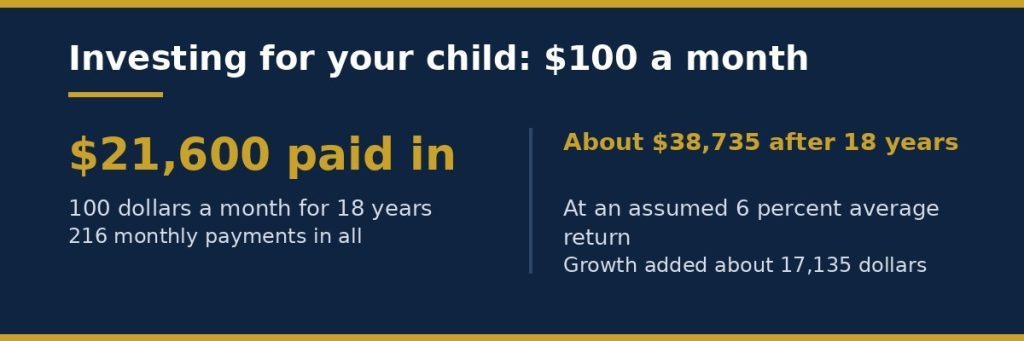
Suppose a parent opens an account when their child is born and puts in 100 dollars every month for 18 years, or 216 payments. Suppose the investments earn an average return of 6 percent per year, compounded monthly. This 6 percent is an assumption used only to show the math. It is not a promise or a guarantee. Real returns vary every year.
Total money paid in: 100 dollars times 216 months equals 21,600 dollars.
Value after 18 years at the assumed 6 percent average return: 38,735.32 dollars.
Growth on top of the money paid in: 38,735.32 minus 21,600 equals 17,135.32 dollars.
So the account ends with about 38,735 dollars, of which 21,600 dollars came from the parent’s pocket and about 17,135 dollars came from growth. The growth comes mostly in the later years, when earlier growth starts earning its own growth. That is compound growth at work.
Now compare a late start. Suppose the same parent waits until the child is 10, then puts in the same 100 dollars a month for 8 years. Same assumed 6 percent average return.
Total money paid in: 100 dollars times 96 months equals 9,600 dollars.
Value after 8 years: 12,282.85 dollars.
Growth: 12,282.85 minus 9,600 equals 2,682.85 dollars.
The early starter paid in 12,000 dollars more, but ends with 26,452.47 dollars more. That gap is the cost of waiting ten years. Starting early is the single most powerful choice a parent can make.
If 100 dollars a month is too much, start with 50. At the same assumed 6 percent return, 50 dollars a month for 18 years grows to about 19,367.66 dollars, from 10,800 dollars paid in. You can raise it later.
A Simple Five Step Plan
The whole plan takes less than an hour to set up.
Step 1: Pick the goal and the date
Write one sentence, such as “We are saving for college in 2044.” A goal with a date is a plan. A goal without one is a wish.
Step 2: Choose one account
Pick the account that fits the goal from the list above. For college, a 529 plan is the usual starting point. For a flexible gift, a custodial account or a brokerage account may fit better. One account is enough to start.
Step 3: Set the monthly amount and automate it
Choose an amount you can pay every month without stress. Set up an automatic transfer for the day after payday, so the money moves before you can spend it. If your income varies, set the automatic amount to your lowest month, and add extra in good months.
Step 4: Choose simple, diversified investments
Inside the account, pick a simple diversified option, such as a broad stock index fund or a target date fund that matches the year your child will need the money. A diversified fund spreads your money across many companies, so one bad company cannot sink the plan. Avoid betting the whole account on one stock or one tip from a friend. If you want to understand why spreading money matters, read our guide to what diversification is and why it matters (https://investclaritypath.com/what-is-diversification-and-why-does-it-matter/).
Step 5: Check once a year, then leave it alone
Look at the account once a year. Check that the automatic payment is still running, that the investment choice still fits the time left, and that the amount still fits your budget. Raise the amount a little if you can, then leave it alone. Checking every week leads to worry and to selling at the wrong time.
What to Invest In, in Simple Words
You do not need to pick individual stocks. Most parents do better with simple funds that hold many investments at once.
A broad index fund holds a large basket of stocks, such as hundreds of companies in one fund. When one company struggles, the others can balance it out. Fees are usually low, often a fraction of one percent per year. Our guide to how compound interest works (https://investclaritypath.com/how-does-compound-interest-work/) explains why small differences in growth add up over long periods.
A target date fund goes one step further. You pick the year your child will need the money, and the fund slowly moves to steadier investments as that year gets closer.
Whatever you choose, keep three rules in mind. Keep fees low, stay diversified, and stay invested through ups and downs. Selling after a fall locks in the loss and misses the recovery.
Common Mistakes to Avoid
Waiting for the perfect time is the most common mistake. Markets rise and fall, and no one can predict the best month to start. Regular monthly investing buys more when prices are low and less when prices are high, without any guessing.
Saving only in a low interest account is the second. Cash is safe for the short term, but over 18 years it usually grows far less than investments.
Putting everything in one stock is the third. A single company can fall sharply, and a diversified fund spreads that risk.
Forgetting the tax rules is the fourth. A 529 plan treats education withdrawals generously, but other withdrawals can face tax and a penalty on the growth. A custodial account gives the money to the child at the age of control, with no way to change your mind. The IRS publication on tax benefits for education, Publication 970 (https://www.irs.gov/publications/p970), is a useful place to check the details.
Ignoring your own finances is the fifth. Investing for your child is generous, but it should not come before your own safety net. Make sure you have a small emergency fund and are handling high interest debt first. You can borrow for college, but you cannot borrow for retirement. Our guide to what a retirement account is in simple terms (https://investclaritypath.com/what-is-a-retirement-account-in-simple-terms/) explains the accounts that protect your own future.
What If You Start Late?
Starting late is not the same as failing. A child who is 12 still has six years before college. Three moves help most when time is short.
First, save more each month if you can, since a larger amount partly makes up for lost years. Second, choose a steadier mix as the date gets closer, because with six years left a big fall hurts more than it does with 18 years left. Third, talk with your child about the plan. A teenager who understands the goal can help by applying for scholarships or working part time.
Frequently Asked Questions
How much money do I need to start investing for my child?
You can start with very little. Many 529 plans and custodial accounts allow you to open with 25 dollars or less, and some have no minimum at all. A small regular amount matters more than a large one time deposit. If you are unsure how small you can start, read our guide to how much money you need to start investing (https://investclaritypath.com/how-much-money-do-i-need-to-start-investing/).
Is a 529 plan or a custodial account better?
It depends on the goal. A 529 plan is usually better for college, because of the tax free growth and withdrawals for education costs, plus possible state tax breaks. A custodial account is usually better for a flexible gift, because the money can be used for anything that benefits the child. Some families open both.
Can I lose money investing for my child?
Yes, investments can fall in value, especially in the short term. Markets go up and down, and no investment can promise a return. That is why a long time frame matters so much. Over 18 years, a diversified mix has historically had time to recover from falls, but the past does not guarantee the future. Keep money you need within a year or two in a savings account.
What happens to a 529 plan if my child does not go to college?
The money stays in the plan. You can change the beneficiary to another family member, use the money for other kinds of education or training, or move some unused money into a Roth IRA for the beneficiary, subject to limits. A withdrawal for non education uses can face income tax and a penalty on the growth.
Should I tell my child about the account?
Yes. A child who knows the plan exists can make better choices about college, work, and spending. For a custodial account, this matters even more, because the child will control it at 18 or 21.
Conclusion
Investing for your child’s future is simpler than it looks. Pick a clear goal, choose the account that fits it, set a monthly amount you can keep, pick a simple diversified investment, and let time work. The worked example shows the point: 100 dollars a month from birth, at an assumed average return of 6 percent, grows to about 38,735 dollars by age 18, while waiting ten years leaves about 12,283 dollars instead. You do not need to be rich or to predict the market. You need to start, stay regular, and stay patient.
If you are ready to begin, open the account this week, and put the next review on your calendar for one year from now. For a clear first plan, read our guide to what a simple first investment plan looks like (https://investclaritypath.com/what-is-a-simple-first-investment-plan/).
Related Reading
- How Does Compound Interest Work? (https://investclaritypath.com/how-does-compound-interest-work/)
- What Is a Simple First Investment Plan? (https://investclaritypath.com/what-is-a-simple-first-investment-plan/)
- How Much Money Do I Need to Start Investing? (https://investclaritypath.com/how-much-money-do-i-need-to-start-investing/)
- What Is a Retirement Account, in Simple Terms? (https://investclaritypath.com/what-is-a-retirement-account-in-simple-terms/)
- What Is Diversification, and Why Does It Matter? (https://investclaritypath.com/what-is-diversification-and-why-does-it-matter/)
This article is for general information and education only. It is not legal or financial advice.
