
US Approved Nearly 900,000 AI Chips for China, House Records Show
The United States approved nearly 900,000 advanced AI chips for Chinese buyers, including companies the Pentagon lists as military companies, according to export license records released by a House committee on Thursday, November 19, 2026.
The disclosure matters because the US has spent years restricting sales of its most powerful AI chips to China. The records show how those rules worked in practice, and they landed in the same week that Nvidia shares fell sharply and the AI trade sold off across global markets.
What happened
House Foreign Affairs Committee Chairman Brian Mast released Commerce Department records on November 19, 2026, using a disclosure power in the Export Control Reform Act. The records cover export license applications filed between December 2025 and May 2026 with the Commerce Department’s Bureau of Industry and Security, known as BIS.
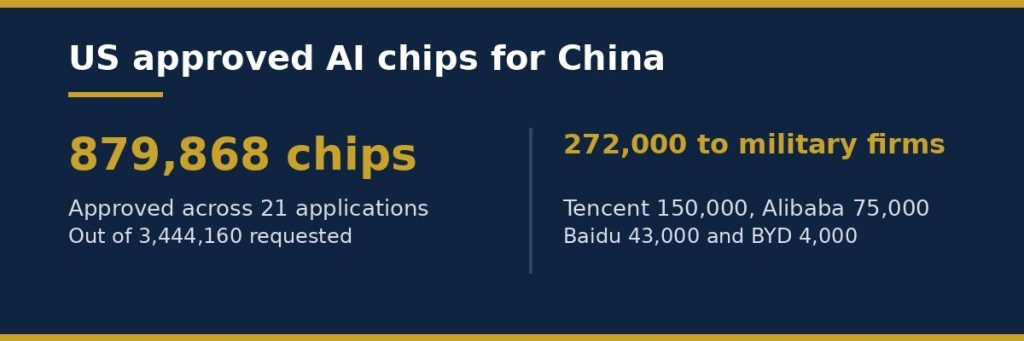
Chinese buyers asked to buy 3,444,160 AI chips from Nvidia and AMD. BIS approved 879,868 of them across 21 applications, as of May 11, 2026. That is roughly one approval for every four chips requested. The chips were Nvidia’s H200 and AMD’s MI325X, two powerful processors used to train and run artificial intelligence systems.
About a third of the approved chips went to four companies on the Pentagon’s list of Chinese military companies. Tencent was approved for 150,000 chips, Alibaba for 75,000, Baidu for 43,000, and carmaker BYD for 4,000. Together that is about 272,000 chips. The Register reported the disclosure on November 20, and Reuters reported the same figures on November 19.
Not every request was approved. Nvidia had applied to sell 610,000 chips to Alibaba and 508,000 to ByteDance, the owner of TikTok, and BIS refused those larger requests.
Mast called the release “the most detailed public disclosure in the history of the Export Control Reform Act.” The committee’s ranking Democrat, Gregory Meeks, said the administration’s handling of export controls had put US security and its technology lead at risk. On Friday, November 20, Senate Minority Leader Chuck Schumer accused President Donald Trump and Commerce Secretary Howard Lutnick of compromising national security by approving the sales.
Approval is not the same as delivery
An important detail is that an approved license does not mean the chips were shipped. The records do not show how many of the 879,868 approved chips actually reached China. In May 2026, Reuters reported that the US had cleared about 10 companies to buy the H200 but that no deliveries had taken place. In July testimony, Commerce official Jeffrey Kessler said shipments had begun but there had been “very few.” Reuters has since reported, citing people familiar with the matter, that several large Chinese internet companies had each obtained about 10,000 H200 chips.
Nvidia says it has since stopped shipping H200 chips to China. On its November 17 earnings call, interim chief executive Colette Kress said licensed sales of its earlier Hopper generation chips to Chinese customers brought in $2.4 billion in the quarter to October 25.
The Commerce Department said its approach to H200 licensing is based on a rule published in the Federal Register in January 2026, which requires applicants to meet significant extra national security conditions to be considered case by case, rather than being refused by default. President Trump announced in December 2025 that H200 chips could be sold to approved Chinese customers under certain conditions.
Why it matters for beginners
AI chips are the engines behind modern artificial intelligence, and the most powerful ones are made mainly by US companies such as Nvidia and AMD. Washington treats them as strategic technology, not ordinary computer parts, because they can also be used for military systems. That is why the US restricts who can buy them.
The disclosure raises a plain question for investors and beginners to understand: the rules were meant to slow China’s access to top AI hardware, yet the US government itself approved hundreds of thousands of chips for Chinese firms, including firms the Pentagon links to China’s military. Lawmakers are now arguing about whether the controls were too loose, while the administration says each license was judged on its own merits under the January 2026 rule.
The timing adds to the pressure on chip stocks. The records came out days after the US closed a loophole that let Chinese firms rent top AI chips from data centres abroad. The US also tightened chip export rules for five countries on November 18. Then on Friday, November 20, Nvidia shares fell 14 percent after Reuters reported that the SEC is examining the company’s accounting.
What to watch next
Watch whether the Commerce Department or the White House responds in detail to the committee’s disclosure, and whether more license records are released. Watch for any tightening of the H200 licensing rules, and for Nvidia and AMD’s next earnings updates for signs of how much of their China business remains. Also watch Nvidia shares when Wall Street opens on Monday, after a week in which the AI trade fell hard.
FAQ
How many AI chips were approved for China?
879,868 chips were approved across 21 applications, out of 3,444,160 requested, according to Commerce Department records released by the House Foreign Affairs Committee on November 19, 2026.
Which chips were they?
Nvidia’s H200 and AMD’s MI325X, powerful processors used to train and run artificial intelligence systems.
Which Chinese companies were approved?
Tencent was approved for 150,000 chips, Alibaba for 75,000, Baidu for 43,000, and BYD for 4,000. All four are on the Pentagon’s list of Chinese military companies.
Does approval mean the chips were delivered?
No. The records do not show how many approved chips were actually shipped. Reuters reported in May 2026 that no deliveries had taken place at that point, and a Commerce official later said shipments had begun but were very few.
Why does the US restrict AI chip sales to China?
Washington says the most powerful AI chips can also be used for military purposes, so it treats them as strategic technology and limits who can buy them.
