
How Do I Rebalance My Portfolio in Simple Terms?
How do I rebalance my portfolio in simple terms?
Rebalancing your portfolio means bringing your mix of investments back to the target you chose. You sell a little of what has grown too big and buy a little of what has fallen behind, until your mix matches your target again. In short: check your mix, compare it with your target, and move money to close the gap.
A portfolio is the collection of investments you own, such as stocks, bonds, and funds. Your target mix is the share of each type you want to hold, for example 60 percent stocks and 40 percent bonds. Over time, the parts grow at different speeds, so the mix drifts away from your target. Rebalancing puts it back.
You do not need to rebalance every day or every week. Most beginners rebalance once or twice a year, or when one part has drifted a long way from its target. This article explains how it works, when to do it, and shows a worked example with real math.
The simple idea behind rebalancing
Think of your portfolio like a recipe with set amounts. Suppose your recipe is 60 percent stocks and 40 percent bonds, and stocks have a strong year while bonds stay flat. Your mix might become 65 percent stocks and 35 percent bonds, even though you did nothing.
That matters because the mix controls your risk. Stocks usually move up and down more than bonds, so when stocks grow to a bigger share, your whole portfolio becomes more exposed to stock market swings. Rebalancing brings the risk back to the level you chose.
FINRA, the Financial Industry Regulatory Authority, puts it plainly in its investor education guide: rebalancing means making regular adjustments to ensure you are still hitting your target allocation over time. See https://www.finra.org/investors/learn-to-invest/key-investing-concepts/asset-allocation It sits alongside asset allocation and diversification as one of the basic tools for managing investment risk. For more on risk itself, see What Is Risk in Investing?
Rebalancing is not about predicting which investment will do best next. It is about keeping your plan steady. You decided on a mix for a reason, and rebalancing keeps you close to that decision instead of letting market moves quietly rewrite it.
Why your portfolio drifts away from its target
Drift happens because different investments grow at different speeds. Stocks, bonds, and cash rarely move together. In a year when stocks rise 20 percent and bonds rise 2 percent, the stock part of your portfolio grows much faster, so stocks take up a bigger share of the total.
New money can also cause drift. If you keep adding money to only one fund, that fund slowly becomes a bigger share.
Withdrawals can shift the mix too. Taking money out of your bond fund makes bonds a smaller share of what is left.
None of this means you did anything wrong. Drift is normal. The question is not how to stop drift, it is how often to correct it. That is what rebalancing is for.
How to rebalance your portfolio, step by step
Rebalancing has five steps, and you can do them with a pen and paper before you touch anything online.
Step 1: Write down your target mix. This is the share of each investment type you want to hold. A common beginner target is 60 percent stocks and 40 percent bonds. Your target depends on your goals and how much risk you can accept. If you have not chosen a target yet, choose one before you rebalance, because rebalancing means moving toward a target.
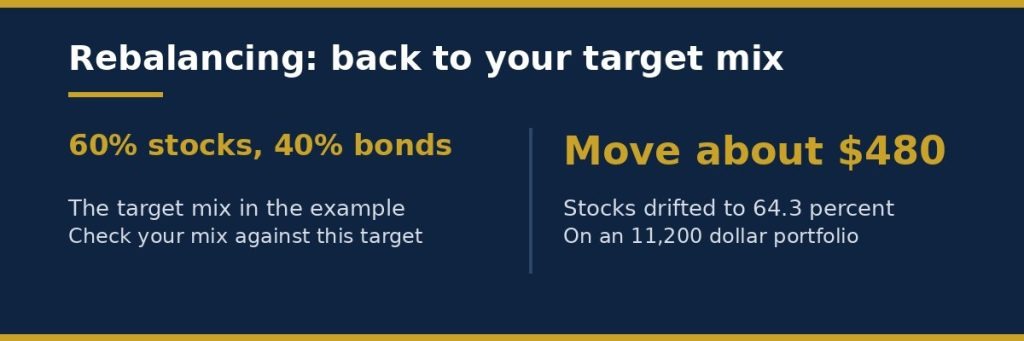
Step 2: Work out your current mix. Add up the total value of your portfolio, then work out the value of each part. Divide each part by the total to get its percentage. For example, if your portfolio is worth 11,200 dollars and your stocks are worth 7,200 dollars, stocks are about 64.3 percent of the total.
Step 3: Compare the current mix with the target. Write both side by side and find the gap. If your target is 60 percent stocks and you hold 64.3 percent, stocks are 4.3 percentage points above target. If your target is 40 percent bonds and you hold 35.7 percent, bonds are 4.3 percentage points below target. The two gaps always match, because the total is always 100 percent.
Step 4: Work out how much to move. Multiply your total portfolio value by the gap to find the dollar amount. In the example above, the total is 11,200 dollars and the gap is 4.3 percent, so the amount to move is about 480 dollars. The worked example below shows this arithmetic step by step.
Step 5: Make the move. Sell about 480 dollars of the investment that is above target, and use the money to buy about 480 dollars of the investment that is below target. Then check the mix again. It should now sit close to your target. Keep a note of the date and the amounts.
If your investments are inside funds, the same steps apply. A fund is a basket of many investments, so you rebalance between funds, not between single stocks. For a plain explanation of funds, see What Is a Mutual Fund? and What Is an Index Fund and Why Do Beginners Use It?
Some accounts do this work for you. A target date fund, which picks a mix based on the year you expect to retire, usually rebalances itself. For more on that, see What Is a Target Date Fund? If you hold a target date fund, you may not need to rebalance it by hand at all.
When should you rebalance?
There are two common ways to decide when to rebalance: by calendar and by threshold. Both are simple, and you can pick the one that suits you.
The calendar method means rebalancing on a fixed schedule, such as once a year or every six months. Pick a date you will remember, such as your birthday or the start of the year, and check your mix on that date. If it has drifted, rebalance. If not, leave it alone. The calendar method is easy to remember and stops daily checking.
The threshold method means rebalancing when the mix drifts past a limit you set. A common limit is 5 percentage points. For example, if your stock target is 60 percent, you rebalance when stocks reach 65 percent or fall to 55 percent. Smaller drifts are left alone. This method means you rebalance only when the drift is large enough to matter, but it asks you to check your mix more often.
Many beginners combine the two: they check the mix once or twice a year and rebalance only if the drift is bigger than 5 percentage points.
A few cautions apply. Do not rebalance every week: small moves cost time, and in a taxable account selling can create a tax bill. Do not rebalance because of a scary headline: a single bad week is not a reason to change your mix. And remember that new money can rebalance for you. If you add money every month, put it into the part below target, which slowly pulls the mix back without selling anything. That is often the cheapest way to rebalance a small portfolio.
A worked example, with real math
Here is a worked example. Every number is an example to show the method. The growth rates are assumed for illustration only, not predictions, and real returns go up and down.
Sam has a portfolio worth 10,000 dollars. His target mix is 60 percent stocks and 40 percent bonds.
First, work out the starting amounts. Stocks are 60 percent of 10,000 dollars. That is 10,000 times 0.60, which equals 6,000 dollars. Bonds are 40 percent of 10,000 dollars. That is 10,000 times 0.40, which equals 4,000 dollars. Check the total: 6,000 plus 4,000 equals 10,000, which matches the starting value.
Next, suppose stocks rise 20 percent over the year and bonds stay flat. The stocks are now worth 6,000 dollars times 1.20, which equals 7,200 dollars. The bonds are still worth 4,000 dollars. The new total is 7,200 plus 4,000, which equals 11,200 dollars. Sam has not added or taken out any money, so the whole change came from growth.
Now work out the new mix. Stocks are 7,200 divided by 11,200, which is about 64.3 percent. Bonds are 4,000 divided by 11,200, which is about 35.7 percent. Check the total: 64.3 plus 35.7 equals 100.
Compare the new mix with the target. Stocks are at 64.3 percent against a target of 60 percent, so they are 4.3 percentage points above target. Bonds are at 35.7 percent against a target of 40 percent, so they are 4.3 points below. The two gaps match, as they must.
Now work out the target amounts at the new total of 11,200 dollars. Stocks should be 60 percent, which is 11,200 times 0.60, or 6,720 dollars. Bonds should be 40 percent, which is 11,200 times 0.40, or 4,480 dollars. Check the total: 6,720 plus 4,480 equals 11,200.
Finally, work out how much to move. Sam holds 7,200 dollars of stocks but the target is 6,720 dollars. The difference is 7,200 minus 6,720, which equals 480 dollars. So Sam sells 480 dollars of stocks and buys 480 dollars of bonds. After the move, stocks are 7,200 minus 480, which is 6,720 dollars, and bonds are 4,000 plus 480, which is 4,480 dollars. Both match their targets, and the total is still 11,200 dollars.
Notice one thing. The stock drift is 4.3 percentage points, below the common 5 point threshold above. A threshold investor might wait, while a calendar investor would rebalance now. Neither choice is wrong. What matters is having a rule and following it.
The example also shows why rebalancing feels strange: it asks you to sell some of the investment that did well and buy more of the one that did not. That is the point. It keeps your risk at the level you chose.
What rebalancing does not do
Rebalancing does not make your portfolio grow faster. It is not a way to pick winners. It keeps your risk steady, and that is its job.
Rebalancing does not protect you from losses. If the whole market falls, a rebalanced portfolio falls too. It keeps the fall in line with the risk level you chose.
Rebalancing does not need to be perfect. You do not need to hit your target to the last dollar. Getting within a percentage point or two is enough for a beginner portfolio. The goal is a mix close to your target, not an exact match.
Rebalancing does not fix a bad target. If your target mix does not suit your goals or your time horizon, rebalancing keeps returning you to a target that is wrong for you. If your life changes, review the target itself first, then rebalance toward the new target.
Common beginner mistakes to avoid
Do not rebalance with no target. If you have not chosen a target mix, you have nothing to rebalance toward, so choose the target first and write it down.
Do not chase the best performer. Some beginners move money into whatever grew most last year. That is the opposite of rebalancing: rebalancing trims the part that grew and adds to the part that lagged.
Do not rebalance too often. Checking every day and trading every week adds cost and stress without improving the plan. A yearly or half yearly check is enough for most beginners.
Do not forget taxes in a taxable account. Selling an investment that has grown can create a tax bill. Inside a retirement account such as a 401(k) or an IRA, the same move usually has no immediate tax bill, but rules differ by account, so check yours before you sell. For a simple explanation of a 401(k), see What Is a 401(k) in Simple Terms? If you are unsure about the tax effect, ask a tax professional before you trade.
Do not expect a change from rebalancing inside a single fund. If all your money sits in one broad fund, there is nothing to rebalance between. Rebalancing works when you hold two or more different parts, such as a stock fund and a bond fund.
Do not let rebalancing replace saving. A perfectly balanced portfolio still needs new money going in. Regular contributions, left alone to grow over time, matter far more than any single rebalance. For a plain explanation of that growth, see How Does Compound Interest Work?
Frequently asked questions
How do I rebalance my portfolio in simple terms?
Rebalancing means bringing your mix back to the target you chose. Sell a little of what has grown above target and buy a little of what has fallen below target, until the mix matches again.
How often should I rebalance my portfolio?
Most beginners rebalance once or twice a year, or when one part drifts more than 5 percentage points from its target. A yearly check on a fixed date is a simple rule to follow.
Do I need to sell investments to rebalance?
Usually yes. But if you add new money regularly, you can rebalance by putting it into the part below target, without selling anything.
Does rebalancing my portfolio cost money?
It can. Selling investments in a taxable account can create a tax bill, and some providers charge trading fees. Inside many retirement accounts there is usually no immediate tax bill, but check your account rules first.
What if my money is all in one fund?
Then there is nothing to rebalance between. Rebalancing works when you hold two or more different parts, such as a stock fund and a bond fund. A target date fund rebalances itself, so you may not need to do it by hand.
Conclusion, and your first step today
Rebalancing is a simple habit: choose a target mix, check your mix once or twice a year, and move a little money to close the gap. The worked example shows the whole job in one move: 480 dollars from stocks to bonds brought a 10,000 dollar portfolio back to its 60/40 target after stocks rose 20 percent.
Start today: write down your target mix, work out your current mix, and note the date of your next check. If the drift is small, wait. If it is past your threshold, rebalance, keep a note of what you moved, and leave the portfolio alone until the next check.
This article is for general information and education only. It is not legal or financial advice.
