

How Do I Open a Joint Bank Account?
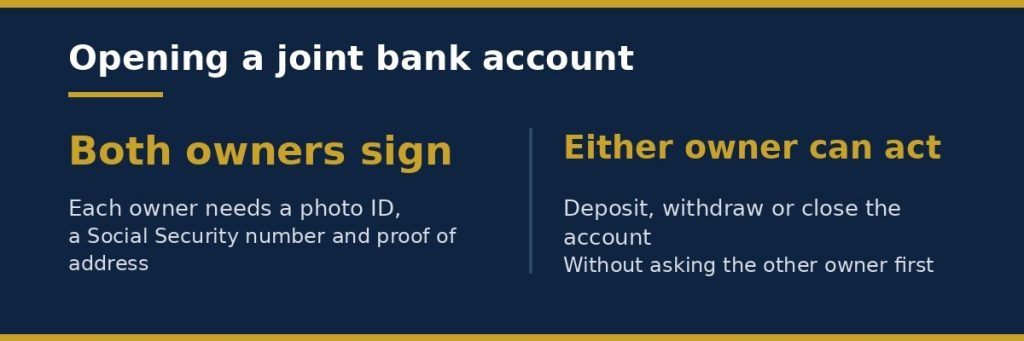
You open a joint bank account by choosing a bank and account type together, gathering both owners’ identification documents, and applying online or in a branch with both people present or both signatures. Each owner usually needs a government photo ID, a Social Security number, and proof of address. The bank checks both owners, both sign the account agreement, and the account is usually ready to use the same day or within a few business days. Before you apply, agree in writing how you will use the account, who pays which bills, and how much personal spending each person keeps.
A joint account is a shared tool, not a fix for a money disagreement. It works best when both owners trust each other, talk openly about money, and agree on the rules before the first deposit.
What is a joint bank account?
A joint bank account is a bank account owned by two or more people. Each owner is a full owner of the account, not a guest or an authorised user. In most cases, either owner can deposit money, withdraw money, write cheques, use the debit card, and close the account, without asking the other owner first. That is the key difference from a regular account, where only the named owner can act.
Joint accounts are often checking accounts, used for shared bills and daily spending, but two people can also open a joint savings account.
For help picking the account type first, see How Do I Choose a Bank Account as a Beginner?
Who is a joint account good for?
A joint account suits people who share regular costs and trust each other with full access to the money. Common cases are married couples and long term partners who pay rent, utilities, and groceries together, and parents and adult children who share household costs. Business partners sometimes open a joint account too, but a business account is usually the better choice for a business, so ask the bank which type fits your situation.
A joint account is not a good idea when trust is low, when one person has a history of spending the shared money without discussion, or when the relationship is new and untested. If you are not sure, start with a small shared account for bills only, keep your main money in your own account, and see how it goes for a few months.
What each owner can do
Each owner can usually withdraw the full balance on their own. One owner does not need the other owner’s permission to take money out, and the bank does not have to check why. Each owner can usually make deposits, set up direct deposit and automatic payments, order cheques, and use online banking and a debit card. Each owner is usually responsible for the whole account, so if the account goes overdrawn, either owner can be held responsible for the full amount. If one owner dies, the surviving owner usually keeps access to the account, but the exact rule depends on the account type and the state, so ask the bank to explain this in plain words before you sign.
The Consumer Financial Protection Bureau (CFPB) explains joint accounts and the rights of each owner on consumerfinance.gov. The Federal Deposit Insurance Corporation (FDIC) explains deposit insurance for joint accounts in general terms on fdic.gov. Both are free to read, and both are worth reading before you open an account.
How to choose the right joint account
Do not pick the first account a bank offers. Compare a few accounts on the points that affect you every month, and ask the bank to confirm each point in writing.
Fees matter most. Ask about the monthly maintenance fee, whether the fee can be avoided, for example by keeping a minimum balance or setting up direct deposit, and what the fee is if you cannot avoid it. Ask about overdraft fees, ATM fees, and fees for paper statements. A low or no fee account is usually the best starting point for a shared bills account.
Interest is worth a look, but it is not the main point of a bills account. If you open a joint savings account, compare the annual percentage yield, which is the yearly return including compounding. See What Is APY and Why Is It Different From Interest Rate? to understand the number before you compare accounts.
What documents you usually need
Banks must verify the identity of each account owner. The exact list varies by bank, so ask your bank before you go, but most banks ask both owners for the same set of documents.
Each owner usually needs a government issued photo ID, such as a driver’s licence, state ID card, or passport. Each owner usually needs a Social Security number. Each owner usually needs proof of address, such as a utility bill, lease, or bank statement showing the current address. Some banks also ask for a second form of ID, a phone number, and an email address for each owner.
If one owner cannot visit a branch in person, ask the bank whether the other owner can open the account with a signed form, or whether the whole application can be done online with both owners signing electronically.
How to open a joint account step by step
Opening a joint account is a simple process when both owners prepare together. Follow these steps in order.
Step 1: Talk first, apply second. Agree on what the account is for, such as shared bills only, or bills plus shared savings. Agree on how much each person will put in each month, who pays which bills, and how much personal spending each person keeps in their own account. Write the plan down, even if it is only a few lines on a page.
Step 2: Compare accounts. Pick two or three banks, compare fees, minimums, and access, and choose the account that fits your plan.
Step 3: Gather documents. Both owners collect their photo ID, Social Security number, and proof of address. Check that the names and addresses match across the documents, because a mismatch can delay the application.
Step 4: Apply online or in a branch. Online is faster, and many banks let both owners sign electronically. In a branch, both owners usually need to be present with their documents. Either way, read the account agreement before you sign, especially the parts about who can withdraw money and how the account is closed.
Step 5: Fund the account. Make the first deposit by transfer from an existing account, by cash, or by cheque. Ask when the money will be available, because a cheque deposit can take a few days to clear.
Step 6: Set up the tools. Both owners should set up their own online login, mobile app access, and debit card. Set up direct deposit or a monthly transfer into the joint account, set up automatic payments for the shared bills, and turn on alerts for low balances and large withdrawals so both owners see what happens.
Step 7: Test it for one month. Check that each bill was paid on time, that the balance never dropped too low, and that both owners are comfortable with the spending. Adjust the monthly amounts after the first month if the plan needs it.
A worked example, with real math
Here is a worked example for a couple, Alex and Sam, who share a home and open a joint checking account for bills. The numbers are examples to show the method, not a promise that your costs will be the same. Alex and Sam have a combined take home income of 5,400 dollars a month.
Shared bills, each month: rent, 1,500 dollars; utilities, 200 dollars; groceries, 500 dollars; transport, 300 dollars; insurance, 180 dollars; phones, 120 dollars.
Add them step by step: 1,500 plus 200 equals 1,700, plus 500 equals 2,200, plus 300 equals 2,500, plus 180 equals 2,680, plus 120 equals 2,800. The shared bills total is 2,800 dollars a month.
Personal spending: 300 dollars each, so 300 plus 300 equals 600 dollars a month. Joint savings: 500 dollars a month.
Planned total going out of the joint account: 2,800 plus 600 plus 500 equals 3,900 dollars a month. Remainder: 5,400 minus 3,900 equals 1,500 dollars a month.
Alex and Sam split the remainder: 900 dollars a month extra to joint savings, and 600 dollars a month for shared fun, such as eating out and trips together. Check the split: 900 plus 600 equals 1,500, which matches the remainder. Check the full plan both ways: 2,800 plus 600 plus 500 plus 900 plus 600 equals 5,400, which matches their combined income exactly.
Each month, Alex and Sam transfer the money into the joint account on payday, the bills are paid automatically, and each keeps their 300 dollars of personal spending in their own account. Neither has to ask permission to spend their personal money, and both can see the joint account at any time.
For a plan to run your shared spending together without arguments, see How Do Couples Budget Together Without Arguments?
How to run a joint account fairly
Pay shared bills from the joint account, and only shared bills. Keep personal spending in your own account, or give each owner a fixed monthly amount that needs no discussion. Agree on a spending limit for the joint account, for example any purchase over 100 dollars needs a quick check with the other owner first.
Review the account together once a month, for about 15 minutes. Look at what came in, what went out, and what is left. If one owner earns more than the other, decide together whether each pays the same amount or a share based on income, and write it down.
Risks to understand before you open one
A joint account is useful, but it carries real risks. Understand them before you sign.
Either owner can usually withdraw the full balance. If one owner takes all the money out, the bank is usually not responsible, and getting it back can be difficult. Trust matters more than the interest rate or the account features.
Debts and legal claims can affect the account. If one owner owes a debt, has a court judgment, or faces a tax lien, the other owner’s money in the same joint account can be at risk, because the account belongs to both owners. The exact rule depends on the state and the type of claim, so this is a good question to ask a lawyer if either owner has serious debts.
Closing the account usually needs agreement. One owner can often withdraw the money, but closing the account and splitting the balance fairly needs both owners to agree. If the relationship ends badly, closing the account can become slow and difficult, and automatic payments may keep coming out until they are cancelled.
To lower these risks, keep the joint account for shared bills only, keep most of your savings in your own name, agree on a spending limit, and turn on alerts so both owners see every withdrawal. If either owner has debts or legal trouble, talk to a lawyer before opening a joint account.
What to do if the relationship ends
First, stop new money going into the joint account. Change direct deposit and automatic transfers to your own account. Second, cancel or move the automatic payments that come out of the joint account, so no bill is missed and no money keeps leaving after you split. Third, agree on how to split the balance, pay any bills still due, and close the account together at the bank. Bring ID, and ask the bank to confirm in writing that the account is closed.
If you cannot agree, or if one owner has already withdrawn money without discussion, talk to a lawyer before you take further steps. Do not take money out of the joint account to punish the other owner, because that can make a legal dispute worse. Keep records of every deposit and withdrawal, because a clear record helps both owners and any adviser you speak to.
Common mistakes to avoid
Do not open a joint account before you agree on the rules. The conversation is the hard part, and the bank form is the easy part. Do it in that order.
Do not put all your money in the joint account. Keep your own account for personal spending and most of your savings, and use the joint account for the shared bills you agreed on. Keep an emergency fund separate from the joint spending account, so a surprise cost does not empty the bills money. See Should I Keep My Emergency Fund Separate From My Spending Money? for a simple way to set that up.
Do not use the joint account for a business. A business needs its own account, its own records, and its own tax treatment.
Do not ignore the statements. Both owners should read the monthly statement or check the app regularly. A small mistake, such as a bill paid twice, is easy to fix early and hard to fix months later.
Do not assume your bank’s rules are the same as another bank’s rules. The rights of each owner, the closing process, and what happens if one owner dies can all vary. Ask your bank to explain its rules in plain words, and keep a copy of the agreement.
For the basics of how checking and savings accounts differ before you choose, see Difference Between Checking and Savings Account
Frequently asked questions
How do I open a joint bank account?
Choose a bank and account together, gather both owners’ photo ID, Social Security number, and proof of address, then apply online or in a branch with both owners signing. Read the account agreement first, fund the account, and set up both owners’ online access and debit cards.
Can one person open a joint account alone?
In most cases, no. Both owners usually need to sign the agreement and provide their documents, even if the application starts online. Ask your bank whether one owner can start the application and the other can sign later.
Can either owner withdraw all the money from a joint account?
In most cases, yes. Each owner is a full owner, so either owner can usually withdraw the full balance without the other owner’s permission. This is the biggest risk of a joint account, so only open one with someone you trust.
What documents do I need to open a joint bank account?
Each owner usually needs a government photo ID, a Social Security number, and proof of address. Some banks ask for a second form of ID. The exact list varies by bank, so check with your bank before you apply.
Is a joint bank account insured?
Deposits in a joint account at an insured bank are covered by FDIC deposit insurance in general terms. The exact coverage depends on the account and the bank, so check the FDIC information on fdic.gov or ask your bank to explain it.
Conclusion, and your first step today
A joint bank account is a practical way for two people who trust each other to pay shared bills from one place. It works when you agree on the rules first, keep personal spending separate, and review the account together every month.
Start today: sit down with the other owner, list your shared bills, agree on how much each person will put in each month, and write the plan down. Then compare two or three accounts, check the fees and the documents you need, and apply together.
This article is for general information and education only. It is not legal or financial advice.
