

How Do I Sell Things Online for Extra Money?
You sell things online for extra money by starting with items you already own, listing them on a marketplace that fits what you are selling, pricing them from recent sold prices for the same item, and taking clear photos with an honest description. Work out the fees and postage before you set your price, so you know what you will keep. Keep a simple record of every sale, meet local buyers in a public place, and never accept an overpayment.
Why selling things you already own is a good first side income
Most homes hold items that are no longer used: clothes that no longer fit, a phone replaced by a newer one, books, toys, kitchen tools, and furniture that does not fit the room any more. Each of those items still has value to someone else, and an online marketplace connects you with those buyers.
There is no sign-up cost to list on most general marketplaces, and you learn the whole process with one item: take photos, write a description, set a price, and post it. See What Is the Simplest Side Income for Beginners? to compare selling with other beginner options.
Step 1: What to sell first
Start with a walk around your home and a simple rule: if you have not used it in the last year, and it is not a keepsake or a spare you truly need, it is a candidate to sell. Make three piles: sell, keep, and give away.
Good first items are easy to post and easy to describe: books, clothes in good condition, small electronics, kitchen tools, toys, and homeware. Larger items such as furniture and bikes sell well locally, because the buyer collects them. Avoid broken electronics, items missing parts, or very heavy items, and state any damage clearly in the listing.
Step 2: Where to sell
General marketplaces are the easiest place to start. They have the most buyers, and they accept almost anything. Local selling apps and groups are best for large or heavy items, because the buyer collects the item and you pay no postage, and you can meet in a public place instead of giving out your home address.
Niche platforms work better for specific items. A site that specialises in clothes will have buyers looking for clothes, and a site that specialises in used electronics will have buyers looking for phones and laptops. They often handle the payment and the postage label for you, but they may charge a higher fee.
Step 3: How to price items
Pricing decides whether your item sells, and how much you keep. Use sold prices, not listed prices, as your guide. Search the marketplace for the exact item, or the closest match, and filter the results to show items that already sold. If three recent sold prices are 20, 25, and 30 dollars, a fair starting price is around 25 dollars.
Set your price after you work out the costs. A 25 dollar sale is not 25 dollars of profit if the platform takes a fee and you pay 4 dollars for postage. The worked example below shows the maths step by step. If an item does not sell in a week, lower the price by about 10 percent and improve the photos before you lower it again.
Step 4: Photos and listings that sell
Buyers cannot hold the item, so your photos and description do the selling. Take photos in daylight, near a window, on a plain background such as a clean table. Take at least four photos: the front, the back, a close-up of any label or brand mark, and a close-up of any wear or damage. For electronics, photograph the screen switched on, so the buyer can see it works.
Write the description as if you are answering the questions a buyer would ask: the brand, the model, the size, the colour, and the condition, then what is included, such as a charger or the original box, and then any wear or missing parts, stated honestly. Use a clear title with the brand, the item, and the size or model, because buyers search with those words. Answer questions quickly and politely, because a buyer who asks a question is close to buying.
Step 5: A worked example, with real math
Here is a worked example for a first clear-out of 10 items. All prices, fees, and postage costs here are example numbers to show the method, not quoted fees from any platform. Always check the current fee on the platform you use before you set a price.
The 10 items and their sale prices are: a jacket, 25 dollars; a pair of trainers, 40 dollars; a book set, 15 dollars; a coffee machine, 60 dollars; a board game, 12 dollars; a lamp, 35 dollars; a handbag, 20 dollars; a tablet, 50 dollars; a toy set, 18 dollars; and a small bookshelf, 30 dollars.
Add the sale prices step by step: 25 plus 40 equals 65, plus 15 equals 80, plus 60 equals 140, plus 12 equals 152, plus 35 equals 187, plus 20 equals 207, plus 50 equals 257, plus 18 equals 275, plus 30 equals 305. Total sales are 305 dollars.
Now the example platform fee. In this example the platform charges 10 percent of each sale price, as an example only. The fee on each item is: jacket 2.50 dollars, trainers 4.00 dollars, book set 1.50 dollars, coffee machine 6.00 dollars, board game 1.20 dollars, lamp 3.50 dollars, handbag 2.00 dollars, tablet 5.00 dollars, toy set 1.80 dollars, bookshelf 3.00 dollars. Add the fees step by step: 2.50 plus 4.00 equals 6.50, plus 1.50 equals 8.00, plus 6.00 equals 14.00, plus 1.20 equals 15.20, plus 3.50 equals 18.70, plus 2.00 equals 20.70, plus 5.00 equals 25.70, plus 1.80 equals 27.50, plus 3.00 equals 30.50. Total example fees are 30.50 dollars.
Now the postage. In this example the postage is 4 dollars per posted item. Eight items are posted, and two items, the lamp and the bookshelf, are collected by the buyer, so no postage is paid on those two. Postage is 8 times 4, which equals 32 dollars.
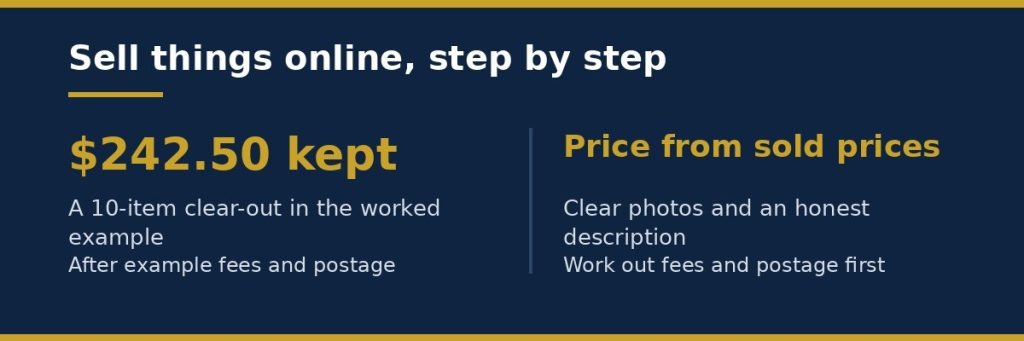
Net profit is total sales minus fees minus postage: 305 minus 30.50 equals 274.50, and 274.50 minus 32 equals 242.50 dollars. You keep 242.50 dollars from 305 dollars of sales in this example.
Check it a second way, item by item. Jacket: 25 minus 2.50 minus 4 equals 18.50. Trainers: 40 minus 4 minus 4 equals 32. Book set: 15 minus 1.50 minus 4 equals 9.50. Coffee machine: 60 minus 6 minus 4 equals 50. Board game: 12 minus 1.20 minus 4 equals 6.80. Lamp: 35 minus 3.50 minus 0 equals 31.50, because the buyer collects it. Handbag: 20 minus 2 minus 4 equals 14. Tablet: 50 minus 5 minus 4 equals 41. Toy set: 18 minus 1.80 minus 4 equals 12.20. Bookshelf: 30 minus 3 minus 0 equals 27, because the buyer collects it.
Add the item nets step by step: 18.50 plus 32 equals 50.50, plus 9.50 equals 60, plus 50 equals 110, plus 6.80 equals 116.80, plus 31.50 equals 148.30, plus 14 equals 162.30, plus 41 equals 203.30, plus 12.20 equals 215.50, plus 27 equals 242.50. The two methods agree at 242.50 dollars, so the maths checks out.
Step 6: Fees and postage to account for
Before you list, work out the three costs that eat into every sale: the platform fee, the payment fee, and the postage. Some platforms charge one combined fee, and some charge them separately. Check the fee page on the platform you use before you list, because fees change.
Weigh the item before you list it, with its packaging, and check the postage cost for that weight. A common mistake is to guess the postage, then find at the post office that the parcel costs twice as much as expected. Pack items well, wrap fragile items in bubble wrap or newspaper, and keep your postage receipts for your records.
Step 7: Staying safe and avoiding scams
Never accept an overpayment. The common scam works like this: the buyer sends more than the price, then asks you to refund the extra money or send it on to a courier. The first payment then turns out to be fake or stolen, and you have already sent real money. If a buyer overpays, cancel the sale and do not send the item. A genuine buyer pays the agreed price, no more.
Never move the conversation off the platform to a private message app when a stranger asks you to, and never accept payment by gift card, wire transfer, or a payment link you do not recognise. Keep the messages and the payment inside the platform, so there is a record if anything goes wrong. The Consumer Financial Protection Bureau has a guide to spotting fraud and scams, which is a useful read before your first sale: https://www.consumerfinance.gov/consumer-tools/fraud/
For local sales, meet in a public place in daylight, such as outside a shop or in a busy car park. Do not give out your home address, and do not invite a stranger into your home. If a buyer changes the plan at the last minute, walk away from the sale. For more warning signs and safe habits, see How Do I Avoid Side Income Scams?
Step 8: Simple records, and setting money aside for tax
Keep a simple record of every sale, even if you only sell a few items. For each sale, write down the date, the item, the marketplace, the sale price, the fee, the postage, and what you kept. A notebook or a simple spreadsheet is enough. Good records show you which items earn money and how much you have actually made after costs.
The IRS explains that keeping good records helps you keep track of income and expenses, and that you should keep records that support the income and expenses you report. The IRS recordkeeping page for small businesses and self-employed people is here: https://www.irs.gov/businesses/small-businesses-self-employed/recordkeeping
Whether you owe tax on selling things online depends on your situation, including whether you are selling your own used items at a loss or buying items to resell for a profit, and on the tax rules where you live. This article is educational only and does not give tax advice. A simple habit is to set aside a share of the money you keep from each sale, in a separate place, so that money is there if tax is due later. If you are unsure, speak to a qualified tax professional. For a simple way to track the money, see How Do I Track Side Income for Tax in Simple Terms?
One-off clear-out or repeatable side income?
A clear-out has a natural end. Once you have sold the unused items in your home, there is nothing left to sell, and the income stops. That is fine if your goal was a one-off lump sum, for example to clear a corner of the house and add a few hundred dollars to savings.
A repeatable side income needs a supply of items. Some sellers buy items cheaply at car boot sales, charity shops, or clearance sales, and resell them online for more. That can work, but you are now spending money on stock, and you can lose money if the items do not sell. Before you turn selling into a regular side income, ask yourself three questions: do you enjoy photographing, packing, and answering questions, can you find items at a price that leaves a profit after fees and postage, and do you have the time each week to list, pack, and post? See Side Income Ideas for Beginners for other ways to earn extra money, and How Do I Find My First Freelance Client? if you would rather earn from a skill than from selling items.
Common mistakes to avoid
Do not list items you have not checked. A phone with a cracked screen you did not notice, a jacket with a broken zip, or a toy with a missing part will come back as a complaint or a refund. Check every item before you photograph it.
Do not forget the postage when you set the price. The most common reason a sale earns less than expected is that the seller guessed the postage and guessed low. Weigh the parcel and check the real cost.
Frequently asked questions
How much money can I make selling things online?
It depends on what you sell, where you sell it, and how much you sell. A clear-out of 10 items in the worked example in this article brought in 242.50 dollars after example fees and postage. There is no fixed amount, and no guarantee.
Which marketplace is best for selling things online?
There is no single best marketplace. General marketplaces have the most buyers. Local selling apps are best for large items the buyer can collect. Niche platforms are best for specific items such as clothes or electronics. Compare the fee and the likely sale price on two places before you choose.
Do I have to pay tax when I sell things online?
It depends on your situation, including whether you are selling your own used items or buying items to resell for a profit, and on the tax rules where you live. This article does not give tax advice. Keep simple records, set aside a share of what you keep, and speak to a qualified tax professional if you are unsure.
How do I avoid being scammed when selling online?
Never accept an overpayment, never move the conversation or the payment off the platform when a stranger asks you to, and never accept gift cards or wire transfers. For local sales, meet in a public place in daylight and do not give out your home address. If a deal feels rushed or too good to be true, walk away.
Conclusion, and your first step today
Selling things online for extra money starts with what you already own. Pick one item you have not used in the last year, check its condition, look at recent sold prices for the same item, and list it with clear photos and an honest description.
Start today: choose one item, take four clear photos in daylight, and write a listing that names the brand, the size, the condition, and what is included. One sale teaches you the whole process.
This article is for general information and education only. It is not legal or financial advice.
