

How Do I Budget for a New Baby?
You budget for a new baby by listing the one time costs first, then the monthly costs, then adding both to your normal monthly budget before the baby arrives. Start three to six months early if you can. Write down every cost you expect, from the hospital bill to diapers, and give each one a monthly number. Then check the total against your take home pay, cut what you can, and build a small baby fund for surprises. A baby budget is not about buying everything at once. It is about knowing the monthly number.
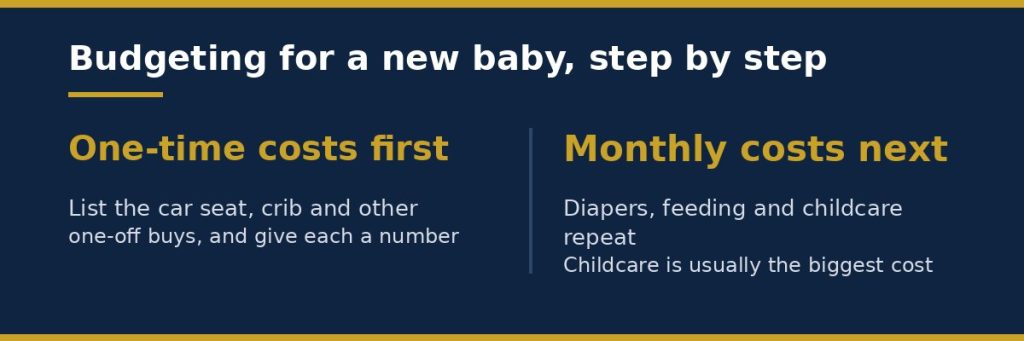
A new baby changes a household budget in two ways. Some costs happen once, such as a car seat or a crib. Others repeat every month, such as diapers, feeding, and childcare, and childcare is usually the biggest. This guide walks through each group, then shows a worked example with real math, so you can copy the method.
Why a baby budget helps before the baby arrives
A baby brings joy, and a long list of small purchases that add up fast. Without a plan, parents buy in a rush, pay full price for items used only a few months, and then feel the strain when the first childcare bill arrives. A written budget shows the real monthly cost in advance, so you can adjust spending, save a little each month, and talk through big choices, such as who stays home and what childcare you will use.
Start early, even if the numbers are rough. A rough budget you update each month beats no budget at all. Prices vary by state, store, and brand, so your numbers will not match anyone else’s. The goal is a plan that fits your income, not a perfect prediction.
Build the baby costs into a full monthly budget. See How Do I Create a Monthly Budget That Actually Works? to set it up first, then add the baby lines to it.
Step 1: List the one time costs
One time costs are things you buy once before the baby arrives, or in the first weeks. List each one with a price you have actually checked, not a guess. Common ones include hospital costs after insurance, a car seat, a stroller, a crib and mattress, bedding, a changing table, a baby bath, bottles, a breast pump, a diaper bag, and first clothes.
Check your health insurance first. Ask your insurer what the plan covers for prenatal care, delivery, and the hospital stay, and what your deductible and out of pocket limit are. What you owe depends on your plan and whether the hospital and doctors are in your network. Do not guess. Get it in writing if you can, and put the expected amount into your baby fund.
Buy safety items new. A car seat and a crib mattress should be new, because a used car seat may have hidden damage and a used mattress may not fit your crib. Other items, such as clothes, a stroller, or a changing table, can often be bought used in good condition. Check for recalls and missing parts before buying anything used.
Write your one time list in three columns: item, price, and when you need it. Add the prices to get your baby fund target, then divide by the months left before the due date. For example, a 950 dollar total over five months means saving 190 dollars a month, because 950 divided by 5 equals 190.
Step 2: List the monthly costs
Monthly costs repeat every month. Common ones include diapers and wipes, formula or feeding costs, baby food once solids start, clothing, toiletries, laundry, health costs, and childcare.
Diapers are the most frequent small purchase. In the first months a baby often uses eight to ten a day, and the number falls as the baby grows. Count how many you use in one week, then multiply by about four and a third for a monthly number. Buy in bulk only once you know the size and brand.
Feeding costs depend on your choice. Breastfeeding has lower direct costs, though a pump and storage bags still cost money. Formula has a clear monthly cost that depends on brand and type. Once your baby starts solids, usually around six months, add a small line for baby food or extra groceries.
Childcare is the biggest item for most working parents. Prices vary a lot by state and type of care. A licensed center, a home daycare, a nanny, and care from a family member all cost different amounts. Get real quotes from two or three options near you, and ask what each quote includes. If one parent plans to stay home, work out the lost income as a monthly number, so the choice is clear.
List each monthly cost as its own budget line, with the amount and due date. Add the lines to get your monthly baby total, the number you will carry into the worked example below. If childcare takes a large share of your income, check whether your fixed costs still leave room for needs, wants, and savings. The 50/30/20 budget rule is a simple way to test that balance.
Step 3: Build the baby budget step by step
First, write down your monthly take home pay, the money that reaches your bank account after tax and other deductions. If your income changes month to month, use the lowest recent month, not the best one.
Second, write down your current monthly spending without the baby.
Third, add the monthly baby costs from Step 2 as new lines and compare the new total with your take home pay. If the total is more than your pay, you have a gap to close before the baby arrives.
Fourth, build a baby fund for one time costs and surprises. Open a separate savings account, and move money into it on payday, before you spend on anything optional. Even 50 dollars a month adds up to 600 dollars in a year. See How to Build an Emergency Fund from Zero for a simple starting plan.
Fifth, check your employer benefits. Many employers offer paid parental leave, flexible spending accounts, or dependent care accounts. Ask your human resources team what is available and what the deadlines are, because some benefits must be chosen before the baby is born. A dependent care account lets you set aside part of your pay before tax for childcare costs. Rules change, so check them with your employer first.
Sixth, learn about the Child Tax Credit in general terms. The US federal government offers this credit for families with qualifying children, and the amount and rules depend on your income, filing status, and the tax year. This article gives no tax advice and states no credit amount. Check the current rules on the IRS website, at https://www.irs.gov/credits-deductions/individuals/child-tax-credit, or speak to a tax professional. Do not count on a tax refund to pay monthly bills, because refunds arrive once a year.
Seventh, review the budget every month after the baby arrives, and update the numbers as costs change.
Step 4: A worked example, with real math
Here is a worked example for a household with a monthly take home income of 4,000 dollars. Every number below is an example to show the method, not a price quote.
One time costs, example prices: car seat, 180 dollars; stroller, 220 dollars; crib and mattress, 300 dollars; nursery basics, 150 dollars; hospital bag and first clothes, 100 dollars.
Add them step by step: 180 plus 220 equals 400, plus 300 equals 700, plus 150 equals 850, plus 100 equals 950. The one time total is 950 dollars. If the family has five months to save, they save 950 divided by 5, which equals 190 dollars a month.
Monthly baby costs, example prices: diapers and wipes, 75 dollars; formula, 125 dollars; clothing, 35 dollars; childcare, 950 dollars; baby health and toiletries, 45 dollars; gear fund for replacements, 70 dollars.
Add them step by step: 75 plus 125 equals 200, plus 35 equals 235, plus 950 equals 1,185, plus 45 equals 1,230, plus 70 equals 1,300. The monthly baby total is 1,300 dollars.
Take home pay is 4,000 dollars a month and current spending without the baby is 2,500 dollars. Add the baby total: 2,500 plus 1,300 equals 3,800 dollars. That leaves 4,000 minus 3,800, which equals 200 dollars a month for savings and surprises.
Check the yearly cost too: 1,300 times 12 equals 15,600 dollars a year. Add the one time 950 dollars, and the first year total is 16,550 dollars.
Check it the other way: 1,300 minus 75 minus 125 minus 35 minus 950 minus 45 minus 70 equals 0.
If the family saves 200 dollars a month, by buying diapers in bulk and using hand me down clothes, the new monthly baby total is 1,300 minus 200, which equals 1,100 dollars. The new household total is 2,500 plus 1,100, which equals 3,600 dollars, leaving 400 dollars a month for savings. That extra 200 dollars a month is 2,400 dollars a year.
Step 5: Where to find savings
You do not need to buy everything new. Start with the big costs.
For childcare, compare two or three real options and ask what each price includes. A home daycare may cost less than a center, and care from a family member may cost less than both. Ask your employer about flexible hours or working from home some days, because fewer paid childcare days lower the bill.
For gear, accept hand me downs for clothes, blankets, and toys, and buy used items such as a stroller or a changing table. Check every used item for recalls and missing parts. Buy diapers and wipes in bulk once you know the size and brand suit your baby. Buy baby clothes a little at a time, because babies grow fast and sizes are hard to predict.
For feeding, if you use formula, compare the store brand with the name brand. Infant formula in the US must meet federal nutrition rules, and store brands must meet the same rules. Ask your pediatrician before you switch brands. If you breastfeed, check whether your health plan covers a breast pump.
Do not cut food spending by skipping meals. Plan meals and cook at home more often instead. See How Do I Cut Food Spending Without Cutting Meals? for simple ways to lower food costs.
Step 6: How to adjust when income is tight
Many families find the baby budget is more than their income, especially if one parent takes unpaid time off or cuts back hours. If that is your situation, adjust in this order.
First, protect the essentials: housing, utilities, food, transport to work, minimum debt payments, and baby needs such as diapers and feeding. Do not miss a minimum debt payment to buy baby gear.
Second, pause optional spending for a few months: streaming services, takeout, and new clothes for adults. A short pause is easier to keep than a strict budget with nothing enjoyable in it.
Third, talk to your childcare provider about the schedule. Fewer days, a shorter day, or a later start date can lower the bill while you settle in. Ask about sibling discounts and any local help with childcare costs in your state or city. Rules vary by place, so check with your local social services office.
Fourth, if the gap is still large, look at the bigger levers: a cheaper home, a cheaper car, or more income from extra hours or a side job. Start early, and do not take on a high cost loan to cover baby costs, because that trades a short term gap for a long term debt.
Review the budget at the end of each month and write down what was different from the plan. See How Do I Review My Budget at the End of the Month? for a short review routine.
Common mistakes to avoid
Do not buy everything before the baby arrives. Buy the safety items and the first weeks of supplies first, then buy the rest as you need it.
Do not buy the most expensive brand of everything. Price is not the same as safety or quality.
Do not forget the costs after the first month. Diapers, formula, and childcare repeat every month.
Do not count on money that is not certain. A tax refund or a bonus should not be the plan that pays the monthly childcare bill.
Do not skip the emergency fund. A small cushion of a few hundred dollars turns a surprise into a problem you can handle.
Frequently asked questions
How much does a new baby cost per month?
It varies a lot by where you live and what childcare you use. Childcare is usually the biggest item, several times larger than diapers, feeding, and clothing put together. Add up your own lines, and do not rely on a national average.
What is the biggest cost of a new baby?
For most working parents, childcare is the biggest monthly cost. Get real quotes from two or three options near you. If one parent stays home, count the lost income as a monthly number.
How much should I save before the baby arrives?
Save enough to cover your one time list, plus a small cushion. Divide the total by the months left and save that amount each month.
Is it safe to buy used baby gear?
Some items are safe to buy used, such as clothes, a stroller, or a changing table, if they are clean, complete, and not recalled. Buy a car seat and a crib mattress new, and always check for recalls and missing parts.
Does the Child Tax Credit help with baby costs?
The US federal government offers a Child Tax Credit for families with qualifying children. The amount and rules depend on your income, filing status, and tax year. Check the current rules on the IRS website. Do not count on a refund to pay monthly bills.
What if my baby budget is more than my income?
Protect housing, food, utilities, debt payments, and baby essentials first. Pause optional spending, compare cheaper childcare options, and ask your employer about benefits. If the gap is still large, look at bigger changes, and avoid high cost debt.
Conclusion, and your first step today
Budgeting for a new baby is not about buying everything at once or getting every number perfect. It is about knowing your monthly number, saving for the one time costs before the baby arrives, and checking the plan each month as your baby grows.
Start today: write down your lists, add them up, and save your monthly number into a baby fund on payday.
This article is for general information and education only. It is not legal or financial advice.
