

Best Savings Account for a Baby: What Parents Should Look For
The best savings account for a baby is a simple, low cost account that a parent or guardian can open and manage, with no monthly fee, no high minimum balance, and easy access when the family needs it. For most families, that means a custodial savings account or a regular savings account set aside for the child, at a bank the family already trusts. The name on the account matters less than the terms: low fees, easy deposits, and a clear plan for adding money bit by bit.
Parents often ask when to start. The simple answer is as early as you can, with an amount you can keep up. Saving for a baby is not about a large first deposit. It is about a small regular habit that runs for years. Even a small monthly amount, saved from birth, can grow into a useful sum by the time the child is older.
This guide explains the main account types, what to compare, how to open an account, and how to build the habit without stress. It does not name specific banks, and it does not quote any current rate or account terms, because rates and terms change.
What is a savings account for a baby?
A savings account for a baby is a place to hold money for a child, separate from everyday spending money. It can hold birthday money from family, small regular deposits from parents, or money set aside for a future goal, like education or a first car. The account keeps the money safe, separate, and easy to track.
There are two common ways to set this up. The first is a custodial account. In a custodial account, an adult, usually a parent or guardian, opens and manages the account for the child, who is named as the beneficiary. The adult makes deposits and withdrawals on the child’s behalf while the child is young. When the child reaches the age set by the law where you live, control of the account passes to the child. The exact age and the rules depend on your state, so check the terms and the law in your state before you open one.
The second way is simpler. A parent opens a regular savings account in the parent’s own name and uses it only for the child’s money. The parent keeps full control, and there is no transfer of control at a set age. This is easier to manage, but the money is legally the parent’s, not the child’s, so the parent must be careful to keep it separate.
The main account types to know
Custodial savings accounts
A custodial savings account is opened by an adult for a child. The adult is the custodian, and the child is the beneficiary. The custodian manages the money until the child reaches the age set by state law. At that point, the child takes control of the account.
Custodial accounts work well for money that is meant for the child, like gifts from grandparents or regular saving by parents. They also work well when several family members want to add money, because everyone can deposit into the same account. The main point to understand is the transfer of control. Once the child reaches the set age, the money is theirs to use.
Regular savings accounts set aside for a child
A regular savings account in a parent’s name, used only for the child’s money, is the simplest option. You open the account, you make deposits, and you keep control. There is no transfer at a set age, and no extra paperwork about custody. The trade-off is that the money is not legally separate from your own money, so you need to be clear that this account is for the child.
This option works well when parents want to keep control for a long time, or when they are saving for a goal that may change, like education, a first car, or help with a first home. It also works well when parents are not sure yet which type of account they want, because they can start saving now and move the money later.
To understand the basics of opening any savings account, read our guide on how to open a savings account.
What to look for: fees, minimums, and access
The best savings account for a baby is not the one with the highest advertised rate. It is the one with the lowest cost and the easiest use for your family. Compare these points before you choose.
First, check fees. Look for an account with no monthly maintenance fee, or a fee that is easy to avoid. A small monthly fee may not look like much, but on a small balance it can eat up the interest and even reduce the balance. Ask the bank to list every fee in writing: monthly fees, withdrawal fees, and any fee for falling below a minimum balance.
Second, check the minimum balance. Some accounts need a minimum deposit to open, or a minimum balance to avoid a fee. For a baby account, a low minimum is better, because the balance starts small. If the minimum is high, keep looking. A new parent should not have to lock up money to open a savings account.
Third, check access. As a parent, you need to be able to deposit money easily, check the balance, and take money out when you need it. Look for online and mobile access, easy transfers from your main account, and a clear way to deposit cheques or cash from family. If the account is hard to use, you will deposit less often, and the habit will fade.
Fourth, check deposit insurance. Make sure the bank or credit union is insured, so deposits are protected up to the limits set by law. For banks, that insurance comes from the Federal Deposit Insurance Corporation, known as the FDIC. You can check a bank’s insurance on the FDIC website at https://www.fdic.gov/resources/deposit-insurance/ Ask the bank directly if you are not sure, and do not open an account until you are.
Fifth, check the interest, but do not chase it. A savings account for a baby earns interest, but the rate is only one part of the choice, and rates change over time. A slightly higher rate on an account with high fees can leave you worse off than a lower rate on a free, simple account. For more on how to judge a savings rate safely, read our guide on is a high-yield savings account safe.
Sixth, check the tools. A simple app, a clear monthly statement, and an automatic transfer option help you keep the habit going. Automatic transfers are the most useful tool of all, because they move money to the baby account on payday, before you can spend it.
How to open an account for your baby
Opening an account for a baby is usually a short process, but it helps to be ready. The exact steps depend on the bank, and the bank will tell you what it needs. In general, expect these steps.
First, choose the account type. Decide between a custodial account and a regular savings account in your name, using the points above. If you are not sure, ask the bank to explain the difference in plain language, and take the information home before you decide.
Second, gather your documents. The bank will need proof of your identity, and it will usually need information about the child as well. The exact list varies by bank, so ask for the list before you visit or apply online.
Third, make the first deposit. This can be small. Many parents start with a modest amount, like the first birthday money or a small sum from their own budget, and then add to it each month. What matters is that the account is open and the habit has started.
Fourth, set up an automatic transfer. Pick an amount you can keep up every month, and set the transfer for the day after payday. Start small if you need to. You can raise the amount later, when your budget allows. Fifth, tell family how to add money. Grandparents often want to give money for birthdays and holidays. Give them clear, simple instructions, or ask them to give the money to you so you can deposit it. Keep the account details safe, and do not share them widely.

Worked example: what small monthly saving adds up to
Here is a worked example using round numbers, stated clearly as an example. The example shows contributions only. It adds no interest, because this guide does not quote any rate, and interest would depend on the account you choose.
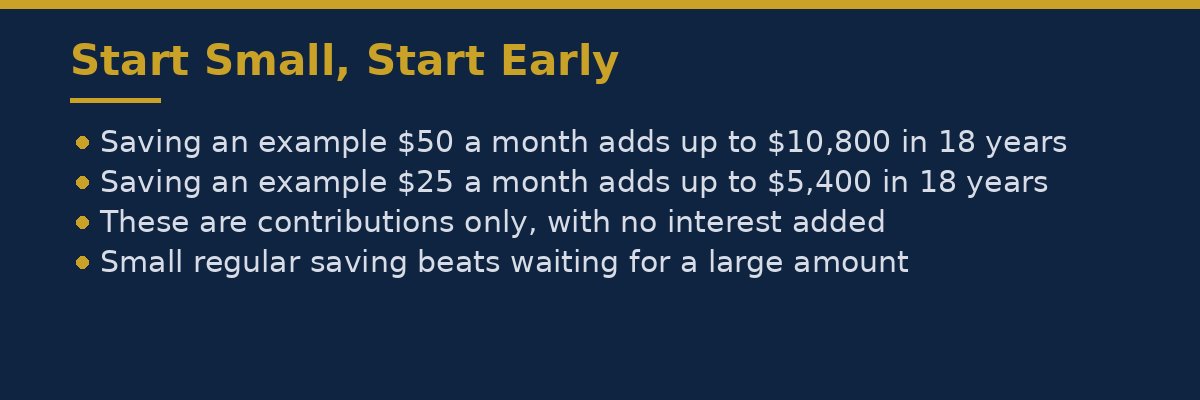
Suppose parents save an example $50 a month from the month the baby is born. In one year, that is 12 times $50, which is $600. In five years, that is 60 times $50, which is $3,000. In ten years, that is 120 times $50, which is $6,000. In 18 years, that is 216 times $50, which is $10,800. That is contributions only, with no interest added.
Now try a smaller amount. Saving an example $25 a month adds up to $300 in a year, $1,500 in five years, $3,000 in ten years, and $5,400 in 18 years, again with no interest added. That is still a useful sum, built from $25 a month.
Now try a larger amount for a shorter time. Saving an example $100 a month for the first five years adds up to 60 times $100, which is $6,000 in contributions. Starting early matters more than the amount, because the months add up.
How much should parents save, and when should they start?
There is no single right amount. The right amount is the amount you can save each month without missing a bill, cutting food, or adding to debt. For some families, that is $25 a month. For others, it is $50 or $100. All of those are fine, because the habit matters more than the amount.
Start as early as you can, but do not worry if you start late. A parent who starts when the child is three or five still has many years of saving ahead. If money is tight, start with a very small amount, even $10 or $20 a month, if you can do so without missing an essential bill.
Keep your own emergency fund separate. Before you save a large amount for your baby, make sure you have a small cushion for your own surprises, like a car repair or a medical bill. A parent with no cushion may have to take money back out of the baby account when a surprise arrives. To learn how much to keep aside, read our guide on how much to keep in an emergency fund.
Common mistakes to avoid
Do not choose an account for its advertised rate alone. A high rate with high fees, a high minimum, or hard access can leave you worse off than a simple free account. Compare fees and minimums first, and treat the rate as one point among many.
Do not mix the baby money with everyday spending money. If the baby money sits in your main spending account, it will be spent. Keep it in a separate account, so you can see the balance grow and you are less likely to dip into it.
Do not wait for a large sum to start. Many parents wait until they can save a large amount, and the months pass with nothing saved. Start with a small amount now. You can raise it later. Finally, review the account once a year. Check the fees, check the rate, and check whether the account still fits.
Frequently asked questions
What is the best savings account for a baby?
The best account is a simple, low cost one that a parent or guardian can manage easily, with no monthly fee, a low minimum, easy deposits, and deposit insurance. For most families, that is a custodial savings account or a regular savings account set aside for the child.
Can I open a savings account for my baby at birth?
In most cases, yes, a parent or guardian can open an account for a baby. The exact steps and documents depend on the bank, so ask the bank what it needs before you apply. You can start with a small first deposit and add to it each month.
What is a custodial savings account?
A custodial savings account is opened by an adult for a child. The adult manages the money while the child is young, and control passes to the child when the child reaches the age set by the law where you live.
How much should I save for my baby each month?
Save an amount you can keep up every month without missing a bill or adding to debt. For many families, that is $25, $50, or $100 a month. Start small if you need to, and raise the amount later. The worked example above shows what each amount adds up to over time, in contributions only.
Should I choose a high-yield savings account for my baby?
A higher rate can help, but it is only one part of the choice. Check fees, minimums, and access first. A high rate on an account with high fees can leave you worse off than a lower rate on a free, simple account. Read our guide on is a high-yield savings account safe before you decide.
Can grandparents add money to a baby savings account?
In most cases, yes. Grandparents and other family members can deposit money into the account, or give the money to the parents to deposit.
Conclusion, and your first step today
The best savings account for a baby is not a special product with a perfect rate. It is a simple, low cost account that you actually use, month after month, from an early age. Pick a custodial account or a regular savings account set aside for your child, check the fees, the minimum, and the deposit insurance, and set up a small automatic transfer.
Start today with three small steps. Choose the account type that fits your family. Open the account with a small first deposit. Set up an automatic transfer for the day after payday.
To learn the basics of opening an account, read our guide on how to open a savings account. To understand the difference between account types, read our guide on the difference between a checking and a savings account. For general information on bank accounts, see the Consumer Financial Protection Bureau at https://www.consumerfinance.gov/consumer-tools/bank-accounts/
This article is for general information and education only. It is not legal or financial advice.
