
How Do I Start Investing With Little Money?
Yes, you can start investing with little money. You do not need thousands of dollars saved up first. Most brokers now let you start with 25 or 50 dollars, and some let you buy part of a share, so a high share price is no longer a barrier. What matters is not the size of your first investment. What matters is starting, and then adding a small amount every month.
Many beginners wait for a large sum before they start. While they wait, months pass and nothing is invested. A small start beats a perfect start that never happens. This guide explains how little you really need, where to put it, and how a small monthly amount can grow over time.
How Little Money Do You Really Need?
The honest answer is: less than you think. Many brokers have no minimum to open an account. Many index funds and ETFs can be bought for the price of one share, and fractional shares let you invest any amount, even 10 dollars, in a fund or a company.
If you have 25 dollars a month spare, you can start. If you have 50 dollars, you can start faster. The amount is less important than the habit. A habit of 25 a month that you keep for ten years beats a one-time 500 investment that you never repeat.
Before you start, make sure you have a small safety net. If you have no emergency savings at all, build a small cushion first, even 500 dollars, so a surprise bill does not force you to sell your investments. Read How Do I Build an Emergency Fund From Zero? for a simple start. For the minimums in more detail, read How Much Money Do I Need to Start Investing?
Step 1: Find a Small Amount You Can Spare Every Month
Look at your budget and find one small amount you can invest without missing it. Common starting points are 25, 50, or 100 dollars a month. Pick the smallest amount you are sure you can keep paying, even in a tight month. You can raise it later.
One easy way to find the money is to cut one small weekly cost. A takeaway coffee or a snack bought every day can cost 25 dollars a week, which is 100 dollars a month. You do not need to cut everything you enjoy. Cut one thing, and invest what you save. If you need help finding the money, read How Do I Set a Weekly Budget Instead of a Monthly One?
Step 2: Open an Account That Fits Small Amounts
Not every broker suits a small investor. Look for three things. First, no minimum deposit, or a very low one. Second, no commission to buy and sell. Third, fractional shares, so you can invest your exact monthly amount instead of waiting until you can afford a whole share.
You can open a general investment account, or a retirement account if your employer offers one. If your employer matches contributions to a retirement plan, take that match first, because it is free money on top of your own. After the match, a general account is a fine place to start your monthly habit. For a checklist of what to compare, read What Should I Check Before Opening an Investment Account?
Step 3: Buy a Broad, Low Cost Fund First
With little money, your first buy should be simple. A broad index fund or ETF holds hundreds of companies in one purchase, so your small amount is spread out from day one. Buying one single stock with 50 dollars puts everything on one company. Buying a broad fund with the same 50 dollars spreads it across a whole market.
Look for a fund with a low yearly fee, called an expense ratio. A low cost index fund may charge 0.10 percent a year. On a 500 balance, that is 50 cents a year. A fund charging 1.00 percent costs 5 dollars a year on the same balance, ten times as much. The difference grows as your balance grows. Read What Is an Index Fund, and Why Do Beginners Use It? and What Is an ETF, and How Is It Different From a Stock?
How Fractional Shares Work
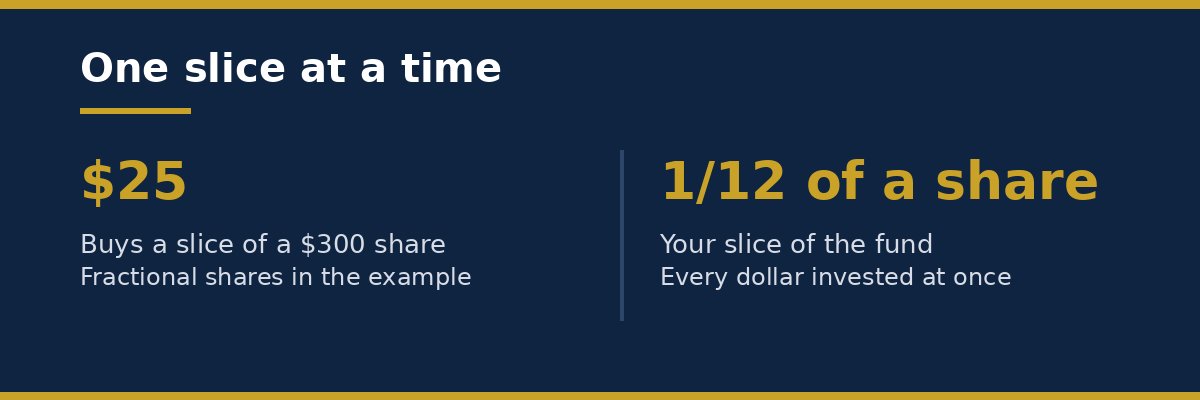
A fractional share is a slice of a share. If one share of a fund costs 300 dollars and you have 25 dollars to invest, you can buy one twelfth of a share. You still own a real piece of the fund, and you still earn your share of any growth or dividends. When you add 25 dollars next month, you buy another slice.
This matters for small investors because it removes the need to save up for a whole share. You can invest your exact monthly amount on the same day every month, and every dollar starts working right away.
A Worked Example: 50 a Month for 10 Years
Here is a simple example with real math. The numbers use an assumed average return of 7 percent a year, which is an illustration only. Real returns vary, and no one can promise 7 percent.
| Monthly amount | Paid in over 10 years | Value after 10 years at 7 percent a year |
|---|---|---|
| 25 | 3,000 | About 4,330 |
| 50 | 6,000 | About 8,660 |
| 100 | 12,000 | About 17,300 |
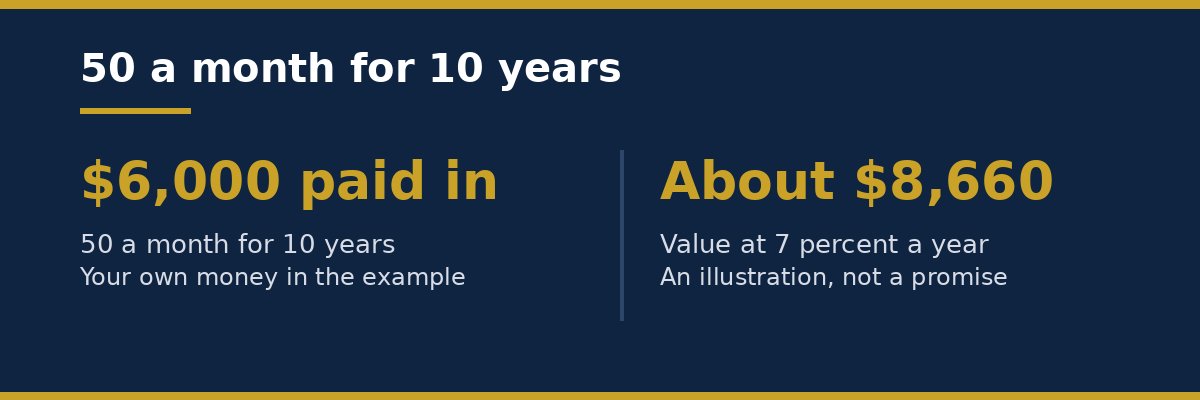
At 50 a month, you pay in 6,000 over ten years. At an assumed 7 percent a year, that could grow to about 8,660. The extra 2,660 comes from returns on your money, and from returns on those returns. The first year looks slow: 50 a month is only 600 paid in. By year ten, the monthly growth is doing more work than your monthly payment. That is why starting early matters more than starting big. Read How Does Compound Interest Work? to see the same idea in detail.
Step 4: Automate It and Forget the Amount
Set up an automatic transfer from your bank to your investment account on payday, and set the investment to buy automatically if your broker allows it. Automation turns investing into a bill you pay yourself first, and it removes the monthly decision.
Then check your account only once or twice a year. Watching a small balance every day is discouraging, because the daily moves are bigger than the daily growth. A yearly check shows real progress: your balance, your total paid in, and how much the market added. For the automation habit in full, read How Do I Automate Saving and Investing?
Step 5: Raise the Amount When You Can
Your starting amount is not your forever amount. When your income rises, or a cost falls away, raise the monthly amount. Even 10 dollars more a month adds up: 10 dollars a month for ten years is 1,200 paid in, plus growth. If you get a pay rise, invest half of it before you get used to spending it. If a loan is paid off, send that old monthly payment to your investments instead of letting it melt into spending.
Mistakes to Avoid With Little Money
First, do not spend your small start on one risky stock because you want it to grow fast. A small amount in one stock that falls by half leaves you with almost nothing and no lesson except regret. A broad fund is slower, but it is still there next year.
Second, do not pay high fees. With a small balance, a 1 percent fee is small in dollars, but it is a large share of your early growth. Low cost funds keep more of your money working for you.
Third, do not stop when the market falls. A fall is when your monthly amount buys more shares for the same money. If you stop investing in a fall, you miss the cheaper shares. Keep the habit going through good months and bad ones.
Fourth, do not borrow money to invest. A loan charging interest costs more than a small investment is likely to earn, and a market fall turns borrowed investing into debt you still have to repay. For a full first plan, read What Is a Simple First Investment Plan? If you want to understand stocks from the start, read How Do I Invest in Stocks for Beginners?
FAQ
Can I start investing with 25 dollars?
Yes. Many brokers accept 25 dollars, and fractional shares let you invest it in a broad fund right away. The amount is small, but the habit is what matters, and you can raise it later.
Is it worth investing small amounts?
Yes, if you keep going. Small amounts grow slowly at first, then faster as returns build on returns. A 50 dollar monthly habit over ten years is 6,000 paid in, and with an assumed 7 percent a year it could be worth about 8,660. The habit also teaches you how investing feels before larger amounts are involved.
Should I save or invest my spare money first?
Build a small emergency cushion first, then invest. Money you might need in the next year belongs in savings, not in the market. Money you can leave alone for five years or more can go to investing.
What is the best first investment with little money?
For most beginners, a broad low cost index fund or ETF. It spreads your small amount across many companies at once, charges a low yearly fee, and needs no stock picking skill.
Do I need a financial adviser to start with little money?
No. A simple plan, a low cost fund, and a monthly automatic payment are enough to start. An adviser can help later, when your money or your life gets more complex. Avoid anyone who charges a large fee to manage a small balance, or who promises fast returns.
Conclusion
Starting to invest with little money comes down to five steps: find a small monthly amount you can spare, open an account that fits small amounts, buy a broad low cost fund, automate the payment, and raise it when you can. You do not need a large sum, a hot tip, or perfect timing. You need a start, and a habit you can keep. Start with 25 or 50 dollars this month, and let time do the rest.
This article is for general information and education only. It is not legal or financial advice.
