
What Is a Target Date Fund, in Simple Terms?
A target date fund is a type of mutual fund that holds a mix of stocks, bonds, and other investments, and changes that mix over time based on one year in its name. That year is the target date, and it is meant to match roughly when you plan to start using the money, often around retirement. You pick the fund with the year closest to your planned date, you add money to it, and the fund manager slowly moves it from a higher stock mix when the date is far away to a lower stock mix as the date gets closer.
The fund does the rebalancing and the gradual shift for you. It does not remove risk, it does not promise a result, and it does not guarantee that you will have enough money at the target date.
What a target date fund does
A target date fund is sometimes called a lifecycle fund. It is one fund that holds many smaller funds inside it. Those smaller funds may hold stocks from many companies, bonds from governments and companies, and sometimes cash-like investments.
When you buy shares in a target date fund, you are not buying one stock. You are buying a small piece of that whole mix. The fund manager decides how much goes to stocks and how much goes to bonds, and changes that split as the target date approaches.
With a target date fund, the main choice you make is the year. The fund then follows a plan, called a glide path, to change the mix over time. Many target date funds hold index funds inside them, and some hold funds that work in a similar way to an exchange traded fund.
How the year in the name works
The year is the most important part of the name. A fund called Target Date 2065 is built for someone who expects to start using the money around 2065. A fund called Target Date 2040 is built for someone who expects to start using the money around 2040.
In general, a later year means a higher share in stocks today, because there is more time before the target date. An earlier year means a lower share in stocks today, because the target date is closer. If you are 25 and you plan to retire around age 65, your target date may be about 40 years away. If you are 50, it may be about 15 years away.
The year is a guide, not a deadline. You do not have to sell the fund on that exact date, and the fund does not close on that date. Many funds keep changing their mix for years after the target date, moving slowly toward a final mix that is often heavier in bonds and cash-like investments. Each provider sets its own exact mix, so two funds with the same year can still differ.
What is inside a target date fund
Most target date funds hold three broad groups: stocks, bonds, and short term investments. The exact funds inside can differ, so look at the fund facts, not just the name.
Stocks
Stocks are shares in companies. In a target date fund, stocks usually provide most of the growth potential when the target date is far away, and they also bring most of the short term ups and downs. The stock part may include large companies, smaller companies, and companies from other countries.
Bonds
Bonds are loans to a government or a company, made in exchange for interest payments. In a target date fund, bonds usually provide more steady income and less sharp movement than stocks. As the target date gets closer, the fund usually holds more bonds.
Short term investments
Short term investments may include cash-like holdings. These are often a small part of the mix early on, and a larger part after the target date, when the fund is built for someone who may soon need to take money out.
Diversification is the idea behind holding all three groups together. When one group falls, another group may fall less, stay steady, or rise. That does not remove losses. It means the fund is not tied to the fate of one company, one country, or one type of investment.
How the mix shifts over time
The glide path is the plan for how the mix changes. It starts with more stocks and ends with more bonds. The change is slow, often over decades, and it usually happens in small steps each year.
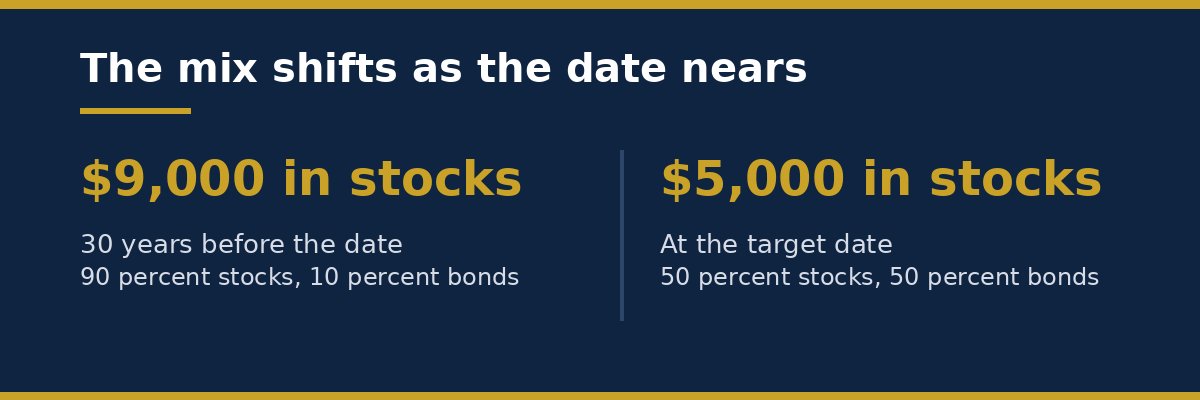
Here is a simple, clearly labelled example, using round numbers only to show the shift. It is not a promise about any real fund, and the percentages will differ by provider. Suppose you have 10,000 dollars in a target date fund:
- 30 years before the target date: 90 percent stocks, 10 percent bonds. That is 9,000 dollars in stocks and 1,000 dollars in bonds.
- 10 years before the target date: 70 percent stocks, 30 percent bonds. That is 7,000 dollars in stocks and 3,000 dollars in bonds.
- At the target date: 50 percent stocks, 50 percent bonds. That is 5,000 dollars in stocks and 5,000 dollars in bonds.
Check the maths: 9,000 plus 1,000 equals 10,000. 7,000 plus 3,000 equals 10,000. 5,000 plus 5,000 equals 10,000. In each case the total stays the same in this example. Only the split changes. In real life, the total would also move up and down with the market. The point is the direction of the shift. Early on, the fund leans toward growth. Later, it leans toward steadier income and lower swings.
Some funds reach their most conservative mix at the target date. Others keep shifting for 10 to 20 years after the target date. The fund documents will state which approach it uses.
A worked example: a small monthly amount
Many people add money in small, regular amounts, often through a workplace plan or a retirement account. Here is a simple example using contributions only, with no return assumed and no growth promised:
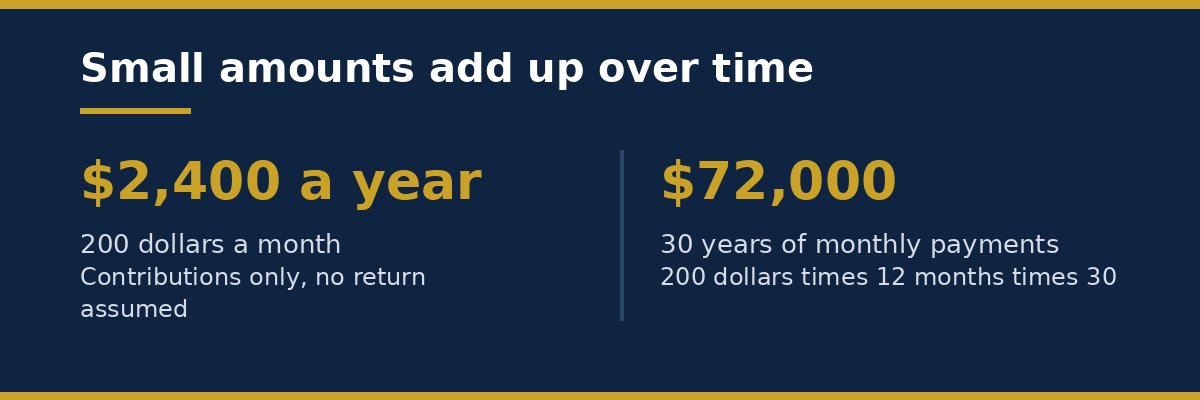
- Monthly amount: 200 dollars per month
- Money added in one year: 200 times 12 equals 2,400 dollars
- Years in the example: 30 years
- Total money added over 30 years: 2,400 times 30 equals 72,000 dollars
That 72,000 dollars is the total of the monthly payments only. It is not the final account value. In real life, the final value would be higher if the investments grew, and lower if they fell, and fees would also affect the result. This example shows only how regular small amounts add up over time.
Benefits and limits to know
A target date fund offers simplicity. One fund holds a diversified mix, and the manager adjusts it over time. It also offers automatic rebalancing. As markets move, the mix can drift away from the plan, and the manager brings it back in line.
There are limits to know. First, no guarantee. A target date fund can lose money, even in the target year, and even after the target date. The glide path lowers the stock share over time, but it does not remove market risk.
Second, fees vary. Compare the expense ratio, which is the yearly cost shown as a percentage of the fund value. For example, an expense ratio of 0.10 percent on 10,000 dollars is 10 dollars per year, while 0.75 percent on 10,000 dollars is 75 dollars per year. Check the maths: 0.10 percent is 0.001 times 10,000, which equals 10, and 0.75 percent is 0.0075 times 10,000, which equals 75.
Third, funds with the same year can differ a lot. One provider may hold 90 percent in stocks 30 years before the date, while another holds 80 percent. The name alone does not tell you the full mix. Fourth, the fund may not match your full picture. It does not know your other savings, your debts, your tax situation, or your exact retirement date.
How to compare target date funds in 5 steps
Step 1: Match the year to your time horizon. Start with the year closest to when you expect to start using the money. Do not pick a far away year just because it held more stocks in the past.
Step 2: Read the glide path and the current mix. Find the current mix in the fund fact sheet or prospectus, and find the planned mix at the target date and after it. Compare two or three funds with the same year side by side.
Step 3: Check the fees. Find the expense ratio and compare it with other funds with the same target year. Also check for other charges, such as a sales load, which is an extra fee some funds charge when you buy or sell.
Step 4: Look inside the fund. Does it hold mostly index funds or actively managed funds? Does it hold international stocks and bonds, or only domestic ones? If you cannot explain in one sentence what the fund holds, read the fact sheet again.
Step 5: Check how it fits your wider plan. If you already hold other stock or bond funds, a target date fund may overlap with them. A guide to a simple first investment plan explains how to put the pieces together in order, starting with an emergency fund and clear goals before investing. A guide on how much money you need to start investing can help you set a realistic first amount. You may also hold it in a brokerage account, so check the account type that fits your goal. For investor education, the U.S. Securities and Exchange Commission site, Investor.gov, explains how these funds work and what to check before you invest.
Common mistakes to avoid
Do not pick the wrong year by choosing the fund with the highest past return, which often means the latest year and the most stocks. Do not treat the target date as a guarantee, because the fund can still lose value near the date. Do not ignore fees, because two funds with the same year can have very different costs. Do not hold several target date funds for the same goal, because that gives you a mixed glide path that is harder to track. Do revisit the choice every year or two, because your planned retirement date, income, and savings may change.
Target date fund vs index fund vs ETF
A target date fund is a fund with a changing mix based on a year. An index fund is a fund that tracks a market index, such as a broad stock index. A target date fund may hold index funds inside it, but an index fund on its own does not change its mix based on your age or a target year. An ETF, or exchange traded fund, is a fund that trades on a stock exchange during the day, like a stock. Many ETFs are index funds, and most target date funds are mutual funds that are bought and sold once per day at the closing price. In short, target date describes the plan and the year, index describes how the fund picks its holdings, and ETF describes how the fund trades.
FAQ
Is a target date fund safe?
No investment is safe in the sense of guaranteed. A target date fund holds stocks and bonds, and both can fall in value. The fund lowers its stock share as the target date nears, which can reduce sharp swings, but it does not remove the risk of loss.
Do I need to do anything after I buy a target date fund?
You do not need to adjust the mix yourself, because the manager does that. You should still review the fund from time to time, check the fees, check the mix, and check whether the target year still matches your plan.
Can I lose money in a target date fund near retirement?
Yes. Even a fund near its target date still holds stocks, often around 40 to 60 percent depending on the provider, and stocks can fall sharply in a short period. Bonds can also fall.
What happens after the target date passes?
The fund does not disappear. Many funds continue to shift the mix for years after the date, moving slowly toward a final mix that is heavier in bonds and short term investments. Some funds stop changing at the date. The fund documents will state the plan.
Is a target date fund good for beginners?
It can be a simple starting point for a beginner who wants a diversified mix in one fund and does not want to manage many funds. It is not right for every beginner, and it is not a recommendation. A beginner should still understand what is inside the fund, what it costs, and how the mix will change.
How do I pick the right target date fund year?
Start with the year closest to when you expect to start using the money. Then compare funds with that year on glide path, current mix, fees, and holdings. Pick the fund whose plan you understand, not the fund with the highest past return.
Conclusion
A target date fund is a simple idea with a clear job. You pick a year, the fund holds a diversified mix of stocks, bonds, and short term investments, and it slowly shifts that mix as the year approaches. The year is a guide to the time horizon, not a promise about the result.
Before you choose one, compare the year, the glide path, the current mix, and the fees. Read the fact sheet, check what the fund actually holds, and see how it fits with your wider plan. A fund you understand, with a cost you can accept and a mix you can hold through ups and downs, is easier to stick with than a fund picked only for its name or its past return.
This article is for general information and education only. It is not legal or financial advice.
