

What Is a Joint Bank Account, and Should We Open One?
What Is a Joint Bank Account?
A joint bank account is a bank account that belongs to two or more people. Each person named on the account is an owner. Each owner can deposit money, withdraw money, pay bills, and see every transaction.
The short answer is this. A joint bank account is a shared account for shared money. It works well when two people trust each other, agree on how the money will be used, and keep talking about spending. It works badly when the people do not agree, do not communicate, or do not trust each other with full access.
Most joint accounts are opened by married couples, partners who live together, parents and adult children, or business partners. Instead of moving money back and forth between two separate accounts, both people put money into one shared account and pay shared bills from it.
A joint account is not the same as giving someone permission to use your account. When you add a person as an authorized user, you stay the only owner. When you open a joint account, that person becomes an owner too, with the same rights you have.
How Does a Joint Bank Account Work?
A joint bank account works like a normal checking or savings account, with one big difference. More than one person owns it.
Each owner has full access
In most joint accounts, each owner can act alone. Either owner can withdraw cash, write a check, move money online, or close the account in some cases. The bank does not usually ask the other owner for permission first. That is why trust matters so much.
Deposits go into one shared pot
Money from either owner goes into the same balance. Once money is deposited, it belongs to the account, not to one person. Either owner can spend it. Only deposit money you are comfortable sharing.
Both owners see everything
Each owner can see the full transaction history and the balance at any time. This openness can help a couple stay honest about spending, but it also means there is no privacy for spending inside the account. If you want to keep some spending private, keep a separate personal account and use the joint account only for shared costs.
The Main Types of Joint Bank Accounts
A joint account can be a checking account or a savings account. The type you pick depends on what the money is for.
A joint checking account is the most common choice. It is used for everyday shared spending, such as rent, utilities, groceries, and other bills. It usually comes with a debit card for each owner, online banking, and bill pay.
A joint savings account is used for a shared goal, such as a holiday, a house deposit, or an emergency fund. It earns a small amount of interest, and it keeps the goal money separate from everyday spending. If you are building a shared safety net, read how much to keep in an emergency fund before you pick a target amount.
Some couples open both, a joint checking account for monthly bills and a joint savings account for shared goals. To understand the difference between the two account types, see the difference between a checking and a savings account.
The Pros of a Joint Bank Account
A joint bank account has clear benefits when it is used well.
First, it makes shared bills simple. Both people put money in, and the bills come out of one place. There is no need to split every bill or work out who owes what each month.
Second, it gives both people a clear view of shared spending. Anyone can check the balance and see what has been paid. This can reduce arguments, because the numbers are in front of both of you.
Third, it can help a couple build a shared goal together, such as a holiday or a house deposit. Saving feels more real when both people can see the balance grow in one place.
Fourth, it can be useful in an emergency. If one owner is ill or away, the other owner can still pay the bills and get cash.
Fifth, it can reduce fees in some cases. Some banks waive a monthly fee when the combined balance or the total monthly deposits reach a set level.
The Cons and Risks of a Joint Bank Account
A joint account also has real risks, and you should know them before you open one.
The biggest risk is that either owner can take out all the money. The bank will not stop them. If the relationship breaks down, one person could empty the account.
The second risk is debt. If one owner has debts, a creditor may be able to take money from the joint account to pay that debt, even if the other owner put the money in. The rules depend on the state and the type of debt.
The third risk is overspending. Because both people can spend, the balance can fall faster than either person expects. If one person spends without telling the other, the account can go into overdraft, and both owners are responsible for the fees.
The fourth risk is a disagreement about what counts as shared spending. One person may think a new television is a shared cost. The other may think it is personal spending. Without clear rules, small disagreements can grow.
None of these risks means you should never open a joint account. They mean you should open one with your eyes open, with clear rules, and only with a person you trust.
A Worked Example: How a Joint Account Covers Shared Bills
Here is a simple example with real numbers. Suppose two people, Alex and Sam, live together and share the bills. They open a joint checking account for shared costs only and keep personal spending in their own separate accounts.
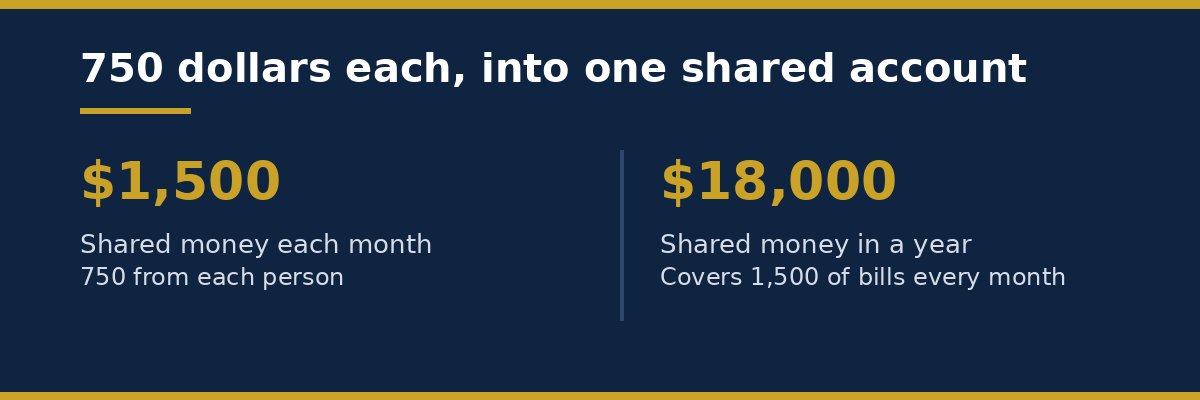
Each month, Alex puts 750 dollars into the joint account. Sam also puts 750 dollars into the joint account. That gives a monthly total of 1,500 dollars.
Now look at their shared monthly bills. Rent is 950 dollars. Utilities are 140 dollars. Internet is 60 dollars. Groceries are 350 dollars. Add them up step by step. Rent plus utilities is 950 plus 140, which is 1,090 dollars. Add internet, and 1,090 plus 60 is 1,150 dollars. Add groceries, and 1,150 plus 350 is 1,500 dollars.
The monthly total of the bills is 1,500 dollars. The monthly total they deposit is also 1,500 dollars. So the deposits cover the bills exactly, with nothing left over.
Over a full year, each person puts in 750 dollars times 12 months, which is 9,000 dollars. Together they put in 1,500 dollars times 12 months, which is 18,000 dollars. Their shared bills over the year are also 18,000 dollars.
This example shows why the numbers matter. If their bills went up by 100 dollars a month, to 1,600 dollars, their deposits of 1,500 dollars would fall short by 100 dollars each month. Over a year, that shortfall would be 1,200 dollars. They would need to raise their deposits to 800 dollars each per month to cover the new total.
How to Decide If a Joint Account Is Right for You
Ask these questions together before you open an account.
Do you trust each other with money? If either person has doubts, do not open a joint account yet. Talk about the doubts first.
Do you agree on what the account is for? Write down the list. Common uses are rent, utilities, food, and other shared bills.
Do you have similar spending habits? If one person is a careful saver and the other spends freely, a smaller joint account for bills only, with separate accounts for personal spending, often works better.
Are either of you carrying debts that could affect the account? If so, learn how your state treats joint accounts and creditors before you deposit money.
If you can answer yes to most of these questions, a joint account may suit you. If you answer no to several, wait. You can still share costs without a joint account, by splitting bills and paying each other back.
Couples who want help with shared money talks should read how couples budget together without arguments.
How to Open a Joint Bank Account, Step by Step
Opening a joint account is much like opening a normal account, but both owners need to be involved.
Step 1. Pick the bank and the account type. Compare monthly fees, minimum balances, overdraft fees, and online banking tools. A joint checking account suits bills. A joint savings account suits a shared goal. If you are new to picking an account, read how to choose a bank account as a beginner.
Step 2. Agree on the rules first. Decide what the account will pay for, how much each person will deposit, and when the deposits will happen. Write the rules down, even if they are simple.
Step 3. Gather your documents. Both owners will usually need a photo ID, such as a driving licence or passport, and a Social Security number. Some banks also ask for proof of address.
Step 4. Apply together. Most banks want both owners present, in a branch or on a joint online application. Both owners sign the account agreement. Read it before you sign, and ask about the right of survivorship and overdraft rules.
Step 5. Set up the deposits. Arrange a regular transfer from each person’s own account into the joint account, timed for just after payday.
Step 6. Set up alerts. Turn on low balance alerts and transaction alerts for both owners. Alerts help you spot a mistake or an unexpected payment early.
Step 7. Review the account together each month. Spend ten minutes looking at the statement and checking that the bills were paid and the deposits arrived.
How to Manage a Joint Account Well
A joint account works best with a few simple habits.
Keep the purpose clear. Use the joint account for shared costs only. Keep personal spending, gifts, and hobbies in your own account.
Agree on a spending limit. For example, agree that any purchase over 100 dollars from the joint account needs a quick check with the other owner first.
Keep a small buffer. Try to keep a few hundred dollars in the account above the normal balance, so a higher bill or a late deposit does not cause an overdraft.
Talk about money often. A short weekly or monthly talk is better than a long argument after a problem appears.
Is Your Money Safe in a Joint Account?
Money in a joint bank account at an insured bank is covered by deposit insurance in the same way as money in a single owner account, but the cover works per owner in many cases. In the United States, the Federal Deposit Insurance Corporation, known as the FDIC, insures deposits at member banks. The standard cover is 250,000 dollars per depositor, per insured bank, for each account ownership category. Joint accounts are a separate ownership category, so each co-owner can be covered up to 250,000 dollars for their share. You can check the current rules on the FDIC deposit insurance pages at https://www.fdic.gov/resources/deposit-insurance/.
This cover protects you if the bank fails. It does not protect you if the other owner spends the money. For a plain explanation, see is my money safe in a bank, and what does insurance mean.
What Happens If the Relationship Ends?
If you open a joint account, think about how it would end, even if the relationship is strong now. A clear plan made early is easier than a hard talk later.
First, agree in advance how you would split the money and close the account. A simple rule is to split the balance in the same share as the deposits, after shared bills are paid.
Second, if the relationship ends, act quickly. Stop any automatic deposits into the joint account and pay any bills that are still due. Then close the account, following the bank’s rules.
Third, open a new account in your own name for your future bills, so you are not left without a way to pay for rent and food.
FAQ
Can I open a joint bank account with anyone?
In most cases, yes. You can open a joint account with a spouse, a partner, a family member, or a friend. The bank will check the identity of each owner. The real question is not whether you can, but whether you should. Only open a joint account with a person you trust with full access to the money.
Can one owner close a joint account without the other?
It depends on the bank. Some banks let either owner close the account alone. Others need both owners to agree. Ask your bank about its rule before you open the account, and keep a note of the answer.
Can I take my name off a joint account?
In many cases, you cannot simply remove your own name. The usual way to leave is to withdraw your share, if the rules allow it, and close the account with the other owner, or to open a new account in your own name. Ask the bank what steps it needs.
How much money should we put into a joint account?
There is no single right amount. Start with the total of your shared monthly bills, as in the worked example above. Add a small buffer for months when a bill is higher than usual. Keep personal spending money in your own accounts.
What happens to a joint account if one owner dies?
In many cases, if the account has a right of survivorship, the money passes to the surviving owner. The exact result depends on the state, the account type, and the terms you signed. Ask your bank how your account is set up.
Conclusion
A joint bank account is a simple tool for shared money. It puts both owners in charge of one pot of money, so shared bills are easy to pay and easy to track. It works well for couples and partners who trust each other, agree on what the money is for, and check the account together each month.
It is not right for everyone. The risks are real. Either owner can spend the money, debts can reach the account, and a breakup can make closing it hard. Lower those risks by setting clear rules before you open the account, using it for shared costs only, keeping a buffer, and keeping some money in your own name.
If you decide to open one, start small. List your shared bills, add them up, set deposits to match, and review the statement together each month.
Further reading
This article is for general information and education only. It is not legal or financial advice.
