

What Is Affiliate Marketing, and Can Beginners Earn From It?
What Affiliate Marketing Is in Plain Words
Affiliate marketing is a way to earn a commission by recommending a product or service to other people. When someone buys through your special link, the seller pays you a small share of the sale. You do not make the product. You do not ship it. You do not handle refunds or customer service. Your job is to help the right people find something useful, and to explain it clearly and honestly.
Here is the direct answer to the question in the title. Yes, beginners can earn from affiliate marketing, but most beginners earn little at first, and many earn nothing for months. It is not quick money. It is a slow skill. You need an audience, or a page that people find in search, before commissions start to add up. If you are willing to learn, write helpful content, and keep going for months, it can become a real side income. If you want fast cash this week, it is the wrong choice.
How Affiliate Marketing Works, Step by Step
The process has four parts: a seller, an affiliate, a link, and a buyer. The seller is the company that owns the product. The affiliate is you. The link is the tracked connection between your content and the sale. The buyer is the person who clicks and buys.
Step 1: Join an affiliate program
Most large online stores and software companies run their own affiliate programs. You apply, and if you are accepted, you get a dashboard with links and reports. Some programs accept new sites with little traffic. Others want to see an established site first. Read the terms before you join.
Step 2: Get your special link
Each product gets a unique link that belongs to you. When someone clicks it, a small file called a cookie is placed on their device. That cookie tells the seller the sale came from you. Cookies last for a set time, often 24 hours, 30 days, or 90 days. If the person buys within that window, you normally earn the commission.
Step 3: Share the link in helpful content
You place the link inside content that helps the reader make a decision. That could be a review, a comparison, a tutorial, or a list of tools you actually use. The link should fit naturally. A page that is only a list of links, with no useful advice, rarely earns trust or sales.
Step 4: Earn a commission on a sale
When a tracked purchase happens, the seller records it in your dashboard. Commissions are usually paid once a month, after a holding period, and only after you pass a minimum payout amount, often 10 dollars or 50 dollars.
How Affiliates Get Paid
Commission rates vary a lot. Physical products often pay between 1 percent and 10 percent of the sale price. Digital products and software often pay more, sometimes 20 percent to 40 percent, because the seller has no shipping or stock cost. Some programs pay a fixed amount per sale, such as 5 dollars for each sign up. Others pay a recurring commission each month while the customer stays subscribed. A high rate is not always better. A 40 percent commission on a product nobody wants is worth less than a 4 percent commission on a product people buy every week. Also check how long the cookie lasts. A 30 day cookie gives you more chances than a 24 hour cookie.
A Worked Example With Real Math
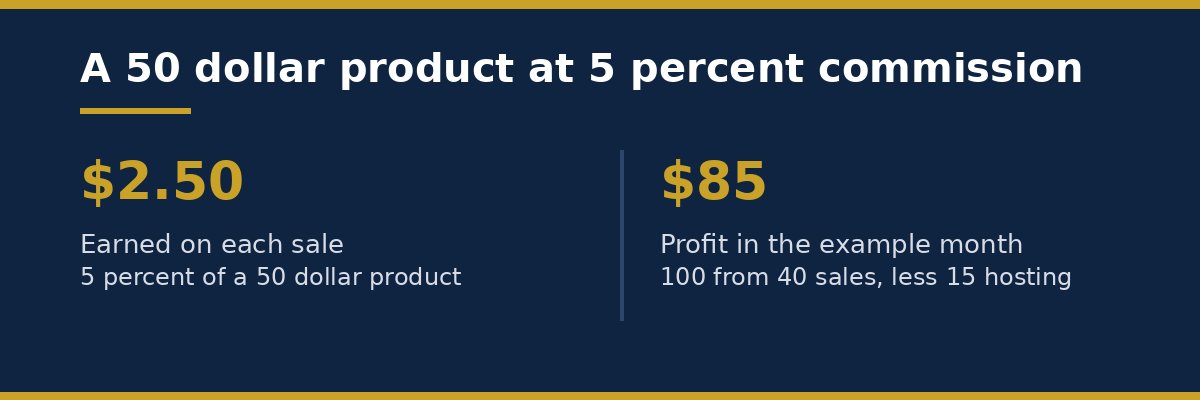
Let us work through a simple example so the numbers are clear. Suppose you recommend a kitchen item that costs 50 dollars. The program pays a 5 percent commission. That is 2 dollars and 50 cents per sale, because 5 percent of 50 dollars is 2 dollars and 50 cents.
Now suppose 40 people buy through your link in one month. Multiply 2 dollars and 50 cents by 40. That gives 100 dollars for the month. The math is 2.50 times 40 equals 100.00.
These numbers show one lesson: small commissions need many sales to add up. Neither example includes your costs. If you pay for a website or an email tool, subtract those costs to find your real profit. For example, if you earned 100 dollars and paid 15 dollars for hosting that month, your profit before tax is 85 dollars, because 100 minus 15 equals 85.
Results vary a lot, and most beginners earn little at first. Income grows only if your traffic grows and your recommendations stay useful.
What Beginners Need to Start
You do not need a large budget to start, but you do need three basics. First, pick a topic you can write or talk about for months, one you know or want to learn deeply. A narrow topic is easier than a broad one. It is easier to become known for honest reviews of budget kitchen tools than for reviews of everything. Second, choose one place to publish. A simple blog is a good choice, because articles can keep bringing visitors from search for months or years. Pick the format you will actually keep doing each week. Third, build trust before you chase sales. Only recommend products you have used, tested, or researched carefully. Say what is good and what is not so good. Honest reviews earn repeat readers, and repeat readers are the people most likely to buy through your links.
How to Pick Products Worth Recommending
Good product choices share four traits. They solve a real problem, they have a fair price, they come from a seller people trust, and they fit your topic. If any one of these is missing, the recommendation will feel forced.
Start with products you already use. Write down five products you use each week and would buy again. Then check whether each one has an affiliate program. If it does, read the terms and the commission rate. Next, compare two or three similar products before you pick one to feature. A comparison helps the reader more than a single glowing review. Note the price, the main features, and who each product suits best.
Avoid products with a poor reputation. Search for recent reviews and complaints. If many buyers report the same problem, do not recommend it, even if the commission is high. One bad recommendation can damage the trust you spent months building. If you want ideas for other ways to earn on the side while your affiliate content grows, read our guide to side income ideas for beginners.
Common Ways Beginners Share Affiliate Links
A blog post is the most common starting point. A detailed guide, such as how to set up a home office on a budget, can include links to the exact items you mention. Search traffic can keep bringing new readers long after you publish. A video review suits people who like to show a product in use. Viewers can see the size, the build, and how it works. Put the links in the video description, and mention in the video that the links are affiliate links. Whatever channel you choose, focus on one first. Learn how it works, publish regularly, and measure what brings clicks and sales.
The Rules You Must Follow
The most important rule is disclosure. You must tell readers clearly that you may earn a commission if they buy through your link. Put the disclosure near the top of the page or video, where people will see it before they click. A small note hidden at the bottom of the page is not enough. A simple sentence works, such as: I may earn a commission if you buy through the links on this page, at no extra cost to you.
The US Federal Trade Commission, the FTC, sets the rules for endorsements in the United States. Its guidance says that any connection between an endorser and a seller that might affect how people weigh the endorsement must be disclosed. You can read it here: FTC Endorsement Guides: What People Are Asking. If your audience is in another country, check that country’s rules too.
Never hide a link or mislead a reader about where it goes. Never claim you used a product when you did not. Never post fake reviews or fake testimonials. Never promise that a product will make someone rich, healthy, or successful. Stick to facts you can check.
Mistakes Beginners Often Make
The first mistake is promoting too many products at once. A new affiliate signs up for ten programs, adds links everywhere, and wonders why nothing sells. A better start is one topic and two or three products you know well. Depth beats volume. The second mistake is writing only to sell. Pages that repeat buy now, best deal, and limited offer do not help the reader decide. Pages that answer real questions do.
The third mistake is ignoring traffic. A good review with no readers earns nothing. You need a plan to bring people to your content, usually by learning basic search optimisation and sharing useful posts where your audience already spends time. Traffic grows slowly, so plan for months, not days. The fourth mistake is choosing a product only for its commission rate. If you write about simple budgeting, then recommend a costly course you have never taken, readers will lose trust.
The fifth mistake is giving up too soon. Many beginners publish five posts, earn nothing, and quit. Affiliate income usually follows a long delay. The posts you write in month one may only start earning in month four or five. A steady pace of one useful post a week for six months gives you a much fairer test than a burst of posts in one weekend. If you want to turn a skill you already have into paid work while your affiliate income builds, see how to turn a skill into side income. If you are looking for faster paid work in the meantime, our guide on how to find your first freelance client sets out the first steps in plain order.
How Long It Takes, and What to Expect
There is no fixed timeline, but a realistic picture helps. In the first month, most beginners are still learning. They pick a topic, set up a site or channel, join one or two programs, and publish their first few posts. Earnings in this stage are usually 0 dollars. In months two to four, traffic starts to trickle in. A few readers click links, and a few sales may follow. Monthly earnings might be 10 dollars, 25 dollars, or still 0 dollars. This is the stage where many people quit, because the work feels large and the reward feels small.
In months six to twelve, the picture can change if publishing stayed steady. Older posts start to rank in search, and repeat readers return. Monthly earnings might reach 100 dollars, 200 dollars, or more, but only for affiliates who kept publishing helpful content. Some will still earn little. That is the honest range, not a promise.
Treat affiliate marketing as a side income, not as a replacement for a job, until the income is steady for many months. Keep your costs low at the start. Spend money on tools only after the income starts to cover them.
Affiliate marketing is often called passive income, and that label needs care. A blog post can keep earning for months after you write it, and that part is passive. But the income is not passive at the start. It can become partly passive over time, after a lot of active work. For a fuller explanation, read what passive income is.
How to Stay Safe From Scams
Affiliate marketing attracts scams, because it promises easy money. Be careful of any course or program that promises guaranteed income, a fixed amount per day, or results with no work. No honest program can promise that. Be careful of anyone who asks you to pay a large fee to join an affiliate program. Real affiliate programs are usually free to join. The seller pays you, not the other way around.
Be careful of fake dashboards and fake payment screenshots. They are easy to make and are often used to sell courses. Check a program before you join it. Search for its name plus words such as review, complaint, or scam, and read results from more than one source. Look for a real company address, clear terms, and a working support contact. If you cannot find those basics, do not join. Our guide on how to avoid side income scams lists the common warning signs in more detail.
Frequently Asked Questions
Do I need a website to start affiliate marketing?
No, but a website helps a lot. You can start with a video channel, an email list, or a social media account. A website is still the most reliable home for your content, because you control it.
How much money do I need to start?
You can start with very little. A basic website often costs 50 dollars to 100 dollars a year for a domain and hosting. Many affiliate programs are free to join. Avoid costly courses and tools at the start.
Do I need many followers to earn?
No. A small audience that trusts you can earn more than a large audience that does not. Focus on helpful content, not on growing a follower count for its own sake.
How do I choose my first product to promote?
Pick a product you already use and would recommend to a friend. Check that it has an affiliate program, read the terms, and note the commission and the cookie length.
Is affiliate marketing legal?
Yes, when it is done honestly. You must disclose your affiliate links, tell the truth about products, and follow the rules of each program and of your country.
Can I do affiliate marketing with no experience?
Yes. Most affiliates start with no experience. Pick a useful topic, write clearly, learn basic search optimisation, and keep publishing.
Conclusion
Affiliate marketing is simple to understand and slow to build. You recommend useful products, share a tracked link, and earn a commission when someone buys. Beginners can earn from it, but the early months usually bring little income, and steady earnings take time, traffic, and trust. Start small. Pick one topic, one channel, and a few products you know well. Write honest, helpful content each week. Disclose your links clearly, and keep your costs low until the income is real.
This article is for general information and education only. It is not legal or financial advice.
