
How Do I Pay Off Student Loans Faster?
A student loan can feel like it will never end. You pay every month, yet the balance seems to move slowly. That is normal, because part of every payment goes to interest before it touches the loan balance. The good news is that small changes can cut years off your payoff date.
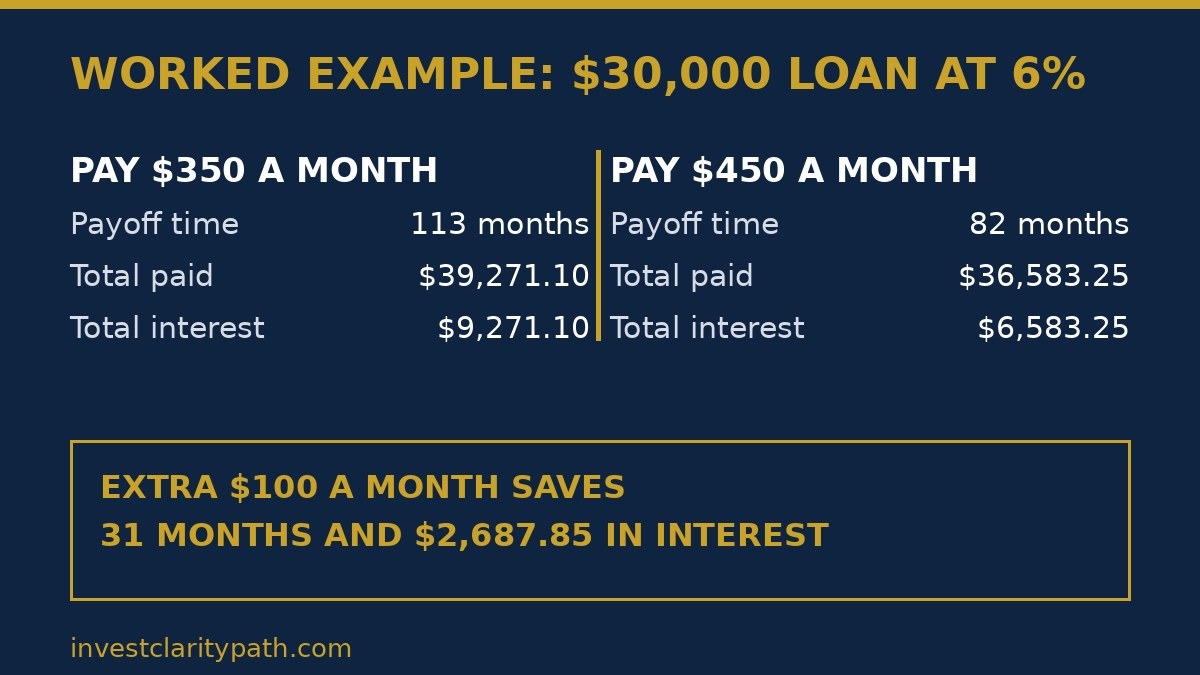
To pay off student loans faster, pay more than the minimum each month, send the extra money to your loan principal, and pick a payoff method you can stick to. The worked example below shows how adding just $100 a month to a $30,000 loan at 6 percent finishes the loan 31 months sooner and saves $2,687.85 in interest.
Paying off faster means two things: you finish in fewer months, and you pay less interest in total. Interest is charged on the balance you still owe, so when the balance falls faster, the interest charged each month falls too. You do not need a big pay rise or a lump sum. A steady extra amount, paid every month, does the job.
Step 1: Know Your Loans
You cannot build a fast payoff plan until you know what you owe. Many borrowers have more than one student loan, each with its own balance, interest rate, and servicer. The servicer is the company that collects your payments.
Write down these details for every loan: the loan type (federal or private), the current balance, the interest rate, the minimum monthly payment, and the servicer name.
Federal loans and private loans follow different rules. Federal loans offer income-driven repayment plans and some forgiveness programs, while private loans do not. That difference matters when you decide whether to refinance, so keep the two groups separate in your list. If you are not sure what federal loans you have, check your loan details on the Federal Student Aid website. Then add up the total balance. That total is your starting point.
Step 2: Pick a Payoff Method: Snowball or Avalanche
When you have more than one loan, you need a rule for where extra money goes. The two common methods are the snowball and the avalanche. Both work. The best one is the one you will keep using.
The debt snowball method means you pay extra on your smallest loan first, while paying the minimum on the rest. When it is gone, you move the extra money to the next smallest. The quick win keeps many people motivated. Our guide on what the debt snowball method is explains it in detail.
The debt avalanche method means you pay extra on the loan with the highest interest rate first, while paying the minimum on the rest. This saves the most interest over time. Our guide on what the debt avalanche method is walks through the math behind it.
If you have one loan only, you do not need to choose. Just send every extra dollar to that loan. If you have several loans, pick one method and stay with it. Switching methods every few months slows you down more than picking the "wrong" one.
Step 3: Pay More Than the Minimum
The minimum payment is set to stretch your loan over many years. Paying only the minimum means you pay the maximum amount of interest. Any amount above the minimum shortens the loan.
Start with an amount you can afford every month. For many beginners, $25 or $50 extra is a realistic start. The worked example below shows what $100 extra a month does to a $30,000 loan. Even half that amount saves hundreds of dollars in interest.
Do not wait for a perfect month to start. A small extra payment this month is worth more than a big one you keep planning for next month. If your income rises later, raise the extra payment at the same time. Our guide on how long it will take to pay off your debt shows how the payoff date changes as the monthly payment rises.
Step 4: Send Extra Money to Principal
This step is easy to miss, and it matters. When you pay extra, your servicer may treat the extra money as an early payment of next month’s bill instead of applying it to your loan balance. That does not cut your interest the same way.
To make extra payments count, tell your servicer in writing that extra payments should go to principal. Most servicers let you set this choice online, in your account settings or in a payment note. Check your next statement after your first extra payment to confirm the principal fell by the extra amount.
Keep paying the regular minimum on time, every month, because extra payments are on top of the minimum, not instead of it. Send the extra payment in the same month as your regular payment, and say which loan it goes to if you have more than one with the same servicer. Keep a simple record of the date, amount, and loan.
Step 5: Find Extra Money in Your Budget
Extra payments need extra money, and most people can find some without a big lifestyle change. Start with one week of spending. Write down every purchase, even small ones. Common places to find $25 to $100 a month include eating out less, cancelling a subscription you rarely use, and cutting back on delivery fees.
Other ways to find extra money: sell items you no longer use and send the money straight to your loan. Put a tax refund, a work bonus, or a cash gift toward the principal. Ask your employer about student loan help, because some employers offer a monthly payment benefit. If your pay rises by $100 a month, send half of it to your loan before your spending adjusts.
If you want a full plan for this, our guide on how to make a debt payoff plan walks through building a budget around extra payments, and our guide on a debt-free plan for the next 12 months shows how to set a one-year target and track it month by month.
Step 6: Automate Your Payments
The fastest payoff plan is the one that runs without you thinking about it. Set up automatic payments for at least the minimum, and add your extra amount to the same automatic payment if your servicer allows it. This stops late fees and missed months, which are two of the biggest reasons payoff plans fail.
Many servicers offer a small interest rate reduction for autopay, often 0.25 percent. It costs you nothing and applies for as long as autopay stays on. Check your servicer website to see if it offers this reduction. Pick a payment date just after payday, so the money is there when the payment goes out, and check your statement once a month to confirm the principal fell as expected.
Worked Example: A $30,000 Loan at 6 Percent
Here is a worked example with real math. The loan is $30,000 at 6 percent annual interest, and the monthly payment is $350.
First, find the monthly interest rate. Divide the annual rate by 12 months: 6 percent divided by 12 equals 0.5 percent a month, or 0.005 as a decimal.
Next, find the interest charged in the first month. Multiply the balance by the monthly rate: $30,000 times 0.005 equals $150. So in month one, $150 of the $350 payment goes to interest, and the other $200 goes to the principal. The balance after month one is $30,000 minus $200, which equals $29,800.
Compare two payment levels.
At $350 a month:
- Payoff time: 113 months, which is 9 years and 5 months.
- Total paid: $39,271.10. The last payment is smaller than the regular payment, which is why this is not exactly 113 times $350.
- Total interest: $39,271.10 minus $30,000 equals $9,271.10.
At $450 a month, which is $100 extra:
- First month interest is still $150, because the balance is still $30,000.
- First month principal is $450 minus $150, which equals $300. That is $100 more principal than the $350 payment.
- Payoff time: 82 months, which is 6 years and 10 months.
- Total paid: $36,583.25.
- Total interest: $36,583.25 minus $30,000 equals $6,583.25.
Now compare the two plans:
- Months saved: 113 minus 82 equals 31 months sooner.
- Interest saved: $9,271.10 minus $6,583.25 equals $2,687.85.
- Extra money paid in total: $100 a month for 82 months equals $8,200, but the total paid falls by $2,687.85, because so much less interest builds up.
The same idea works with smaller amounts. An extra $50 a month on this loan still saves many months and well over $1,000 in interest, because every extra dollar cuts the interest charged in every month after it.
Should I Refinance or Consolidate My Student Loans?
Refinancing and consolidation are often mixed up, but they are different. Consolidation combines several federal loans into one federal loan, usually at the average of the old rates. Refinancing replaces your loans with a new private loan, often at a lower rate if your credit and income are strong.
Refinancing can lower your rate and your monthly payment, which can help you pay off faster if you keep paying the old amount. But refinancing a federal loan into a private loan means you lose federal protections, including income-driven repayment plans and forgiveness programs. That trade is hard to undo, so think carefully before you refinance a federal loan.
Consolidation does not usually lower your rate, but it can simplify your payments into one monthly bill. Our guide on whether you should consolidate your debt explains the trade-offs in more detail.
A simple rule: if your loans are federal and your income is uncertain, keep the federal protections and focus on extra payments instead. If your loans are already private and your credit is strong, compare refinance offers and check the fees first. Never pay a company a fee to consolidate or refinance your federal loans for you. The Federal Student Aid website explains the official process for free. The Consumer Financial Protection Bureau also explains the fastest way to pay off student loans.
What About Income-Driven Repayment and Forgiveness?
Federal loans offer income-driven repayment plans. These plans set your monthly payment based on your income and family size, and they can lower your payment a lot. After 20 or 25 years of payments on these plans, the remaining balance may be forgiven. Some jobs, such as many public service roles, can lead to forgiveness sooner under the Public Service Loan Forgiveness program.
Here is the tension: a lower payment helps if money is tight, but it can stretch the loan out and raise the total interest. Paying off faster and chasing forgiveness pull in opposite directions, so you need to pick one path.
If your income is low and your balance is high, forgiveness may save you more than fast payoff. If your income is steady and your balance is manageable, paying off faster usually costs less in total. The Federal Student Aid website lists the current repayment plans, so you can compare them before you choose. If you are already working toward forgiveness, do not send large extra payments without checking the program rules first.
Mistakes to Avoid When You Pay Off Student Loans Faster
- Paying only the minimum and hoping the loan ends soon. The minimum is built to last many years.
- Sending extra money without telling the servicer to apply it to principal. Check your statement to confirm it went to principal.
- Refinancing a federal loan into a private loan without weighing the loss of federal protections.
- Stopping extra payments after one hard month. A smaller extra payment is better than none.
- Ignoring your other debts. If you also carry high-rate credit card debt, compare the rates first.
- Paying a company to help with federal loans. The official help on the Federal Student Aid website is free.
- Forgetting your emergency fund. Keep a small cash buffer first, so one surprise bill does not force you to miss a payment.
Frequently Asked Questions
How much extra should I pay on my student loans each month?
Pay what your budget allows every month, even if it is only $25. On a $30,000 loan at 6 percent, $100 extra a month finishes the loan 31 months sooner and saves $2,687.85 in interest. Start small and raise the amount when your income rises.
Should I pay off student loans or save first?
Do both, in order. First, build a small emergency fund, often $500 to $1,000, so one surprise bill does not force you to miss a payment. Then send extra money to your loan and keep saving a little each month.
Is it better to pay off the smallest loan or the highest rate loan first?
It depends on what keeps you going. Paying the smallest loan first, the snowball method, gives you a quick win. Paying the highest rate first, the avalanche method, saves the most interest. Both work, so pick the one you will stick to.
Does paying extra on student loans hurt my credit score?
No. Paying extra and paying on time helps your credit over time, because it lowers your balance and shows a steady payment history. The only risk is missing a payment, which is why automatic payments help.
Can I pay off student loans faster with a low income?
Yes, but the path is different. Start with a small extra payment, even $25 a month, and send one-time money such as a tax refund to principal. Check income-driven repayment plans on the Federal Student Aid website too, because forgiveness may be a better path than fast payoff.
Should I refinance my student loans to pay them off faster?
Refinancing can help if it lowers your rate and you keep paying the old amount, so the saving goes to principal. But refinancing a federal loan into a private loan removes federal protections, including income-driven plans and forgiveness programs. Compare offers carefully, check the fees, and only refinance if the new rate and terms are clearly better.
Conclusion
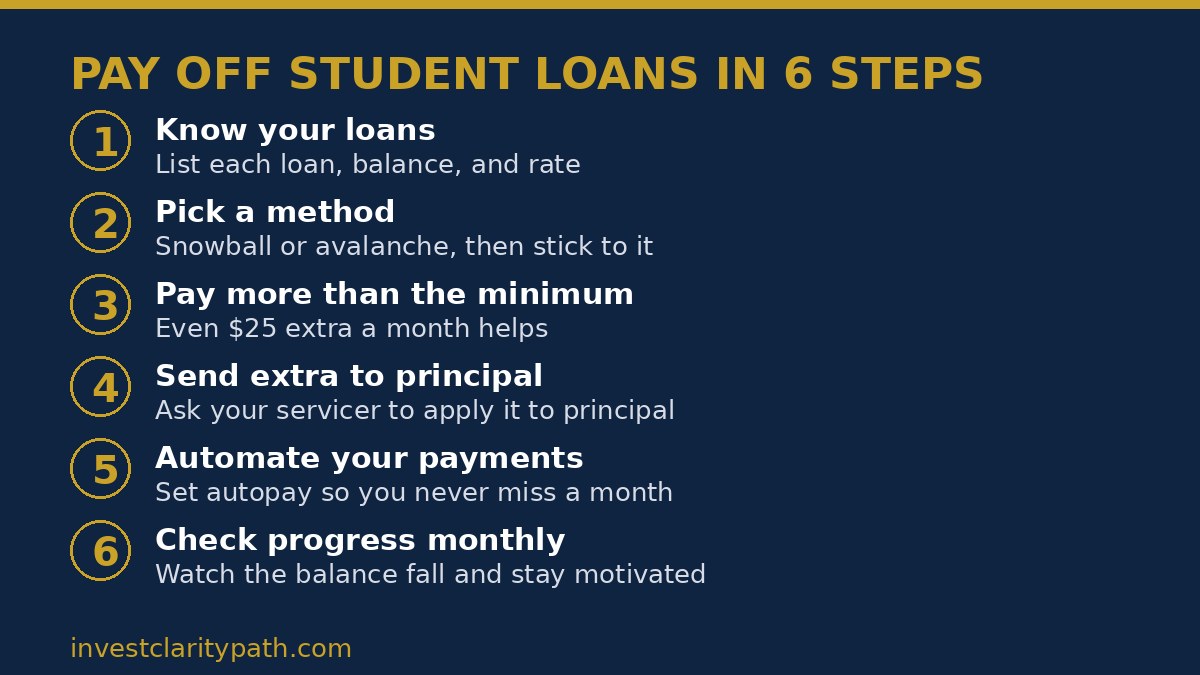
Paying off student loans faster comes down to six steps: know your loans, pick a payoff method, pay more than the minimum, send the extra money to principal, find extra money in your budget, and automate the payments. In the worked example, a $30,000 loan at 6 percent with a $350 monthly payment takes 113 months and costs $9,271.10 in interest. Adding $100 a month finishes it in 82 months and costs $6,583.25 in interest, saving 31 months and $2,687.85. Start this week and check your statement next month to see the balance fall.
This article is for general information and education only. It is not legal or financial advice.
