
Direct answer
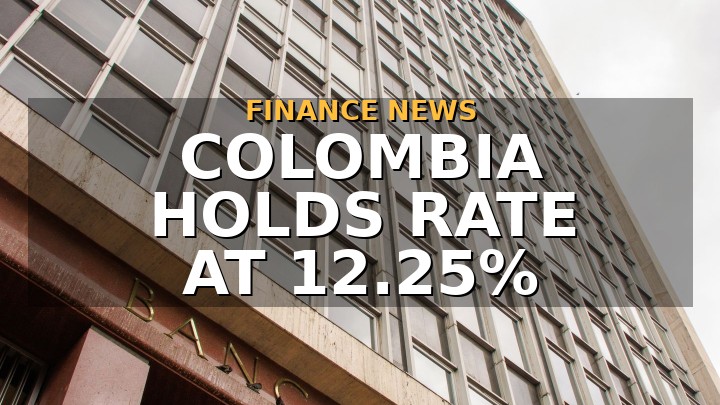
Colombia’s central bank held its benchmark interest rate at 12.25% on October 30, 2026. The decision was close, with four directors voting to hold and three voting for a 0.25 percentage point increase to 12.50%. The bank said growth looked slower in the third quarter, while inflation was still well above its 3% target, so it chose to wait for more data.
What happened
The Board of Directors of Banco de la Republica, Colombia’s central bank, voted by majority to keep the monetary policy interest rate unchanged at 12.25%. The bank published its decision on October 30, 2026.
The vote shows how divided the board was. Four directors voted to hold. Three directors wanted to raise the rate by 0.25 percentage points, to 12.50%. A majority vote was enough to hold, but the split shows that a hike was seriously considered.
Reuters reported the same decision on October 30, 2026. Its report said the board voted by majority to hold at 12.25%, amid estimates of slower economic growth and uncertainty over public finances. It also said the board approved the purchase of 2 billion dollars from the government, to shore up the bank’s reserves. That reserves purchase was a separate decision, not a change to the interest rate.
Most analysts had expected a hike. In a Reuters poll of 31 analysts, 17 expected a 0.25 percentage point increase to 12.50%, one expected a larger 0.75 percentage point increase to 13%, and 13 expected no change at 12.25%. The hold therefore surprised the majority view, even though a sizable minority had predicted it.
The bank gave three main reasons for waiting. First, annual inflation edged up in September to 6.3%, slightly below market expectations, while core inflation, excluding food and regulated prices, fell from 6.1% in August to 6.0% in September. Second, the Colombian economy’s annual growth was estimated to have slowed in the third quarter compared with the previous quarter, with slower consumption growth and weak performance across economic sectors. Third, the evolution of public finances is a key factor for future policy, and the board stressed the importance of a rigorous review of the Economic Recovery Bill submitted to Congress.
Inflation expectations also remain above target. Economic analysts’ expectations for December 2026 rose slightly to 6.9%, while expectations for a two year horizon stayed around 4.0%. Expectations from the public debt securities market rose in the short term and remain above the 3% target across all horizons.
The bank said the majority decision supports a restrictive monetary policy, consistent with reducing inflation in 2027. Future decisions will depend on new information as it becomes available.
Why it matters for beginners
A central bank interest rate is a basic tool for managing inflation and growth. When a central bank raises its rate, borrowing tends to become more expensive, which can slow spending and help bring inflation down. When it holds its rate, it is choosing not to tighten further for now, often because it wants to see whether growth is cooling on its own.
This decision is a good example of that balance. Inflation at 6.3% is more than double the 3% target, which would normally point toward higher rates. At the same time, slower third quarter growth points the other way, because raising rates too fast can weaken an already slowing economy. The board chose to hold and watch the next set of data.
For beginners, the main lesson is simple. A hold does not mean the fight against inflation is over, and it does not mean borrowing costs will fall soon. It means the bank is pausing, not finishing. The bank’s own message was that policy stays restrictive, which means borrowing conditions stay tight for now.
It also helps to understand why analysts disagreed. Some focused on high inflation and expected a hike. Others focused on slower growth and expected a hold. When the data point in different directions, even experts can read the same economy in different ways.
For a simple explanation of how interest rates affect borrowing costs, see our guide on how credit card interest charges work.
What to watch next
First, watch the third quarter economic performance figures, due in mid November. Those figures will show whether growth really slowed as the bank estimated, and they could shape the next decision.
Second, watch the next inflation release. If inflation falls more clearly toward target, the case for holding strengthens. If inflation rises again, pressure for a hike could return.
Third, watch the December meeting. There is no monetary policy meeting in November, so the December vote is the next decision point. The board will have more data by then, including the third quarter figures and the progress of the Economic Recovery Bill in Congress.
Finally, watch the reserves purchase separately from the rate. The 2 billion dollar purchase is about building up reserves, not about changing the cost of borrowing. It should not be confused with a rate cut or a rate hike.
Frequently asked questions
What is a benchmark interest rate?
It is the main rate set by a central bank. It influences borrowing costs across the economy, including loans and credit, even though it is not the exact rate any one person pays.
Why did Colombia hold at 12.25% instead of raising to 12.50%?
Because growth was estimated to have slowed in the third quarter, and the board wanted more data before tightening further, even though inflation at 6.3% remains well above the 3% target.
Does a hold mean inflation is under control?
No. Inflation at 6.3% is still well above the 3% target, and expectations for December 2026 are around 6.9%. The bank said policy stays restrictive, which means it is still trying to bring inflation down.
When is the next Colombia rate decision?
There is no monetary policy meeting in November. The next vote is in December, when the board will have more economic data to review.
Is this financial advice?
No. This post explains a central bank decision in simple terms. It is educational only, and it does not recommend any investment, loan, or financial decision.