

How Do I Earn Side Income From Pet Sitting?
How Do I Earn Side Income From Pet Sitting?
Pet sitting pays you to look after other people’s animals while they travel. You feed them, walk them, and keep them company. It needs no stock, no shop, and no special degree. If you like animals, have a reliable home, and can be trusted with a key, you can start within a couple of weeks.
The money is real but modest at first. Rover’s national averages from September 2025 put drop-in visits at 21.80 dollars per visit, house sitting at 55.45 dollars a day, and dog boarding at 49.01 dollars a night. Part-time sitters typically report 300 to 800 dollars a month, and a realistic beginner target is about 500 dollars a month. Full-time sitters with repeat clients can reach 2,500 dollars a month or more, but that takes months of good reviews.
This guide explains the four services, what each one pays, what the platforms keep, how to start in five steps, and the mistakes that cost beginners money. It is educational only. It is not financial advice, and it does not promise any income.
The 4 Pet Sitting Services
Pet sitting is not one job. It is four services, and they pay differently. Pick the ones that fit your home, your hours, and your comfort with animals.
Drop-in visits are the simplest. You visit the pet’s home for about 30 minutes, feed it, let it out, and play for a bit. The national average is 21.80 dollars per visit. Dogs usually need two or three visits a day, so one dog can mean three visits and about 65 dollars a day. Cats usually need one visit a day. Drop-ins fit around a full-time job, because you can do them before work, at lunch, and after work.
Dog walking is similar but outdoors. A 30-minute walk averages about 21 dollars, and an hour walk runs about 29 to 38 dollars. Walks suit people who want exercise with their income, and they pair well with drop-ins for the same client.
Dog boarding means the dog stays overnight at your home. The national average is 49.01 dollars a night, with city rates from 47 dollars in Dallas to 63 dollars in New York City. Boarding pays the most per booking, but it needs a safe home, a fenced yard or nearby walks, and the owner’s trust. One dog for a week is about 343 dollars at the average rate.
House sitting means you stay overnight at the owner’s home. The national average is 55.45 dollars a day. House sitting suits people who are happy to sleep elsewhere and look after the home as well as the pet. It pays well, but it takes your evenings and nights, so it fits fewer people.
Most beginners start with drop-ins and walks, then add boarding once they have reviews. Each service has its own rate, and you set them all yourself on the platform.
What Pet Sitting Pays, After the Platform Fee
The rate you list is not the rate you keep. Rover, the largest pet care marketplace in the United States, takes a 20 percent service fee from the sitter’s earnings, so you keep 80 percent of your listed rate. Owners also pay an 11 percent booking fee outside California, but that is added to their bill, not taken from you. Wag, the other big platform, takes 40 percent on on-demand walks and 20 percent on boarding and sitting.
Here is what the averages mean after Rover’s 20 percent fee. A drop-in visit listed at 21.80 dollars pays you 17.44 dollars. A boarding night listed at 49.01 dollars pays you 39.21 dollars. A house sitting day listed at 55.45 dollars pays you 44.36 dollars. Tips are yours in full, usually 10 to 20 percent for short stays, or a flat 20 to 100 dollars for longer ones.
Your city changes the numbers a lot. Boarding averages 63.58 dollars a night in New York City and 62.58 dollars in Los Angeles, but 51.83 dollars in Chicago and 41.51 dollars in Houston. A second pet usually adds 5 to 10 dollars per visit or per night. Major holidays carry a premium of about 1.5 times the normal rate. Check what sitters near you charge before you set your rates, because a rate that is fair in one city is too high or too low in another.

A Worked Example: 662 Dollars a Month Part Time
Here is a realistic part-time month for a beginner with a few repeat clients. These are example numbers, built on Rover’s national averages, to show how the maths works. Your month will differ, but the method is the same.
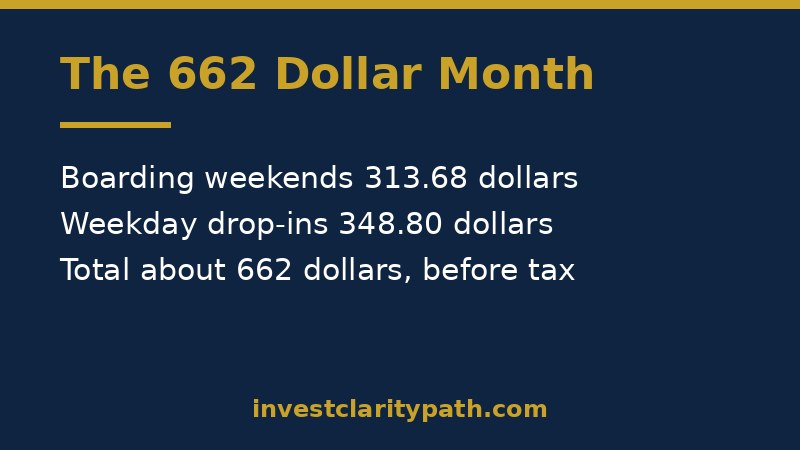
Boarding: two nights every weekend at 49.01 dollars a night. That is 98.02 dollars gross per weekend. Rover keeps 20 percent, which is 19.60 dollars, so you keep 78.42 dollars per weekend. Four weekends in a month is 313.68 dollars.
Drop-ins: five visits a week at 21.80 dollars each. That is 109 dollars gross per week. Rover keeps 20 percent, which is 21.80 dollars, so you keep 87.20 dollars per week. Four weeks is 348.80 dollars.
Add them together: 313.68 plus 348.80 is 662.48 dollars a month, or about 662 dollars, before tax and costs. The hours are about 10 to 12 a week: two boarding nights, five half-hour visits, plus travel and messages. That is the shape of a real part-time pet sitting month. It is not passive, and it is not a full-time wage, but it is real money for work you can do around a job.
To reach 500 dollars a month, a beginner needs about three to four bookings a week, or one regular boarding client plus a few drop-ins. The first month is usually slower, because you have no reviews yet. Most beginners earn less in month one, then grow as reviews and repeat clients build.
How to Start Pet Sitting in 5 Steps
Step 1: Pick your service and check your home
Start with drop-ins and walks if you have a full-time job, or boarding if you are home most days. Check your home honestly. A dog that stays overnight needs a safe room, a place to sleep, and a yard or a park nearby. If you rent, check your lease and your landlord’s pet rules first. If you have your own pet, think about how it reacts to strangers’ animals. How Do I Choose a Side Income That Fits My Skills? helps you match an idea to your life, and What Is the Simplest Side Income for Beginners? compares pet sitting with other low-cost starts.
Step 2: Join Rover and pass the checks
Create a Rover profile with clear photos of you with animals, a short honest bio, and the services you offer. Rover runs a background check of about 35 dollars and charges a profile review fee of 49 to 79 dollars depending on your city, so budget roughly 85 to 115 dollars to get started. The review usually takes a few days. Wag is the other option: it charges a 49.95 dollar application fee and runs its own background check, and it assigns walks automatically, which can mean faster first bookings. How Much Time Does a Side Income Really Take? helps you judge the hours before you commit.
Step 3: Set your rates from local listings
Look at what sitters in your area charge for the same service, and price near the middle, not at the top. A new profile with no reviews should start at or slightly below the local average, then raise rates as reviews come in. Remember the fee: on Rover you keep 80 percent, so a 49 dollar boarding night pays you about 39 dollars. Set holiday rates about 1.5 times your normal rate, and add 5 to 10 dollars for a second pet. Do not copy a New York rate if you live in a small town. Local rates are the only ones that matter.
Step 4: Get your first bookings and reviews
Your first bookings come from a complete profile, fast replies, and a low starting rate. Answer requests within an hour when you can, because owners often message three sitters at once and book the first good reply. Always do a free meet-and-greet before the first booking, at the owner’s home or a park, so you meet the pet and learn its routine, food, medicine, and quirks. After each booking, ask for a review. Five good reviews change everything. They lift you in search, they bring repeat clients, and they let you raise your rates.
Step 5: Run it well and keep records
Answer messages fast, send a photo update each day, and follow the owner’s instructions exactly. A photo of a happy dog is the best marketing there is, and it is also proof that the pet is safe. Keep a record of every payment, every fee, and every cost, from day one. How Do I Track Side Income for Tax in Simple Terms? explains what to track and why it matters. Once you earn more than 600 dollars in a year through a platform, the platform reports it, and you must report the income too.
Costs, Insurance, and Rules
Starting costs are small, but they are not zero. The background check and profile review run roughly 85 to 115 dollars on Rover. You may need extra leads, poop bags, treats, and cleaning supplies, which cost a few dollars per booking. A spare bed, bowls, and a baby gate for boarding cost about 50 dollars once.
Insurance matters more than most beginners think. Rover includes the Rover Guarantee, which covers vet care and damage in some cases, but it has limits and conditions, so read the current terms before you rely on it. Your home or renter policy may not cover a paying guest’s pet. If a dog damages your home or bites someone, the bill can be large. Some sitters buy separate pet sitter insurance, which costs roughly 200 to 400 dollars a year, and that cost belongs in your rate maths.
The rules are simple but firm. Never take a pet you cannot handle. Large or aggressive dogs need experience, not enthusiasm. Never leave a dog alone for long stretches, and never take two unfamiliar dogs off lead together. If an owner asks you to do something unsafe, say no and cancel the booking. Your safety and the animal’s safety come before the fee. How Do I Avoid Side Income Scams? explains how to spot a bad client before you take the booking.
Common Mistakes to Avoid
The first mistake is pricing from the gross rate. A 49 dollar boarding night is not a 49 dollar income. After Rover’s 20 percent fee, it is about 39 dollars, and after travel and supplies, less. Judge every service on what you keep, not what the owner pays.
The second mistake is taking every booking. A dog that is aggressive, a home that is unsafe, or an owner who will not answer questions is a booking to refuse. One bad stay can mean a bad review, a vet bill, or an injury. Saying no to the wrong client protects the right ones.
The third mistake is skipping the meet-and-greet. Meeting the pet first shows you its size, its temper, its routine, and whether your home suits it. A ten-minute meeting saves a miserable weekend. Never accept a first booking without one.
The fourth mistake is forgetting tax. Pet sitting income is income, and you must report it. Keep records of every payment and every cost, because costs such as travel, supplies, and platform fees reduce the taxable amount. If you earn more than 600 dollars in a year through a platform, expect a tax form.
Frequently Asked Questions
How much can a beginner make pet sitting?
A realistic beginner target is about 500 dollars a month part time. Part-time sitters typically report 300 to 800 dollars a month. The first month is usually slower, because you have no reviews yet. With repeat clients and good reviews, a part-time mix of boarding and drop-ins can reach about 662 dollars a month.
What does Rover charge pet sitters?
Rover takes a 20 percent service fee from the sitter’s earnings, so you keep 80 percent of your listed rate. Owners also pay an 11 percent booking fee outside California, but that is added to their bill. Rover also charges a background check of about 35 dollars and a profile review fee of 49 to 79 dollars depending on your city.
Do I need experience to start pet sitting?
No formal experience is needed, but owning a pet or caring for friends’ pets helps. What matters most is reliability, honesty, and comfort with animals. A complete profile, a free meet-and-greet, and good communication matter more than a qualification. If you have never handled a large dog, start with cats and small dogs.
Is pet sitting better on Rover or Wag?
Rover is better for most beginners. You set your own rates, keep 80 percent, and build a profile that brings repeat clients. Wag is better if you want a walk today, because it assigns walks automatically, but it takes 40 percent on on-demand walks and sets the price. Many sitters use both: Wag for fast first bookings, Rover for the long term.
Do I need insurance to pet sit?
Rover includes the Rover Guarantee, but it has limits, so read the current terms. Your home or renter policy may not cover a paying guest’s pet. Some sitters buy separate pet sitter insurance for roughly 200 to 400 dollars a year. If you board dogs in your home, insurance is worth pricing into your rates.
Can pet sitting replace a full-time job?
For most people, no, not quickly. Full-time sitters with strong reviews and repeat clients can reach 2,500 dollars a month or more, but that takes months to build and means working most days, including holidays. Treat it as a side income first, and only consider full time once the bookings are steady for several months. Can I Start Side Income While Working Full-Time? explains how to fit it around a job.
Conclusion
Pet sitting is one of the simplest side incomes, because it starts with what you already have: a home, a love of animals, and a few free hours. A drop-in visit pays 21.80 dollars on average, a boarding night 49.01 dollars, and a house sitting day 55.45 dollars, before Rover’s 20 percent fee. A part-time mix of boarding weekends and weekday drop-ins can reach about 662 dollars a month.
Start small. Pick one service, join Rover, set local rates, and get five good reviews. Price from what you keep, meet every pet first, and keep records from day one. If the first month is slow, that is normal. Reviews compound, repeat clients return, and the income grows with them.
This article is for general information and education only. It is not legal or financial advice.
