
How Do I Get Out of Payday Loan Debt?
Payday loan debt feels impossible to escape because the loan is designed to roll over. You borrow a few hundred dollars, you cannot repay the full amount in two weeks, you pay the fee to extend it, and the loan starts again. The fee repeats, the principal never shrinks, and the debt grows while your paycheck stays the same.
Getting out takes three things, in order. First, stop the cycle: do not take a new payday loan to pay the old one. Second, get a real payoff number and a plan to reach it, usually by replacing the loan with a cheaper option or a payment plan. Third, fix the shortfall that sent you to the lender in the first place, so you do not need the next loan. It is educational only. It is not legal or financial advice. If a lender is threatening you or taking money from your account without permission, talk to a qualified professional or a nonprofit credit counsellor right away.
What Is a Payday Loan?
A payday loan is a short-term, high-cost loan, generally for 500 dollars or less, that is due in one lump sum on your next payday, usually two to four weeks after you borrow. The lender asks for proof of income, a bank account, and identification. Most lenders do not check your credit score in the usual way, which is why people with damaged credit can still get one. The loan is repaid from your next paycheck, either by a post-dated check or by automatic withdrawal from your bank account.
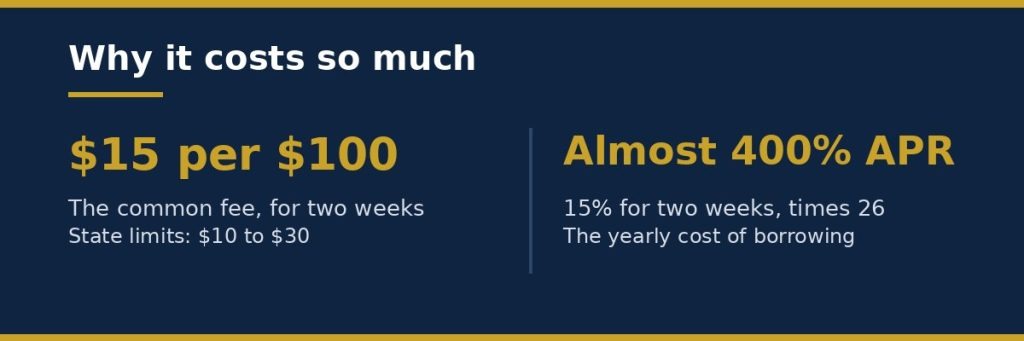
The cost is a flat fee for every 100 dollars borrowed, not a monthly interest rate like a credit card. State law sets the maximum fee, and it ranges from 10 to 30 dollars for every 100 dollars borrowed. A fee of 15 dollars per 100 dollars is common. That fee sounds small, but the loan lasts only two weeks, and the fee is charged again every time the loan rolls over. The Consumer Financial Protection Bureau explains payday loans and their costs in plain words on its payday loan page.
Why Payday Loans Cost So Much: The 400 Percent APR
The fee is charged for two weeks, but an annual percentage rate, or APR, measures the cost over a full year. That is why a 15 dollar fee per 100 dollars becomes an APR of almost 400 percent. The CFPB works it out this way: a 15 dollar fee on 100 dollars is 15 percent for two weeks. There are about 26 two-week periods in a year, so 15 percent times 26 is about 390 percent. The CFPB states the APR as almost 400 percent.
Here is the CFPB’s own example. If you borrow 300 dollars before your next payday, at a fee of 15 dollars per 100 dollars, you pay 45 dollars in fees, and you must repay 345 dollars in two weeks. For comparison, borrowing the same 100 dollars on a credit card with a 30 percent APR would cost about 1.25 dollars for two weeks, and 30 dollars for a full year.
The fee also never shrinks the loan. When you pay the fee to roll the loan over, you are paying only the cost of borrowing for two more weeks. The amount you borrowed stays exactly the same. That is the trap: every payment feels like progress, but the balance never moves.
The Rollover Trap: A Worked Example
Here is the full math, with example numbers only. This is not a recommendation, and it is not your loan. It shows how the debt grows.
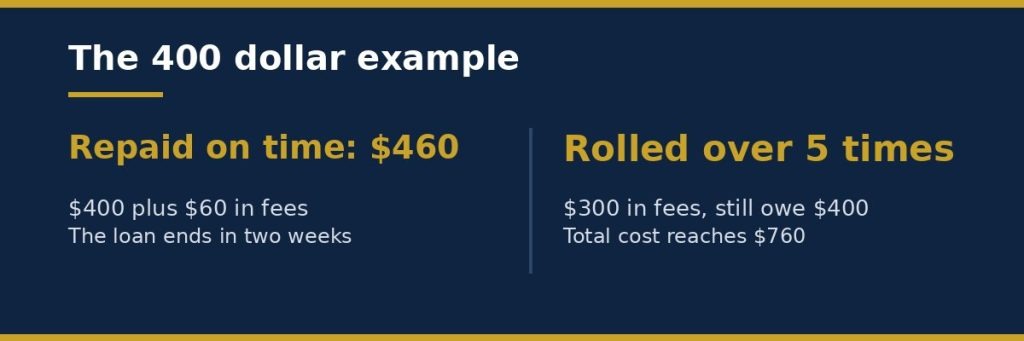
You borrow 400 dollars, at a fee of 15 dollars per 100 dollars. The fee for two weeks is 4 times 15, which is 60 dollars. If you repay on time, you pay 460 dollars in total: 400 plus 60 equals 460. That is expensive, but it ends.
Now suppose you cannot repay the 460 dollars in two weeks, so you pay the 60 dollar fee and roll the loan over for two more weeks. You still owe 400 dollars. You do that five times. You have paid 5 times 60, which is 300 dollars in fees, and you still owe the original 400 dollars. When you finally repay the loan, you pay 460 dollars more: 400 of principal plus 60 of fee for the last two weeks. Your total out of pocket is 300 plus 460, which is 760 dollars, to borrow 400 dollars for 12 weeks.
This is not a rare outcome. The CFPB found that more than 80 percent of payday loans are rolled over or renewed within two weeks. A borrower who rolls a loan over many times can pay more in fees than the amount they originally borrowed, and still owe the full principal. That is why the first rule of getting out is to stop the rollovers.
How to Get Out of Payday Loan Debt in 7 Steps
Step 1: Write down the real numbers
List every payday loan you have: the lender, the amount borrowed, the fee, the due date, and the total you must pay to close it. Add up the total. Most people with more than one loan are surprised by the sum, because each loan felt small on its own. You cannot make a plan until you can see the whole number.
Step 2: Stop taking new payday loans
Do not borrow from one payday lender to pay another. That is the rollover trap with extra steps, and it adds a second fee to the first. If your paycheck cannot cover the loan and your bills, the answer is not a bigger loan. Tell yourself plainly: no new payday loan, even if the lender offers one.
Step 3: Ask the lender for an extended payment plan
Some states require payday lenders to offer an extended payment plan, which lets you repay the loan in smaller amounts over a longer period, without new fees. Even where the law does not require it, some lenders will agree to a plan if you ask, because a plan that pays is better for them than a loan that defaults. Call the lender, explain that you cannot pay the full amount on the due date, and ask what repayment options exist. Get any agreement in writing before you pay anything under it. The CFPB’s payday loan pages explain which protections apply in your state.
Step 4: Replace the loan with a cheaper option
A payday loan at almost 400 percent APR can almost always be replaced by something cheaper, if you can get it. Options to try, in order:
- An advance on your pay from your employer. Some employers offer this free, or through a payroll app. Ask human resources before you borrow anywhere else.
- A credit union payday alternative loan, sometimes called a PAL. Credit unions offer small loans with much lower rates and longer terms than payday lenders, often for members who have been with the credit union for a short time.
- A payment plan with the people you owe. A landlord, a utility company, or a medical provider will often accept a partial payment and a plan, and that costs nothing in interest.
- A small personal loan from a bank or credit union, or a credit card with a lower rate, used only to clear the payday loan and then paid down on a fixed plan.
- A nonprofit credit counselling agency. A counsellor can look at your whole budget, talk to your creditors, and set up a debt management plan. When Should I Ask for Help With Debt? explains when to get help and what a counsellor does.
Do not replace a payday loan with a title loan, a pawn loan, or another high-cost loan. That is the same trap with a different name.
Step 5: Free up the payoff money in your budget
Work out what you must pay to close the loan, and find that money in the next two pay periods. Common places to find it: pause a subscription, cook at home for two weeks, sell something you no longer need, or pick up an extra shift. How Do I Pay Off Debt on a Low Income? has a full plan for finding payoff money when income is tight.
If the loan is 400 dollars and the fee is 60 dollars, you need 460 dollars. If you can find 230 dollars from each of your next two paychecks, the loan is gone in a month. Write the two dates down, and treat them like a bill that cannot be skipped.
Step 6: Protect your bank account
A payday lender usually has access to your bank account, either through a post-dated check or an automatic withdrawal. If the lender tries to take the money and it is not there, your bank may charge you an overdraft fee on top of the lender’s fee, and the lender may try again. Talk to your bank about your options, which can include stopping an automatic payment or closing the account the lender has access to and opening a new one for your pay and bills. Do this before the due date, not after a failed withdrawal. Keep a record of every payment you make to the lender, with dates and amounts.
Step 7: Build a small buffer so it does not happen again
Once the loan is gone, send the money you were paying in fees to a separate savings account instead. Sixty dollars every two weeks is 120 dollars a month, or 1,440 dollars in a year. That is a starter emergency fund, built from money you were already spending. Should I Use Savings to Pay Off Debt? explains the trade-off between saving and paying debt, and why a small cushion comes first. If you have other debts, How Do I Handle Multiple Debts at Once? explains how to order them, and How Do I Get Out of Debt Fast? covers the fastest safe ways to clear them.
What If You Already Cannot Pay?
If the due date has passed and you cannot pay, do not hide from the lender. A missed payday loan can be sent to a collector, and it can damage your credit if the lender reports it. Call the lender and ask for a payment plan. Call a nonprofit credit counsellor for free advice. And check your state’s law: 21 states and the District of Columbia have interest rate caps that effectively prohibit high-cost payday loans.
Do not take a new loan to pay the old one. Do not ignore collection letters. And do not pay a company that promises to settle the debt for a large upfront fee. A legitimate nonprofit counsellor will explain its fees before you sign anything.
Frequently Asked Questions
How do I get out of payday loan debt fast?
Stop the rollovers first, then replace the loan with a cheaper option or an extended payment plan, and pay it off from the next two paychecks. The fastest safe path is usually an employer pay advance, a credit union payday alternative loan, or a payment plan agreed with the lender. Do not take a new payday loan to pay the old one.
What happens if I cannot pay a payday loan?
The lender may try to withdraw the money from your bank account, which can cause overdraft fees. The loan may be sent to a collector, and it can damage your credit if it is reported. Call the lender and ask for a payment plan, talk to your bank about stopping automatic withdrawals, and get free advice from a nonprofit credit counsellor.
Can a payday loan be rolled over forever?
No, but it can feel that way. Each rollover costs a new fee and leaves the principal unchanged. The CFPB found that more than 80 percent of payday loans are rolled over or renewed within two weeks. Some states limit how many times a loan can be rolled over, and some require lenders to offer an extended payment plan instead.
Is a payday loan ever a good idea?
Almost never. At almost 400 percent APR, it is one of the most expensive ways to borrow. An employer advance, a credit union loan, a payment plan with a biller, or help from a nonprofit counsellor is cheaper in almost every case. The only time a payday loan is not a bad choice is when every cheaper option has been tried and the cost of not borrowing, such as losing a home or a job, is clearly greater, and even then the loan should be repaid in full on the due date, never rolled over.
How much does a 400 dollar payday loan really cost?
At a fee of 15 dollars per 100 dollars, a 400 dollar loan costs 60 dollars in fees for two weeks, so repaying on time costs 460 dollars. If you roll it over five times, you pay 300 dollars in fees and still owe 400 dollars, and repaying then costs another 460 dollars, for a total of 760 dollars to borrow 400 dollars for 12 weeks.
Will a payday loan hurt my credit score?
A payday loan itself is not usually reported to the credit bureaus, so taking one may not affect your score. But if you do not pay and the debt goes to a collector, the collection can be reported and can damage your score for years. Paying only the minimum on a credit card also hurts, and What Happens If I Only Pay the Minimum on My Credit Card? explains how that damage builds.
Conclusion
Payday loan debt is not a sign that you are bad with money. It is a sign that a very expensive product met a shortfall at the wrong time. The fee looks small, 15 dollars per 100 dollars, but it repeats every two weeks, and the APR is almost 400 percent. The rollover is where the money is lost. Every rollover is another fee for nothing, and the principal never moves.
Getting out is a short, practical job. Stop the rollovers. Ask for an extended payment plan. Replace the loan with a cheaper option, an employer advance, a credit union loan, or a plan with the people you owe. Pay it off from the next two paychecks, protect your bank account, and then send the fee money to a savings account instead, so the next shortfall does not send you back to the lender. The loan felt endless because it was designed to repeat. Break the repeat, and it ends.
This article is for general information and education only. It is not legal or financial advice.
