

How Do I Make Money From a Blog as a Beginner?
The Short Answer
To make money from a blog as a beginner, pick one topic you can write about for a year, publish helpful posts regularly, grow readers through search, and only then add income. Blogs earn money in four main ways: ads, affiliate links, sponsored posts, and selling your own product or service. None of them pay much at first. A new blog usually earns nothing for months, then small amounts, then more as readers grow. Anyone who promises fast blog income is selling a dream, not a plan.
The order matters: readers first, income second. A blog with no readers cannot earn from ads or affiliates, because there is nobody to click. Your first job is to write posts that answer real questions. Your second job is to keep writing until search engines start sending readers. The money comes third.
Pick a Topic You Can Write About for a Year
A blog needs a topic narrow enough to stand out and wide enough to write about for a year. “Money” is too wide. “Saving money on groceries for a family of four” is narrow enough to own and wide enough for a hundred posts. “Budgeting for beginners” is a good middle ground.
Pick a topic you know something about, or are willing to learn in public. You will write about it every week, so it must hold your interest. If you pick a topic only because it sounds profitable, you will run out of things to say by month two.
Check that people actually search for your topic. Use the questions people type into search engines as your post ideas. If nobody searches for it, nobody will find your blog. Our finance blog focuses on beginner questions for this reason: people search for simple answers to money questions every day.
How Blogs Actually Earn Money
Ads
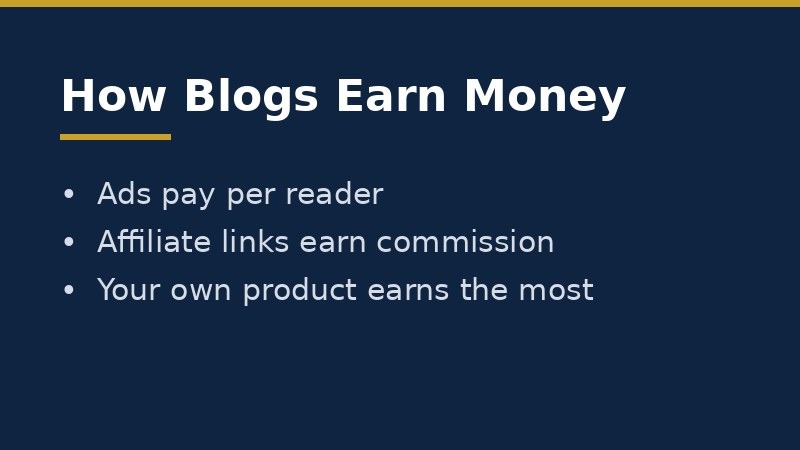
Ads are the simplest way to earn. You place ad code on your blog, and you earn a small amount when readers see or click the ads. The amount depends on your topic and your readers. Finance, business, and technology topics usually earn more per reader than hobbies, because advertisers pay more to reach those readers.
Ads pay little at first. A blog with 1,000 readers a month might earn a few dollars. A blog with 100,000 readers a month can earn a real income. Ads are the slowest way to earn, but they are also the most hands off once they are set up. You need a lot of readers before ads matter.
Affiliate Links
Affiliate links earn you a small commission when a reader buys something through your link. You write about a product you have used, link to it, and if a reader buys, you earn a percentage. The rate varies: some products pay 3 percent, some pay 50 percent.
Affiliate income works best when the product truly helps your reader. Recommending a budgeting app you use is honest. Recommending ten products you have never tried is not, and readers can tell. Always say clearly when a link is an affiliate link. Honesty builds trust, and trust brings readers back.
Sponsored Posts
A sponsored post is an article a company pays you to publish. Rates depend on your readers and your topic. A small blog might earn $50 for a sponsored post. A large blog can earn thousands. Sponsored posts only come when you have readers a company wants to reach, so they are a later income, not a first income.
Your Own Product or Service
Selling your own product, like a guide, a course, a template, or a service, usually earns the most per reader. You keep the full price, instead of a small ad payment or a small commission. But you need a product worth buying, and readers who trust you enough to pay. This is the hardest income to build, and the most rewarding once it works.
The Realistic Timeline
Month 1 to 3: You set up the blog and publish your first 10 to 20 posts. Income is $0. This is normal. Your job is to learn to write helpful posts and to publish on a schedule.
Month 4 to 6: Search engines start to notice. A few posts begin to rank, and readers arrive in small numbers. Income is still $0, or a few dollars from ads if you set them up early.
Month 7 to 12: If you publish regularly, readers grow. A blog with 50 good posts can reach a few thousand readers a month. Affiliate income may start, a few dollars here and there. Ads may earn $10 to $50 a month.
Year 2: With 100 or more good posts, readers can reach tens of thousands a month. Ads and affiliates can add up to a few hundred dollars a month. Your own product becomes possible.
Year 3 and beyond: The blogs that earn a full time income usually took two to three years of steady work to get there. There is no shortcut. The bloggers who quit in month three never find out what month twelve would have brought.
If you want a faster side income, freelancing or selling a skill is faster than blogging. Our guide on how to find your first freelance client explains a quicker path. Blogging is slow, but it can keep earning from old posts for years after you write them.
A Worked Example: The Math of Blog Income
Here is a worked example with real math, so you can see how blog income adds up. These are example numbers, not a promise. Real blogs vary a lot.
Imagine your blog reaches 10,000 readers a month after a year of steady writing.
Ads: If ads earn $10 for every 1,000 readers, 10,000 readers earn $100 a month. $10 times 10 equals $100.
Affiliates: If 1 percent of readers click an affiliate link, that is 100 clicks. If 5 percent of those clicks turn into a purchase, that is 5 sales. If each sale earns $10 in commission, that is $50 a month. 100 times 0.05 equals 5, and 5 times $10 equals $50.
Total: $100 from ads plus $50 from affiliates equals $150 a month. That is real money, but it is not a full time income. To earn $1,500 a month, you would need about ten times the readers, or a product of your own, or much higher paying affiliate products.
Now imagine the same blog after two more years, with 100,000 readers a month. Ads at $10 per 1,000 readers earn $1,000 a month. Affiliates at the same rates earn $500 a month. Total: $1,500 a month. Add a $29 guide that 20 readers a month buy, and that is $580 more. Total: $2,080 a month. That is a part time income, built slowly from posts written years earlier.
The math shows two things: readers are the key number, and your own product is what turns a small income into a real one.
What to Do First, Week by Week
Week 1: Pick your topic and set up the blog. Keep it simple. A basic design, your topic, and an about page are enough. Do not spend a month choosing a design. Spend that month writing.
Week 2 to 4: Write and publish your first 8 to 10 posts. Each post should answer one clear question, in simple language, with a direct answer at the top. Long posts of 1,500 words or more work best for search, because they answer the question fully. Write the posts you wish you had found when you were learning the topic.
Month 2 to 3: Keep publishing two to three posts a week. Learn the basics of search: use clear titles, write for readers first, and link between your own posts so readers can find the next step. Our pillar posts link to each other for this reason, so a reader who finishes one guide can find the next one easily.
Month 4 onwards: Keep publishing, and start learning from your numbers. Which posts get readers? Write more like those. Which posts get nothing? Fix them or move on. After six months and 50 posts, you will know what your readers want. That is the time to add ads and affiliate links, because now there are readers to earn from.
Costs of Starting a Blog
Starting a blog costs little, but it is not free. A domain name costs about $10 to $15 a year. Basic hosting costs about $3 to $10 a month. A simple design is free. So the first year costs roughly $50 to $135 in total. Do not buy expensive courses or tools at the start. The money you spend should go to keeping the blog online, not to learning how to blog.
Your real cost is time. Each post takes two to four hours to write well. Two posts a week is four to eight hours a week. That is the true price of a blog, and it is why most blogs fail: not from lack of money, but from lack of steady time.
Mistakes Beginners Make
The most common mistake is writing about everything. A blog about money, travel, food, and fitness is really four weak blogs. Pick one topic and stay with it for a year. Readers and search engines both reward focus.
Another mistake is adding ads and affiliate links on day one. A new blog with ads and no readers earns nothing and looks messy. Build the readers first, then add the income. A clean blog with good posts will earn more later than a cluttered blog earns now.
A third mistake is copying other blogs. Search engines and readers both punish copied content. Write in your own words, from your own experience, even if your experience is simply learning the topic yourself. A beginner explaining a topic to other beginners is often clearer than an expert who forgot what it was like not to know.
Watch out for offers that promise fast blog income for a fee. Real blog income is slow. Any course or tool that promises you can earn $1,000 in your first month is selling a dream. Our guide on how to avoid side income scams lists the warning signs to check before you pay for anything.
FAQ
How much money can a beginner blog make in the first year?
Most beginner blogs make $0 to $100 in total in the first year. That is normal. The first year is for building posts and readers, not for income. Blogs that earn in the first year usually have a writer who already has an audience somewhere else, or who writes about a high paying topic with strong search demand.
Do I need to be an expert to start a blog?
No. You need to be one step ahead of your reader, and willing to research carefully. A beginner who learns a topic and explains it clearly is often the best teacher for other beginners. What you must not do is invent facts or copy other sites. Research each post, check your numbers, and say plainly when you are sharing your own experience rather than an established fact.
How many posts do I need before I earn money?
There is no fixed number, but most blogs need at least 30 to 50 good posts before search engines send steady readers. Ads usually need thousands of readers a month to pay anything worth counting. Affiliates can start sooner, with fewer readers, if the product fits the post well. Focus on reaching 50 helpful posts before you judge the income.
Should I use free blogging platforms or pay for hosting?
A free platform costs nothing and is fine for testing whether you enjoy blogging. But a self hosted blog with your own domain looks more serious, gives you control over ads and design, and is easier to move later. If you are sure you will blog for a year, paying $50 to $135 for the first year is worth it. If you are only testing, start free and move when you are ready.
How do I get readers to my blog?
Most blog readers come from search engines. Write posts that answer questions people actually search for, use clear titles that match the question, and write the answer in full. Share new posts where your readers already spend time, but do not spam. One helpful post shared in the right place beats ten posts shared everywhere. Over time, search becomes your main source of readers, and it keeps working while you sleep.
Conclusion
Making money from a blog as a beginner is simple, but slow: pick one topic, publish helpful posts every week, grow readers through search, and then add ads, affiliates, or your own product. Expect $0 for months, small amounts after a year, and real income only after two or three years of steady work. If you can give it that time, a blog can become a side income that keeps earning from posts you wrote long ago. If you need money fast, freelancing is the quicker path, and blogging can wait.
This article is for general information and education only. It is not legal or financial advice.
