

What Is a Bear Market in Simple Terms?
What Is a Bear Market in Simple Terms?
The short answer
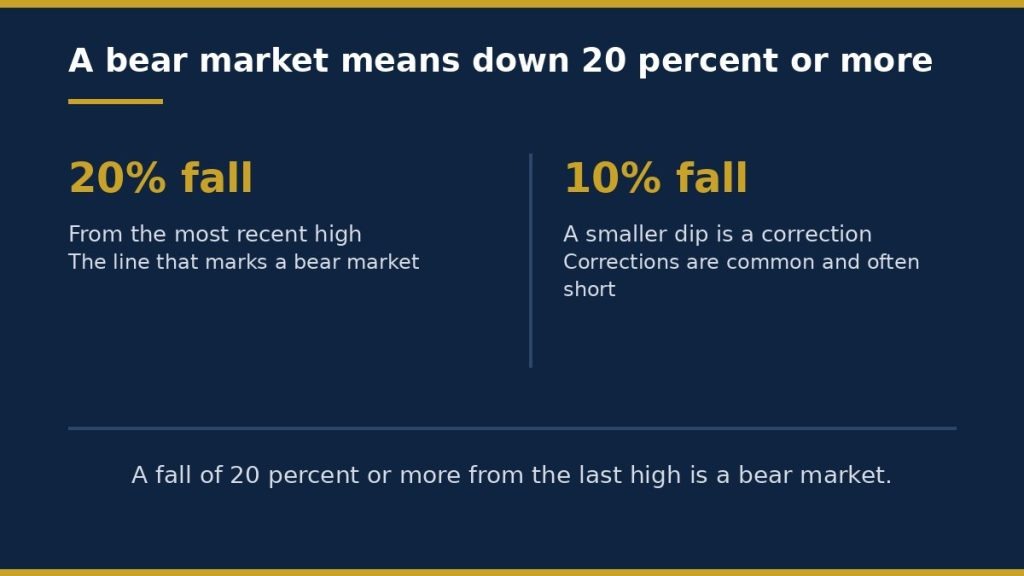
A bear market is a period when a broad stock market index falls by 20 percent or more from its most recent high, and stays down for a while. The most common measure in the United States is the S&P 500 index, which tracks 500 large American companies. When that index closes 20 percent below its last peak, financial writers call it a bear market.
That 20 percent line is a rule of thumb, not a law of nature. It gives everyone a shared word for a deep, lasting fall, as opposed to a short dip. A fall of 10 percent is called a correction. A fall of 20 percent or more is a bear market. A very fast, sharp fall is often called a crash, but a crash can happen inside a bear market or on its own.
If you are new to investing, the most useful thing to know is this: bear markets are a normal part of investing. They have happened many times before, and every one of them so far has ended. That does not mean the next one will be short or easy. It means a bear market is not a sign that investing itself is broken.
What counts as a bear market?
First, size. The fall must reach 20 percent from the last high. If the S&P 500 peaked at 6,000 points and then fell to 4,800 points, that is a 20 percent fall, so it counts. If it fell only to 5,400 points, that is a 10 percent fall, so it is a correction, not a bear market.
Second, breadth. A bear market is about the whole market, not one company. One stock can fall 30 percent while the market as a whole rises. That is a problem for that one company, not a bear market. A bear market means most stocks are falling together. If you are still learning how shares work, our guide to what the stock market is (https://investclaritypath.com/what-is-the-stock-market/) explains the basics in plain words.
Third, time. A bear market usually lasts weeks or months, not one bad day. A single day when prices fall 5 percent is painful, but it is not a bear market by itself. The market has to stay down, with more sellers than buyers, for a stretch of time.
The United States Securities and Exchange Commission runs investor.gov (https://www.investor.gov/introduction-investing/investing-basics/glossary/bear-market), a free education site for investors. Its glossary defines a bear market as a market in which prices are falling, and it explains that the term is often used when a market falls by 20 percent or more. You can read that definition on investor.gov if you want the official wording. For a plain official guide to how shares work, see investor.gov’s introduction to stocks (https://www.investor.gov/introduction-investing/investing-basics/investment-products/stocks).
Bear market vs correction vs crash
Beginners often hear these three words used as if they mean the same thing. They do not, and the difference matters for your decisions.
A correction is a fall of 10 percent or more from a recent high. Corrections are common. They happen most years, and they often end within a few weeks or months. A correction is the market taking a breath after a run of gains. Risk is part of every investment, and our guide to what risk means in investing (https://investclaritypath.com/what-is-risk-in-investing/) explains the main kinds in simple terms.
A bear market is a fall of 20 percent or more. It is deeper and usually longer than a correction. Bear markets are often linked to a recession, high interest rates, or a big shock to the economy. They can last many months.
A crash is about speed, not size. A crash is a sudden, sharp fall over a few days. A crash can start a bear market, or it can happen and then reverse quickly. The 1987 crash, when the market fell more than 20 percent in a single day, is the famous example. Prices recovered much of that loss in the months that followed, so it did not turn into a long bear market.
Here is a simple way to remember it:
- Correction: down 10 percent, fairly common, often short.
- Bear market: down 20 percent or more, less common, often longer.
- Crash: very fast fall, can be short or can start something longer.
Why do bear markets happen?
Bear markets do not have one single cause. They usually start when investors begin to expect lower profits, higher costs, or a weaker economy, and many of them decide to sell at the same time. Common triggers include:
- Rising interest rates. When borrowing costs more, companies earn less and savers can earn a return without taking stock market risk.
- High inflation. When prices rise fast, it squeezes household budgets and company margins at the same time.
- A shock, such as a war, a banking crisis, or a pandemic. Shocks create uncertainty, and uncertainty makes investors sell first and ask questions later.
- Prices that ran too far. After a long rise, prices can get ahead of what companies actually earn, and when expectations come back down, prices fall with them.
None of these triggers can be predicted with confidence. Professional investors, economists, and banks all try, and they are wrong often.
What happens to your money in a bear market?
This is the part that worries beginners most, so let us work through real numbers.
A worked example: a $10,000 portfolio
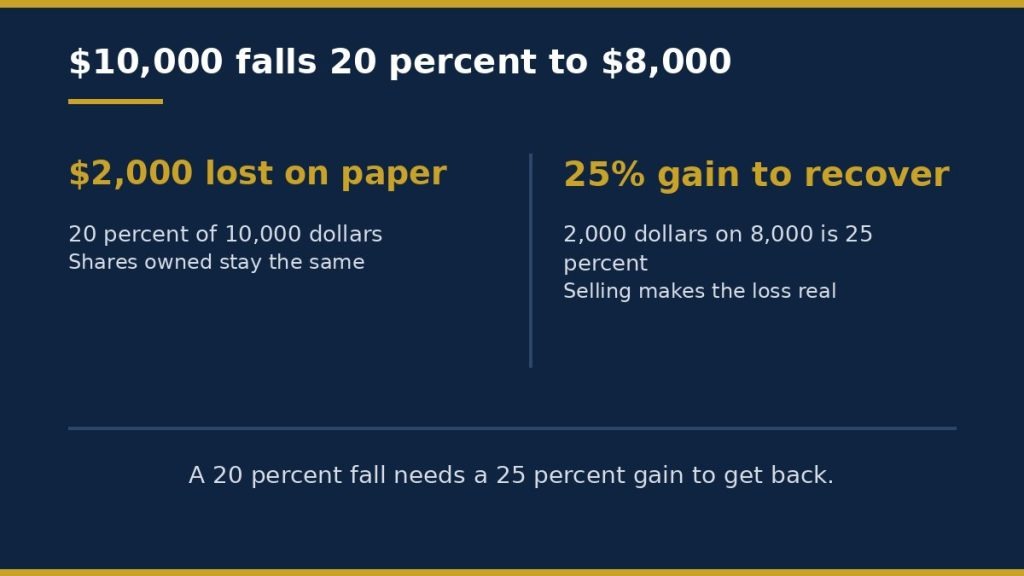
Imagine you invested $10,000 in a broad index fund (https://investclaritypath.com/what-is-an-index-fund-and-why-do-beginners-use-it/) that tracks the whole market. The market then falls 20 percent, which is the line for a bear market.
- Your starting value: $10,000
- The fall: 20 percent of $10,000 is $2,000
- Your value after the fall: $10,000 minus $2,000 is $8,000
You have lost $2,000 on paper. Here is the part many beginners miss: to get back to $10,000, your portfolio does not need to rise 20 percent. It needs to rise 25 percent.
- The gap to recover: $10,000 minus $8,000 is $2,000
- The gain needed: $2,000 divided by $8,000 is 25 percent
That is because the same $2,000 is now a bigger share of a smaller pot. A 20 percent fall needs a 25 percent gain to undo it. A 30 percent fall needs about a 43 percent gain to recover.
Now imagine a second investor with the same $10,000 who keeps investing $100 a month through the bear market. During the fall, each $100 buys more shares than it did at the peak, because prices are lower. When the market recovers, those extra shares are worth more. This is not a promise that the recovery will come quickly. It is the reason long-term investors often say that regular investing during a fall can help, as long as the money is for the long term and they can leave it alone.
Paper losses and real losses
A fall in the value of your investments is a paper loss until you sell. Your shares are still yours. The number of shares has not changed. Only the price has changed. If the price recovers later, the paper loss disappears.
A real loss happens when you sell for less than you paid. That is the moment the loss becomes permanent. This is why so much beginner advice about bear markets comes down to one idea: do not sell in a panic. Having a plan written down before the fall starts makes it much easier to follow.
How long do bear markets last?
There is no fixed length. Some bear markets have lasted a few months. Others have lasted more than a year. The average in the United States over the last century is roughly 9 to 10 months from peak to bottom, but averages hide wide differences. A few have been short and sharp. The one that followed the 2007 financial crisis lasted about 17 months from peak to bottom.
The recovery takes longer than the fall. After the market bottoms out, it can take months or years to climb back to the old high. That is normal too. If you are investing for retirement in 20 or 30 years, a bear market is a chapter, not the whole book. If you need the money in the next year or two, it should not have been in the stock market in the first place.
What beginners usually do wrong in a bear market
Bear markets punish the same few mistakes again and again.
First, checking your balance every day. When prices fall, daily checks turn normal worry into panic. Checking once a month, or even once a quarter, is enough for a long-term investor.
Second, selling everything at once. Selling at the bottom locks in the loss and leaves you with the hard question of when to buy back. Most people buy back too late, after prices have already recovered.
Third, stopping regular contributions. Many beginners pause their monthly investing when the market falls, yet a fall is when the same money buys more shares. If your job and emergency fund are secure, keeping the habit going is usually the steadier choice.
A simple plan for a bear market
You do not need a complicated plan. A simple one you can actually follow beats a clever one you abandon. Here are six steps.
Step 1: Check your emergency fund first
Before you think about the market, make sure you have cash for real life. A common target is three to six months of essential spending in a savings account. If your emergency fund is thin, topping it up matters more than anything you do with your investments.
Step 2: Remember your time horizon
Ask when you need this money. If the answer is 10, 20, or 30 years away, a bear market is uncomfortable but not an emergency. If the answer is next year, your money should probably have been in savings, not stocks.
Step 3: Review your mix, not your balance
Look at the balance between stocks, bonds, and cash in your portfolio, not the dollar total. If stocks have fallen, they now make up a smaller share than before. Rebalancing, which means selling a little of what held up and buying a little of what fell, brings the mix back to your target. Many retirement accounts and index funds do this automatically. Our guide to how stocks, bonds, and funds work together (https://investclaritypath.com/how-do-stocks-bonds-and-funds-work-together/) explains the three parts, and our guide to diversification (https://investclaritypath.com/what-is-diversification-and-why-does-it-matter/) explains why spreading your money across many investments matters.
Step 4: Keep your regular contributions going
If you invest a set amount each month, keep doing it if you can afford it. Automatic investing removes the daily decision, and it means you buy at low prices as well as high ones. If your income has fallen, it is fine to reduce the amount. Do not stop just because prices are down.
Step 5: Avoid new debt and new risks
A bear market is not the time to borrow money to invest, or to put savings you need soon into risky bets. Keep your financial base steady while the market finds its footing.
Step 6: Write down what you will do next time
After the bear market ends, write one short paragraph about what you felt and what you did. Next time prices fall, read it before you act.
Bear markets and retirement accounts
If you have a 401(k) or an IRA, a bear market can look alarming because the balance drops. The same ideas apply, with a few extra notes. If you are unsure how these accounts work, read our plain guide to what a retirement account is (https://investclaritypath.com/what-is-a-retirement-account-in-simple-terms/).
Money in a retirement account is usually invested for decades. A bear market in your 30s or 40s is a normal event on a long road, not a reason to stop contributing. Many employer plans invest your contributions automatically, so your money keeps buying shares at lower prices while the market is down.
Frequently asked questions
Is a bear market a good time to start investing?
It can be a reasonable time to start, if you are investing for the long term and you invest regularly. Prices are lower than they were at the peak, so your money buys more. But nobody knows where the bottom is, and prices can fall further after you start. Starting with small, regular amounts is steadier than investing a large lump sum all at once in a falling market.
Should I sell my stocks in a bear market?
Selling everything in a panic is usually the costliest choice, because it locks in the loss and leaves you guessing when to buy back. The better question is whether your portfolio still matches your goals and your time horizon. If it does, staying invested is usually the steadier path. If you need the money soon, it should not have been in stocks.
Can a bear market last for years?
Yes, it can. Most bear markets last months, but a few have lasted more than a year, and the recovery to the old high can take longer still. That is why money you need in the next few years belongs in savings, not in the stock market.
What is the difference between a bear market and a recession?
A bear market is a fall in stock prices. A recession is a fall in the wider economy, usually measured by shrinking output and rising unemployment. The two often happen near each other, but they are not the same thing. Stock markets sometimes fall before a recession starts, and sometimes recover before the recession ends.
Conclusion
A bear market is a fall of 20 percent or more in a broad market index, usually the S&P 500. It is deeper and longer than a correction, and it is a normal, if painful, part of investing. The math is simple: a 20 percent fall needs a 25 percent gain to recover, which is why panic selling at the bottom hurts so much. The plan is simple too: keep an emergency fund, know when you need the money, keep your regular contributions going if you can, and avoid new debt and new risks while prices are down.
You cannot predict the next bear market, and you do not need to. What you can do is build a plan that survives one. If your money is invested for the long term, a bear market is a test of patience, not a reason to quit.
This article is for general information and education only. It is not legal or financial advice.
