
How Do I Budget for Groceries Without Overspending?
Groceries are one of the largest costs you can control in a household budget. Rent and loan payments stay fixed, but the food bill changes every week, and small choices at the shop add up fast. That is why groceries are a good place to start when a budget feels tight.
To budget for groceries without overspending, first find out what you spend now, then set a monthly number that fits your budget, plan your meals for the week, shop once a week with a list, and track what you spend. The worked example below shows how a household spending $800 a month can cut that to $650 a month and save $1,800 a year.
What Does It Mean to Budget for Groceries?
A grocery budget is a fixed amount of money you plan to spend on food each month. It covers the food and drink you buy to eat at home, such as fresh food, bread, milk, meat, rice, and cleaning products you buy at the same shop. Eating out, takeaway, and coffee on the go are separate costs, so keep them out of this number, or your grocery budget will look wrong every month.
Budgeting for groceries is not a diet plan, and it is not about eating less. It is about deciding the number before you shop, instead of finding out the number after you have already spent it. When you know the number, you can plan around it, and you can see at once when a week is going over.
Step 1: Find Out What You Spend Now
You cannot set a fair target until you know your starting point. Guessing usually makes the target too low, and a target that is too low fails in the first week.
Look at the last three months of bank or card statements and add up every food shop. If you spent $750 in one month, $820 in the next, and $830 in the month after that, the total is $2,400. Divide $2,400 by 3 and you get $800 a month. That is your starting point, not a failure. It is simply the number you will work from.
If you often pay cash, check your receipts, or keep a simple note for one month. Write down every food shop, even the small top-up trips, because those small trips are often where the extra money goes. At the end of the month, add them up. Most people are surprised by the total, and that surprise is useful, because it shows exactly where the money is going.
Step 2: Set a Monthly Grocery Number That Fits Your Budget
A good grocery target fits inside your whole monthly budget. Start with your income after tax, then list your fixed costs, such as rent, bills, transport, and loan payments. What is left is the money for food, saving, and everything else, so your grocery number has to fit inside what is left.
Our guide on how to create a monthly budget walks through the full process, and the 50/30/20 budget rule gives a simple split to check your numbers against, with about 50 percent for needs, 30 percent for wants, and 20 percent for saving and paying off debt. Groceries sit inside the needs part of that split.
Set a target you can reach in one step. If you spend $800 a month now, a first target of $650 is a real cut of $150, and it is much easier to reach than a target of $500. You can always lower the target again next month, once the new habits are working. The Consumer Financial Protection Bureau also offers free consumer and budgeting tools that can help you work out what your household can afford.
Step 3: Plan Your Meals Before You Shop
Meal planning is the single most useful habit for a grocery budget. When you know what you will cook, you buy only what those meals need, and you stop buying food that sits in the fridge until it goes bad.
Plan seven dinners for the week before you shop. Check the pantry and the fridge first, and build meals around what you already have. Keep a short list of 10 to 14 meals your household likes, and rotate through them, so planning takes ten minutes instead of an hour. Theme nights help too: pasta on Monday, chicken on Tuesday, soup on Wednesday, and so on.
Write the plan where everyone can see it, on the fridge or on a phone note. Plan lunches the same way, using leftovers from dinner where you can, because a lunch made from leftovers costs almost nothing extra.
Step 4: Shop With a List and Shop Once a Week
A list is a promise to yourself. Write it from your meal plan, and buy what is on it. The items that are not on the list are the ones that push the bill over budget.
Shop once a week if you can. Every extra trip is another chance to buy things you did not plan to buy. One weekly shop also makes it easier to track spending, because there is only one receipt to check against your weekly limit.
Do not shop when you are hungry, because hungry shoppers buy more. Compare the price per unit, not just the pack price, because the bigger pack is not always cheaper. Skip the middle aisles unless something on your list is there. And check the receipt before you leave the shop, so a pricing mistake does not eat into your budget.
Step 5: Cut Waste Before You Cut Meals
Food you throw away is money you already spent. Cutting waste is the easiest saving in a grocery budget, because it needs no change to what you eat, only a change to what you throw out.
Use leftovers on purpose. Cook a little extra at dinner and pack the rest for lunch the next day. Freeze food before it goes bad, in portions you can use later, and label each box with the date. Use the oldest food first, and move food that is close to its date to the front of the fridge so you see it.
Buy only what you will use before it spoils. A large bag of salad is cheap, but not if half of it goes in the bin. Small, fresh buys often cost less in total than big buys that go to waste. Our guide on how to cut food spending without cutting meals has more ideas for saving money while keeping the same meals on the table.
Step 6: Use Store Brands, Sales, and Seasonal Food
Store brands often cost much less than big brands for the same basic food, such as rice, pasta, oats, tinned tomatoes, and cleaning products. Try the store brand once. If your household cannot tell the difference, keep buying it and keep the saving every week.
Buy on sale only the things you already use. A sale is not a saving if the food sits in the cupboard for a year. When a food you use every week is on sale, buy two or three and store them, but only if you have the space and you will use them before they go bad.
Seasonal fruit and vegetables usually cost less and taste better than out-of-season food. Food prices also change through the year, so a number that worked in spring may need a small change in winter. The U.S. Department of Agriculture publishes a food price outlook that tracks how food prices are moving, which can help you understand why your bill changes even when your shopping does not.
Worked Example: From $800 to $650 a Month
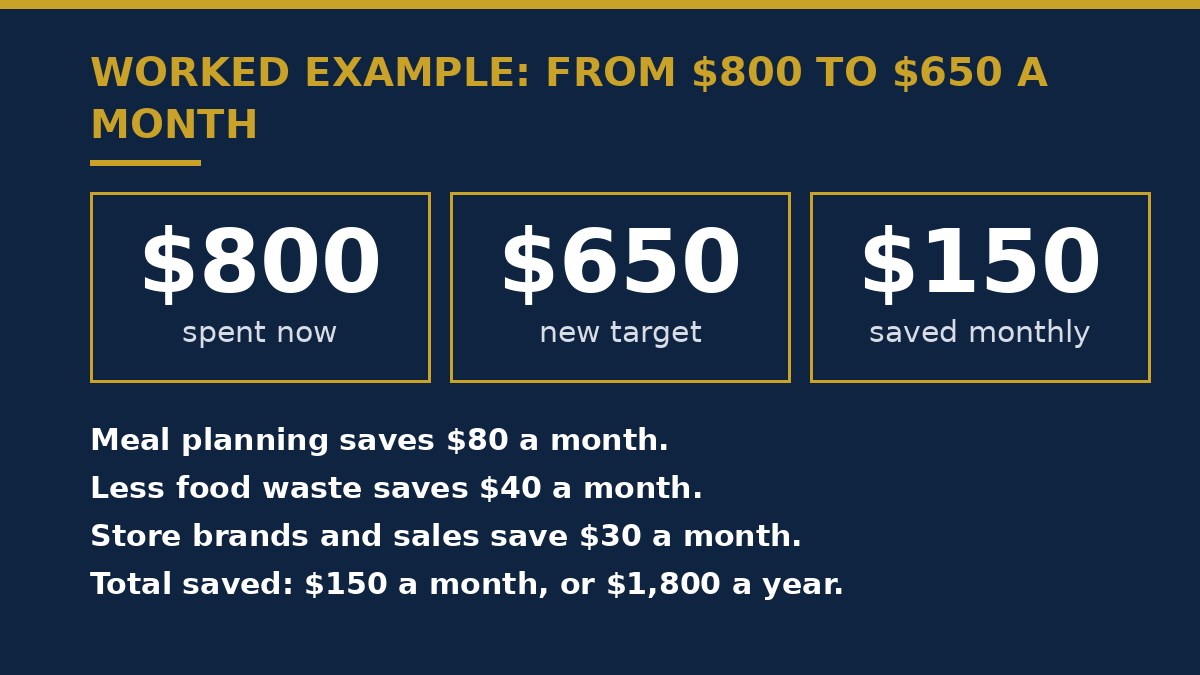
Here is a worked example for a household that spends $800 a month on groceries and wants to cut that spending without eating worse.
- Current spending: $800 a month
- New target: $650 a month
- Monthly saving: $800 minus $650 equals $150.
- Yearly saving: $150 times 12 equals $1,800.
Where does the $150 a month come from? It comes from three changes, and each one is small on its own.
- Meal planning saves $80 a month, because fewer impulse buys and fewer takeaways replace planned meals.
- Less food waste saves $40 a month, because leftovers become lunches and less food goes in the bin.
- Store brands and sales save $30 a month, because basic foods cost less without changing the meals.
- Check the total: $80 plus $40 plus $30 equals $150 a month.
The saving is real money. At $150 a month, the household keeps $1,800 over a full year, which can go to savings or paying off debt. Nothing in this example cuts a meal or asks the household to eat worse food.
Turn Your Monthly Number Into a Weekly Limit
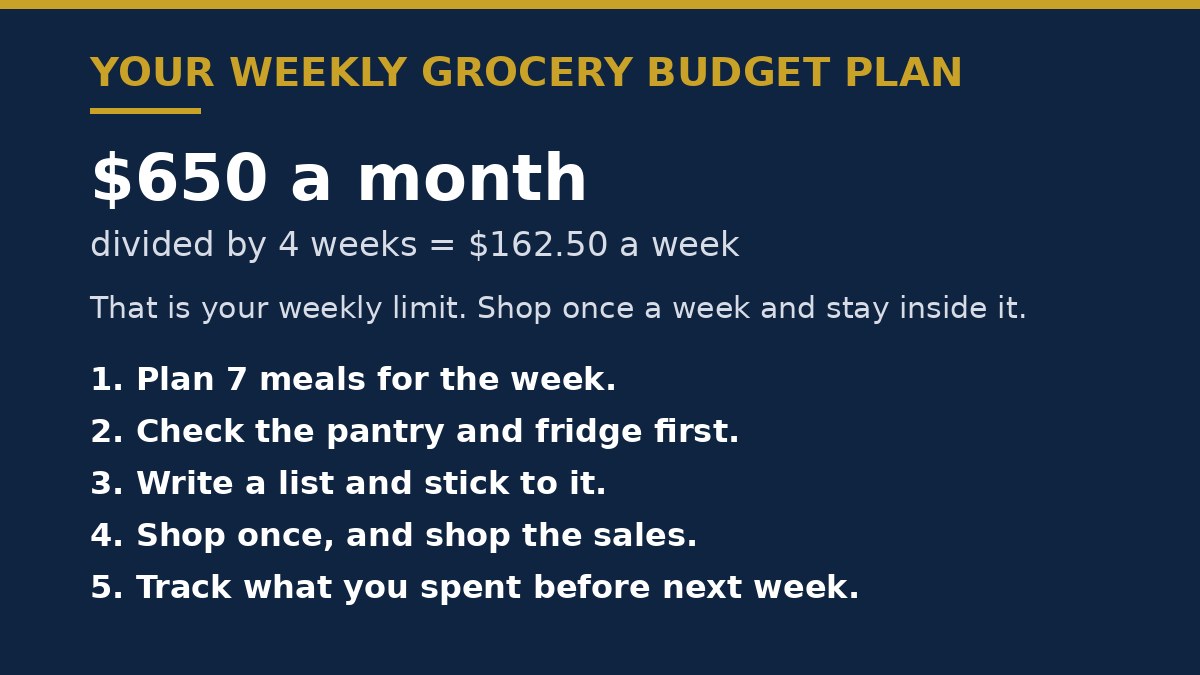
A monthly number is easier to follow when you turn it into a weekly limit. Take your monthly target and divide it by 4. For the worked example, $650 divided by 4 equals $162.50 a week. That is your weekly limit.
Track each shop against that limit. If you spend $140 in week one, you have $22.50 left over to carry forward, because $162.50 minus $140 equals $22.50. If you spend $180 in week one, you are $17.50 over, because $180 minus $162.50 equals $17.50, so week two has $17.50 less to spend. The weekly limit only works if you check it every week, so keep the running total on your phone or on the fridge.
Some people find it easier to use cash for groceries. Take out the weekly limit in cash, and when the cash is gone, the shopping is done. Others prefer a card and a simple note of each shop. Either way works, as long as the limit is clear and the spending is tracked. Our guide on how to set a weekly budget instead of a monthly one explains the weekly method in more detail.
What to Do When You Go Over Budget
Going over budget once does not mean the budget failed. It means something changed that week, and the job is to find out what it was.
Check the cause first. Did guests come for dinner? Did prices rise? Did you make three extra trips to the shop? Did a sale tempt you into buying food you did not need? Each cause has a different fix, so do not change the whole budget before you know which one it was.
If one week goes over, take the extra amount off next week, so the month still ends on target. If every week goes over, the target may be too low, and it is better to raise it by a small amount than to give up on budgeting altogether. And if your income changes from month to month, our guide on how to budget on an irregular income shows how to set a grocery number that still works when paydays are uneven.
Mistakes to Avoid When You Budget for Groceries
- Setting a target far below what you spend now. A cut of $150 a month is realistic, a cut of $400 in one month usually is not.
- Shopping without a list. The list is what keeps the bill near the target.
- Shopping every day. Each extra trip adds unplanned items to the bill.
- Throwing food away. Waste is the easiest money to save, and the easiest to ignore.
- Buying in bulk what you will never use. A big pack is only cheap if you finish it.
- Forgetting the small shops. A top-up trip still counts, so write it down.
- Giving up after one bad week. One week over budget is a signal, not a failure. Our guide on why your budget fails every month explains the common traps and how to fix them.
Frequently Asked Questions
How much should I budget for groceries each month?
It depends on your household size, your income, and where you live. Start from what you spend now, then cut in steps. In the worked example, a household spending $800 a month sets a first target of $650 a month, which saves $150 a month and $1,800 a year. If your household is smaller, your number will be smaller.
How do I budget for groceries for one person?
Use the same steps on a smaller scale. Find what you spend now, set a monthly target, plan seven meals, and shop once a week with a list. Cooking in batches helps a lot for one person: cook four portions, eat one, and freeze three for later in the week.
What is a good weekly grocery budget?
Divide your monthly target by 4. For the worked example, $650 a month divided by 4 equals $162.50 a week. That weekly limit is your real test, because it tells you after each shop whether you are on track for the month.
How can I lower my grocery bill without eating worse?
Plan meals, cut waste, and switch to store brands for basic foods. Those three changes save money without changing what is on the plate. Our guide on how to cut food spending without cutting meals explains each of them in detail.
Should I use cash or a card for groceries?
Either one works if you track what you spend. Cash makes the limit visible, because you can see the money running out. A card gives you a clear record on your statement. Pick the one you will actually stick to, and check the total against your weekly limit after every shop.
What if my grocery costs keep rising?
Food prices change through the year, so a target that worked six months ago may need a small rise. Check your last three months again, set a new target from the new average, and look at the U.S. Department of Agriculture food price outlook to see how food prices are moving. Raising the target by a small amount is better than giving up on the budget.
Conclusion
Budgeting for groceries without overspending comes down to six steps: find out what you spend now, set a monthly number that fits your budget, plan your meals before you shop, shop once a week with a list, cut waste before you cut meals, and use store brands, sales, and seasonal food. In the worked example, a household spending $800 a month cuts that to $650 a month, saves $150 a month, and keeps $1,800 over a year. Start this week: add up your last three months, set your number, and plan seven meals before your next shop.
This article is for general information and education only. It is not legal or financial advice.
