

How Does Social Security Work?
Social Security is the monthly payment millions of retired workers in the United States receive after a lifetime of work. You pay into it from almost every paycheck, and later it pays you back, month after month, for the rest of your life.
So how does Social Security work? In short, workers and employers pay a payroll tax on earnings while people work, and that money funds monthly benefits for retired workers, their families, and survivors. Your own benefit is figured from your 35 highest earning years, and the age you start claiming changes the amount: claim at 62 and you get less each month, wait until 70 and you get more.
What Is Social Security in Simple Terms?
Social Security is a federal program run by the Social Security Administration. It pays a monthly benefit to retired workers who have paid into the system, and it also pays benefits to some spouses, children, and survivors of workers who have died. For most retired workers, it is one part of retirement income, alongside savings and any workplace pension, not the whole plan.
You do not save your own payroll tax into a personal account that waits for you. The money paid in by workers today funds the benefits paid out to retirees today. If you want the shorter version first, our guide on what Social Security is in simple terms covers the basics, and this guide explains how the pieces fit together.
How Does Social Security Get Its Money?
Almost every worker in the United States pays Social Security tax from each paycheck, and your employer pays too.
- As an employee, you pay 6.2 percent of your covered earnings in Social Security tax. That money comes out of your pay before you see it.
- Your employer pays the same 6.2 percent on your earnings, on top of your pay.
- If you are self-employed, you pay both shares yourself, or 12.4 percent of your covered earnings.
- The tax only applies up to a yearly earnings limit set by law. Earnings above that limit are not taxed for Social Security in that year.
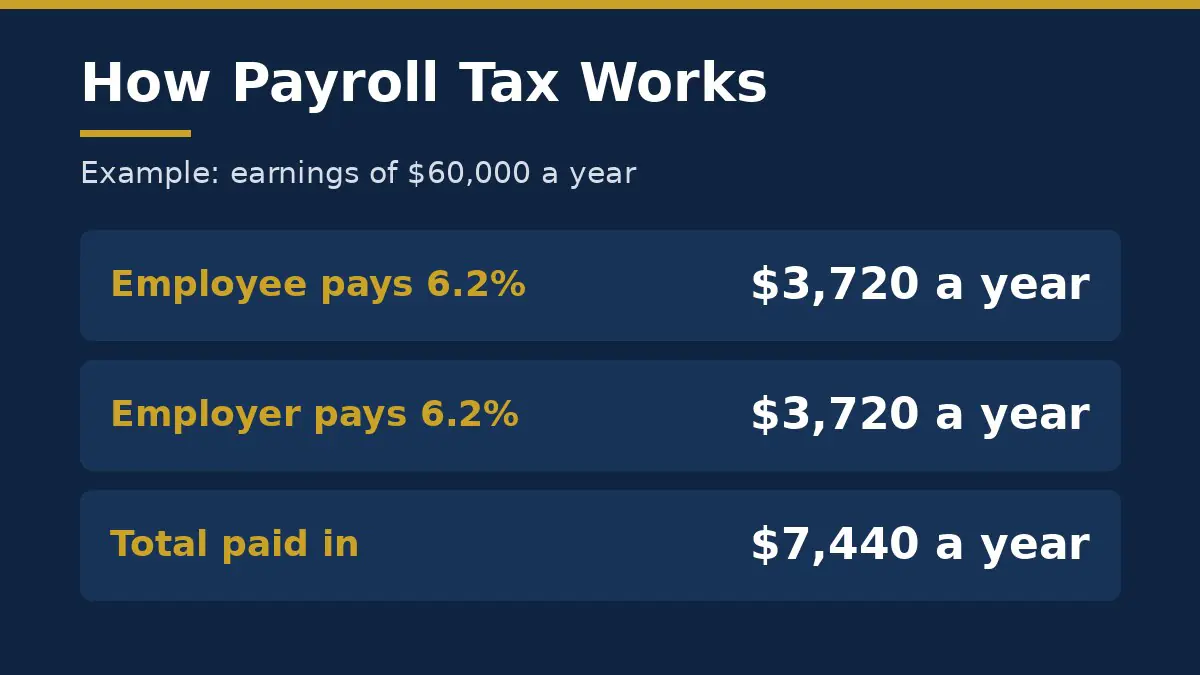
Take a worker who earns $60,000 in a year. At 6.2 percent, the employee share is $3,720 for the year, because $60,000 times 0.062 equals $3,720. The employer pays another $3,720. Together, $7,440 goes into the system for that worker in that year.
You also earn work credits as you pay in. You can earn up to four credits a year, and you need at least 40 credits, or about 10 years of work, to qualify for retirement benefits. You can typically get monthly retirement benefits starting at age 62 if you have worked and paid Social Security taxes for 10 years or more.
How Is Your Benefit Figured?
Your benefit is not a fixed amount, and it is not the same as the tax you paid in. It is figured from your earnings record, in four steps that the Social Security Administration follows for every worker.
Step 1: Take your 35 highest earning years. The Social Security Administration looks at your earnings after 1950 and picks the 35 years in which you earned the most. If you worked fewer than 35 years, the missing years count as zero, which pulls your average down.
Step 2: Adjust those earnings for wage growth. A dollar earned in 1995 was worth more then than a dollar earned today, so old earnings are adjusted upward to reflect how average wages have grown. Earnings are generally adjusted to wage levels in the year you turn 60.
Step 3: Average them into a monthly figure. Your 35 highest years of adjusted earnings are added up and divided by 420, the number of months in 35 years. The result is called your average indexed monthly earnings, and it is the base for your benefit.
Step 4: Apply the benefit formula. A formula turns that monthly average into your primary insurance amount, which is the monthly benefit you receive if you claim at your full retirement age. The formula replaces a larger share of earnings for lower paid workers.
One point matters a lot here. Because the benefit is based on your 35 best years, working extra years can raise your benefit if the new years replace low or zero years in your top 35.
When Can You Start, and What Does Timing Change?
The age you start claiming is one of the biggest choices in retirement planning, because it changes your monthly payment for the rest of your life.
Your full retirement age is the age at which you receive your full, unreduced benefit. It depends on the year you were born:
- Born 1943 to 1954: full retirement age 66
- Born 1955: 66 and 2 months
- Born 1956: 66 and 4 months
- Born 1957: 66 and 6 months
- Born 1958: 66 and 8 months
- Born 1959: 66 and 10 months
- Born 1960 or later: 67
You can start as early as age 62, but your benefit is permanently reduced for every month you claim before your full retirement age. The cut is 5/9 of 1 percent for each of the first 36 months early, then 5/12 of 1 percent for each month before that. For someone with a full retirement age of 67, claiming at 62 means 60 months early, and the total cut is 30 percent. That smaller amount stays smaller for life, apart from the yearly cost of living adjustment.
You can also delay past your full retirement age, and that earns delayed retirement credits. For people born in 1943 and later, each month of delay adds two-thirds of 1 percent, or 8 percent a year, up to age 70. For someone with a full retirement age of 67, waiting until 70 raises the monthly benefit by 24 percent. There is no extra credit for waiting past 70.
Spouses and survivors have their own rules, and family benefits can start before 62 in some cases.
Worked Example: Claiming at 62, 67, and 70
Here is a worked example with clearly labelled example numbers. Imagine a worker whose benefit at full retirement age is $2,000 a month. That $2,000 is an example figure only, not an average or a promise of what you will receive. Your own benefit comes from your own earnings record.
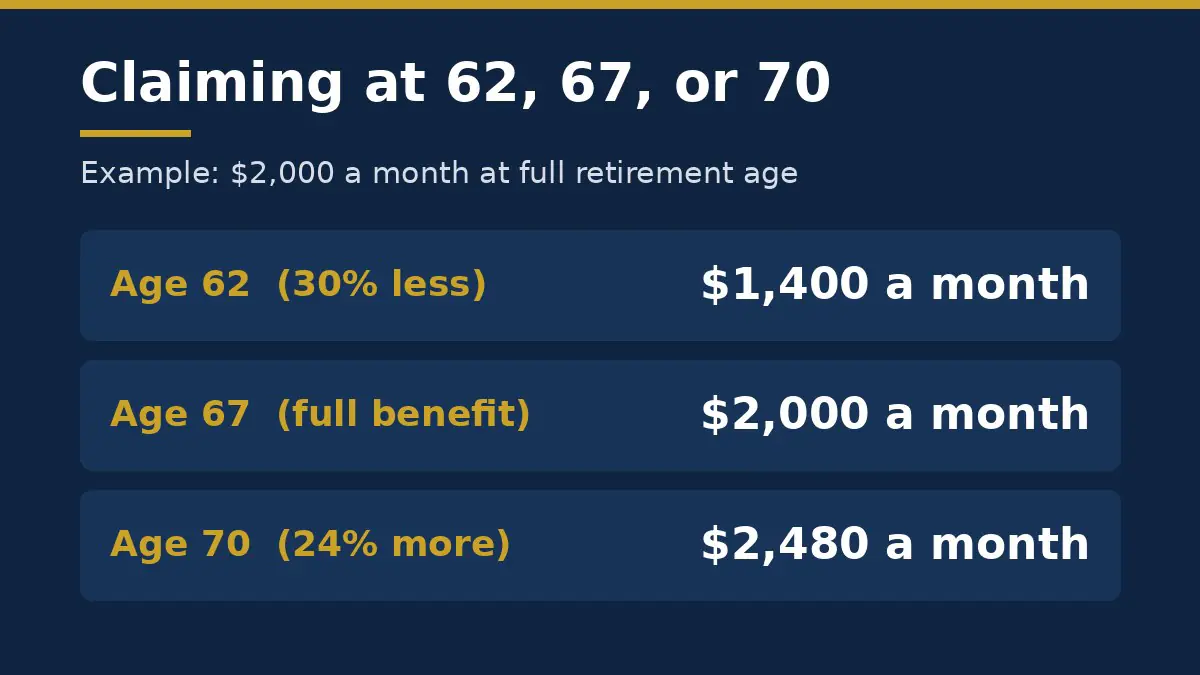
- Claim at 62, with a full retirement age of 67. The benefit is cut by 30 percent. The cut is $2,000 times 0.30, which equals $600. The monthly benefit is $2,000 minus $600, which equals $1,400 a month.
- Claim at 67, the full retirement age. There is no cut and no bonus. The monthly benefit is $2,000 a month.
- Claim at 70. The benefit rises by 24 percent, because 8 percent a year for 3 years equals 24 percent. The rise is $2,000 times 0.24, which equals $480. The monthly benefit is $2,000 plus $480, which equals $2,480 a month.
Now look at the yearly totals. At $1,400 a month, the yearly total is $16,800. At $2,000 a month, it is $24,000. At $2,480 a month, it is $29,760. The gap between claiming at 62 and claiming at 70 is $1,080 a month, or $12,960 a year, on this example.
That gap does not make waiting right for everyone. Claiming at 62 gives you five more years of payments than claiming at 67. If you need the money now, or your health is poor, starting early can be the right call even with the smaller check.
What Happens If You Keep Working?
Working and claiming at the same time is allowed, but the rules change with your age. Before your full retirement age, the Social Security Administration withholds part of your benefit if you work and earn over a yearly earnings limit, which changes each year. The withheld money is not lost: at your full retirement age, your monthly amount is increased to account for the months you did not get a check. After your full retirement age, your earnings do not affect your benefits.
Working also helps in another way. If you keep working after 60, those earnings count at their actual value, and if they are higher than some of your earlier years, they can replace a lower year in your top 35 and raise your benefit. If you are still building your retirement savings late in your career, our guide on how to catch up on retirement savings at 50 shows practical steps that work alongside Social Security.
How to Check Your Own Record and Estimate
You do not need to guess what your benefit will be. The Social Security Administration keeps your full earnings record, and you can see it online.
- Create a personal account on the Social Security Administration website and check your earnings record each year. If an employer reported your earnings wrong, or a year is missing, it is much easier to fix it now than after you retire.
- Look at your benefit estimates at ages 62, your full retirement age, and 70. Seeing your own three numbers, instead of an example like the one above, makes the claiming choice concrete.
- Check that you have earned enough credits. Most people need 40 credits, and your statement shows how many you have.
If you have never checked your statement, do it this month. It takes only a few minutes, and it replaces guessing with your own real numbers.
How Social Security Fits Into Your Retirement Plan
Social Security was designed as a base layer of retirement income, not the whole plan. Most planners treat it as one of three parts: Social Security, a workplace pension or retirement account, and personal savings. That is why the claiming decision should be planned together with the rest of your money.
A few planning steps help:
- Work out how much you should have saved for retirement by age, so you can see whether Social Security plus savings covers your spending. Our guide on how much to save for retirement by age gives simple targets to check against.
- Put the whole picture together with a written plan. Our guide to financial planning for retirement walks through the steps of turning savings, benefits, and spending into one plan.
- Understand the accounts that sit next to Social Security. A 401(k) or IRA works very differently from Social Security, and our guide on what a retirement account is in simple terms explains the difference.
- Start early if you can, because time is what turns small monthly saving into a large sum. Our guide on when to start investing explains how to judge whether you are ready.
Social Security also gets a yearly cost of living adjustment, usually in December, based on changes in a measure of consumer prices called the Consumer Price Index for Urban Wage Earners and Clerical Workers. That adjustment helps your benefit keep up with rising prices, but it is based on a general price index, not on your own spending.
Mistakes to Avoid With Social Security
A few common mistakes cost people real money over a retirement that can last 20 or 30 years.
- Claiming at 62 without doing the math. The smaller check is permanent, so run your own three numbers before you decide.
- Ignoring your earnings record. An error in one year can lower your benefit for life, and it is free to check.
- Assuming Social Security alone will be enough. For most people it replaces only part of pre-retirement pay, so savings matter.
- Waiting past 70 for extra credit. Delayed retirement credits stop at 70, so waiting longer does not raise the benefit.
- Forgetting that benefits can be taxed. Depending on your combined income, up to part of your Social Security benefit can be subject to federal income tax.
- Not telling the Social Security Administration about changes. If you move, marry, divorce, or your earnings change before full retirement age, report it, because it can affect your payment.
Frequently Asked Questions
How does Social Security work in simple terms?
You and your employer each pay 6.2 percent of your earnings in payroll tax while you work. That money funds monthly benefits for current retirees. When you retire, your benefit is figured from your 35 highest earning years, and the age you claim changes the amount: less at 62, full at your full retirement age, and more if you wait until 70.
What is full retirement age for Social Security?
It depends on your birth year. It is 66 for people born from 1943 to 1954, then rises by two months per birth year, reaching 67 for anyone born in 1960 or later.
How much less do I get if I claim Social Security at 62?
For someone with a full retirement age of 67, claiming at 62 cuts the monthly benefit by 30 percent. In the worked example in this guide, a $2,000 benefit at full retirement age becomes $1,400 at 62.
How much more do I get if I wait until 70?
For people born in 1943 and later, delaying past full retirement age adds 8 percent a year, up to age 70. For someone with a full retirement age of 67, waiting until 70 raises the benefit by 24 percent. In the worked example, a $2,000 benefit becomes $2,480 at 70.
Do I have to stop working to get Social Security?
No. You can apply while still working, and you can typically get monthly benefits starting at age 62 if you have worked and paid Social Security taxes for 10 years or more. Before full retirement age, part of your benefit may be withheld if your earnings are over the yearly limit, but after full retirement age your earnings do not affect your benefit.
Can I live on Social Security alone?
For most people, no. Social Security replaces only part of pre-retirement pay, and it was designed as one layer of retirement income alongside savings and retirement accounts. Check your own estimate against your monthly spending, and build savings to cover the gap.
Conclusion
Social Security works in three steps: workers and employers pay 6.2 percent each in payroll tax, your benefit is figured from your 35 highest earning years, and the age you claim sets the size of your monthly check. In the worked example, claiming at 62 gives $1,400 a month, claiming at 67 gives $2,000, and claiming at 70 gives $2,480. Your own numbers will differ, because they come from your own earnings record, so check your statement and plan Social Security as one part of a wider retirement plan, not the whole of it.
This article is for general information and education only. It is not legal or financial advice.