

How Do I Save for a Vacation Without Debt?
A vacation feels much better when you come home to zero trip debt. No card balance waiting for you, no interest quietly adding up, and no months of payments for a trip that is already over. That calm feeling starts before you book anything, with a simple plan and a separate place to keep the money.
To save for a vacation without debt, pick a trip total first, then divide it by the number of months until you travel. Save that amount every month in a separate savings account, and book only what the saved money can pay for. In the worked example below, a $2,400 trip is covered by saving $300 a month for 8 months, because $300 times 8 equals $2,400. Plan the trip, skip the debt, and the holiday stays a holiday.
Why Paying for a Vacation in Advance Works
A vacation paid for in advance changes every choice you make about it. When the money is already saved, a cheaper hotel feels like a win, not a loss, because the saved money stays yours. When the trip is on a credit card, every extra meal and side trip adds to a balance you will still be paying after you are back at work.
Paying in advance also gives you a clear limit. Once you know your total, you can compare flights, hotels, and dates against that one number. If a choice pushes the total above what you have saved, you change the choice, not the plan. Saving for a trip also teaches the same habit you need for every other goal: set a target, set a date, and save a fixed amount on a fixed day. Our guide on how to save for a goal and an emergency fund at the same time shows how to run two goals side by side without mixing the money.
Step 1: Pick Your Trip and Your Total
Start with the trip you actually want, not a dream trip with no price on it. Write down where you want to go, when you want to go, how many nights you will stay, and who is travelling with you. Those four facts decide almost everything about the cost.
Then get real prices for the big items: flights for your dates, two or three hotels or rentals, and the cost of getting around once you arrive. You need a solid estimate for flights, lodging, food, transport, and activities, plus a buffer.
Add the numbers up and write the total down as your trip target. If the total is more than you can save before the travel date, travel later, spend less on the trip, or save more each month. All three are better than putting the gap on a credit card. Set the travel date only after you know the monthly amount. If the trip costs $2,400 and you can save $300 a month, you need 8 months, because $2,400 divided by $300 equals 8. If you can save only $200 a month, you need 12 months, because $2,400 divided by $200 equals 12.
Step 2: List Every Cost, Including the Small Ones
Most vacation budgets fail on the small costs, not the big ones. Airport parking, tips, snacks, sunscreen, and phone roaming are the costs that quietly push a trip over budget.
Make a list under these headings, and put a real figure next to each one:
- Flights or fuel and tolls, for everyone travelling.
- Lodging, for every night, including taxes and fees added at checkout.
- Food, for every day, including breakfast, lunch, dinner, snacks, and drinks.
- Local transport, such as a rental car, buses, trains, taxis, or rideshares.
- Activities, such as tickets, tours, shows, and day trips.
- Travel insurance, if you decide to buy it. Read what it covers before you pay.
- Luggage, passport, and document costs, if anything needs renewing.
- Clothes and gear for the trip, such as swimwear or walking shoes.
- Souvenirs and small extras, with a fixed limit you agree in advance.
- Buffer, for the surprises. A buffer of $100 to $200 is a sensible start for a short trip.
Add the list up twice, because a single missed line can hide a few hundred dollars. If your list has no buffer and no food figure, it is not finished. Food and surprises are real costs, and leaving them out is how a paid-for trip turns into card debt on day three.
Step 3: Find the Money in Your Monthly Budget
Once you know your monthly saving amount, find it in your budget. Look at last month, not at the month you wish you had. Start with your take-home pay, subtract your fixed bills, and what is left can be split between food, fun, and saving. Your vacation amount has to come from that leftover, not from money already promised to a bill.
Simple ways to find $200 to $300 a month for a trip fund:
- Cook at home more often in the saving months, and keep takeout to one planned night a week.
- Pause one subscription you barely use until the trip is paid for.
- Set a weekly fun budget in cash, and stop spending on fun when the cash runs out.
- Sell one or two items you no longer use, and put the money straight into the trip fund.
- Put any small refund or rebate into the trip fund first.
Do not fund the trip by skipping a bill, stopping a debt payment, or raiding your emergency fund. A vacation is a want, and an emergency fund is for real emergencies. If money is tight, read our guide on how to build an emergency fund from zero first, and keep the two pots of money separate. The Consumer Financial Protection Bureau guide to building an emergency fund covers the same first steps.
If you cannot find the full monthly amount, move the travel date later, or pick a cheaper version of the same trip. Saving $200 a month for 12 months still reaches $2,400, because $200 times 12 equals $2,400. A slower plan that works is better than a fast plan that breaks in month two.
Worked Example: A $2,400 Vacation, Paid in Full
Here is a full worked example for one person, a 6 day trip with 5 nights in a hotel, travelling 8 months from now. Change the figures to match your own trip, and the method stays the same.
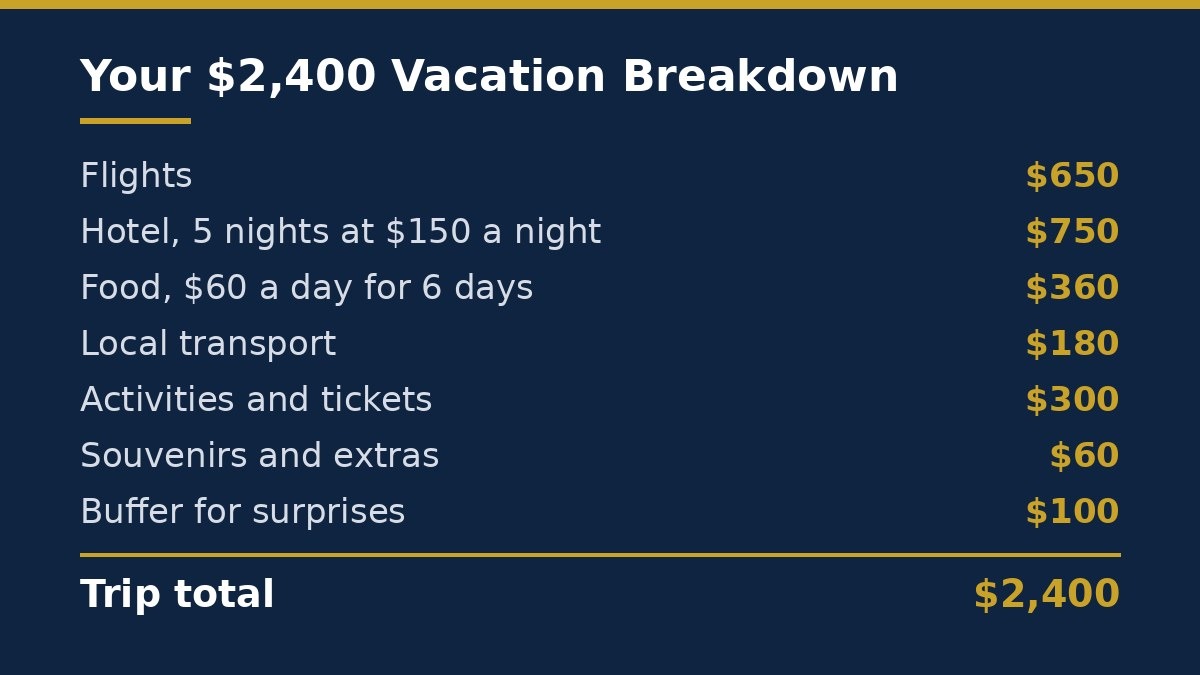
Trip cost breakdown:
- Flights: $650
- Hotel, 5 nights at $150 a night: $750
- Food, $60 a day for 6 days: $360
- Local transport: $180
- Activities and tickets: $300
- Souvenirs and extras: $60
- Buffer for surprises: $100
- Trip total: $650 plus $750 plus $360 plus $180 plus $300 plus $60 plus $100 equals $2,400.
Now turn that total into a saving plan. You have 8 months until the trip, so divide the total by 8:
- $2,400 divided by 8 equals $300 a month.
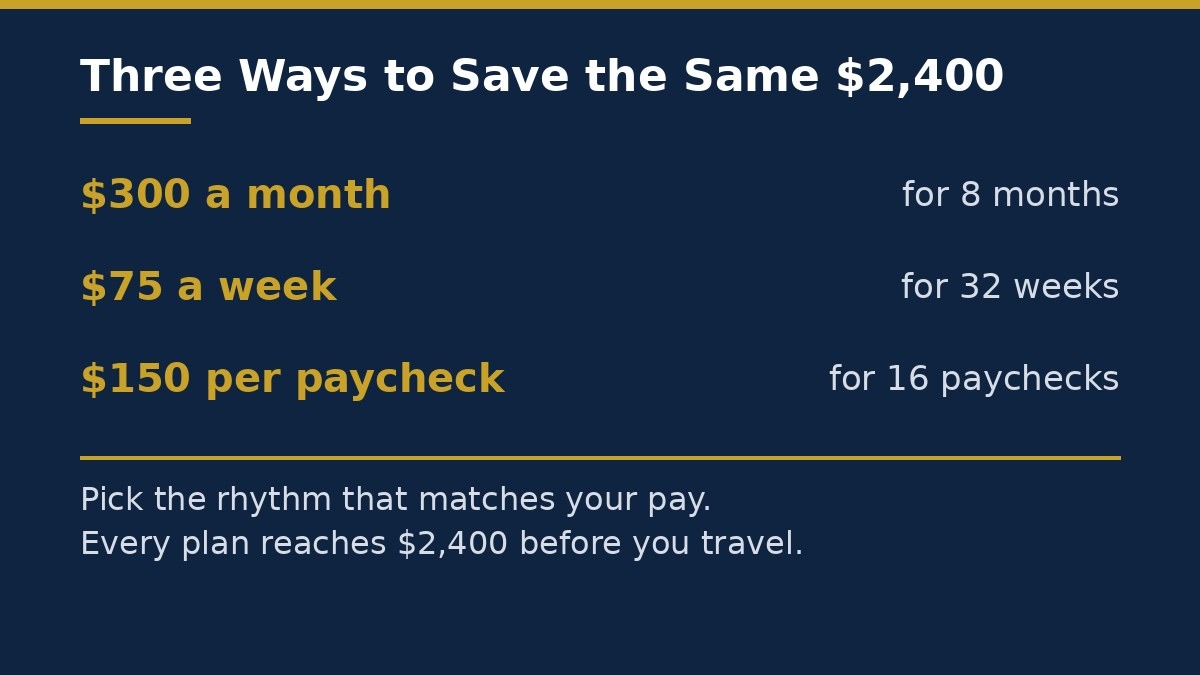
That $300 a month is the plan. Save it every month, on payday, and the trip is paid for before you leave. If you prefer to save weekly, the same total works out like this:
- $2,400 divided by 32 weeks equals $75 a week.
- $300 a month for 8 months equals $2,400.
- $75 a week for 32 weeks equals $2,400.
If you are paid every two weeks, you can save per paycheck instead:
- $150 per paycheck for 16 paychecks equals $2,400.
Pick the rhythm that matches your pay. Monthly, weekly, or per paycheck, the total is the same, and the trip is paid for in full before you go.
Step 4: Automate the Saving
A plan you have to remember every month is a plan that will slip. The fix is to automate it, so the money moves on payday without you thinking about it.
Open a separate savings account just for the trip, with a clear name such as Vacation Fund. Money mixed in with everyday spending gets spent, while money in its own account gets watched and protected. Our guide on how to choose a bank account as a beginner walks through what to look for. If you want the money to earn a little interest while it waits, our guide on what a money market account is explains one option, and our guide on whether a high yield savings account is safe answers the safety question many beginners ask.
Then set up an automatic transfer from your checking account to the vacation account, for the day you get paid. In the example above, that is $300 on payday each month, or $150 per paycheck. Our guide on how to automate saving and investing shows how to set this up.
Two rules make automation work. First, pay the trip fund on payday, before you spend on anything else. Second, do not move money back out of the trip fund for everyday spending. If a real emergency happens, use your emergency fund, not the trip fund. The Consumer Financial Protection Bureau page on setting a goal and starting a savings habit makes the same point: automatic saving is one of the easiest ways to reach a goal. Check the balance once a month, so you can see if you are behind while there is still time to catch up.
Step 5: Book Smart, and Pay Only With Saved Money
When the money is saved, book flights and lodging first, because those are the biggest costs and the prices move the most. Then book the activities you know you want. Leave food, local transport, and souvenirs to pay as you go, from the trip fund, not from a credit card.
A few booking habits keep the total inside your target:
- Compare at least two flight options and two lodging options before you book.
- Check what the lodging price includes. A room with breakfast can be cheaper overall than a cheaper room without it.
- Read the cancellation terms before you pay. A non refundable deal is only a deal if your dates are firm.
- Book activities in advance only when the price is better or the place sells out.
- Keep a simple daily spending limit for food and extras, and check it each evening. In the example above, food is $60 a day, so a $90 lunch means a $30 dinner, not a $60 dinner.
Pay with a debit card linked to the trip fund, or with cash you set aside from the trip fund. If you use a credit card because a hotel asks for one, pay it off in full from the trip fund the same week. The trip is only debt free if every charge is covered by money already saved.
Mistakes to Avoid When You Save for a Vacation
Most vacation debt comes from a few common mistakes. Knowing them in advance makes them easy to avoid.
- Booking before you know the total. A flight deal is only a deal if the whole trip still fits your budget.
- Forgetting food and transport. These two lines alone are $540 in the example above, which is more than a fifth of the trip.
- Saving in your everyday account. Money you can see when you shop is money you will spend.
- Raiding the emergency fund for a holiday. An emergency fund is for emergencies, and a holiday is not one.
- Putting the trip on a card and hoping to pay it later. Hope is not a payment plan, and interest makes the trip cost more than the price you saw.
- Telling yourself you will save what is left at the end of the month. Save on payday first, or there is rarely anything left.
Frequently Asked Questions
How much should I save for a vacation?
Add up flights, lodging, food, transport, activities, and a buffer, and that total is your target. In the worked example in this guide, the total is $2,400 for a 6 day trip with 5 hotel nights. Your own total will be different, so work out your own list and save that total before you travel.
How far in advance should I start saving for a vacation?
Start as soon as you pick the trip. Divide your total by the number of months until you travel, and save that amount each month. In the example here, $300 a month for 8 months reaches the $2,400 target. If you have only 4 months, you need $600 a month, because $2,400 divided by 4 equals $600.
Can I save for a vacation and an emergency fund at the same time?
Yes, if you keep the money in separate accounts and give each goal its own monthly amount. Our guide on how to save for a goal and an emergency fund at the same time shows how to split the money without mixing it up. Build the emergency fund first if you have no safety net, then start the vacation fund.
Should I use a credit card for a vacation?
Only if you can pay the full balance from money you have already saved. A card can be handy for a hotel hold or for booking online, but the trip is only debt free if every charge is paid off in full, straight away. If you cannot pay it in full, pay with saved money instead.
What if I cannot save enough before the travel date?
Move the date, shorten the trip, or pick a cheaper place to stay. Saving $200 a month for 12 months still reaches $2,400. A later trip that is paid for is better than an early trip that leaves you in debt for months after you get home.
Where should I keep my vacation savings?
Keep it in a separate savings account, away from your everyday spending money, so you can see the balance grow and are less likely to spend it. Set up an automatic transfer on payday, so the money moves before you have a chance to spend it.
Conclusion
Saving for a vacation without debt comes down to three steps: work out the full trip total, divide it by the months until you travel, and save that amount automatically in a separate account. In the example in this guide, saving $300 a month for 8 months pays the $2,400 total in full, because $300 times 8 equals $2,400. Book only what the saved money can pay for, keep your emergency fund separate, and come home with memories, not a balance to pay off.
This article is for general information and education only. It is not legal or financial advice.
