
What Is a Debt Management Plan in Simple Terms?
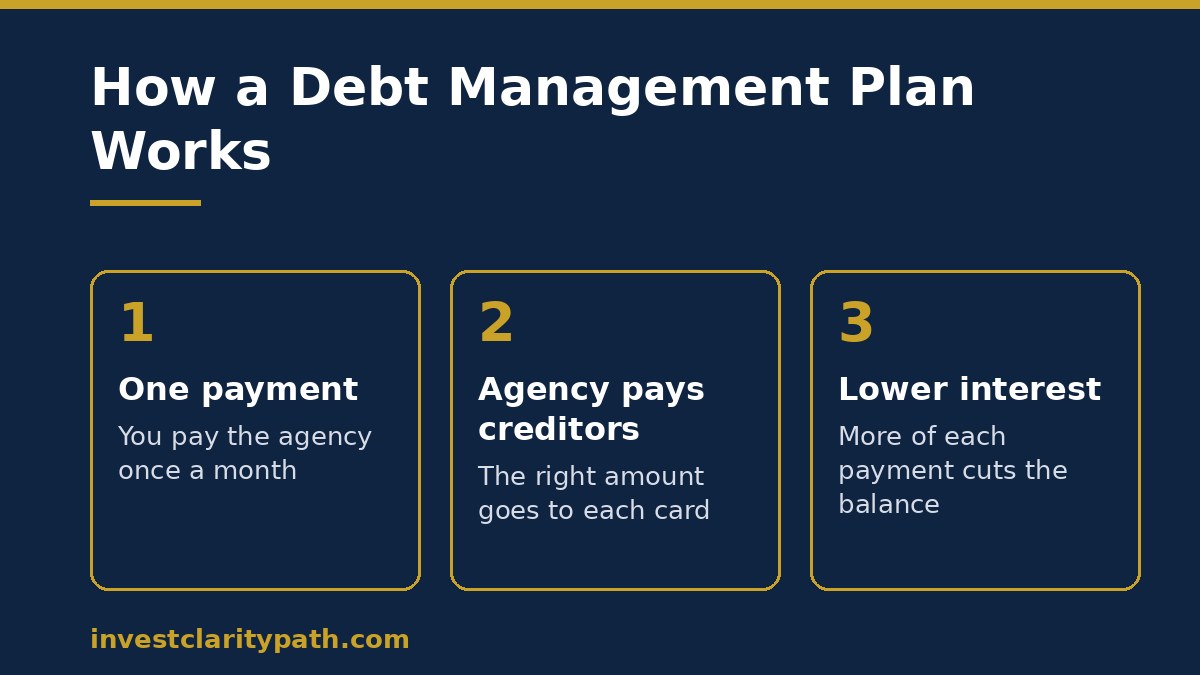
A debt management plan is a structured way to pay off credit card debt with help from a nonprofit credit counselling agency. Instead of paying each card separately, you make one monthly payment to the agency. The agency then sends the right amount to each of your creditors.
The key benefit is that many creditors agree to lower your interest rate and stop late fees while you are on the plan. That means more of your payment goes toward the balance, and less goes toward interest. You still repay the full amount you owe. A debt management plan is not a loan, and it is not a deal to pay less than you owe. It is a plan to pay what you owe in full, in one steady monthly payment, usually over three to five years.
If your card payments feel scattered and the interest keeps growing faster than your payments can shrink the balance, a debt management plan may be worth a look. This guide explains how it works, what it costs, and how it differs from debt settlement and from a consolidation loan, so you can decide with clear facts.
How a Debt Management Plan Works
A debt management plan starts with a free or low cost counselling session. A credit counsellor reviews your income, your spending, and every debt you carry. Together, you work out how much you can pay each month without falling behind on rent, food, or other basic costs.
The plan then runs in five simple steps:
- You meet with a counsellor from a nonprofit agency and share a full list of your debts, interest rates, and minimum payments.
- The counsellor contacts your creditors and asks them to lower your interest rate, stop late fees, and accept the plan.
- You make one monthly payment to the agency, usually by bank transfer, on a set date each month.
- The agency splits your payment and sends the agreed amount to each creditor, on time, every month.
- You get a monthly statement showing what went to each creditor and how your balances are falling.
Most plans run for three to five years. While you are on the plan, the cards in the plan are usually closed to new charges. That rule helps you stop adding debt while you pay the old debt down. You can still use cash, a debit card, or a card that is not part of the plan, but the counsellor will usually ask you to avoid new borrowing until the plan is finished.
What Debts Can Go Into a Plan
A debt management plan is built for unsecured debt. That is debt with no asset tied to it, such as a house or a car. The debts that usually fit are:
- Credit cards and store cards, which are the most common debts in a plan.
- Some personal loans and lines of credit, if the lender agrees.
- Some medical bills, when the provider accepts the plan.
Some debts do not fit. A mortgage and a car loan are secured debts, so they stay outside the plan. Most student loans and tax debts also stay outside, because those lenders follow their own repayment rules. Your counsellor will sort your debts into the ones that can join the plan and the ones that must be handled another way.
Before you talk to a counsellor, it helps to have a clear picture of your debts. Our guide on how to make a debt payoff plan shows a simple way to list them.
How a Debt Management Plan Differs From Debt Settlement and a Consolidation Loan
These three options sound alike, but they work in very different ways. Mixing them up can lead to a costly choice, so here is the plain difference.
| Debt management plan | Debt settlement | Consolidation loan | |
|---|---|---|---|
| New loan? | No | No | Yes, one new loan pays off the old debts |
| Pay in full? | Yes, full balances | No, less than owed, if creditors agree | Yes, old debts paid in full by the new loan |
| Interest rate? | Lower rate negotiated by the agency | No set rate, accounts often fall behind first | One new rate, set by your credit score |
| Effect on credit? | Accounts close, on time payments help over time | Missed payments and settled accounts can hurt credit for years | Old accounts close or stay open, a missed payment hurts |
With a debt management plan, you pay every dollar you owe, just at a lower interest rate. With debt settlement, a company may ask you to stop paying and save money in a separate account, then offer creditors a smaller lump sum. That can leave your credit badly damaged, and forgiven debt can sometimes count as taxable income. With a consolidation loan, you swap several debts for one new loan, which only helps if the new rate is lower than the old ones and you do not run the old cards back up.
If you are weighing a new loan instead, read our guide on whether you should consolidate your debt first.
A Worked Example With Real Numbers
Numbers make the idea clear. Take a simple example with three debts and one monthly payment of 250 dollars.
- Card A: 3,000 dollars at 24 percent interest
- Card B: 2,000 dollars at 19 percent interest
- Store card: 1,000 dollars at 28 percent interest
The total is 6,000 dollars. The payment of 250 dollars a month is split in proportion to each balance, so about 125 dollars goes to Card A, 83 dollars to Card B, and 42 dollars to the store card.
Without a plan
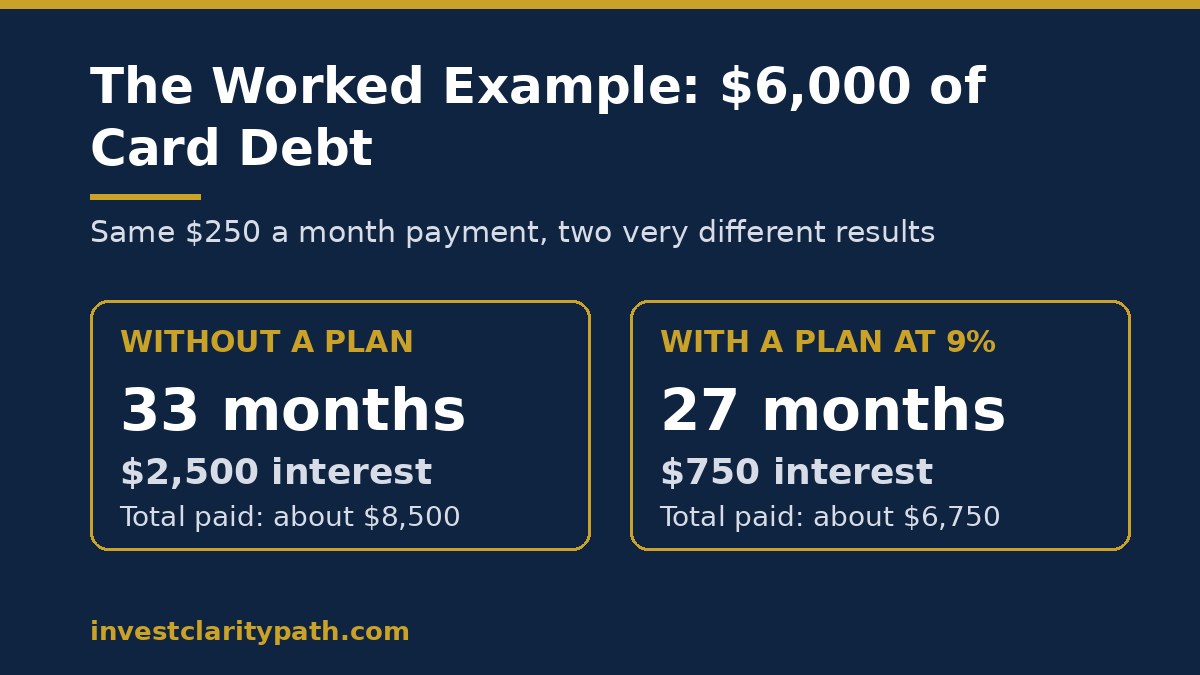
If you paid 250 dollars a month at the original rates, with an average rate of about 24 percent, it would take about 33 months to clear the 6,000 dollars. You would pay about 8,500 dollars in total, which means about 2,500 dollars of that would be interest alone.
With a debt management plan
Now suppose the agency negotiates the rate down to 9 percent on all three debts, and you keep paying the same 250 dollars a month. The same 6,000 dollars would be cleared in about 27 months. You would pay about 6,750 dollars in total, so the interest would be about 750 dollars.
The difference is about 1,750 dollars less interest, and about six months sooner debt free. That is the whole point of a plan: the same monthly payment, but more of it reaches the balance because the interest rate is lower.
Fees change the result, so include them. If the agency charged a 30 dollar monthly fee, that would add 810 dollars over 27 months. The saving would then be about 940 dollars instead of 1,750 dollars. This example uses round numbers to show the idea. Your own rates, balances, and fees will differ, and no agency can promise an exact result before it talks to your creditors.
Paying only the minimum is the slowest path of all. See what happens if you only pay the minimum on a credit card.
What a Debt Management Plan Costs
Nonprofit agencies charge fees, but the fees are usually modest and are limited by state rules. You may pay a one time setup fee and a monthly fee for running the plan. Some agencies reduce or waive fees when income is low, so ask about that before you sign. Always get the full fee list in writing, including the setup fee, the monthly fee, and the date your first payment is due. A trustworthy agency will explain every fee in plain words and will never ask for a large payment before any work is done.
Watch out for companies that charge high upfront fees, promise to cut your debt in half, or tell you to stop paying your creditors. Those are signs of a debt settlement firm, not a nonprofit credit counselling agency. The National Foundation for Credit Counseling, or NFCC, lists member agencies that meet its standards. You can find one through the NFCC website.
The Pros and Cons
What works well
- One payment each month, instead of several due dates and minimums to track.
- Lower interest rates, so more of each payment cuts the balance.
- Late fees often stop, which ends the cycle of fees on top of interest.
- A clear finish date, usually three to five years, so you can see the end.
- Support from a counsellor, who can help if your income changes during the plan.
What to watch out for
- Enrolled cards are usually closed, so you cannot use them for new spending.
- Monthly fees add to the cost, and they reduce the interest you save.
- Your credit score may dip at first when accounts close, even though steady payments help it over time.
- Not every debt can join, so some bills still need a separate plan.
- Missing a payment can end the lower rates, so the monthly payment must fit your budget.
To see how your own payoff time might look, try our guide on how long it will take to pay off your debt.
How to Start a Debt Management Plan, Step by Step
- List every debt. Write down each balance, interest rate, minimum payment, and due date.
- Check your monthly budget. Work out what you can pay each month after rent, food, transport, and other basic costs.
- Find a nonprofit agency. Look for a member of the NFCC or a HUD approved housing counselling agency with credit services, and check reviews and state licensing.
- Book a counselling session. The first session is often free. Bring your debt list, pay slips, and a recent bank statement.
- Review the plan in writing. Check the monthly payment, the new interest rates, the fees, and the expected finish date before you agree.
- Make the first payment on time. Set up an automatic transfer if you can, and check the first monthly statement to confirm each creditor was paid.
If the monthly payment feels too tight, say so before you sign. A plan that fails in month three helps no one. A good counsellor will adjust the plan or suggest another route, such as the debt snowball method or the debt avalanche method, which you can run yourself without an agency.
Is a Debt Management Plan Right for You?
A plan fits best when you have steady income, several card debts at high rates, and you can pay a set amount each month without missing rent or food. It also fits when you want a fixed finish date and you are willing to stop using the enrolled cards.
It may not fit if your income is very low or unsteady, if most of your debt is secured or student loans, or if you could clear the balances yourself in a few months with extra payments. In that case, a self run plan may cost less. Our guide on paying off debt faster with extra payments shows how small extra amounts change the finish date.
Frequently Asked Questions
How long does a debt management plan take?
Most plans run three to five years. The exact length depends on your total balance, your interest rates, and the monthly payment you can afford.
Does a debt management plan hurt my credit score?
It can lower your score at first, because enrolled accounts are closed and that changes your available credit. Over time, steady on time payments can help your score recover. The effect is usually smaller than the damage from missed payments or a settlement.
Can I still use my credit cards during the plan?
No, not the cards in the plan. Those accounts are closed to new charges. You can use a card that is not in the plan, but most counsellors will ask you to avoid new borrowing until the plan is finished.
Can I leave a debt management plan early?
Yes. You can end the plan at any time, but the lower interest rates and fee waivers usually end with it, and your creditors may return to the original terms. Talk to your counsellor first if you are thinking of leaving.
What happens if I miss a payment?
Contact the agency at once. One missed payment can lead a creditor to drop the plan terms, so act fast and ask whether the payment can be made up or the date moved.
Is a debt management plan the same as debt settlement?
No. A debt management plan pays your balances in full at a lower interest rate. Debt settlement tries to pay less than you owe, often after missed payments, and it can damage your credit far more.
Conclusion
A debt management plan is a simple idea: one payment, lower interest, and a fixed finish date, arranged through a nonprofit counsellor. It does not erase debt, and it does not suit everyone, but for a borrower with steady income and several high rate cards, it can turn a scattered set of minimum payments into a plan with an end in sight.
Start by listing your debts and checking what you can pay each month. Then talk to a nonprofit agency, compare the plan with a self run payoff method, and choose the route you can stick with for the full term. The best plan is the one you can finish. For the official definition, the Consumer Financial Protection Bureau explains what a debt management plan is.
This article is for general information and education only. It is not legal or financial advice.
