

How Do I Budget for Moving Out for the First Time?
Moving out for the first time is exciting, and it is also the first time many people pay every bill themselves. Rent, utilities, groceries, and moving costs all land in the same month, and that first month is usually the most expensive one.
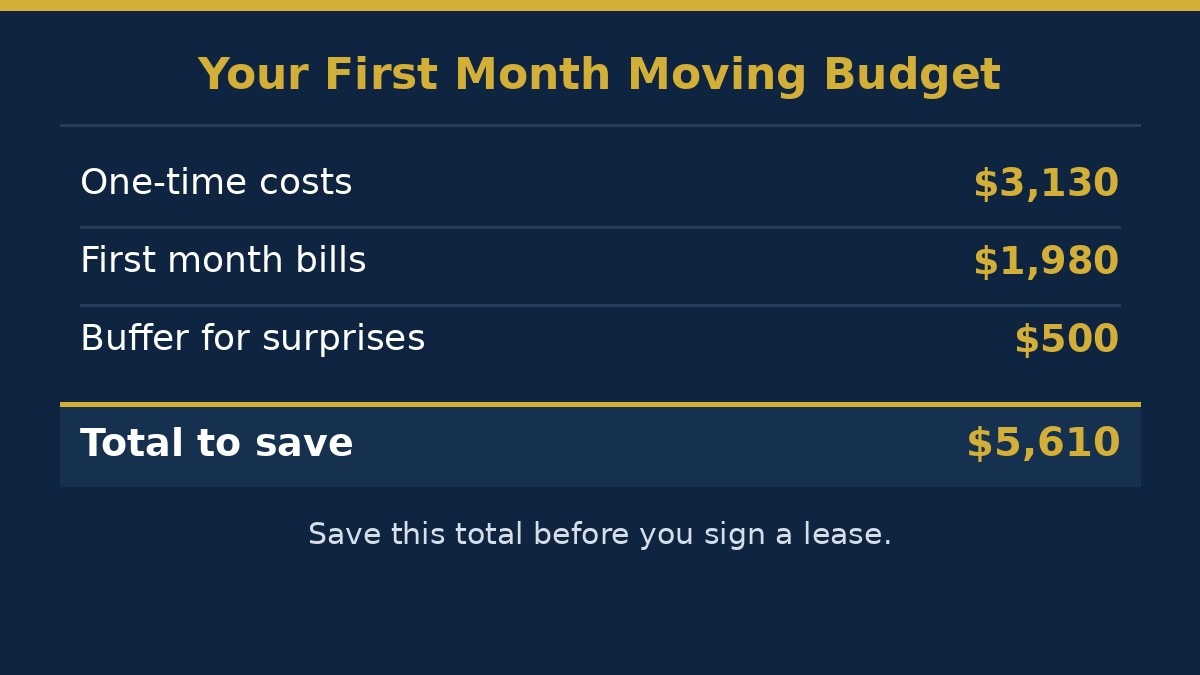
To budget for moving out, add up three numbers: the one-time costs of the move, your new monthly bills, and a small buffer for surprises. Save that total before you sign a lease, then check that your monthly bills fit your take-home pay. The worked example below shows how this looks with real numbers, and the total in that example comes to $5,610.
How Much Money Do You Need to Move Out?
There is no single number that fits everyone, because rent and moving costs change a lot by city and by how far you move. A useful guide is that your one-time costs often equal two to three months of rent. Then you add your first month of bills on top of that, plus a buffer of $500 to $1,000 for the things you forgot.
That means if your rent is $1,200 a month, you should expect to need roughly $2,400 to $3,600 for one-time costs, plus about $2,000 for the first month of bills, plus a buffer. In the worked example later in this guide, those three parts add up to $5,610. Your own total will be different, and that is fine. The point is to work out your own three numbers before you commit to a place, not after. For most first time movers, renting is the simpler start, and our guide on whether it is better to get an apartment or a house walks through that choice.
Step 1: Work Out What Rent You Can Afford
Start with your take-home pay, which is the money that actually lands in your bank account after tax. Do not budget from your salary before tax, because that money is never yours to spend.
A common guide is to keep rent near 30 percent of your take-home pay. On $3,200 of take-home pay a month, 30 percent is $960. That is a guide, not a rule, and in many cities it is hard to hit. In the example below, rent is $1,200 on $3,200 of take-home pay, which is 37.5 percent. That can still work, but only if the rest of the budget is tighter. The higher your rent share, the less room you have for food, transport, fun, and saving.
A simple way to test a rent figure is the 50/30/20 budget rule, which splits take-home pay into needs, wants, and saving. Read our guide to the 50/30/20 budget rule to see how the split works, then test your rent against it. If rent alone eats most of your needs budget, the place is probably too expensive for your pay right now.
Once you have a rent range, write a full monthly budget before you sign anything. Our guide on how to create a monthly budget that actually works shows the steps. If the numbers do not fit on paper, they will not fit in real life either. It is far better to find that out before you sign a lease than after. The free US government budgeting page at USA.gov is a good cross-check for your own numbers.
Step 2: List Every One-Time Cost
One-time costs are the bills you pay once, around moving day. They are easy to forget, because you do not pay them every month, but they are the reason the first month feels so expensive. Make a list, get the real figures from the landlord and the moving company, and write them down.
Here are the one-time costs most first time movers pay:
- Security deposit. This is often one month of rent, and in some places it can be more. In our example, the deposit is $1,200, the same as one month of rent.
- First month of rent. Many landlords ask for the first month of rent when you sign, so this money leaves your account before you even move in.
- Last month of rent. Some landlords ask for this too, so ask in writing what is due before move-in day.
- Application fee. This is often a small fee, commonly $25 to $75, and it is usually not refunded if you do not get the place.
- Moving costs. A rented truck, boxes, tape, and help from friends or movers.
- Furniture and household basics. A bed, a table, chairs, kitchen items, cleaning supplies, and a shower curtain. You do not need everything on day one.
- Utility setup fees and deposits. Some utility companies charge a setup fee or ask for a deposit if you have no payment history with them.
- Pet deposit. If you have a pet, ask about this early, because it can add a few hundred dollars.
Add the list up as soon as you have the real figures. If a landlord cannot tell you the deposit and the fees before you sign, treat that as a warning sign and ask again in writing. The US government moving checklist at USA.gov is a handy way to check you have not missed a step, from changing your address to setting up utilities.
Step 3: List Your New Monthly Bills
After the one-time costs, list every bill you will pay each month in your own place. This is your new normal, and it has to fit your take-home pay every single month.
Your monthly list will usually include:
- Rent, which is normally your biggest bill.
- Electric, water, and gas. Ask the landlord or the utility company what past tenants paid, so you are not guessing.
- Internet, which is a fixed monthly bill in most places.
- Phone, which you may already pay, but check that your plan still fits.
- Groceries, which depend on how much you cook at home.
- Transport, which covers fuel, bus or train fares, or parking.
- Laundry, if your building charges for machines or you use a laundromat.
- Household items, such as cleaning products, toilet paper, and light bulbs.
- Renter’s insurance, which is often a small monthly cost. Ask for a quote before you move, and check what it covers.
Write the list with real numbers, not guesses. Call the utility companies, check your last three months of grocery spending, and look up the bus fare or fuel cost for your route to work. A budget built on guesses will break in the first month.
Worked Example: A First Month Budget for Moving Out
Here is a full worked example, so you can see how the three numbers fit together. The example uses a monthly take-home pay of $3,200 and rent of $1,200. Change the figures to match your own pay and your own rent, and the method stays the same.
One-time costs before move-in day:
- Security deposit: $1,200
- First month of rent, paid when you sign: $1,200
- Moving truck and supplies: $280
- Basic furniture and household items: $450
- One-time costs total: $1,200 plus $1,200 plus $280 plus $450 equals $3,130.
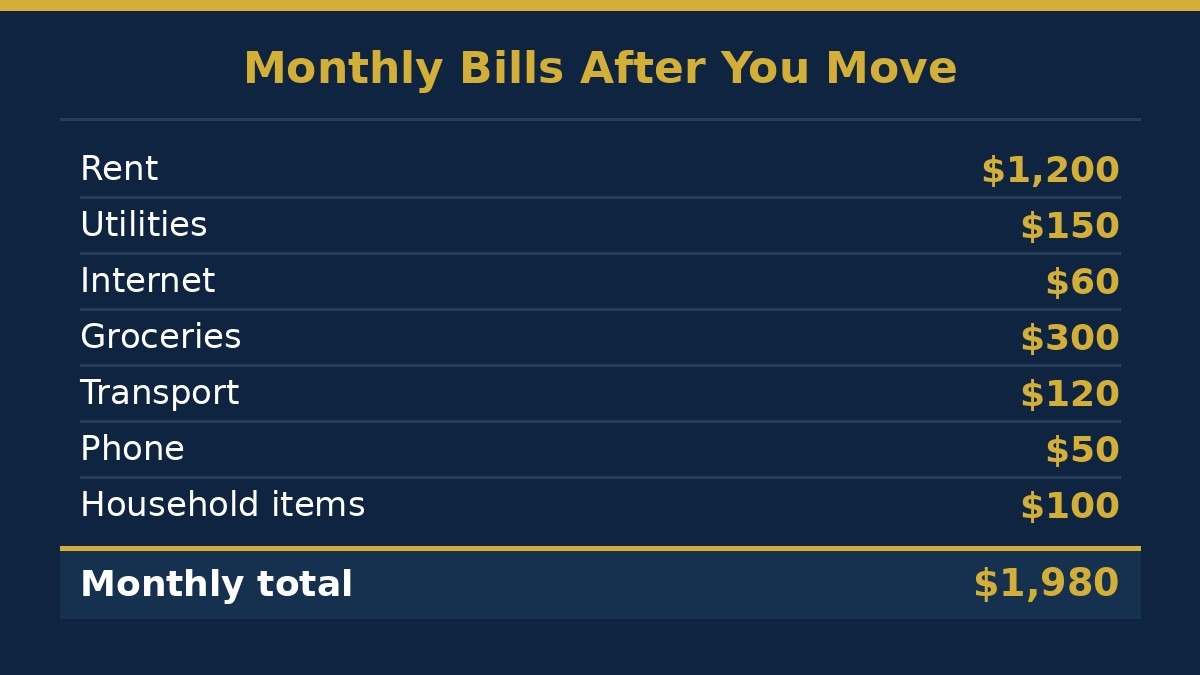
Monthly bills in the first month:
- Rent: $1,200
- Utilities, electric and water: $150
- Internet: $60
- Groceries: $300
- Transport: $120
- Phone: $50
- Household and personal items: $100
- Monthly bills total: $1,200 plus $150 plus $60 plus $300 plus $120 plus $50 plus $100 equals $1,980.
Now add the buffer. A buffer of $500 covers the small surprises, such as a plunger, a lamp, extra cleaning supplies, or a first grocery shop that costs more than planned.
- Total cash needed before move-in day: $3,130 plus $1,980 plus $500 equals $5,610.
That $5,610 is the savings target for this example. It is not the cost of living for a month. It is the cash you need in hand before you move, so the first month does not go on a credit card.
Now check the monthly budget after the move. Take-home pay of $3,200 minus monthly bills of $1,980 leaves $1,220. That $1,220 has to cover saving, debt payments, fun, and anything you missed. If that leftover feels too tight, the rent is too high for your pay, or the monthly bills need to come down. Run the same check with your own figures before you sign a lease.
Step 4: Build Your Moving Fund
Once you know your total, turn it into a saving plan. Take your total target and divide it by the number of months until you want to move. In the example above, the target is $5,610. Save $935 a month for six months, and you reach it, because $935 times 6 equals $5,610. If six months is too fast, save $467.50 a month for twelve months, because $467.50 times 12 also equals $5,610. Pick the timeline you can actually keep.
Keep your moving fund in a separate savings account, away from your everyday spending money. That way you can see the balance grow, and you are less likely to spend it on something else. If you want to learn how much to hold back for surprises after the move, read our guide on how much to keep in an emergency fund. A moving fund and an emergency fund are two different pots of money, and you need both.
If you are starting from zero, do not let that stop you. Our guide on how to build an emergency fund from zero shows how to start small and grow the habit. The same method works for a moving fund: set a small automatic transfer on payday, raise it when you can, and watch the total climb. A simple trick is to pay your moving fund first, on the day you get paid, before you spend on anything else.
Step 5: Lower the Cost of Moving Out
You do not have to pay full price for everything. A few smart choices can cut hundreds of dollars from the first month.
- Move at a quiet time if you can. Movers and truck rental are often cheaper on weekdays and in the middle of the month.
- Ask friends and family for boxes, and check local free listings before you buy new ones.
- Buy secondhand furniture for the big items, such as a bed frame, a table, and shelves. You can upgrade later, one piece at a time.
- Split the cost with a roommate. Two people sharing rent, utilities, and internet can each save a large amount every month.
- Compare internet and phone plans before you sign a contract. A cheaper plan that still fits your use is money saved every month.
- Cook at home in the first month. Eating out every day in a new place is one of the fastest ways to blow the budget. Our guide on how to cut food spending without cutting meals has simple ideas that work for beginners.
- Buy only what you need for the first week. A lamp, a pan, plates, and bedding will do. The rest can wait until your next paycheck.
Every dollar you save on the move is a dollar that stays in your buffer, and a bigger buffer means a calmer first month.
Mistakes to Avoid When You Move Out for the First Time
First time movers often make the same few mistakes. Knowing them in advance makes them easy to avoid.
- Forgetting the deposit. Many people save for rent and forget the deposit, which can be another full month of rent.
- Moving with no buffer. Without a buffer, one surprise bill goes straight onto a credit card.
- Signing a lease before checking the bills. Rent is only one bill. Utilities, internet, and transport can add several hundred dollars a month.
- Ignoring transport costs. A cheap apartment far from work can cost more in fuel or fares than a closer place with higher rent.
- Buying all the furniture at once. A new place does not need to be fully furnished on day one.
- Having no emergency fund. A moving fund gets you in the door. An emergency fund keeps you there when life happens.
- Not reading the lease. Check the length of the lease, the notice period, and what happens if you need to leave early.
Frequently Asked Questions
How much money should I save before moving out?
Save the total of your one-time costs, your first month of bills, and a buffer of $500 to $1,000. In the worked example in this guide, that total is $5,610. Your own total depends on your rent and your bills, so work out your three numbers and save that total before you sign a lease.
Is one month of rent enough for a security deposit?
Often yes, but not always. Many landlords ask for one month of rent as a deposit, and some ask for more. Rules also change by state and by landlord. Ask the landlord in writing how much the deposit is, and when it is due, before you sign anything.
What bills do I pay when I move out?
You pay rent, utilities such as electric and water, internet, phone, groceries, transport, and household items. You also pay one-time costs such as the deposit, the first month of rent, moving costs, and basic furniture.
Can I move out with $1,000 saved?
For most renters, no. If your rent is $1,200, the deposit alone is often $1,200, and that is before the first month of rent and the moving costs. Use the method in this guide to work out your own total, then save until you reach it.
Should I get a roommate to save money?
A roommate can help a lot, because you split the rent, utilities, and internet. But only share a place with someone you trust, and agree in writing on how you split the bills and what happens if one person leaves.
When should I start saving to move out?
Start as soon as you know you want to move, even if the date is a year away. Divide your total target by the number of months you have, and save that amount each month. In the example here, $935 a month for six months reaches the $5,610 target.
Conclusion
Budgeting for moving out for the first time comes down to three numbers: the one-time costs, the monthly bills, and a buffer. Work them out with real figures, save the total before you sign a lease, and check that your monthly bills fit your take-home pay. In the example in this guide, the total is $5,610, and the monthly bills of $1,980 leave $1,220 from $3,200 of take-home pay. Start small if you need to, and build your moving fund one month at a time.
This article is for general information and education only. It is not legal or financial advice.
